
Best AI Writing Tools for SEO Content: What to Use and Avoid

In short
The best AI writing tool for SEO is not the one that produces the fastest draft. It is the one that combines source-based research, search-intent planning, brand and product context, fact-checking, useful visuals, internal linking, editorial review, and publishing support, so the output needs less repair before it can earn a place on the site.
Key takeaways
- For SEO, evaluate the complete workflow from topic selection through publishing, not prose quality alone.
- A fast draft that still needs sourcing, formatting, visuals, internal links, metadata, and CMS work may be the more expensive option.
- Google's October 1, 2026 guidance for generative AI content says AI-generated material should be manually fact-checked and reviewed for accuracy and trustworthiness before publication.
- General writing assistants suit isolated drafting and editing tasks, while content engines suit recurring, search-oriented publishing programs.
- High-stakes claims should never be published without current primary sources and a qualified human reviewer.
Table of contents
- What makes AI-written content publishable?
- Which type of AI writing tool fits each job?
- Which capabilities matter most for SEO content?
- How should you compare AI writing tools without being distracted by demos?
- What should you never trust an AI writing tool to do alone?
- Where does an AI content workflow save time, and where does it add work?
- Which AI writing workflow is the best fit for SEO publishing?
- What else do people ask about AI writing tools?
- What should you do next?
Most comparisons begin with product names, feature grids, and prices that can change within months. A more durable question is what kind of system can finish the job at hand, and how much research, editing, design, and publishing work remains when the software stops.
What makes AI-written content publishable?
Publishable content is accurate, useful, specific to the business, complete enough to format, and ready for accountable human approval. An AI writing tool is useful only when it reduces the total work between a real search opportunity and a finished page, not when it merely produces more words.
Fluent prose is a low bar. A confident article can still answer the wrong question, cite a source that does not support the claim, recommend a service the business does not provide, or arrive without the elements the CMS needs.
A publishable SEO article normally has to do all of the following:
- Answer the searcher's main question early and directly.
- Cover the important subquestions already associated with the topic.
- Trace factual claims, dates, quotations, and statistics to suitable sources.
- Reflect the company's actual products, audiences, terminology, and boundaries.
- Add a useful decision, example, explanation, or structure rather than paraphrasing what already ranks.
- Include the title, metadata, internal links, image descriptions, visuals, and formatting needed for publication.
- Pass review by a person who is accountable for the page.
The publication gate
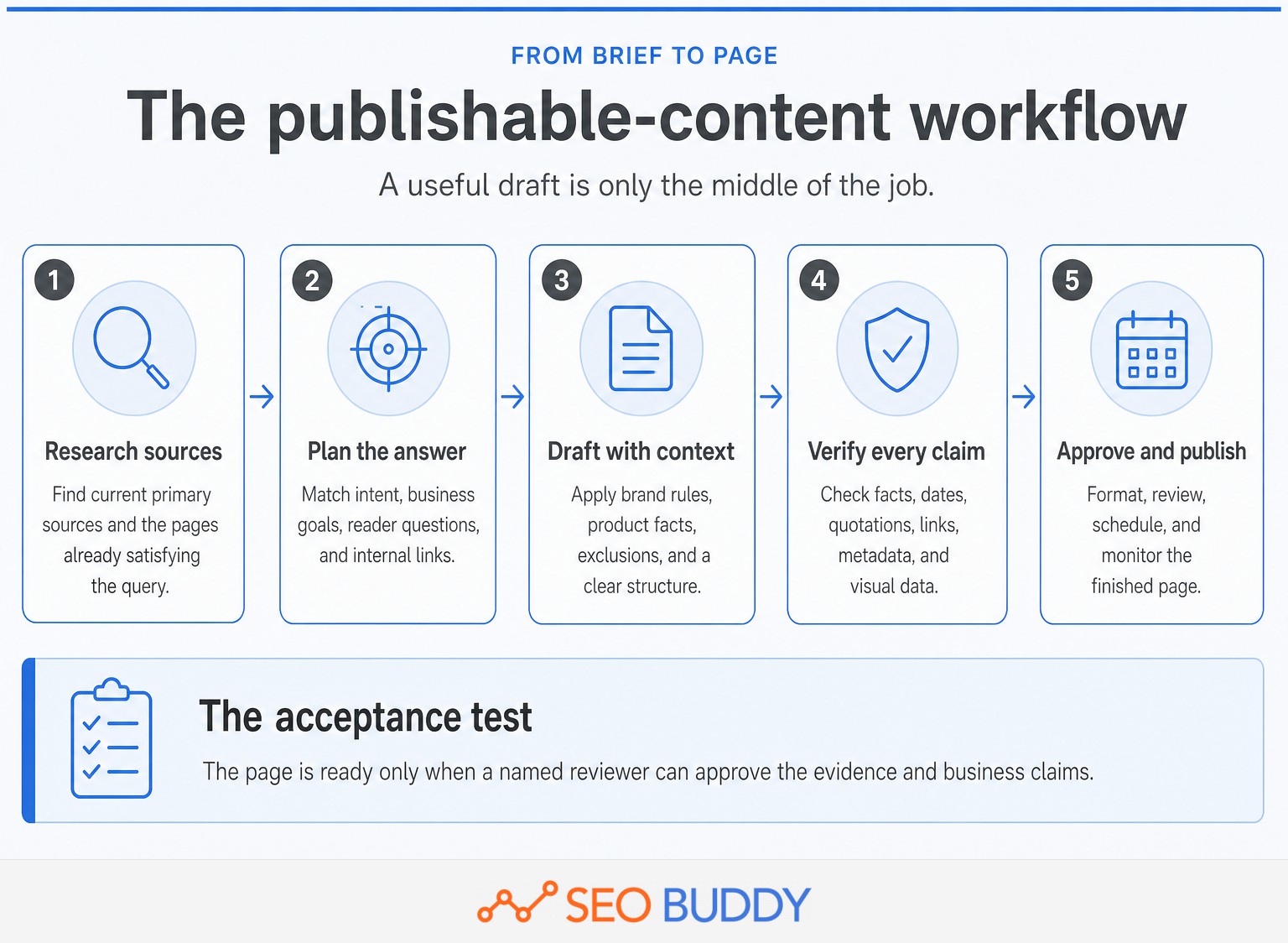
A practical acceptance gate separates a usable page from a plausible draft. The editor should be able to confirm the topic, sources, business fit, originality, production assets, and approval status before the page reaches the publishing queue.
Google's current guidance says generative systems predict likely word sequences rather than retrieving facts, which is why apparently polished outputs can contain inaccuracies. The 2024 Generative AI Profile from the National Institute of Standards and Technology calls confidently presented false information confabulation and identifies over-reliance as a related human risk.
The safest approach is not to reject AI assistance. It is to build verification into the workflow. A documented process for researching, writing, editing, illustrating, linking, and approving SEO content gives the tool a standard it must meet.
A publishable page is the product; the generated draft is only one component.
Anybody can generate an article. Knowing which one is worth writing is the hard part.
The AI Content Engine reads your site and your competitors, then builds a ranked content plan and writes it. Setup is free, and you see your plan before you pay for anything.
See your content plan freeWhich type of AI writing tool fits each job?
Different AI writing tools solve different parts of the writing process. The right category depends on whether the job is a short message, a manuscript, an edited draft, a researched article, a brand campaign, or a recurring publishing program.
A job-to-tool map
| Job to finish | Best-fit tool type | What good output looks like | Main limitation to check |
|---|---|---|---|
| Brainstorm a topic or produce a rough first draft | General AI writing generator | Several usable directions produced quickly | It may lack current sources and site context |
| Rewrite, shorten, translate, or polish existing text | Writing and editing assistant | Cleaner text that preserves the intended meaning | It does not decide whether the underlying claim is correct |
| Plan and draft a book or long manuscript | Long-form authoring workspace | Chapters that follow an outline, notes, and continuity rules | Context can weaken across a large manuscript |
| Produce a researched SEO brief or article | Research-linked SEO writer | A query-focused draft with inspectable sources | It may stop before design, links, and publishing |
| Create campaign copy across approved channels | Brand-governed marketing workspace | Consistent messaging based on stored brand rules | Brand consistency does not guarantee factual accuracy |
| Run a recurring search-content program | End-to-end content engine | Planned, researched, illustrated, linked, reviewed, and delivered articles | It requires accurate setup data and a clear approval policy |
A general AI writing generator is sensible when the task is small and easy to inspect. It can expand a human-created taxonomy, create alternative headlines, or turn an outline into rough paragraphs. For example, a marketer can start from organized fitness blog post ideas and ask for variations for a defined audience.
A free AI writing tool can also help with routine letters, social posts, or internal drafts. Avoid pasting confidential customer, employee, legal, or commercial information until the tool's retention, access, and training terms have been reviewed.
A writing assistant is a better fit when a solid draft already exists. Editing tools are useful for shortening, reorganizing, clarifying, translating, or changing tone, but the editor still owns the facts and argument.
A long-form authoring workspace needs different strengths. Book writers benefit from outline management, chapter context, continuity notes, revision history, and the ability to work on individual sections without losing the manuscript's structure.
A research-linked SEO writer should connect claims to inspectable sources and organize the draft around search intent. It is useful when a human has already selected the topic and mainly needs research, structure, and a first draft.
An end-to-end content engine is the better category when topic selection is part of the problem. It should consider the existing site, search performance, competing pages, business priorities, internal-link destinations, brand rules, production assets, and publishing destination before treating the assignment as complete.
Choose the tool category that matches the job you need finished, not the longest feature list.
Which capabilities matter most for SEO content?
SEO content requires more than grammatical sentences and natural transitions. The most valuable capabilities are research traceability, search planning, persistent business context, production completeness, workflow integration, and editorial control.
Three levels of workflow support
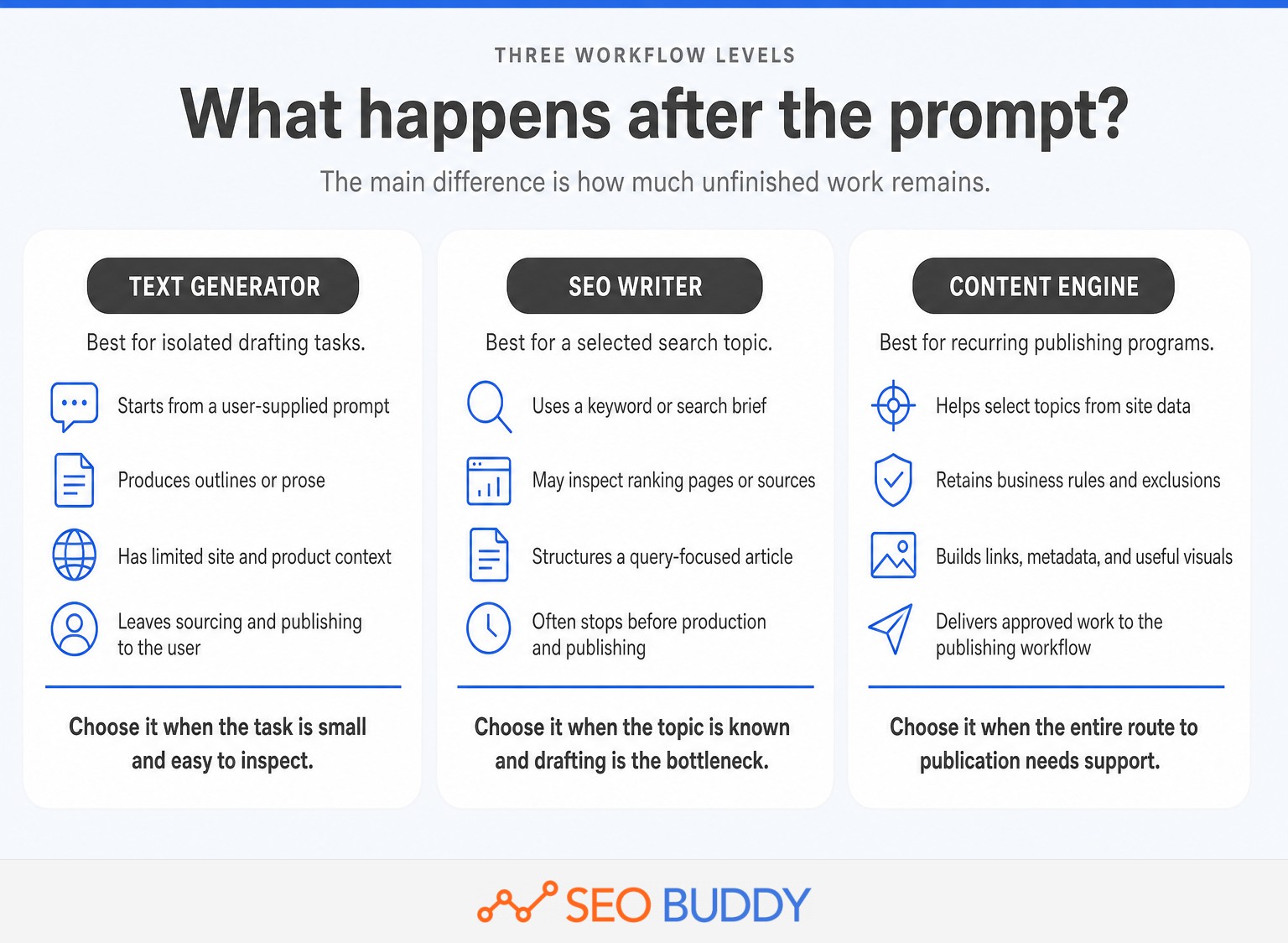
A text generator produces words. An SEO writer adds search and source context. A content engine coordinates the decisions and production tasks that surround the article as well as the article itself.
Research depth and traceability
A useful research function should open current sources, distinguish primary material from commentary, retain publication dates, and show which source supports which claim. A list of links at the bottom is not enough if the cited pages do not contain the statements attached to them.
Look for evidence of source selection rather than source decoration. Official documentation should carry a product claim, a regulator should carry a legal claim, and an original dataset should carry its own numbers.
Search planning and topic selection
Some tools assume the user already knows what to write. Others can compare demand, competition, the site's existing coverage, its current visibility, and the relationship between an article and a commercial offer.
That difference matters. Generating an excellent article for an irrelevant or unattainable query still wastes the production budget. Topic selection should happen before drafting, with a written reason explaining why the page belongs on this particular site.
Brand and product context
A brand-voice prompt affects vocabulary. Real business context goes further.
The system should know who the company serves, what it sells, what it does not sell, which claims it can support, which pages deserve internal links, and which conversion path makes sense. Persistent exclusions are especially valuable because one invented service can damage trust more than an awkward sentence.
Production completeness
Check what arrives with the text. A publication-ready package may need a featured image, useful diagrams, data-backed charts, alt text, metadata, internal links, a visible FAQ, structured-data recommendations, and a clear call to action.
Generated decoration does not count as useful illustration. A diagram should clarify a process or comparison, and a chart should be built from real numbers that also appear in the text.
Workflow automation and publishing
An export button is not the same as a publishing workflow. Examine whether the tool can create drafts in the actual CMS, preserve headings and tables, upload media correctly, apply metadata, schedule publication, support review mode, and provide a signed or authenticated delivery method.
The more production steps a team handles every week, the more valuable workflow support becomes. For a one-off article, copying a draft may be acceptable. For a monthly calendar across several sites, repeated manual cleanup becomes the real cost.
Editorial control
Useful controls include review mode, role permissions, source visibility, revision history, editable business rules, and the ability to stop automatic publication. The system should make approval easier, not make errors harder to see.
For SEO content, context and completion matter more than fluent prose on its own.
How should you compare AI writing tools without being distracted by demos?
Compare candidates with the same real assignment and the same publication standard. A controlled article test exposes missing research, context, production, and governance far more reliably than a product tour built around a perfect example.
Use one controlled test article
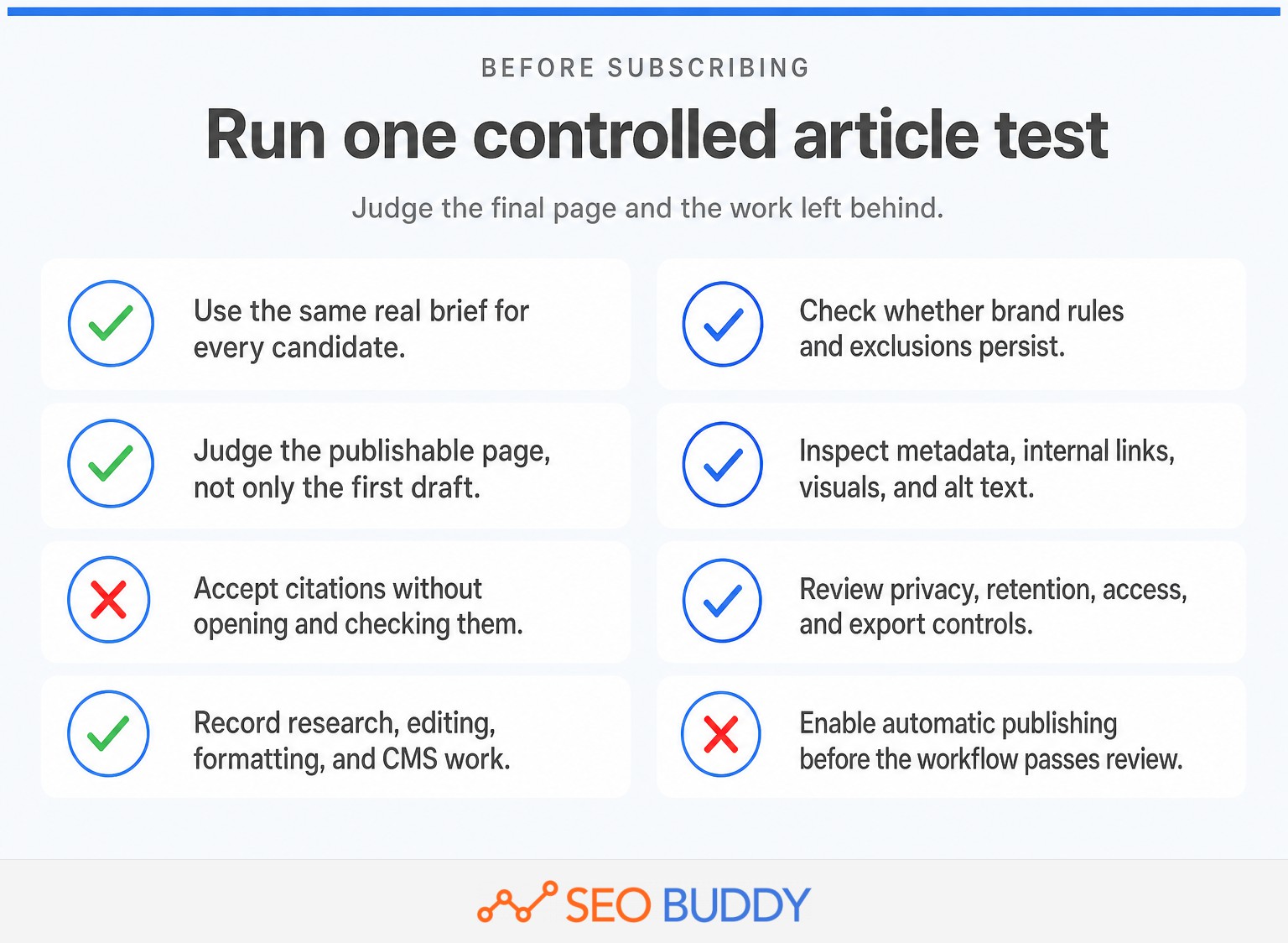
Choose a topic that matters to the business but is not so specialized that only one employee can assess it. Give every candidate the same inputs:
- The target audience and the question the page must answer.
- The primary keyword and known related questions.
- The company's product facts and prohibited claims.
- The desired tone, market, and spelling conventions.
- Existing pages available for internal links.
- Several primary sources that a responsible article should consider.
- The CMS or delivery format required at the end.
Then inspect the output in this order:
- Topic fit: Does the system explain why the topic belongs on the site, or does it simply accept the prompt?
- Source quality: Can each important claim be traced to a current, suitable page that genuinely supports it?
- Answer quality: Does the page answer the main question immediately and organize the rest around reader decisions?
- Business accuracy: Does it respect the company's audiences, products, terminology, and exclusions?
- Added value: Does it contribute a useful framework, example, visual, comparison, or conclusion beyond the ranking pages?
- Production completeness: Are metadata, internal links, images, diagrams, tables, and formatting included where needed?
- Editorial control: Can a reviewer inspect, edit, approve, reject, and prevent publication without fighting the software?
Do not judge only the first draft. Record every manual task required to make the page publishable: finding replacement sources, correcting product claims, rewriting generic sections, producing visuals, adding links, entering metadata, and repairing the CMS layout.
The real cost is the subscription plus the human time spent researching, editing, producing, publishing, and correcting mistakes. A cheaper generator can cost more if it transfers most of that work to the team.
A controlled article test reveals more than a polished demo or a feature checklist.
What should you never trust an AI writing tool to do alone?
An AI writing tool should not have final authority over facts, consequential advice, quotations, legal conclusions, business promises, or publication. The higher the possible cost of an error, the stronger the source and reviewer requirements should be.
Google's scaled content abuse policy focuses on large amounts of unoriginal content created primarily to manipulate rankings rather than help users, regardless of how the pages were produced. Automation is not the violation; low-value, search-manipulating output is.
Facts, quotations, and citations need inspection
A generated citation may be irrelevant, outdated, or fabricated. Open the page, locate the supporting passage, check the date and jurisdiction, and make sure the article does not make a stronger claim than the source.
Current prices, product features, laws, officeholders, schedules, and software interfaces deserve a fresh check shortly before publication. Reusing a previously correct answer is not enough when the underlying fact can change.
Practical instructions need a real source

Step-by-step advice can look harmless while omitting a device requirement, eligibility rule, regional restriction, or safety condition. For a travel connectivity article, for example, an editor could use a guide to verifying an iPhone's carrier-lock status to confirm that specific prerequisite rather than accepting a generated compatibility claim.
The same rule applies to tax forms, account settings, medical devices, financial transactions, and legal procedures. Practical advice should be checked against a current source that shows the actual requirement.
High-stakes advice needs qualified review
Medical, legal, financial, safety, and regulated-industry content should remain human-led. AI can help organize approved material, but it should not decide what a person must do or present uncertain advice as a professional conclusion.
Business claims need an owner
Do not allow the software to invent availability, pricing, guarantees, customer results, locations, credentials, or integrations. Give it approved facts and hard exclusions, then check the final page against the current product documentation.
Copyright questions need jurisdiction and human contribution
In the United States, the U.S. Copyright Office's January 2025 report concluded that generative AI output can receive copyright protection only where a human author has determined sufficient expressive elements. Merely providing prompts is not enough. Other jurisdictions may apply different rules, so this is not a universal legal conclusion.
Automatic publishing needs a defined risk boundary
Automatic publication may be reasonable for low-risk, repeatable content after the workflow has been tested. Review mode is safer during setup, after business changes, and for topics involving consequential claims.
AI can accelerate a claim, but a named human must remain accountable for its truth.
Where does an AI content workflow save time, and where does it add work?
AI saves the most time on repeatable transformations and coordinated production tasks with clear inputs. It adds work when weak research, missing context, or incomplete output forces people to reconstruct the article after generation.
Time is commonly saved on:
- Generating alternatives from an approved brief.
- Turning notes and source material into an organized outline.
- Reformatting supplied information for different channels.
- Drafting metadata, image descriptions, summaries, and FAQs.
- Suggesting internal links from an existing sitemap.
- Applying repeatable templates and publication rules.
- Moving approved content into a CMS or delivery workflow.
Work is commonly added by:
- Writing before the topic and search intent are validated.
- Replacing unsupported or low-quality sources.
- Removing generic statements that add no decision or evidence.
- Correcting invented product capabilities or brand claims.
- Commissioning missing visuals and rebuilding bad charts.
- Repairing tables, headings, media, and metadata after export.
- Reviewing a large batch of pages that should not have been produced.
AI writing also sits inside a wider automation stack. Teams comparing research, publishing, monitoring, and repeatable operational tasks can use this guide to automated SEO tools to decide which stages should be connected and which should retain a human checkpoint.
The value also changes by team. A founder may need topic selection because there is no content strategist. An in-house marketer may need faster research and production while retaining final approval. An agency may care most about client context, repeatable processes, permissions, and delivery across several domains.
Software is not always the right answer. A company that lacks a strategy, internal reviewer, or subject-matter access may need human execution rather than another interface. Comparing the scope of AI SEO services can clarify when outside strategy and production support is the better fit.
Automation pays when it removes repeatable production work without hiding editorial risk.
Which AI writing workflow is the best fit for SEO publishing?
The best fit is the smallest workflow that reliably reaches the organization's publication standard. A general assistant may be sufficient for occasional drafting, while a recurring search-content program usually needs research, planning, persistent business context, production assets, review controls, and CMS delivery.
Use this decision path:
- Choose a general generator for low-risk brainstorming, alternatives, letters, and disposable drafts.
- Choose an editing assistant when the source material and argument already exist.
- Choose a long-form authoring workspace for books, chapters, narrative continuity, and manuscript revision.
- Choose a research-linked SEO writer when the topic is already selected and the main need is a sourced brief or article.
- Choose a brand-governed workspace for approved campaign messaging across several channels.
- Choose an end-to-end content engine when the system must help select topics and coordinate the work through publication.
As of October 2026, SEO Buddy's AI Content Engine is designed for the last use case. Its documented workflow reads a site's sitemap, optional Search Console data, competing pages, business priorities, brand inputs, and the products the business does and does not sell. It then plans articles, produces sourced drafts and visuals, adds internal links and SEO fields, and delivers approved work to supported publishing destinations or a signed webhook.
The AI Content Engine is not a dedicated rank tracker, technical crawler, standalone backlink database, existing-page optimization editor, or AI-citation monitoring platform. Organizations needing those functions should plan for separate systems rather than assuming one content product includes them.
If the bottleneck is the full path from search opportunity to a scheduled article, review the AI Content Engine workflow and compare it against the publication gate above before deciding.
The best SEO option is the smallest workflow that reliably reaches your publication standard.
What else do people ask about AI writing tools?
The recurring questions point to one rule: select the tool for the actual writing job and the level of risk involved. A useful category for a book, letter, or brainstorming session may be the wrong category for researched commercial content.
Which AI tool is best for writing books?
For books, the best choice is a long-form authoring workspace that can retain outlines, character or argument notes, chapter context, and revision history. Fiction writers need scene and continuity support; nonfiction writers need source management and structural control. A general generator can help brainstorm, but it should not manage the manuscript alone.
Is there a free AI letter writer available?
Yes. Free AI letter writers can produce a first draft for routine messages such as requests, complaints, invitations, and follow-ups. Check privacy terms before pasting personal information, verify names and facts, and rewrite the tone for the recipient. Sensitive employment, legal, medical, or financial letters deserve qualified human review.
What are the benefits of using AI writers?
AI writers can reduce blank-page time, generate alternatives, reorganize notes, summarize supplied material, adapt tone, and produce repeatable first drafts. The largest gains come from well-defined, low-risk tasks. Benefits shrink when the tool lacks sources, business context, or workflow support because people must repair those gaps before publication.
The task, not the loudest category label, determines the right AI writing tool.
What should you do next?
Choose one real article, write its acceptance gate before testing any software, and compare how much work remains when each tool stops. Keep the tool only if it reduces total research, editing, production, and publishing work without weakening accuracy, business fit, or editorial control.
Do not start with a feature tour. Start with the page that must be published, the evidence it must carry, and the person who will approve it.
Choose the tool that leaves fewer important decisions unfinished, not simply a longer draft.

CEO & Founder at SEO Buddy


 Best SEO Tools of 2025: Which Ones Are Still Worth Using in 2026?
General SEO
Best SEO Tools of 2025: Which Ones Are Still Worth Using in 2026?
General SEO
 AI SEO Services: What Providers Do, What They Cost, and How to Choose
General SEO
AI SEO Services: What Providers Do, What They Cost, and How to Choose
General SEO
 Programmatic SEO: How It Works, When to Use It, and When Not To
General SEO
Programmatic SEO: How It Works, When to Use It, and When Not To
General SEO
 A Repeatable SEO Workflow Process: From Research to Reporting
General SEO
A Repeatable SEO Workflow Process: From Research to Reporting
General SEO
Get the SEO work done, not just read about it
Create a free account and run your first content plan, keyword research and link-building campaign. No card, and setup is free until your first article.
Free to start. We never sell your address.