
SEO Content: How to Research, Write, and Publish Articles That Rank

In short
SEO content is useful, evidence-backed material built around a real search need and a business goal. A reliable process starts with the site, audience, offer, and live search results; then it turns those inputs into a differentiated brief, a clear draft, supporting visuals and links, publication checks, and a measured update plan.
Key takeaways
- A target keyword is only one input; the workflow also needs the audience, business offer, existing site coverage, conversion path, and evidence boundaries.
- The live search results determine the expected format and table-stakes coverage, but they should not dictate a copied outline.
- Google's September 2026 guidance says foundational SEO practices still apply to generative AI search, with no special AI schema or machine-readable file required. Google's AI optimization guide emphasizes valuable, non-commodity content instead. (developers.google.com)
- Publication includes metadata, crawlable links, useful images, accessibility, indexability, structured data, and performance checks, not just pasting prose into a CMS.
- Automation is best used for repeatable collection, formatting, and production tasks; business judgment, factual approval, and original insight still need accountable human ownership.
Table of contents
- What makes SEO content different from generic optimized text?
- What business inputs should come before keyword research?
- How do you choose an SEO content topic worth publishing?
- What should you learn from the live search results?
- How do you turn research into a useful content brief?
- How do you write SEO content for readers, search engines, and AI answers?
- What should the article add that competitors cannot copy?
- How should visuals and internal links support the article?
- What should you check before publishing SEO content?
- How do you measure and improve SEO content after launch?
- Which SEO content tasks should be automated?
- What else do people ask about SEO content?
- What is the next step?
What makes SEO content different from generic optimized text?
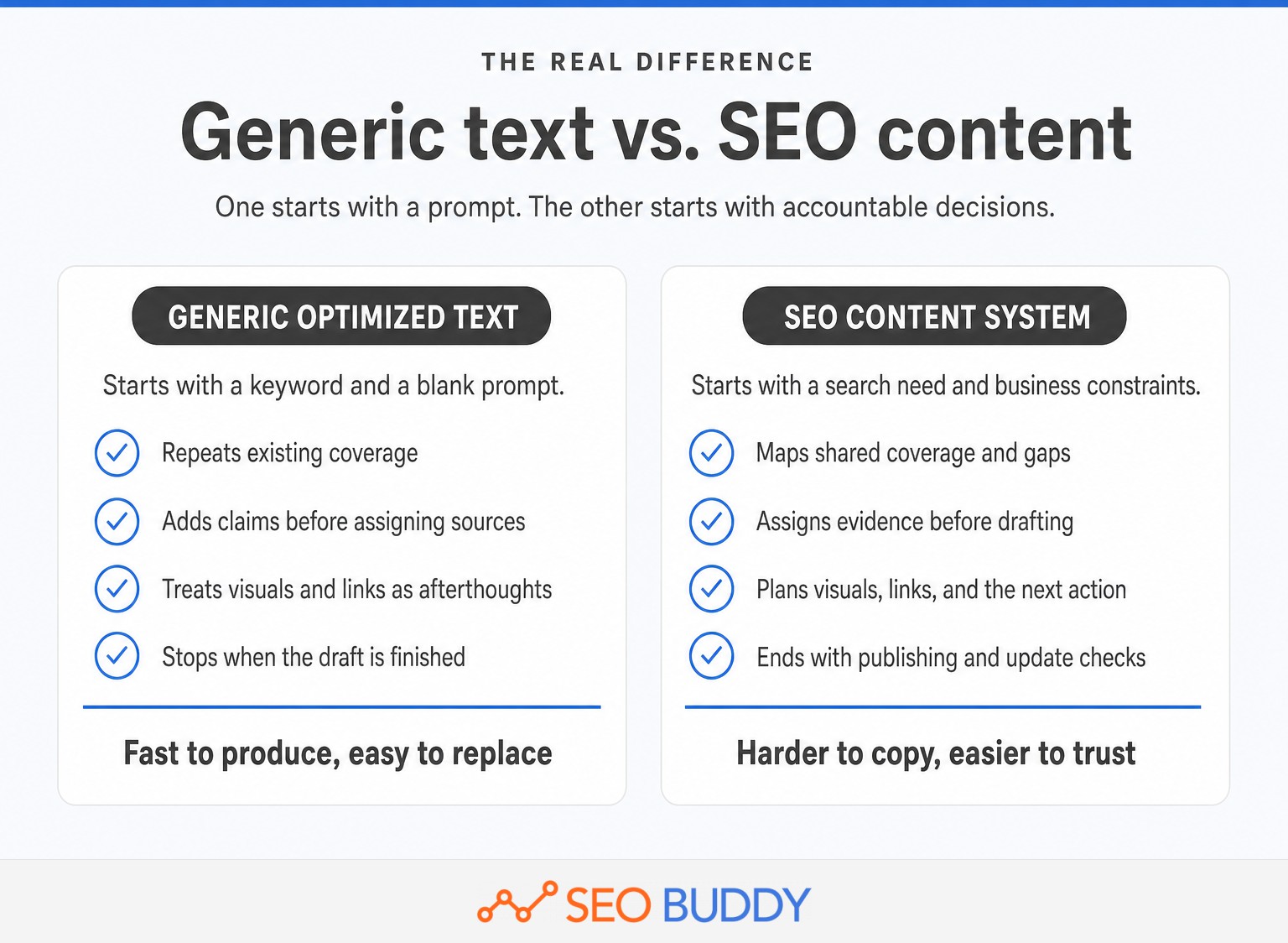
SEO content is produced through a search-informed decision process, not ordinary copy with a keyword added. The page must satisfy the reader's task, support a legitimate business goal, add a reason to choose it, and remain accessible to search systems.
Google's Search Essentials reduces the core practices to useful, reliable, people-first content; prominent use of the words people search for; crawlable links; and appropriate handling of media and structured data. Google's documentation does not define success as reaching a keyword count or optimization score. (developers.google.com)
A useful production model follows a longer chain:
- Select a search need that matters to the business.
- Confirm what the results page already satisfies.
- Find a defensible gap or a better way to answer the need.
- Assign sources, examples, visuals, and internal links.
- Draft for comprehension and extraction.
- Verify the page as a factual, technical, and commercial unit.
- Publish, measure, and improve it.
Each stage can invalidate the work before it. A well-written article cannot repair a topic with no business value. An original draft cannot rank if it is blocked from indexing. A ranking page can still fail commercially if it attracts the wrong audience or sends the reader nowhere useful.
Google describes Search as three broad stages: crawling, indexing, and serving results. Google also says following its requirements does not guarantee that a page will be crawled, indexed, or shown, which is why SEO content should be treated as a qualified opportunity rather than a promised ranking. Google's guide to how Search works explains those stages and limits. (developers.google.com)
SEO content earns attention by making better decisions before writing, not by inserting more keywords afterward.
Anybody can generate an article. Knowing which one is worth writing is the hard part.
The AI Content Engine reads your site and your competitors, then builds a ranked content plan and writes it. Setup is free, and you see your plan before you pay for anything.
See your content plan freeWhat business inputs should come before keyword research?
A useful SEO content strategy starts with the business, not a blank keyword tool. Before researching queries, define the intended audience, offer, exclusions, existing pages, available proof, and action the right reader should take.
Start with these inputs:
- Audience: Who has the problem, what do they already understand, and what decision are they trying to make?
- Offer: Which product, service, or resource can genuinely help after the article answers the question?
- Boundaries: Which products, features, locations, claims, or outcomes must the article not imply?
- Site inventory: Which pages already cover the topic, compete with it, or deserve a contextual internal link?
- Performance evidence: Which pages already earn impressions, clicks, leads, or sales, and where does the site nearly rank?
- Business evidence: Which tests, processes, screenshots, customer examples, subject-matter experts, or datasets are available?
- Conversion destination: What is the one reasonable next step for a qualified reader?
These inputs prevent several expensive mistakes. They stop the article from targeting an irrelevant audience, duplicating an existing page, recommending something the company does not sell, or ending with a call to action that has little connection to the search need.
They also make the brief more efficient. A content writer should not have to infer the company's commercial priorities from a homepage or guess which product claims are approved. Record the decisions once, then make them reusable across the content program.
The source plan should also begin here. Create a simple evidence ledger with the claim, preferred source, publication or update date, jurisdiction when relevant, and any known limitation or disagreement. Primary sources should carry product facts, rules, standards, and platform behavior whenever they are available.
The brief should know the audience, offer, boundaries, evidence, and destination before it asks for prose.
How do you choose an SEO content topic worth publishing?
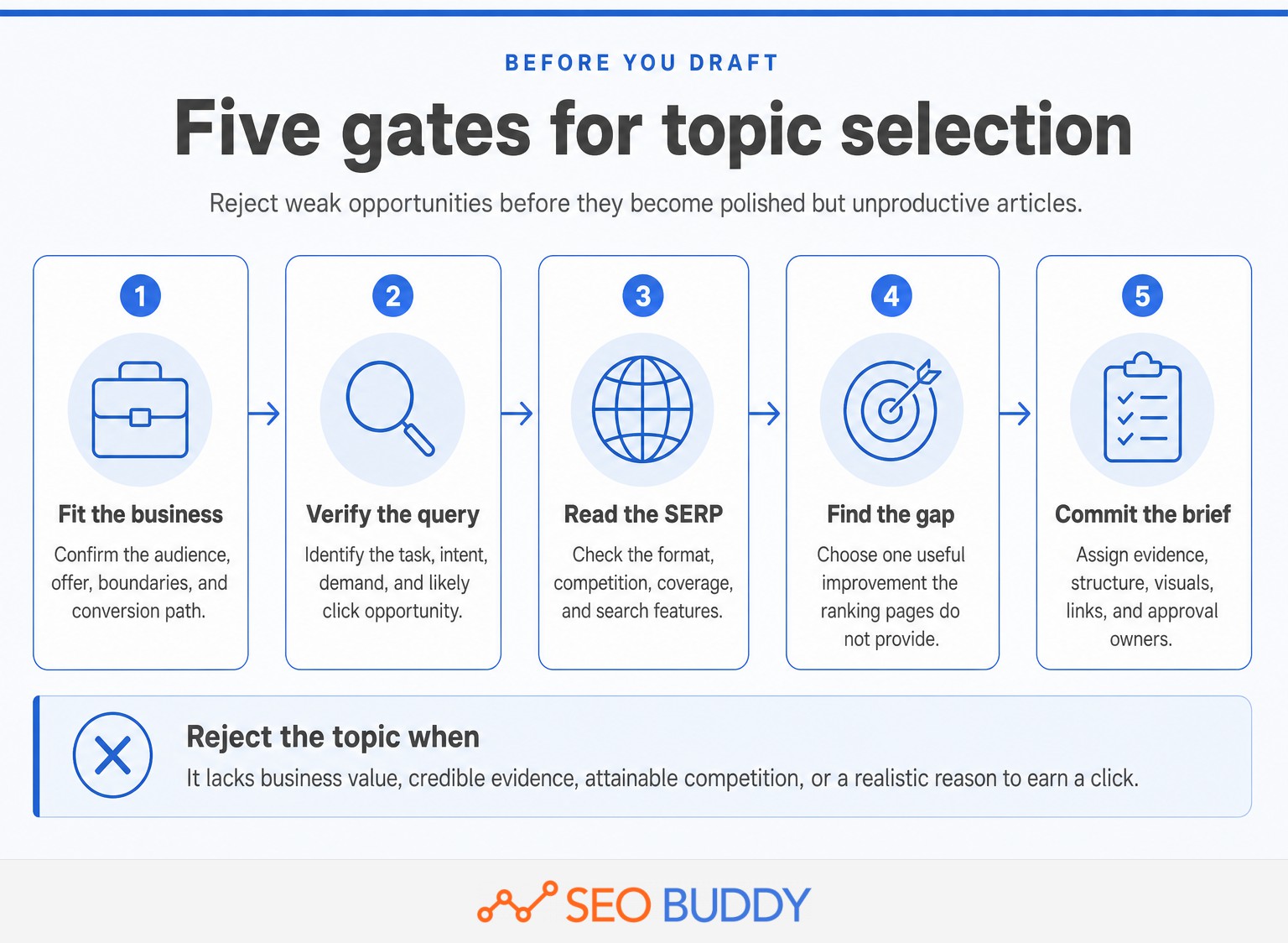
Choose a topic only when search demand, business value, attainable competition, defensible evidence, and a realistic click opportunity overlap. Keyword volume and difficulty can filter candidates, but they cannot make that decision alone.
Score each candidate against six questions:
- Does the right audience search for it? A popular query can still be irrelevant to the people the business needs.
- What does the searcher want to do? Informational, commercial, transactional, and navigational needs produce different pages.
- Can the business answer credibly? Access to expertise, examples, product knowledge, or current sources matters.
- Can this site compete? Compare the difficulty and authority of ranking pages with queries the site has already won, not an abstract industry ideal.
- Will a ranking attract a click? AI answers, calculators, maps, videos, shopping units, and other search features can satisfy the need before a visit.
- Is there a gap worth filling? A new article needs a reason to exist beyond rewriting the current leaders.
Reject candidates that fail a central gate. A commercially relevant keyword with no credible evidence can damage trust. A low-difficulty query with no conversion path may consume production capacity without helping the business. A high-volume question answered completely on the results page may offer less traffic than its volume suggests.
Software can collect keyword data, cluster variants, identify competing pages, and flag search features. The site's published guide to AI SEO tools can help evaluate where software fits across research, writing, and optimization. The final topic choice still requires judgment about customers, credibility, and opportunity.
A topic is worth publishing only when search demand, business value, attainable competition, and click opportunity meet.
What should you learn from the live search results?
The live search results reveal the job Google currently believes the query requires, the format readers expect, and the competitive standard the article must meet. Read them as a research set to beat, not as an outline to copy.
Record three layers:
Shared coverage is the information nearly every ranking page includes. It is table stakes. Cover it accurately and quickly because repeating it at greater length does not create differentiation.
Partial coverage includes useful subjects that only some pages address. Decide whether each subject belongs based on the reader's task, not because one competitor added another heading.
Missing coverage is where the article can earn its place. Look for an unanswered People Also Ask question, an obsolete recommendation, a missing implementation step, an unsupported claim, an ignored audience, or a decision that no page helps the reader make.
Check the dominant page type and content format. If the results favor detailed guides, a short product landing page is unlikely to satisfy the same need. If they favor tools or templates, another explanatory essay may be the wrong asset.
Read the sequence as well as the headings. When every article starts with a long definition but the searcher urgently needs a process, answer the process first and compress the definition. The final outline should reflect the reader's priority, not the average competitor order.
People Also Ask and related searches reveal adjacent language and unresolved questions. Discussion pages can reveal how readers describe their frustration, but forum posts should supply vocabulary rather than factual evidence unless their claims are verified elsewhere.
As of September 2026, Google's AI optimization guide says the same foundational SEO practices remain relevant for generative AI features. Google says no special AI schema or machine-readable file is required, so the durable response to AI search is a crawlable, useful, distinctive page rather than a separate layer of invented technical requirements. (developers.google.com)
The SERP is a research set to beat, not an outline to copy.
How do you turn research into a useful content brief?
A useful brief converts research into explicit decisions that a writer can execute and an editor can verify. It should define the page's promise, differentiation, evidence, structure, visual plan, links, boundaries, and publication requirements before drafting begins.
At minimum, record these fields:
| Decision | Required brief entry | Why it matters |
|---|---|---|
| Reader | The searcher's problem, knowledge level, and intended decision | Prevents generic explanations |
| Business | Relevant offer, conversion path, and claims to avoid | Keeps the article commercially accurate |
| Search | Primary query, intent, dominant format, and click suppressors | Aligns the asset with the live results |
| Competition | Shared coverage, gaps, and one differentiation axis | Gives the article a reason to exist |
| Evidence | Source assigned to every material factual claim | Prevents unsupported drafting |
| Structure | Question-led outline in reader-priority order | Produces clear, extractable sections |
| Media | Purpose, format, and placement of each visual | Stops images becoming decoration |
| Links | Contextual internal destinations and essential citations | Connects the page to the site and its evidence |
| Publication | Title, description, URL, schema, indexability, and QA owner | Treats publishing as production work |
Write the outline as questions a reader would ask. Each H2 should receive a direct two-sentence answer before the explanation, examples, or caveats. That structure helps scanning, editorial review, and extraction without turning the page into disconnected snippets.
Assign sources before writing claims. A source field marked later invites the writer to create a strong sentence first and search for something that appears to support it afterward. Evidence should constrain the sentence from the beginning.
Plan the visuals in the brief as well. State what each visual makes clearer than prose, then choose the format: a process for ordered steps, a comparison for options, an anatomy for parts, a checklist for rules, a chart for numerical shape, or an illustration for a mechanism or scene.
Repeatable teams can document these decisions as SEO content SOPs so researchers, writers, editors, designers, and publishers work from the same definitions and approval gates.
A useful brief converts research into decisions that a writer can execute and an editor can verify.
How do you write SEO content for readers, search engines, and AI answers?
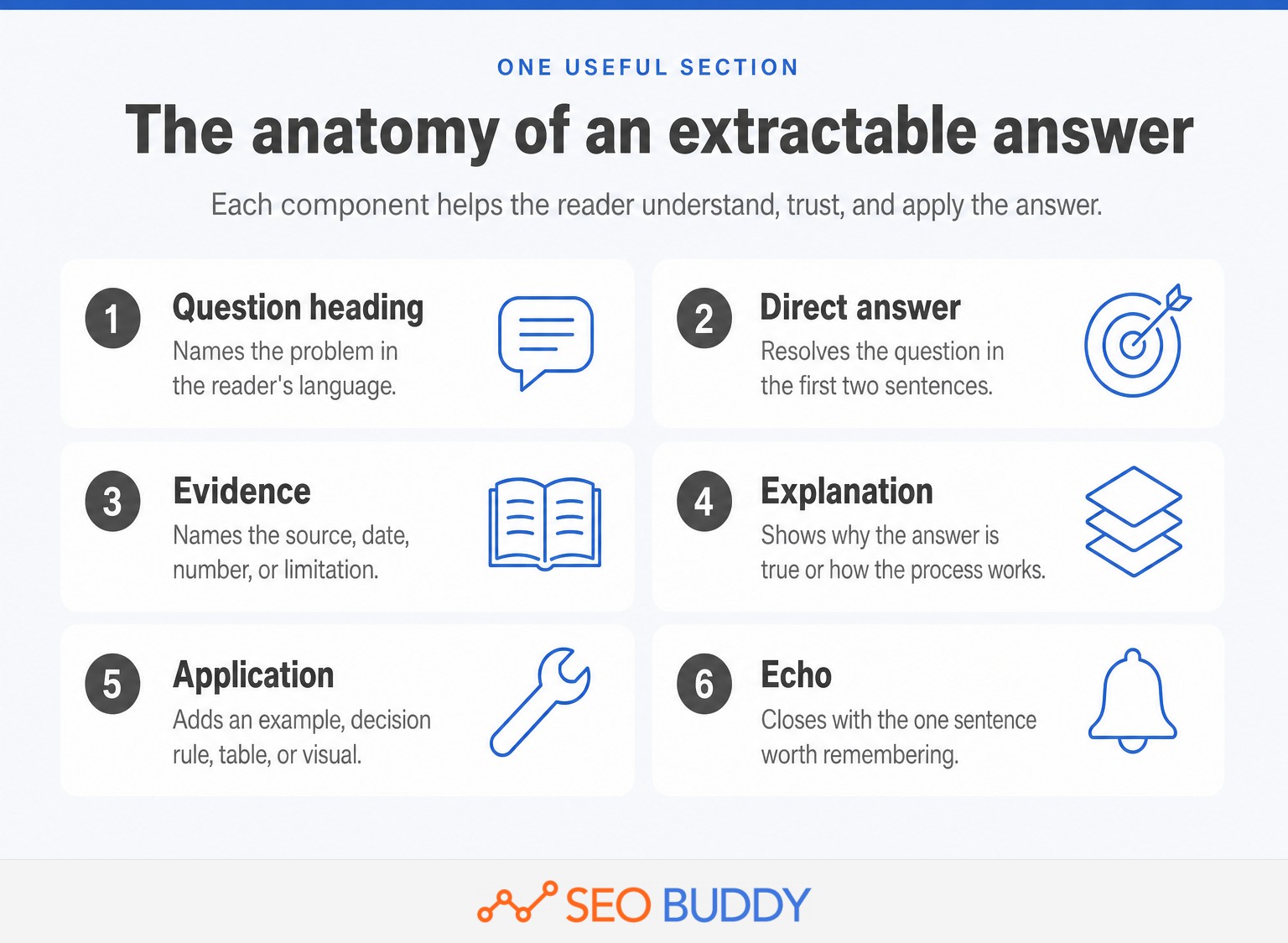
Write for a person who wants the answer quickly, then provide enough explanation and evidence for that person to act with confidence. Search engines and AI systems benefit from the same clear subjects, explicit claims, descriptive headings, accessible text, and reliable sourcing.
Use a consistent section pattern:
- Question heading: Name the reader's problem in plain language.
- Direct answer: Resolve the question in the first two sentences.
- Mechanism: Explain why the answer is true or how the process works.
- Evidence: Name the source, date, number, jurisdiction, or limitation that supports the claim.
- Application: Add a concrete example, decision rule, table, or visual.
- Echo: Close with the one sentence worth remembering.
Google's guide to creating helpful, reliable, people-first content asks whether a page provides original information or analysis, gives a substantial description, demonstrates experience or expertise, and leaves the reader feeling that the goal was achieved. Those questions are a better editorial test than mechanically adding variations of a keyword. (developers.google.com)
Write self-contained passages. Replace unresolved pronouns with the actual subject, and keep the claim, qualifier, date, and source close together. A sentence such as Google's FAQ rich result stopped appearing on May 7, 2026 can survive extraction; a sentence such as this stopped recently, as explained above cannot.
Use the language readers use, but do not force every variation into the copy. Google's systems can relate pages to queries without an exact phrase for each variation, according to the SEO Starter Guide. Clear terminology and full answers matter more than awkward repetition. (developers.google.com)
Name sources visibly when authority matters. Write that Google's September 2026 documentation says a practice is current instead of hiding the basis behind a vague phrase such as experts recommend. Include the year for claims likely to change, and state the jurisdiction for legal or regulatory guidance.
Generative AI can help organize research, summarize supplied material, draft alternatives, and format content. Google's guidance on generative AI content says the concern is not the tool itself but scaled production with little accuracy, originality, or value. Automatically generated titles, descriptions, structured data, and alt text still need factual and editorial review. (developers.google.com)
Write each section so a reader can get the answer quickly and still find enough evidence to trust it.
What should the article add that competitors cannot copy?
The article should add information or judgment that cannot be produced by summarizing the same ranking pages. The strongest options are first-party data, documented experience, named expert input, a real process, a worked example, or a current correction supported by a primary source.
Useful forms of original value include:
- First-party data: Search Console patterns, customer questions, production times, test results, or anonymized product usage.
- A documented example: A real page, decision, screenshot, failure, or revision with enough context to understand it.
- Expert judgment: A named practitioner explaining why one option was chosen and what trade-off was accepted.
- Operational detail: The exact checklist, approval gate, calculation, template, or source hierarchy used in practice.
- A current correction: A dated platform, legal, product, or standards change that older pages have not incorporated.
Do not invent originality. If no first-party dataset or case study exists, state the evidence gap internally and write the strongest article the available sources support. A truthful synthesis with a distinct decision framework is more useful than an imaginary survey or customer result.
Accurate authorship also matters. Google's helpful-content guidance recommends making it clear who created content and, where useful, how it was produced. A real byline, relevant profile, reviewer, and transparent production note strengthen trust; fabricated credentials do the opposite. (developers.google.com)
SEO content examples should show decisions and consequences, not merely polished paragraphs. A worked example becomes defensible when the reader can see the input, choice, evidence, output, and limitation.
The strongest differentiator is information the competing pages could not have written without this business.
How should visuals and internal links support the article?

Visuals and internal links should reduce effort for the reader, not decorate the page or satisfy a quota. A visual should clarify a process, comparison, mechanism, structure, or numerical pattern, while a link should answer the next likely question or support the current claim.
Choose each visual by its job:
- Use a process infographic when order matters.
- Use an anatomy graphic when readers need to identify parts.
- Use a comparison when two or three options must be weighed.
- Use a checklist when the reader needs a reusable rule set.
- Use a chart only when real numbers have a trend, distribution, share, or ranking.
- Use a screenshot only when a real interface or output is necessary to understand the instruction.
Google's image SEO best practices recommend relevant, representative, high-quality images near the text they support. Image alt text should describe the useful subject or function rather than repeat the article keyword. (developers.google.com)
Internal links should use concise, descriptive anchor text and appear where the destination genuinely helps. Google's link best practices state that internal links help people and Google understand and find pages, and that there is no magical ideal number of links for a page. (developers.google.com)
Technical handling matters too. Set image dimensions to reserve layout space, use modern formats with fallbacks, and lazy-load below-the-fold images. Do not lazy-load the likely Largest Contentful Paint image; web.dev's browser-level image lazy-loading guidance recommends eager loading for likely in-viewport and LCP images and using fetchpriority="high" for an important LCP image when appropriate. (web.dev)
Every visual and link should answer a reader's next question or make the current explanation easier to understand.
What should you check before publishing SEO content?
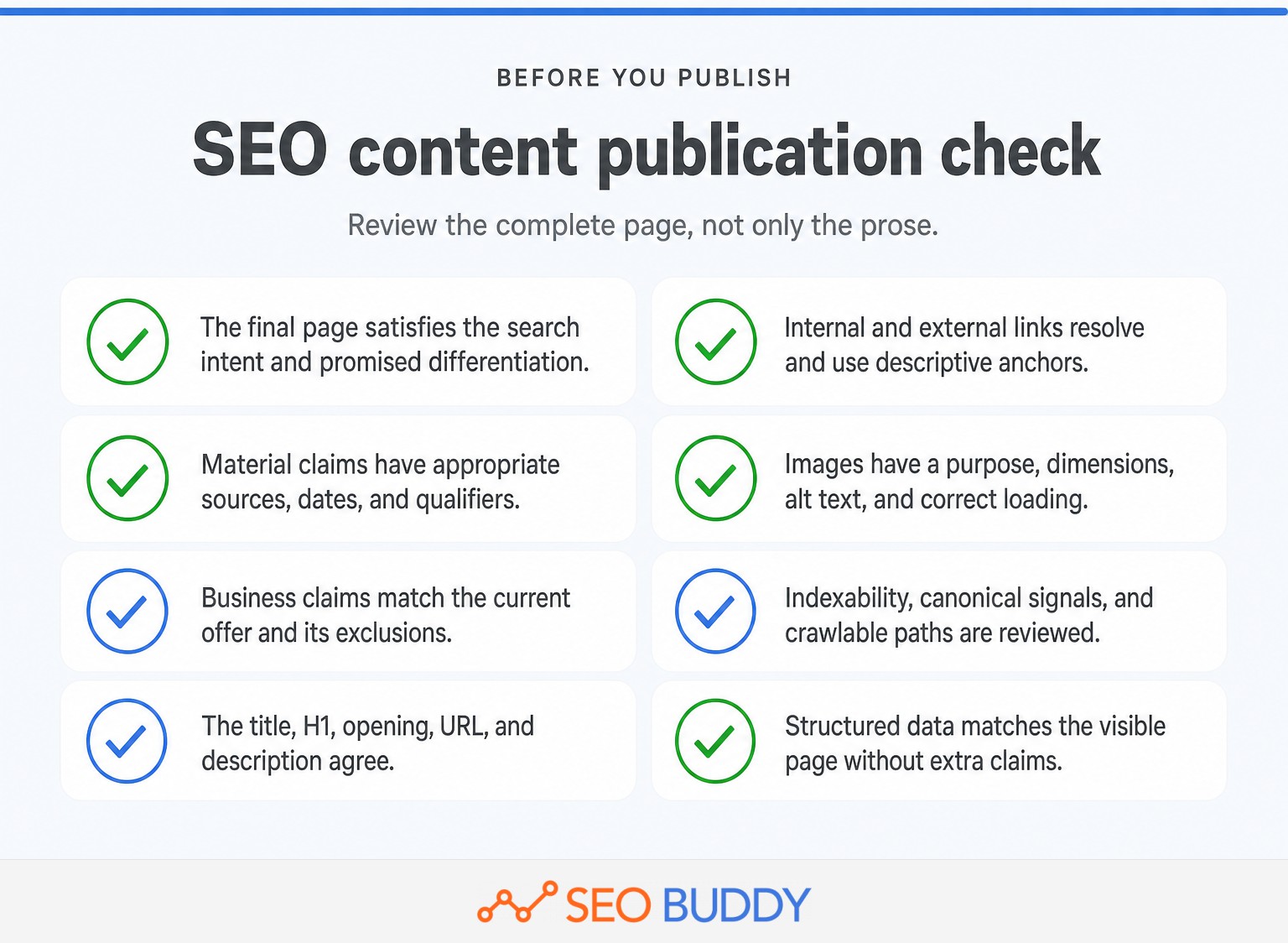
Publishing requires a factual, editorial, commercial, technical, and visual review of the complete page. The page is ready only when its claims, links, media, metadata, indexing signals, structured data, and next action agree with what the reader can actually see.
Run these checks:
- Intent: Does the page complete the task suggested by the query and live results?
- Accuracy: Does every material factual claim have an appropriate source, date, and qualifier?
- Business truth: Does the copy accurately describe what the company sells and avoid unsupported features, results, or endorsements?
- Differentiation: Is the promised gap visible in the final article, rather than only in the brief?
- Title and snippet: Are the title, H1, introduction, and meta description aligned without keyword repetition?
- Links: Do internal links resolve, use descriptive anchors, and help at the point where they appear? Do external citations support the sentence beside them?
- Media: Does every image have a useful purpose, appropriate dimensions, descriptive alt text, and correct loading behavior?
- Indexability: Is the preferred URL accessible, indexable, canonicalized correctly, and connected through crawlable links or a sitemap?
- Structured data: Does the markup describe the visible page without adding claims or content the reader cannot see?
- Conversion: Is there one reasonable next step for the qualified reader, and does it match the article's promise?
Google's title link guidance recommends unique, concise, descriptive title text without stuffing or boilerplate. Google's snippet guidance says snippets are primarily generated from page content, although a useful page-specific meta description may be used when it describes the page better. (developers.google.com)
For a blog article, BlogPosting or Article structured data can clarify the headline, author, images, and publication dates. Google's Article structured data documentation also makes clear that structured data describes the page; it does not substitute for useful visible content. (developers.google.com)
Visible FAQs can still help readers and make concise answers available for extraction, but do not promise a Google FAQ rich result. Google's Search documentation updates state that FAQ rich results stopped appearing on May 7, 2026, and the supporting documentation was removed on June 15, 2026. (developers.google.com)
Turn the final review into a repeatable SEO Checklist with named owners for factual approval, editing, media, technical publishing, and post-launch measurement.
Publishing is the final production stage, not the moment a draft is pasted into a CMS.
How do you measure and improve SEO content after launch?
Measure the stage where performance breaks instead of treating every disappointing page as a writing problem. Discovery, impressions, clicks, engagement, conversion, and continued accuracy require different diagnoses and different fixes.
Use a simple failure map:
| Signal | Likely question | Useful response |
|---|---|---|
| Page is not indexed | Can search systems access and understand the preferred URL? | Check status, indexability, canonical signals, links, sitemap inclusion, and page quality |
| Few impressions | Does the page match a real query and have enough relevance or authority? | Reassess intent, topic choice, coverage, evidence, and internal support |
| Impressions but few clicks | Does the result communicate a useful and distinctive promise? | Review title, snippet-generating copy, freshness, and SERP presentation |
| Clicks but weak engagement | Does the page answer quickly and match the result's promise? | Improve the opening, structure, examples, usability, and performance |
| Engagement but few conversions | Is the offer relevant, credible, and placed after enough information? | Review audience fit, CTA, proof, and conversion path |
| Prior performance declines | Has the query, competition, source material, product, or page quality changed? | Compare the current SERP and update only where the page can become materially better |
Do not assign a universal ranking deadline. Google says crawling, indexing, and serving are not guaranteed, and recrawling can vary substantially. Record the publication baseline, annotate meaningful changes, and wait for enough data to distinguish a pattern from daily noise. (developers.google.com)
As of September 2026, Google reports traffic from AI Overviews and AI Mode within the overall Search Console Performance report under the Web search type. That means Search Console can contribute to performance analysis, but it does not provide a separate complete attribution report for every AI-generated mention or citation. (developers.google.com)
Update a page when the answer, evidence, reader need, product, competition, or search presentation has materially changed. Changing a date without improving the visible content is not an update strategy.
Measure the stage where performance breaks, then change the page to fix that stage.
Which SEO content tasks should be automated?
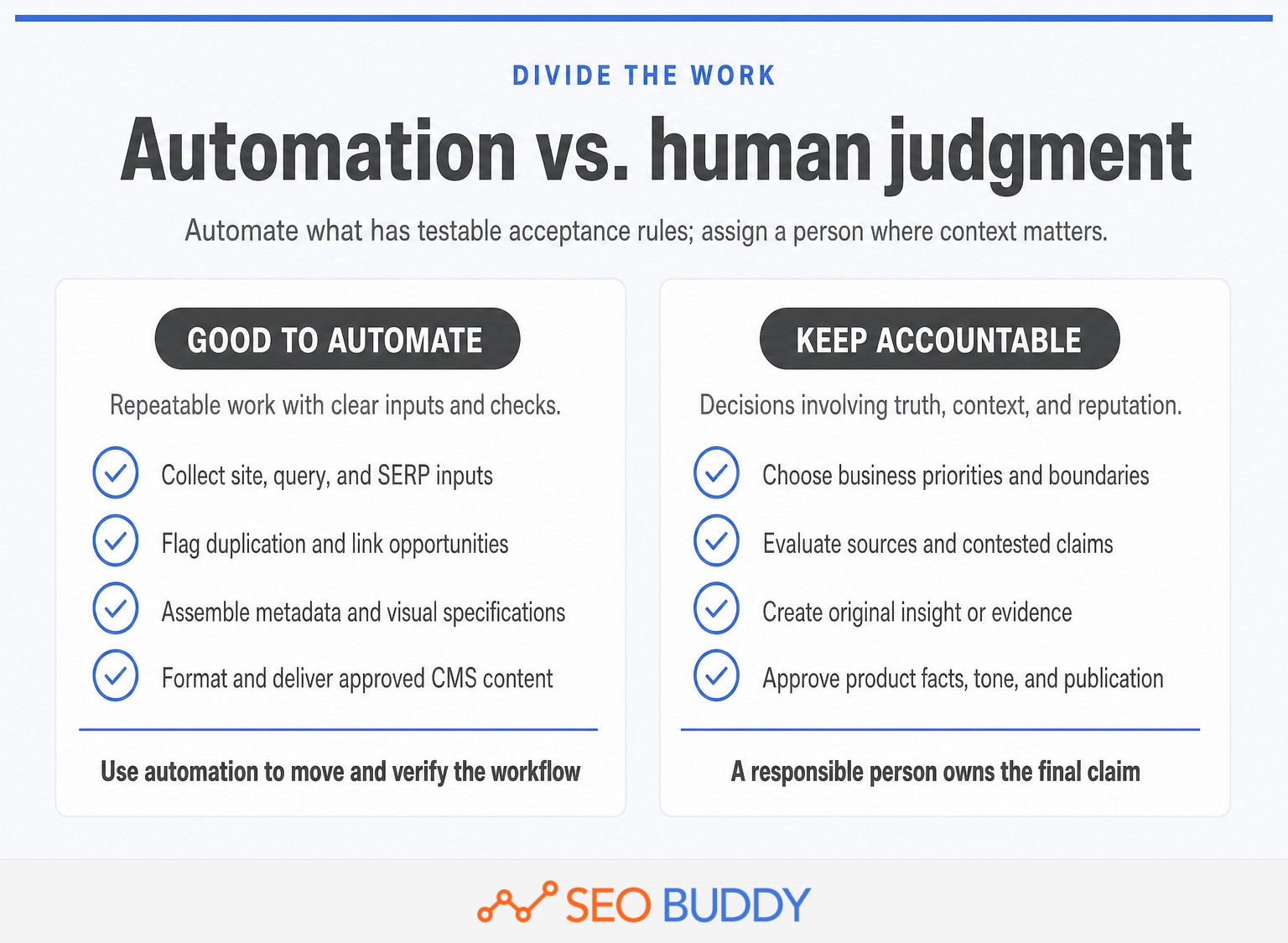
Automate repeatable collection, comparison, formatting, and publishing work when the inputs and acceptance rules are clear. Keep topic approval, source judgment, original insight, business claims, and final factual responsibility with a person who can defend the decision.
Good automation candidates include:
- Reading sitemaps and collecting existing page data.
- Importing optional search-performance inputs.
- Gathering live search results, related questions, and page headings.
- Flagging possible duplication and contextual internal-link opportunities.
- Building a first coverage map and source checklist.
- Formatting metadata, image specifications, and CMS fields.
- Converting approved content into consistent publishing markup.
- Running deterministic checks for missing links, fields, headings, or media attributes.
Human approval should remain central when the workflow must:
- Decide whether a topic supports the business and its customers.
- Interpret a contested, incomplete, or jurisdiction-specific source.
- Confirm that a product claim matches the current offer.
- Select the differentiating insight or first-party evidence.
- Judge whether an example is representative and ethically usable.
- Resolve trade-offs between completeness, clarity, risk, and conversion.
- Approve the final page under a real person's or organization's reputation.
Google's generative AI guidance supports using automation for research and structure, but it warns against producing many pages with little originality or added value. The operating rule is simple: automate a task when the acceptance criteria can be checked; assign a responsible person when the task requires truth, context, or judgment. (developers.google.com)
SEO Buddy's AI Content Engine is built for teams that want this workflow connected rather than split across isolated prompts and spreadsheets. The product reads a sitemap, optional Search Console data, competitors, business priorities, and brand settings; then it plans, writes, illustrates, adds internal links, and can deliver drafts to supported publishing destinations. Review the workflow to see whether those inputs match the current production bottleneck. (seobuddy.com)
Automate repeatable production work, but keep business judgment and factual approval with a responsible person.
What else do people ask about SEO content?
The following questions cover the definitions and starting points that readers frequently ask before adopting a full production workflow. Each answer stands alone, but the same principle applies throughout: serve the reader's task with accurate, useful, accessible content.
What are SEO contents?
SEO contents are pages, articles, product copy, guides, videos, or other website materials created to satisfy a search need and support a useful business outcome. Good SEO content is not defined by keyword repetition. It is relevant, reliable, accessible to search engines, clearly structured, and worth choosing over the results already available.
How do you write SEO content?
Write SEO content by defining the searcher's task, checking the live results, identifying shared coverage and a genuine gap, and assigning credible sources before drafting. Lead each section with a direct answer, explain it with evidence, add useful visuals and internal links, then verify metadata, indexability, performance, and business accuracy before publication.
What does SEO mean?
SEO means search engine optimization. Google describes SEO as work that helps search engines understand content and helps people find a site and decide whether to visit. SEO includes content, internal linking, page structure, technical accessibility, and presentation, but following best practices does not guarantee crawling, indexing, or a particular ranking. (developers.google.com)
Can a beginner do SEO?
Yes. A beginner can handle foundational SEO by learning how search works, choosing a focused topic, writing a clear page, adding descriptive links and images, and checking that the page can be indexed. Start with one page and one measurable goal; the free SEO University lessons provide a structured path without requiring an account.
The simplest definition holds: SEO content helps a real reader complete a search-driven task.
What is the next step?
Run the next proposed article through the workflow before commissioning a draft. Write down the searcher's task, business goal, topic acceptance case, competitive gap, source list, visual plan, internal links, publication owner, and measurement plan.
If any field is blank, the research is not finished. Fix the missing decision before adding more words.
The quality of SEO content is decided before the first paragraph and protected until the page is live.

CEO & Founder at SEO Buddy


 Best AI Writing Tools for SEO Content: What to Use and Avoid
General SEO
Best AI Writing Tools for SEO Content: What to Use and Avoid
General SEO
 Best SEO Tools of 2025: Which Ones Are Still Worth Using in 2026?
General SEO
Best SEO Tools of 2025: Which Ones Are Still Worth Using in 2026?
General SEO
 AI SEO Services: What Providers Do, What They Cost, and How to Choose
General SEO
AI SEO Services: What Providers Do, What They Cost, and How to Choose
General SEO
 Programmatic SEO: How It Works, When to Use It, and When Not To
General SEO
Programmatic SEO: How It Works, When to Use It, and When Not To
General SEO
Get the SEO work done, not just read about it
Create a free account and run your first content plan, keyword research and link-building campaign. No card, and setup is free until your first article.
Free to start. We never sell your address.