
Link-Building Packages Explained: Deliverables, Pricing, and Red Flags

In short
A legitimate link-building package should explain how prospects are found, which sites qualify, who approves placements, what content is included, when payment is charged, how links are verified, and what happens if a link disappears. Compare packages by approved, relevant placements and disclosed risk, not by the largest link count or the lowest headline price.
Key takeaways
- A legitimate package defines the acquisition method, site standards, buyer approval rights, content scope, payment trigger, reporting fields, and replacement terms.
- The most useful pricing unit is the cost per approved live placement after the included labor and quality controls have been normalized.
- Prepublication approval protects the buyer from paying for off-topic, unindexed, low-traffic, or otherwise unsuitable sites.
- Google's current policies identify bought ranking links as link spam and say advertisements or paid placements should use
sponsoredornofollowattributes. (developers.google.com) - A startup should test a small, stoppable package before committing to a large monthly volume.
Table of contents
- What is a link-building package?
- What should a legitimate link-building package include?
- Which link-building package model fits the work you want to outsource?
- What actually drives link-building package pricing?
- How should you compare packages that quote different deliverables?
- Which red flags should make you reject a link-building package?
- What should a startup buy first?
- What else do buyers ask about link-building packages?
- What should you do before signing?
The word package often hides more than it explains. Two offers can promise five links per month while including completely different research, content, approval, publisher compensation, quality controls, and replacement commitments.
What is a link-building package?
A link-building package bundles some combination of prospect research, outreach, content, publisher communication, placement, verification, and reporting into one price. The label alone does not reveal which tasks are included or what the buyer will receive.
A package may be sold as a fixed number of placements, an ongoing monthly campaign, access to software or opportunities, or a mixture of strategy and execution. The actual deliverable might be a prospect list, sent emails, published articles, live links, media coverage, or simply hours of specialist work.
That distinction matters because activity is not the same as an outcome. A package promising 200 outreach emails has delivered the stated activity even if no publisher replies. A package priced per approved live placement has a different payment event and transfers more delivery risk to the provider.
Buyers who need a broader explanation of backlink categories should first review which link types actually improve visibility. A package should then be assessed according to the type of link it is expected to produce, rather than treating every backlink as interchangeable.
A package is useful only when the buyer can see the work, standards, and payment event behind the link count.
Anybody can generate an article. Knowing which one is worth writing is the hard part.
The AI Content Engine reads your site and your competitors, then builds a ranked content plan and writes it. Setup is free, and you see your plan before you pay for anything.
See your content plan freeWhat should a legitimate link-building package include?
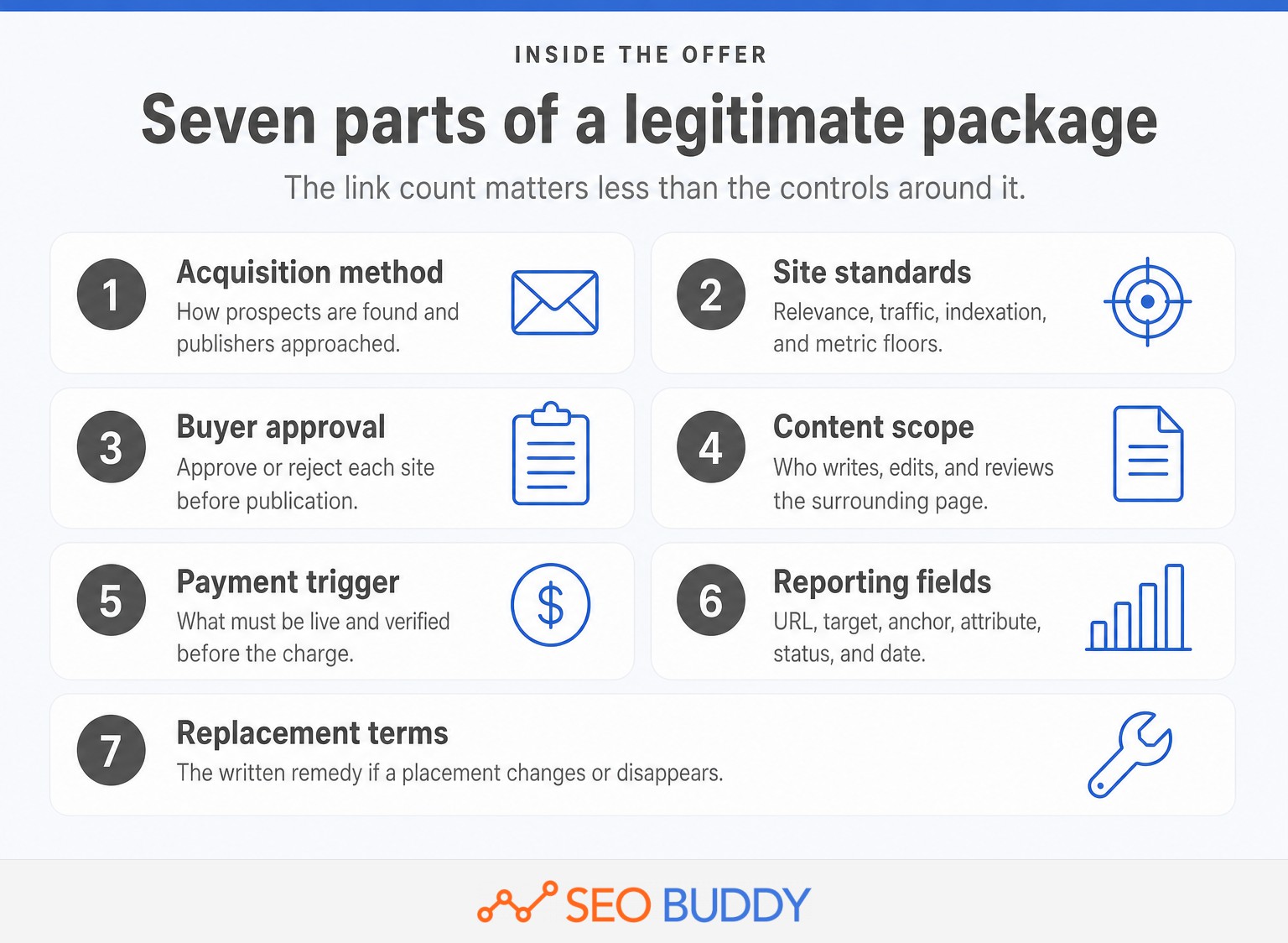
A legitimate package should make its method, deliverables, acceptance rules, pricing, reporting, and remedies clear before work begins. If the provider cannot explain these points in writing, the buyer cannot compare the offer or verify delivery.
Require the following seven elements.
- A named acquisition method. The proposal should say whether links come from manual outreach, digital public relations, resource-page outreach, unlinked mentions, guest contributions, listings, exchanges, existing publisher inventory, or another method. Vague language such as authority links is not a method.
- Site acceptance standards. Require topical relevance, indexation, estimated organic traffic, geographic or language fit, and any third-party metric floor. Metrics should include their source and check date because scores and traffic estimates can change.
- Approval and rejection rights. The buyer should know whether proposed sites can be reviewed before content is written or published. The contract should also state whether rejecting an unsuitable site costs anything.
- Content and anchor scope. Define who selects the target page, proposes anchor text, writes the surrounding content, edits it, and checks that the link makes sense within the sentence. Exact-match anchor quotas are not a substitute for editorial judgment.
- A precise payment trigger. The package should state whether payment covers research, outreach attempts, publisher acceptance, article production, publication, verification, or a mixture of these events.
- Useful reporting. At minimum, a placement report should show the publishing URL, target URL, anchor text, link attribute, publication date, verification status, and any agreed site metrics.
- Written replacement terms. Define what happens if a page is removed, the link changes, an attribute is added, or the page becomes unavailable. The monitoring period, replacement process, refund conditions, and exclusions should not be left to an informal promise.
Google's spam policies define link spam as links created primarily to manipulate rankings and list bought ranking links, excessive exchanges, automated creation, and low-value content among the examples. Google's outbound-link guidance says advertisements and paid placements should use rel="sponsored", with nofollow also accepted. (developers.google.com)
A concrete managed-service example shows how specific the controls can become. SEO Buddy's current service lets buyers set a minimum Domain Rating tier, approve or reject every proposed site, and pay only after a placement is published and verified. It also checks relevance, traffic, indexation, and topical rankings and rechecks placements for 90 days. (seobuddy.com)
A legitimate package makes acquisition, approval, payment, reporting, and replacement terms visible before work starts.
Which link-building package model fits the work you want to outsource?
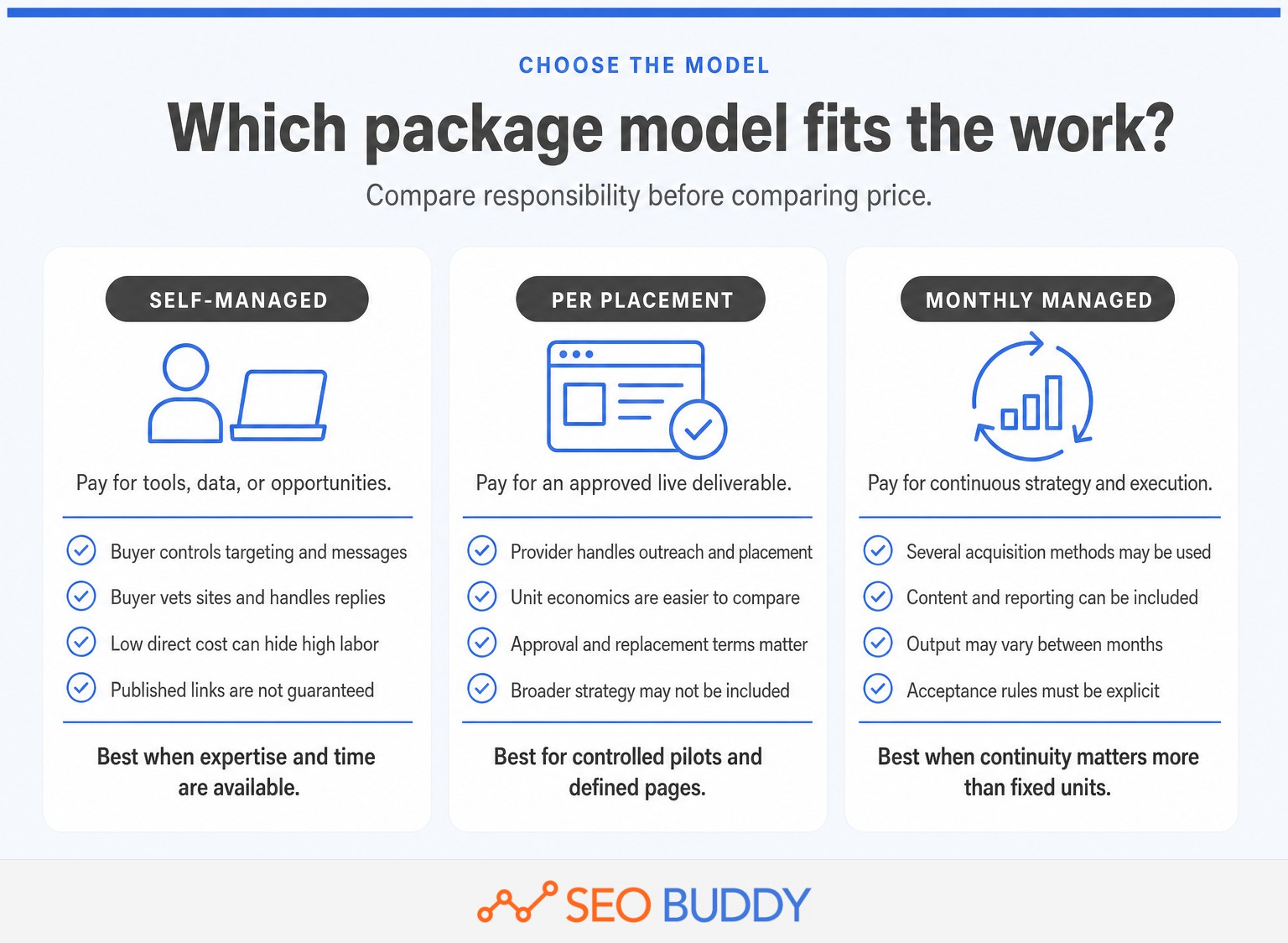
The right model depends on who will perform research, vet sites, contact publishers, create content, monitor replies, and verify placements. Buying more service reduces internal labor, but it also makes transparency and approval rights more important.
| Package model | Buyer handles | Provider handles | Best fit | Main pricing trap |
|---|---|---|---|---|
| Self-managed software | Strategy, site review, outreach decisions, content, negotiation, and follow-up | Prospect discovery, contact data, sending tools, or workflow | Teams with link-building knowledge and available time | Mistaking low software cost for low total labor cost |
| Curated opportunity access | Site selection, submissions, quality review, and tracking decisions | Organizing known opportunities and supporting workflow | Newer sites and delegated operators building a foundation | Assuming every listed opportunity suits every website |
| Managed per-placement service | Target pages, acceptance rules, proposal approval, and final oversight | Prospecting, outreach, content, placement, and verification | Buyers wanting controlled delivery without a long retainer | Comparing only the price per link and ignoring relevance or attributes |
| Monthly managed campaign | Goals, budget, approvals, and performance review | Ongoing strategy, outreach, content, relationships, and reporting | Programs that need continuity across several methods | Paying a fixed fee without defining acceptable output |
A team that wants to control targeting and messages can use Link Building Campaign for prospect discovery, contact finding, and a three-email sequence sent from its own mailbox. The buyer remains responsible for relevance, mailbox authentication, message content, and the legal basis for outreach. (seobuddy.com)
A newer site that needs known submission opportunities rather than cold outreach may be better suited to Link Chest. That route transfers less work to a provider and should be evaluated as a workflow and opportunity database, not as a promise of published editorial placements. (seobuddy.com)
Choose the model by the work you can perform, not by the label printed on the offer.
What actually drives link-building package pricing?
Link-building cost can range from a small software usage charge to hundreds of dollars per managed placement or a larger monthly retainer. A price is reasonable only when the scope, approval rights, placement standards, payment event, and replacement terms are clear.
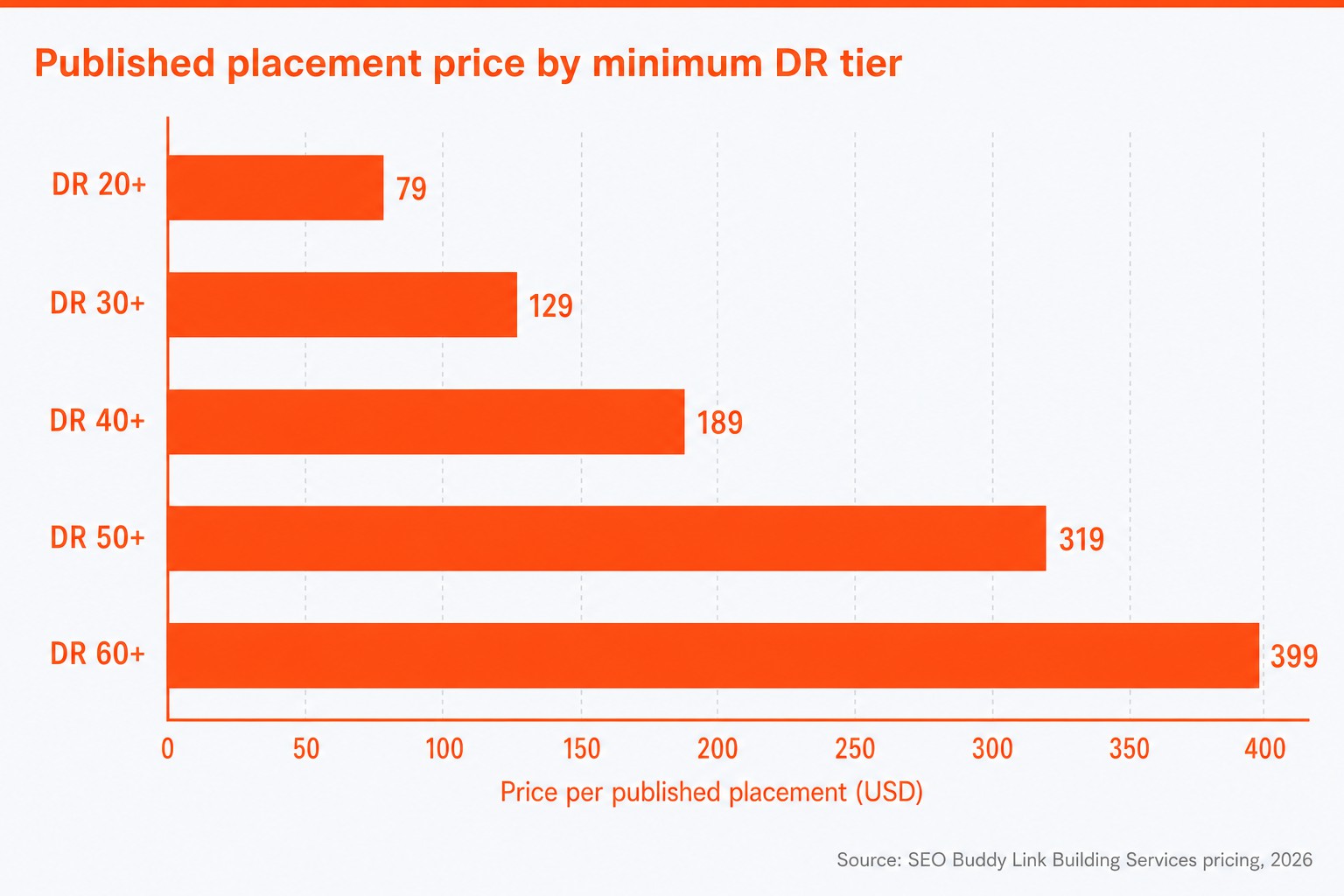
The same provider can charge very different amounts for different levels of work. As of October 30, 2026, SEO Buddy's managed placement tiers are $79 for a DR 20+ site, $129 for DR 30+, $189 for DR 40+, $319 for DR 50+, and $399 for DR 60+, with each price covering one published and verified placement. These are provider-specific prices, not an industry average. (seobuddy.com)
By contrast, one measured self-managed campaign identified 73 opportunities and 44 published contact addresses for $1.80. That figure covered software usage, not the labor, content, negotiation, or uncertainty involved in earning a published link. (seobuddy.com)
The main cost drivers are:
- the amount of human prospecting and outreach;
- publisher selectivity and the difficulty of the niche;
- content research, writing, and editing;
- site relevance, traffic, indexation, and metric requirements;
- approval, verification, monitoring, replacement, and reporting work.
Normalize offers with the formula total package fee ÷ approved live placements. Then check what the result excludes. A lower cost per placement may still be poor value if sites are off-topic, publisher compensation is undisclosed, links are not monitored, or internal staff must perform most of the work.
The fairest price comparison is cost per approved live placement after the included labor and quality controls are normalized.
How should you compare packages that quote different deliverables?
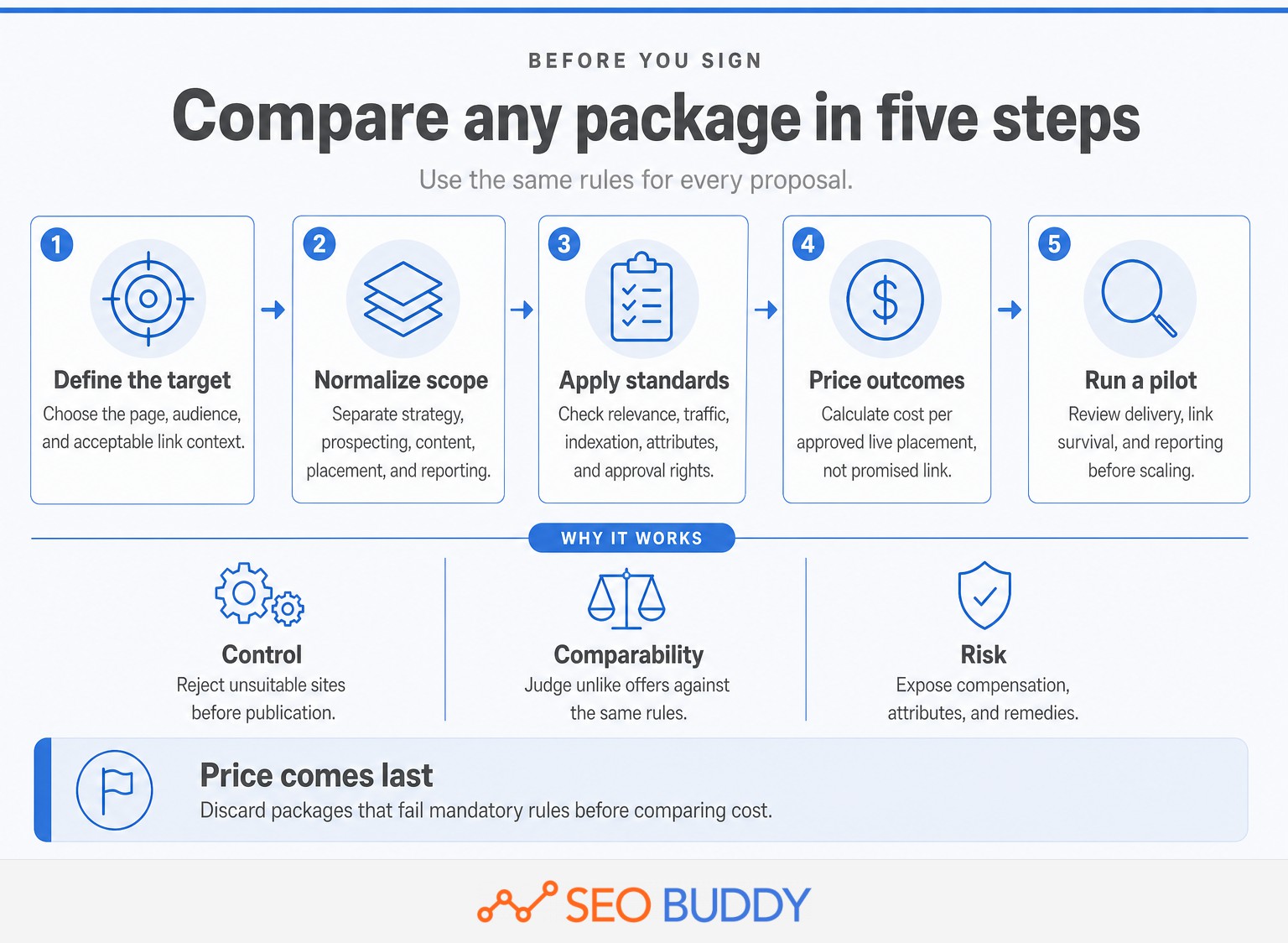
Create one acceptance scorecard and require every provider to answer it in the same format. This prevents a low-scope prospecting offer from appearing cheaper than a managed package that includes content, approval, publication, verification, and replacement protection.
| Criterion | Question to ask | Evidence to require |
|---|---|---|
| Acquisition | How is each opportunity found? | A named method and disclosure of any existing inventory |
| Relevance | Why does the site and page fit the target audience? | Example topics, rankings, categories, or editorial context |
| Traffic and indexation | Is the site active and discoverable? | Current estimates, check dates, and indexed-page evidence |
| Approval | Can the proposed site be rejected before publication? | Written approval and no-cost rejection terms |
| Content | Who writes and reviews the surrounding article? | Word scope, editorial process, and revision responsibility |
| Compensation and attributes | Is the publisher compensated, and how will the link be marked? | Written disclosure of the commercial arrangement and link attribute |
| Payment | What event makes the charge final? | A payment schedule tied to defined deliverables |
| Reporting | What information appears in each report? | A sample report with URLs, anchors, attributes, dates, and status |
| Replacement | What happens when a placement changes or disappears? | Monitoring window, remedy, exclusions, and response time |
Apply mandatory rules before comparing prices. If a package fails topical relevance, disclosure, approval, or reporting requirements, a lower price should not return it to consideration.
Start with the smallest useful pilot. Review the provider's actual proposals, reasons for selecting each site, publication quality, delivery timing, final report, and response when something changes. Scale only after the process performs as promised.
For contract-level questions about ownership, communication, case studies, exit terms, and guarantees, use the guide to how to hire a link building agency before signing.
A comparison becomes meaningful only after every provider is judged against the same acceptance rules.
Which red flags should make you reject a link-building package?
Reject a package when the provider substitutes volume, unexplained metrics, or ranking promises for a verifiable acquisition process. The buyer should be able to identify where links come from, why each site fits, what money pays for, and what happens after publication.
Google's current policy identifies buying or selling links for ranking purposes, excessive exchanges, automated link creation, and low-value content designed to manipulate linking signals as link spam. It also says paid placements should be marked with sponsored or nofollow. (developers.google.com)
SEO Buddy's service page says its placements are normally dofollow and unsponsored unless a publisher's policy requires another attribute, while its acquisition description says editors are approached through outreach rather than links being bought from a network. Google's guidance means buyers should ask a precise follow-up: is the fee paying for research, outreach, content, and verification that may earn an independent editorial decision, or does money, a product, or a service go to the publisher in exchange for the link? (seobuddy.com)
Walk away from offers that include any of these warning signs:
- guaranteed rankings, traffic, or a fixed search position;
- a large link count with no named acquisition method;
- Domain Rating or another metric used as the only quality standard;
- hidden sites with no approval before publication;
- private blog networks, expired-domain farms, automated directory blasts, or sites that publish unrelated topics for anyone;
- a blanket dofollow promise without publisher-compensation disclosure;
- fixed exact-match anchor quotas;
- payment for undelivered placements with no cancellation, refund, or replacement terms;
- reports that contain only a list of URLs and no target, anchor, attribute, date, or status.
Reject packages that substitute hidden inventory, metric promises, or ranking guarantees for editorial judgment and buyer control.
What should a startup buy first?
A startup should usually begin with a small, stoppable pilot tied to one or two useful pages rather than a large monthly volume. The first package should test process quality, audience fit, approval controls, reporting, and link survival before the company attempts to scale.
A practical first package has four characteristics:
- A narrow target. Choose a page that genuinely answers a customer question or supports a commercial decision.
- Low commitment. Avoid a long contract until the provider has shown real proposals and complete reporting.
- Prepublication control. Reject sites that are irrelevant, inactive, unindexed, or unsuitable for the brand.
- A learning objective. Record which topics, pitches, publishers, and page types receive a positive response.
Startups should also account for internal readiness. A provider cannot make a thin landing page useful to publishers, and a link package cannot replace technical accessibility, clear positioning, or content worth citing.
A startup package should be small enough to inspect, easy to stop, and focused on learning which placements actually fit.
What else do buyers ask about link-building packages?
Buyers repeatedly ask about cost, service scope, tools, and startup options. The short answers below are designed to stand alone, but each still depends on the package's actual deliverables.
How much does link building cost?
Link building can cost from a small software usage fee to hundreds of dollars per managed placement or a larger monthly retainer. Compare the scope before comparing totals. A fair price should state the work included, the placement standard, the approval process, the payment trigger, and any replacement commitment.
What is a link building service?
A link building service helps a website acquire backlinks through prospect research, outreach, content creation, publisher communication, placement, or reporting. Services vary widely. Some provide only software or prospect lists, while others deliver approved live placements or manage an ongoing campaign, so the contract should define the exact deliverable.
What is the best link building tool in 2026?
The best link building tool in 2026 is the one that matches the work the buyer can perform. A capable in-house team may need prospecting and outreach software. A time-poor buyer may need a managed placement service. Evaluate site controls, contact data, sending safeguards, approval rights, reporting, and total labor required.
What are some effective link building packages for startups?
Effective link building packages for startups keep commitments small, target one or two useful pages, allow site rejection before publication, and report every live placement clearly. Early-stage companies should usually prefer a controlled pilot over a large volume promise, then expand only after the placements fit the audience and remain live.
The right answer depends on the work included, the control retained, and the risk disclosed.
What should you do before signing?
Write the acceptance rules before requesting or approving a package. Then buy the smallest test that can prove the provider follows those rules.
Define the target pages, acceptable topics, minimum site checks, approval process, compensation disclosure, link attributes, payment trigger, reporting fields, and replacement remedy. Keep those requirements beside every proposal so price cannot distract from suitability.
If managed editorial placements fit those rules, review SEO Buddy's link-building services, where proposed sites can be approved or rejected before publication and charges are tied to live, verified placements. (seobuddy.com)
Define the acceptance rules first, then buy the smallest package that can prove it meets them.

CEO & Founder at SEO Buddy





Get the SEO work done, not just read about it
Create a free account and run your first content plan, keyword research and link-building campaign. No card, and setup is free until your first article.
Free to start. We never sell your address.