
Is SEO an Ongoing Process? What to Repeat Monthly, Quarterly, and Annually

In short
SEO is an ongoing process because websites, competitors, search demand, and search systems keep changing. A practical routine is to review performance and site health monthly, refresh priorities and content quarterly, and reassess strategy, structure, and major technical risks annually. The exact cadence should follow each site's publishing pace and business risk.
Key takeaways
- Google's 2025 Search Console guidance suggests checking routine performance about once a month or after significant content changes.
- Monthly work should detect changes, resolve urgent problems, support new content, and record the next action.
- Google's October 2026 guidance warns against changing page dates to create an appearance of freshness when the content has not substantially changed.
- Quarterly reviews should produce a decision for each important page or topic cluster: keep it, improve it, consolidate it, or investigate further.
- Annual reviews should reassess goals and structure, but migrations, redesigns, and major offer changes require the same checks immediately.
Table of contents
- Why can't SEO be finished once?
- What should you do every month?
- What belongs in a quarterly SEO review?
- What should you check once a year?
- How do you choose the right cadence for each task?
- How much ongoing SEO can a small team realistically manage?
- What else should you know about ongoing SEO?
- What should you do next?
The mistake is treating SEO as a project with a finish line. An initial audit, redesign, or optimization sprint can create a strong foundation, but maintenance is what keeps that foundation aligned with the site, its audience, and the evidence arriving from search performance.
Why can't SEO be finished once?
SEO cannot be finished once because the site and its environment continue to change after the initial optimization. New pages, removed products, shifting demand, competitor activity, links, and search-system updates can change what people find and how pages perform.
What does the recurring loop look like?
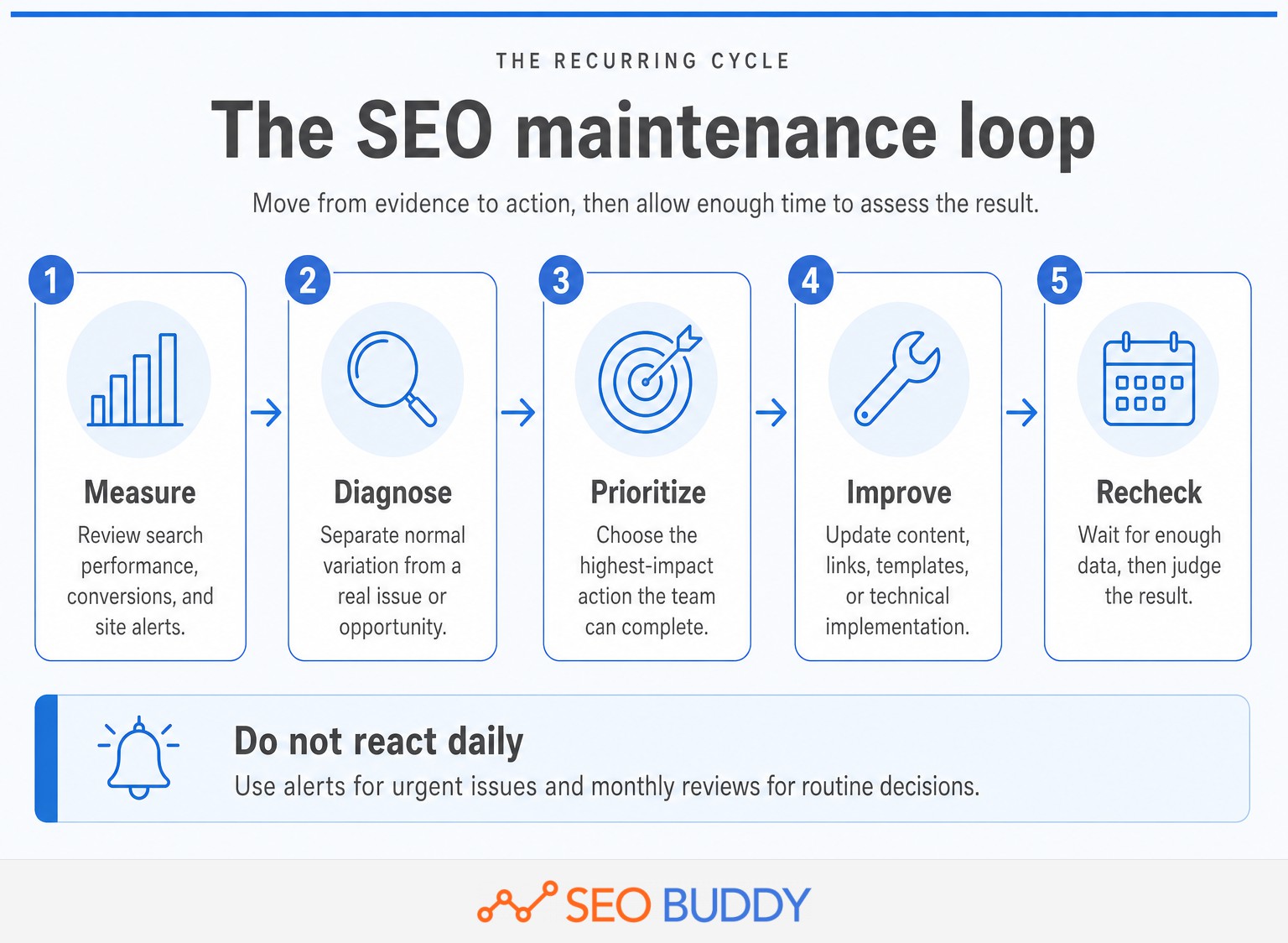
Google's 2025 SEO Starter Guide defines SEO as helping search engines understand content and helping users decide whether to visit a site from search results. That job continues whenever the site publishes, edits, moves, or removes information.
The evidence also arrives slowly. Google says some changes may appear within hours while others can take several months, and it generally recommends waiting a few weeks before assessing whether an SEO change helped. Daily reactions can therefore replace useful analysis with noise.
External conditions change as well. Google's public Search Status Dashboard recorded several ranking and spam updates during 2026. A maintenance process can annotate these events and investigate material changes without assuming every fluctuation requires a rewrite.
A useful loop has five stages: measure what changed, diagnose the cause, prioritize one response, implement it, and return after enough evidence has accumulated. The loop should also permit a no-action decision when the data does not support intervention.
Ongoing SEO is a controlled improvement loop, not a permanent rewrite of everything.
Anybody can generate an article. Knowing which one is worth writing is the hard part.
The AI Content Engine reads your site and your competitors, then builds a ranked content plan and writes it. Setup is free, and you see your plan before you pay for anything.
See your content plan freeWhat should you do every month?
Monthly work should answer three questions: what changed, what needs attention now, and what should be published or improved next? Google's Search Console guidance updated in 2025 says daily checks are unnecessary and suggests reviewing the account around once a month or after content changes.
Which tasks belong in the monthly loop?

- Review search and business performance. Check clicks, impressions, queries, landing pages, and countries in Search Console, then connect that activity to conversions or other business outcomes in the site's analytics system. Compare the latest period with the previous period and, when demand is seasonal, the equivalent period from the previous year.
- Triage alerts and recent technical changes. Review indexing, security, structured data, and page-experience alerts that affect important pages. A full technical audit does not need to happen every month on every site, but a release, template change, migration, or sudden loss of traffic should trigger a focused investigation.
- Publish useful content and refresh pages that genuinely need work. Prioritize changed facts, outdated advice, missing answers, weak examples, and pages whose search intent no longer matches the results. Google's October 2026 people-first content guidance warns against changing dates to make unchanged pages appear fresh, so every refresh should improve the substance.
A repeatable content production workflow can connect research, planning, drafting, internal linking, and publishing. The workflow still needs editorial priorities and quality control; producing more pages is not a substitute for choosing useful topics.
- Add and repair internal links. Link relevant older pages to newly published resources and add links from the new page back into the site's established topic structure. Google's Starter Guide says links help users and search engines discover pages and understand the resources connected to a subject.
- Continue promotion and authority work. Keep ongoing authority building in the calendar through relevant outreach, community participation, public relations, useful resources, or relationship development. Avoid turning this work into a fixed monthly link quota, because relevance and editorial value matter more than producing a convenient count.
- Record decisions. For every material action, log the page, evidence, owner, change, expected result, and date for reassessment. This prevents the team from repeating tests or abandoning a change before it has had time to produce evidence.
A monthly SEO routine should detect change, protect working pages, and create the next prioritized action.
What belongs in a quarterly SEO review?
Quarterly reviews should identify patterns that are too noisy to judge week by week. Use roughly three months of data to decide which pages and topic clusters deserve expansion, consolidation, improvement, or less investment.
What decisions should a quarterly review produce?
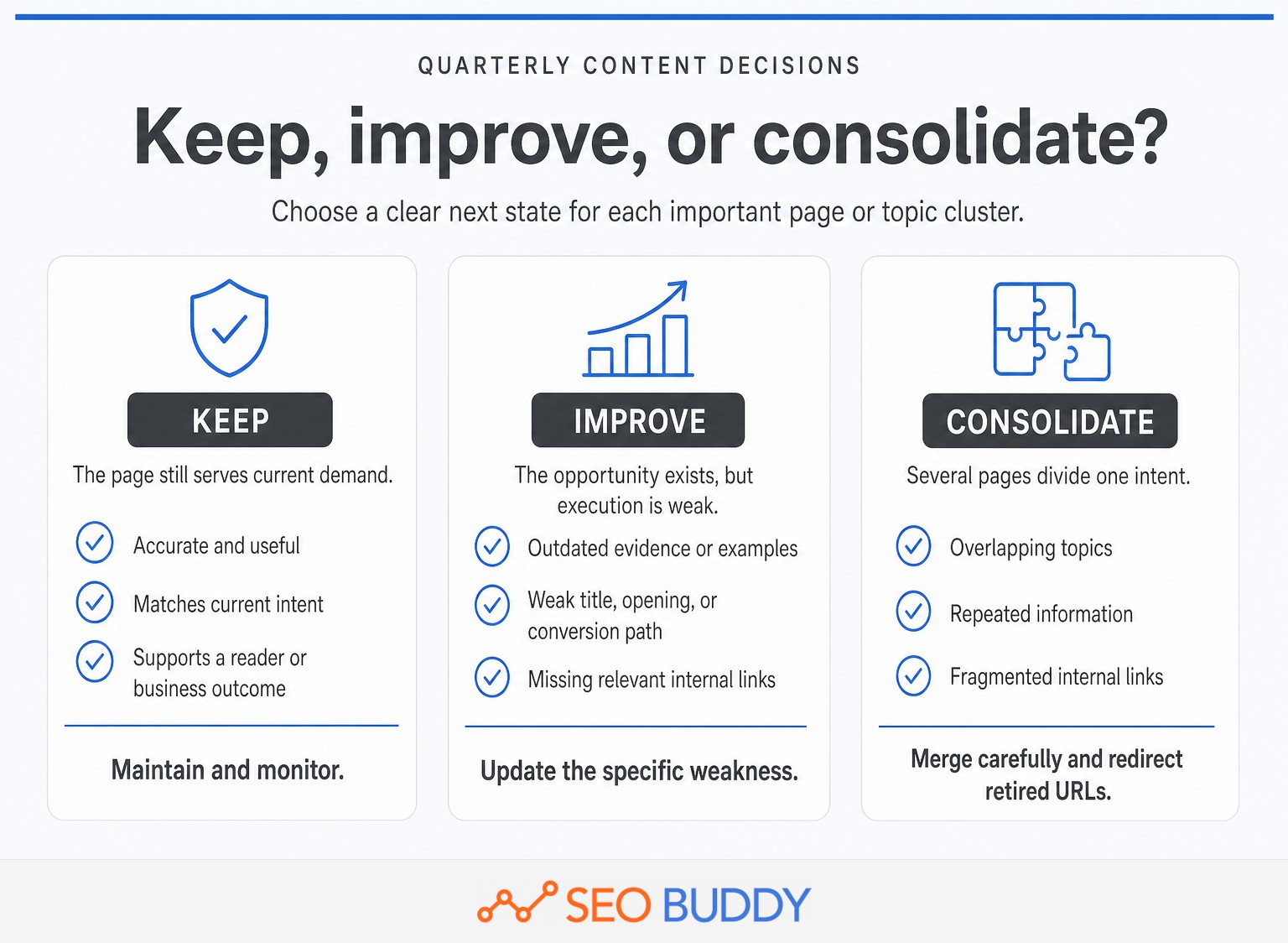
Start by grouping performance by topic, page type, audience, offer, or conversion goal. Site-wide averages can hide a growing content cluster, a weak template, or a high-traffic group of pages that contributes little to the business.
- Keep: Leave a page substantially unchanged when it serves current intent, remains accurate, attracts the right audience, and supports a useful reader or business outcome. Minor maintenance may still be necessary.
- Improve: Update a page when demand exists but the result is weak. Possible actions include replacing outdated evidence, clarifying the opening answer, strengthening examples, improving the title and description, or adding relevant internal links.
- Consolidate: Consider merging pages when several URLs divide the same intent, repeat similar information, or compete for the same internal links. Preserve useful material and use appropriate redirects when URLs are retired.
- Investigate: Do not force a decision when the cause is uncertain. Check seasonality, tracking changes, indexing, site releases, search-result changes, and the time elapsed since the last edit.
A quarterly review is also the right place to reassess search intent. Look at the questions being asked, the formats appearing in search results, and whether customers now use different language for the problem.
Plan seasonal work before demand peaks. A business with recurring annual questions should review those pages early enough to verify facts, update availability, improve links, and complete editorial review before customers begin searching in volume.
Finally, examine experiments as a group. A title change, content update, internal-link addition, or new supporting page should be assessed against its original hypothesis rather than credited or blamed for every movement in the reporting period.
A quarterly review should end with a decision for each important page or topic cluster.
What should you check once a year?
An annual review should challenge assumptions that monthly and quarterly routines take for granted. Revisit business goals, site structure, measurement, major templates, and the resources assigned to SEO, then rebuild the maintenance plan for the next 12 months.
What belongs in the annual audit?
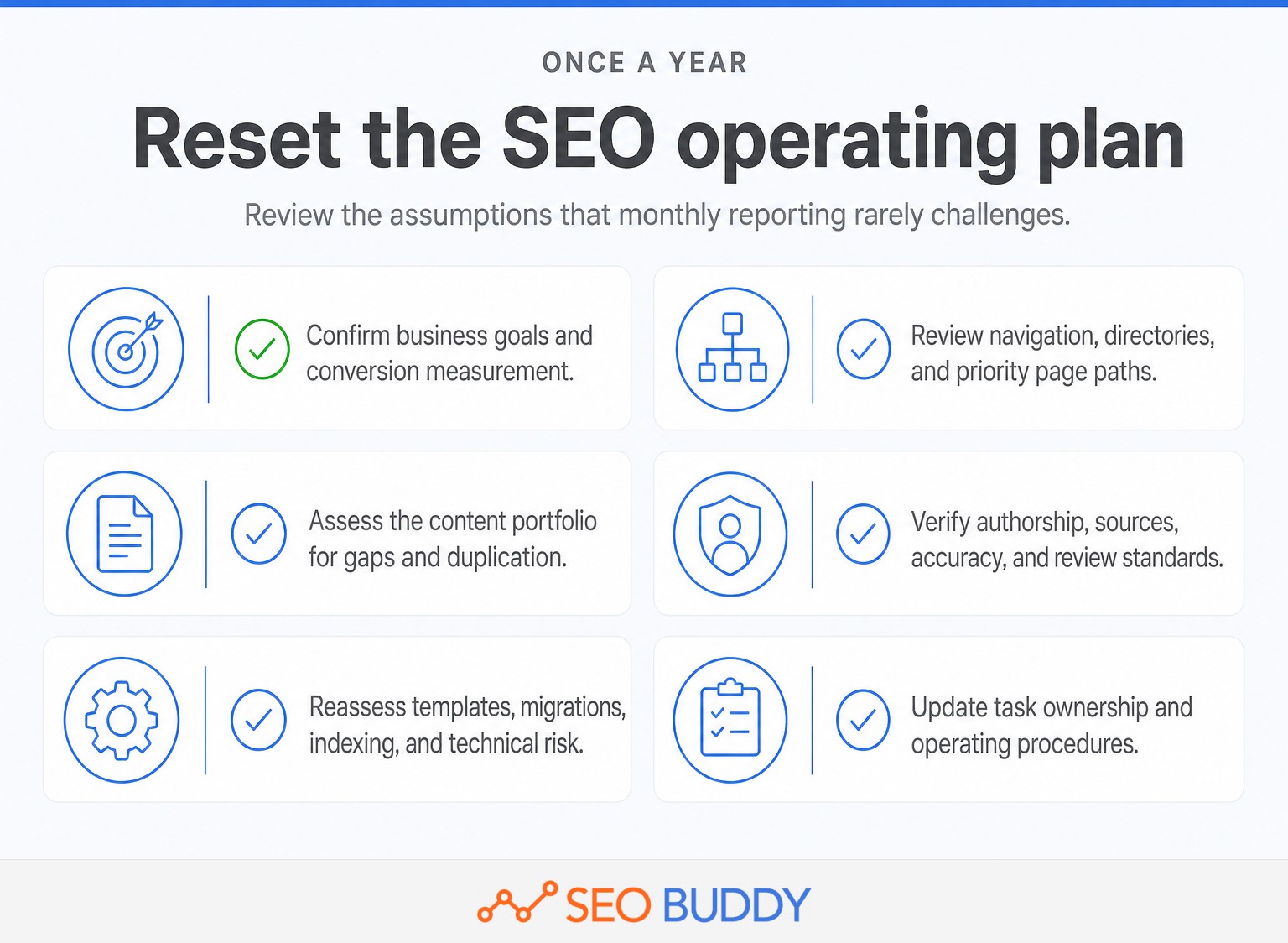
- Goals and conversions: Confirm that reporting still measures the actions the business values. Remove obsolete goals and document any gaps in attribution.
- Site architecture: Review navigation, directories, URL patterns, important hubs, and the paths users and crawlers take to priority pages.
- Content portfolio: Identify outdated sections, duplicated topics, unsupported claims, missing audience questions, and areas that no longer match the business.
- Authorship and evidence: Review bylines, reviewer roles, source quality, update records, and standards for AI-assisted work. Google's 2026 guidance encourages accurate authorship information and warns against fabricated creator identities.
- Technical risk: Examine templates, redirects, canonical signals, structured data, mobile rendering, performance, security, and any recurring indexing failures.
- Ownership and process: Confirm who owns measurement, content, development work, internal linking, and promotion. Update procedures when tools, responsibilities, or approval steps have changed.
Do not wait for the annual review after a domain move, content-management-system migration, major redesign, rebrand, acquisition, or substantial change to products and services. Those events should trigger the relevant annual checks as part of the project.
The annual review resets the operating system, while major site changes trigger the same checks immediately.
How do you choose the right cadence for each task?
Choose cadence by rate of change and the cost of missing a problem, not by copying a generic calendar. High-change, high-risk work needs shorter intervals; stable, low-risk work can wait for a quarterly or annual review.
Use this calendar as a starting point:
| Task | Default cadence | Do it sooner when |
|---|---|---|
| Search and conversion review | Monthly | Traffic, leads, or sales change materially |
| Indexing and technical alert triage | Monthly | A release, migration, or template change occurs |
| New content and internal links | Monthly or each publishing cycle | A new priority page is published |
| Content portfolio review | Quarterly | Accuracy, intent, or performance clearly changes |
| Search-intent and competitor review | Quarterly | The search results or customer language change |
| Strategy, architecture, and measurement review | Annually | The business, brand, platform, or site structure changes |
Cadence is a default, not a deadline. A news publisher, marketplace, or large ecommerce site may need weekly checks for high-risk areas, while a stable brochure site may need less frequent reporting but should still respond quickly to security, indexing, or migration problems.
Avoid scheduling work simply because a calendar reminder appeared. Every recurring task should produce evidence, a decision, an assigned action, or a documented reason to leave the site unchanged.
The right cadence follows risk and rate of change, not a universal task frequency.
How much ongoing SEO can a small team realistically manage?
Small teams should maintain a short priority queue rather than attempt every possible SEO task. Assign one owner, one evidence source, one next action, and one review date to each current priority.
How should a small team organize the queue?
Divide work into three queues:
- Protect: Resolve issues that threaten valuable pages, conversions, indexing, accuracy, or trust.
- Grow: Publish or improve pages connected to demonstrated demand and a real business offer.
- Learn: Run a limited test or investigation when the team lacks enough evidence to choose a larger action.
Set a fixed capacity for recurring work before selecting tasks. If the team can complete only a few meaningful changes, protect existing value first, choose the strongest growth opportunity second, and postpone low-impact cleanup.
A master inventory helps prevent important areas from disappearing from view. The SEO checklist organizes 122 steps across nine areas, but it should be used to identify priorities rather than treated as a list that must be completed every month.
The operating board can remain simple: task, page, evidence, owner, status, and next review date. Detailed reports are less useful when nobody knows which decision the report is supposed to support.
A small team needs a prioritized queue and clear ownership, not an endless list of SEO chores.
What else should you know about ongoing SEO?
Ongoing SEO is easier to manage when the team shares a definition of the work, realistic expectations, and a reliable way to learn. These common questions clarify what SEO maintenance is and what it is not.
What is search engine optimization?
Search engine optimization is the work of helping search engines understand a site and helping people decide whether to visit it from search results. Google's 2025 SEO Starter Guide frames SEO this way. In practice, the work includes technical access, useful content, clear organization, relevant links, and measurement.
Where can I get certified in SEO?
SEO certificates are available from universities and training providers, but Google said in a June 2023 Search Central office-hours answer that it was not aware of a Google SEO certification. Choose a course with practical projects and current official guidance; treat the certificate as proof of study, not proof of ranking results.
Will SEO exist in 5 years?
SEO is likely to exist in 2031, although workflows and search interfaces will change. As long as people use search systems to discover and evaluate information, organizations will need to make content accessible, understandable, trustworthy, and useful. The durable work is audience research, technical access, quality control, measurement, and improvement.
Ongoing SEO depends more on current evidence and repeatable practice than on a one-time credential.
What should you do next?
Start by scheduling the monthly review and choosing one quarterly decision date; do not begin with a giant annual audit. Give each recurring task an owner, evidence source, and next review date so the process can continue without depending on memory.
Once the routine is in place, use the prioritized action plan on how to get more organic search traffic to choose growth work. If execution still lives in people's heads, use the 66-procedure SOP Collection to turn recurring tasks into delegated procedures.
The calendar should make the next SEO decision obvious before the next reporting cycle begins.

CEO & Founder at SEO Buddy


 Link-Building Packages Explained: Deliverables, Pricing, and Red Flags
General SEO
 Is SEO Dead? What AI Search Changed and What Still Works
General SEO
 How to Hire a Link-Building Agency: 12 Questions to Ask Before Signing
General SEO
 Legal SEO: A Practical Growth Framework for Law Firms
General SEO
Get the SEO work done, not just read about it
Create a free account and run your first content plan, keyword research and link-building campaign. No card, and setup is free until your first article.
Free to start. We never sell your address.