
Is SEO Dead? What AI Search Changed and What Still Works

In short
SEO is not dead in 2026. AI answers have reduced clicks for some informational searches, but search visibility still depends on crawlable websites, useful content, authority, and clear relevance. The job has expanded from winning blue-link rankings to being discovered, trusted, cited, and chosen across search results and AI-generated answers.
Key takeaways
- Pew Research Center's 2025 browsing study found that users clicked traditional results on 8% of visits with an AI summary, compared with 15% without one.
- Google's May 2026 guidance says foundational SEO practices remain relevant because its generative search features use core ranking and quality systems.
- AI-assisted content is not automatically spam, but producing large amounts of unoriginal content without adding value can violate Google's scaled content abuse policy.
- Useful original material, crawlable pages, relevant links, and authentic third-party recognition remain durable sources of visibility.
- SEO investment should be judged by qualified discovery, conversions, revenue, and assisted demand rather than raw organic sessions alone.
Table of contents
- Is SEO actually dead in 2026?
- What did AI search change about organic traffic?
- Which SEO tactics are dying, and which still work?
- Is GEO or AEO replacing SEO?
- How do content, authority, and brand mentions work together now?
- Can AI create SEO content without creating spam?
- Is SEO still worth investing in for your business?
- What should your SEO plan look like for the next 90 days?
- Frequently asked questions
- What should you do next?
The claim that SEO is dead usually treats unpaid Google clicks as the whole discipline. That definition is now too narrow. A business still needs its information to be discovered, interpreted, trusted, and selected, but those decisions increasingly happen inside generated answers, rich search features, videos, community discussions, and conventional results.
The right question is not whether the old traffic model survived unchanged. It did not. The useful question is which parts of SEO still create commercial value and how the investment should change.
Is SEO actually dead in 2026?
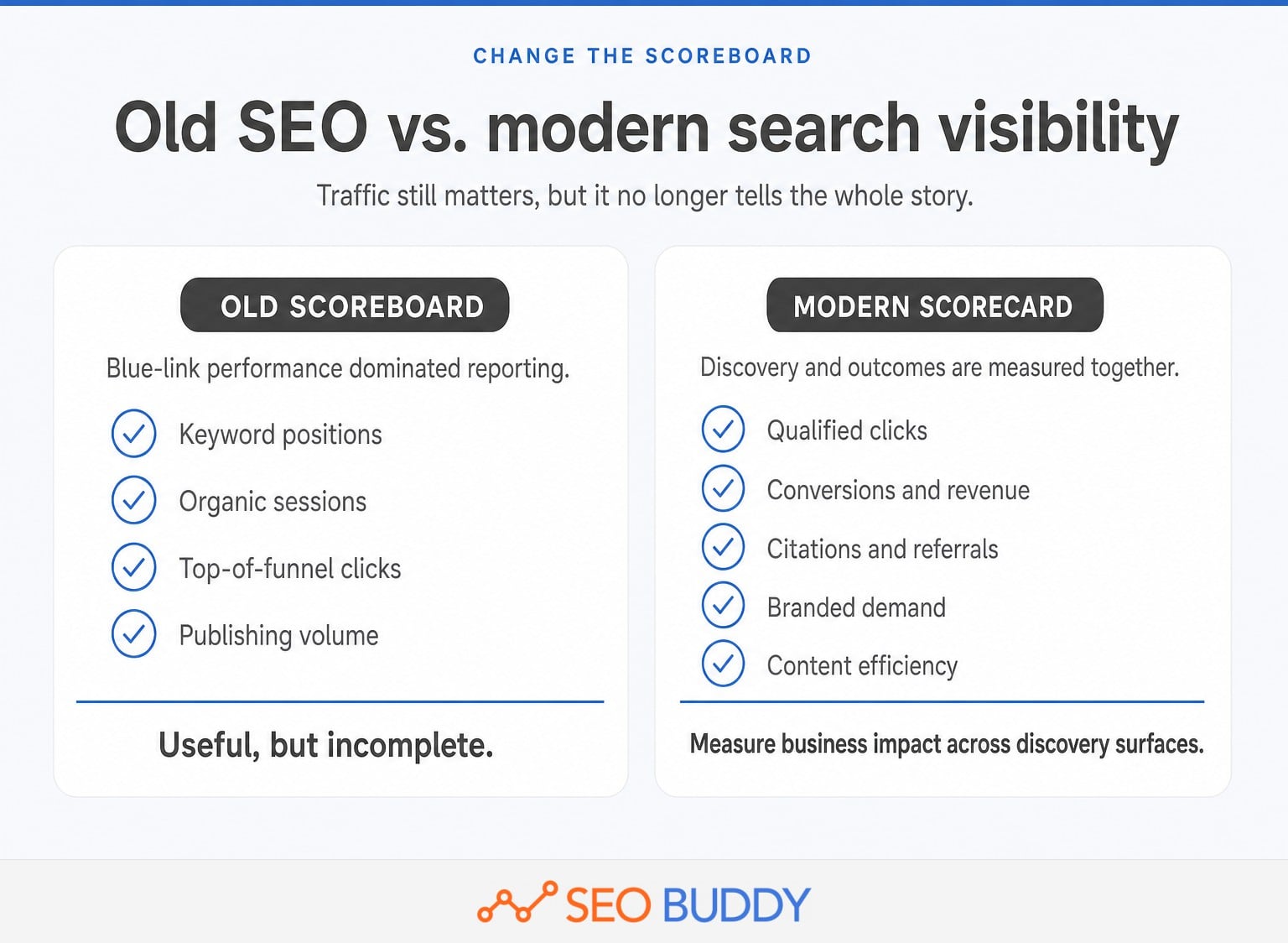
No. The version of SEO built around easy rankings, generic articles, and predictable click-through rates is weakening, but the underlying work of making a business discoverable remains necessary. As of October 2026, Google explicitly says its generative search features are grounded in the same core ranking and quality systems that support conventional Search.
Google's 2026 generative AI search guide explains that AI Overviews and AI Mode retrieve material through Google's search index and ranking systems. Retrieval, crawlability, relevance, source quality, and technical eligibility have not disappeared. The interface presenting those sources has changed.
Other answer systems also depend on accessible web content. OpenAI's publisher guidance says public websites can appear in ChatGPT search and advises publishers that want summaries and snippets to permit OAI-SearchBot. Allowing a crawler does not guarantee selection, but blocking it can remove an opportunity to be retrieved.
A practical definition of SEO in 2026 is therefore broader than ranking a page for one keyword. It is the work of making a business eligible, relevant, credible, and useful wherever search systems assemble an answer.
That broader definition includes:
- Making important pages crawlable and indexable.
- Matching the underlying problem behind a query.
- Publishing information that adds something unavailable elsewhere.
- Helping systems understand the business, products, authors, and subject expertise.
- Earning links and authentic references that support discovery and trust.
- Turning visibility into a useful next action for the reader.
SEO is alive because AI discovery still depends on content that can be found, understood, trusted, and retrieved.
Anybody can generate an article. Knowing which one is worth writing is the hard part.
The AI Content Engine reads your site and your competitors, then builds a ranked content plan and writes it. Setup is free, and you see your plan before you pay for anything.
See your content plan freeWhat did AI search change about organic traffic?
AI search has reduced the need to click for some quick-answer queries and made organic traffic less evenly distributed among publishers. It has also created additional search behavior and citation surfaces, so the impact varies by query, website, and business model.
Pew Research Center's July 2025 analysis examined 68,879 Google searches associated with 900 U.S. adults. Users clicked a traditional result on 8% of visits where an AI summary appeared and 15% of visits without one; browsing sessions ended after 26% of visits with a summary and 16% without one.
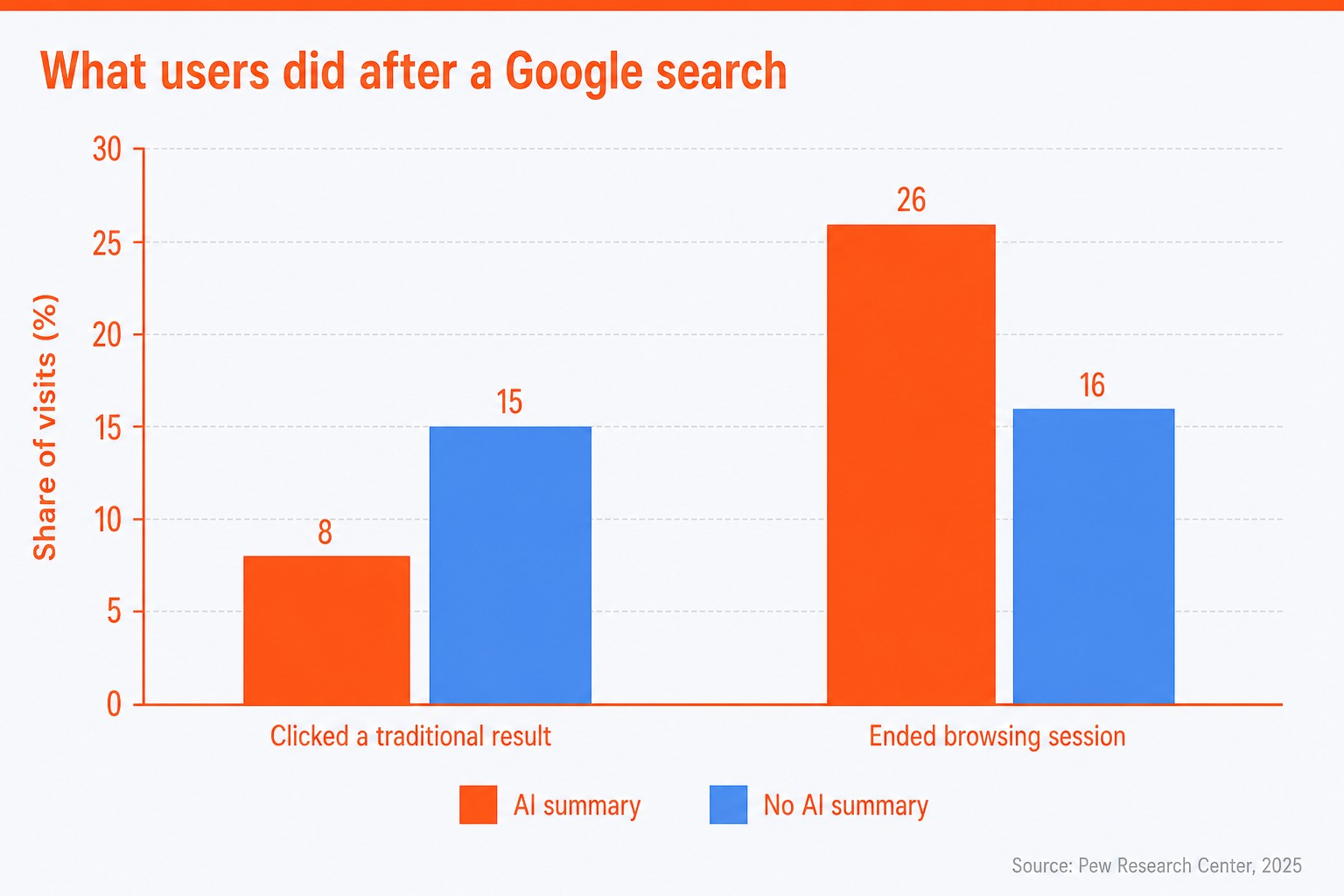
Clicks on a source linked inside the AI summary occurred on just 1% of visits with a summary. The study is important, but its limits matter: it covered U.S. participants during March 2025, and the search results were collected in April 2025. It does not establish one universal click rate for every country, industry, query, or later product version.
Google presents a different aggregate view. In an August 2025 statement about AI search traffic, Google said total organic click volume was relatively stable year over year and that the average quality of those clicks had increased. The post did not provide the query-level breakdown needed to compare it directly with Pew's sample.
Both findings can be true. Informational queries that can be answered in a few sentences may lose clicks, while searches involving purchases, detailed evaluation, tools, original experience, or deeper learning may continue to send valuable visitors. Aggregate search activity can remain large even as traffic shifts sharply between query classes and websites.
Use a wider SEO scorecard
Track four levels instead of treating sessions as the final result:
- Discovery: Search impressions, visible pages, cited URLs, branded demand, and the queries producing visibility.
- Engagement: Qualified visits, return visits, content consumption, and meaningful actions on the page.
- Business outcomes: Leads, sales, subscriptions, assisted conversions, and customer quality.
- Efficiency: Cost per useful page, time to update, conversion value, and the proportion of content that contributes to an objective.
AI visibility is becoming more measurable. As of October 2026, Google's generative search guide points site owners to a Generative AI performance report in Search Console, while Microsoft's February 2026 AI Performance announcement introduced citation reporting across supported AI surfaces. OpenAI also adds a ChatGPT referral parameter to outbound search links, according to its publisher documentation.
The winning metric is no longer maximum traffic; it is qualified discovery that produces measurable business value.
Which SEO tactics are dying, and which still work?
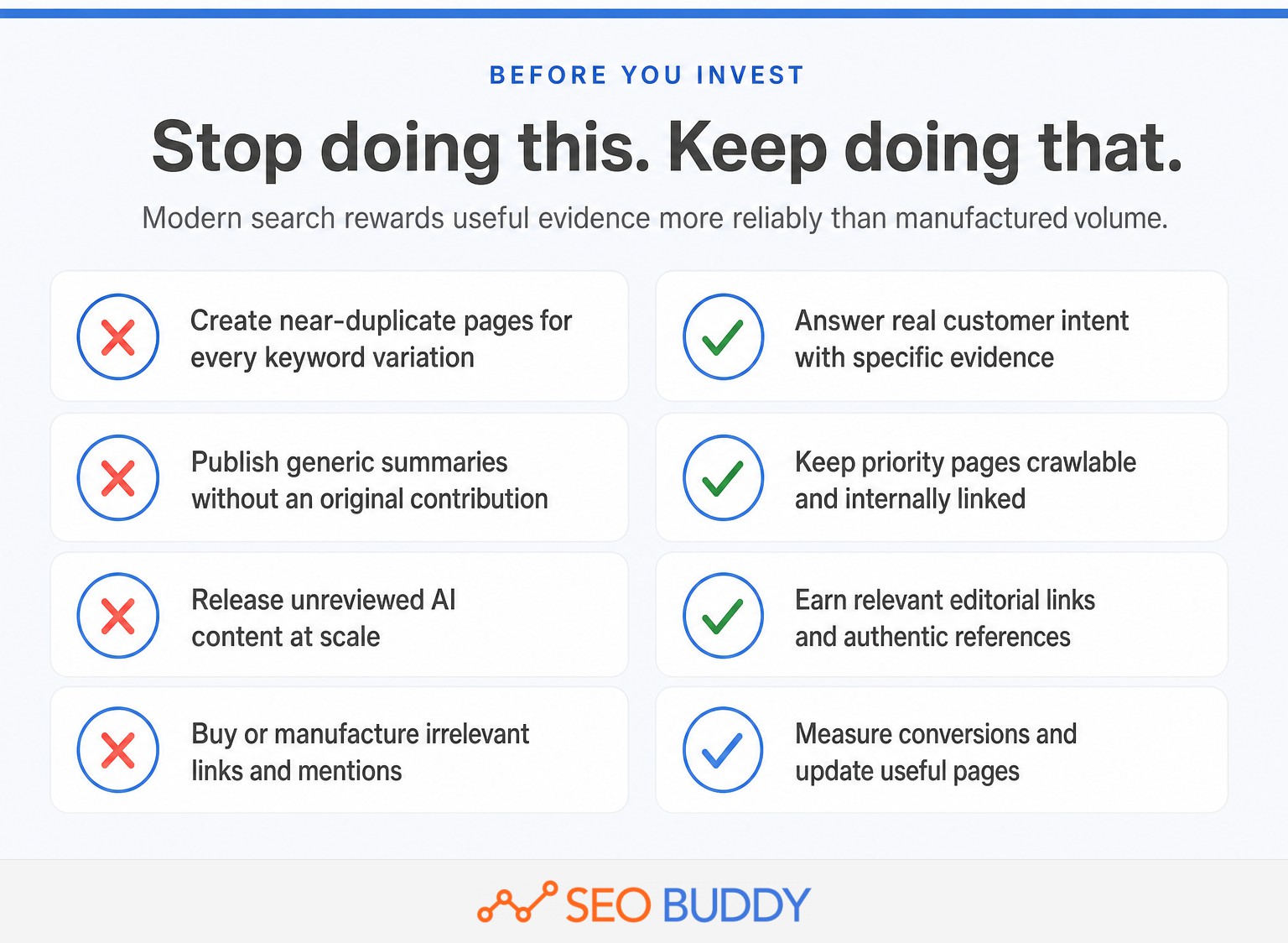
Tactics designed mainly to manufacture relevance at scale are becoming less dependable and more exposed to spam enforcement. Practices that improve access, usefulness, evidence, authority, and customer decisions remain valuable across conventional and generative search.
Google's current spam policies define scaled content abuse as producing many pages primarily to manipulate rankings rather than help users. The policy applies regardless of whether the pages were written by a person, generated with AI, scraped, translated, or assembled through another method.
Tactics losing value
- One page for every keyword variation: Modern language systems understand related concepts, making fleets of nearly identical pages unnecessary and risky.
- Generic summaries of existing results: A page that merely restates available information gives readers and answer systems little reason to choose it as a source.
- Unreviewed content automation: Publishing large volumes without original input, verification, or editorial accountability creates accuracy and duplication problems.
- Manufactured links and mentions: A high count of irrelevant references does not substitute for genuine subject relevance or editorial recognition.
- Keyword density targets: Repeating a phrase does not resolve intent, demonstrate expertise, or improve an unsatisfying page.
- Publishing without maintenance: Advice, product details, interfaces, and regulations can change, leaving an initially useful page inaccurate.
- Reporting rankings without outcomes: A high position has limited business value when it attracts the wrong audience or produces no useful action.
Practices that still work
- Intent research: Understand the decision, problem, or task behind the query before deciding what to publish.
- Original contribution: Add first-hand examples, primary data, expert analysis, useful visuals, tools, or a defensible point of view.
- Technical eligibility: Keep important pages crawlable, indexable, fast enough to use, and connected through descriptive internal links.
- Clear information design: Answer the main question early, organize supporting detail logically, and make sources and ownership visible.
- Relevant authority: Earn links and editorial references from pages that have a real reason to discuss the subject.
- Content maintenance: Update material when the evidence, product, market, or search interface changes.
- Conversion alignment: Give the right reader a proportionate next step instead of optimizing only for the visit.
Links have not become irrelevant. Google's ranking systems guide still lists link analysis and PageRank among its core systems, while its link guidance says links help crawlers find pages and understand relevance. What has weakened is the assumption that any link, mention, or page count creates equal value.
Low-value manipulation is fading, while useful content, technical access, authority, and conversion discipline still compound.
Is GEO or AEO replacing SEO?
No single discipline is replacing SEO. GEO and AEO are useful labels for optimizing visibility inside generated or direct answers, but the foundational work remains search optimization.
Google's May 2026 guide says that, from its perspective, optimizing for generative AI search is still SEO. Its systems use techniques such as query fan-out, where one complex question produces several related searches that retrieve supporting material from the index.
This makes topic depth and clear evidence more useful than mechanically targeting one exact phrase. It does not mean creating a separate thin page for every imagined fan-out query.
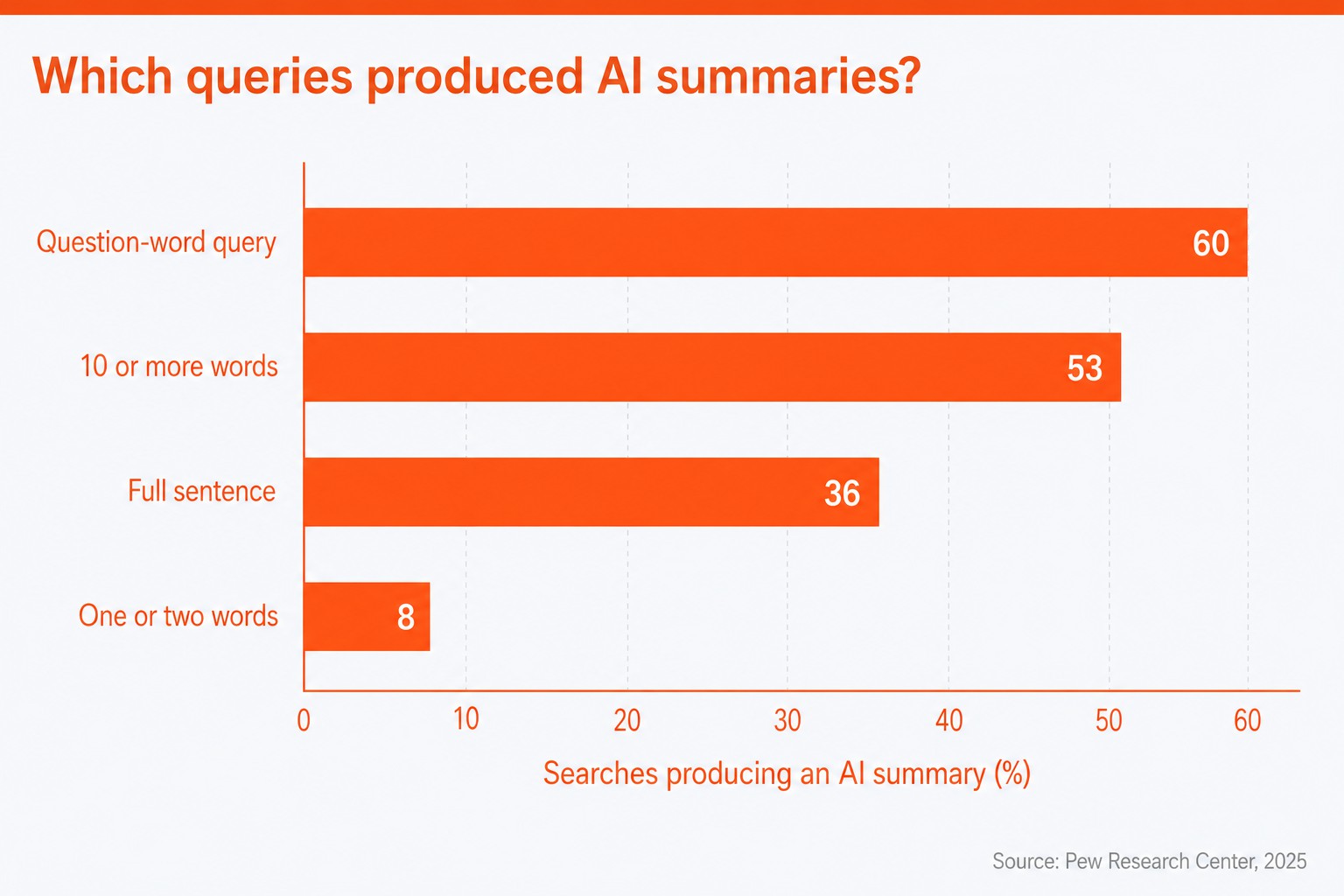
Pew's 2025 dataset illustrates why complex questions matter. AI summaries appeared for 60% of queries beginning with question words, 53% of queries containing ten or more words, 36% of full-sentence queries, and 8% of one- or two-word searches.
The practical additions to an SEO workflow are straightforward:
- Put a self-contained answer near the start of an informational page.
- Keep names, dates, units, product facts, and qualifications in the same passage as the claim they explain.
- Cite primary evidence and make the creator or reviewer clear where readers expect accountability.
- Use accessible HTML, descriptive headings, useful images, and crawlable links.
- Publish material with enough original value to justify being selected as a source.
- Permit the relevant crawlers when inclusion in a platform's search experience is desirable.
- Measure citations and referrals where the platform provides reliable reporting.
Avoid turning GEO into a collection of unsupported technical rituals. Google says no special schema, AI text file, llms.txt file, forced chunking method, or AI-specific writing style is required for its generative Search features. Structured data can still support eligible search features, but it is not a shortcut to citation.
GEO and AEO are practical extensions of SEO, not substitutes for the foundations that make a source retrievable and trustworthy.
How do content, authority, and brand mentions work together now?
Content supplies the evidence, authority helps validate the source, and authentic mentions connect the business to topics and conversations beyond its own website. None of the three works well as an isolated volume target.
Content should answer a real question and provide something worth retrieving. That might be original data, direct experience, a detailed process, a comparison method, an expert explanation, or a useful visual. Commodity copy competes with every similar summary and with the answer engine's ability to summarize those pages directly.
Authority develops when relevant people and publications have a defensible reason to cite, discuss, or link to the material. Google continues to use link analysis in ranking, but relevance and editorial context matter more than accumulating arbitrary domains.
Brand mentions can help people and systems encounter consistent information about an organization across articles, discussions, videos, reviews, and other public sources. A mention should not be treated as a guaranteed ranking factor or a point on a universal GEO score. Google's generative search guide specifically warns that pursuing inauthentic mentions is unlikely to provide the hoped-for benefit.
A useful sequence is:
- Identify a customer question that matters commercially.
- Publish the strongest evidence the business can genuinely provide.
- Connect the page to related material through descriptive internal links.
- Distribute it to people, publications, and communities that already discuss the problem.
- Earn relevant citations, links, and conversations rather than manufacturing them.
- Update the material as new questions and evidence appear.
When outreach capacity is the constraint, an approval-based managed link-building process can handle prospecting and placement work while the business retains control over proposed sites. The destination and context still need to be relevant. Outsourcing execution does not remove the need for a credible reason to link.
Content creates the evidence, authority validates it, and authentic mentions help the market connect that evidence to the brand.
Can AI create SEO content without creating spam?
Yes. AI can support research, organization, drafting, metadata, and production, but the published page still needs accurate facts, editorial accountability, and a contribution beyond what a model can assemble from existing material.
Google's guidance on generative AI content says automation can be useful for research and structure. It also says generated material must be manually reviewed for accuracy because models can produce incorrect information, and that review extends to titles, descriptions, structured data, and image alt text.
The dividing line is purpose and value, not the presence of AI. Google's spam policy targets scaled pages created mainly to manipulate search systems without helping users. A carefully researched, reviewed, and differentiated AI-assisted article is not the same product as thousands of unverified pages generated from a template.
Use this publication gate before approving AI-assisted content:
- Source fidelity: Can every factual claim be traced to a reliable source?
- Original contribution: Does the page add expertise, data, examples, analysis, or a useful decision framework?
- Business accuracy: Are product capabilities, exclusions, service areas, prices, and policies correct?
- Intent fit: Does the page solve the problem implied by the query instead of merely repeating its words?
- Editorial review: Has a responsible person checked the logic, language, and factual limits?
- Visual integrity: Are charts based on real data and are screenshots taken from real interfaces?
- Maintenance: Is there an owner and trigger for future updates?
For a practical comparison of systems and their limitations, see the guide to AI writing tools. If the decision is whether to use internal software, hire specialists, or outsource execution, the guide to AI SEO services explains the operating models and selection questions.
Google's people-first content guidance also recommends making authorship clear and explaining how automation was used when readers would reasonably want that context. A disclosure does not rescue poor content, but accurate ownership and methodology can strengthen trust in useful work.
AI can accelerate production, but human accountability and original value decide whether the output deserves to rank or be cited.
Is SEO still worth investing in for your business?
SEO is worth investing in when customers search before making a decision, the business can publish differentiated evidence, and visibility can lead to a measurable outcome. It deserves a lower priority when demand is absent, the offer is not competitive, or the organization cannot maintain the website and content.
| Business situation | Investment case | Sensible first move |
|---|---|---|
| Customers already search, but the site has little visibility | Strong | Fix eligibility and improve pages closest to a commercial decision. |
| Organic traffic exists, but few visitors become customers | Conditional | Correct intent, offer alignment, calls to action, and conversion measurement before adding volume. |
| The category is new and direct search demand is limited | Long-term | Create category education while using faster channels to generate awareness. |
| The business has no original evidence or subject expertise to publish | Weak until fixed | Gather examples, customer questions, product knowledge, expert input, or first-party data. |
| The business needs immediate pipeline this month | Secondary | Use channels with faster feedback while building search assets that can compound later. |
A basic investment model is:
Expected SEO value = qualified discovery × conversion rate × contribution value, plus defensible assisted value.
Use the business's own numbers. Universal traffic forecasts hide differences in sales cycles, margins, customer value, geography, brand strength, and result-page features.
Three questions usually reveal whether the foundation exists:
- Is there discoverable demand? Examine how customers research the problem, not only the shortest keyword.
- Can the business produce a better source? Better may mean more specific, more current, better evidenced, or based on experience competitors cannot copy.
- Can a useful visit become an outcome? The page needs a credible path to a product, consultation, subscription, store, tool, or other next step.
SEO should not be the only acquisition channel. It becomes fragile when a business depends on one ranking, one platform, or top-of-funnel traffic that never reaches a commercial decision. The strongest case combines useful search assets with email, direct demand, partnerships, community participation, and other channels appropriate to the audience.
SEO is worth funding when discoverable demand, differentiated evidence, and a measurable conversion path exist together.
What should your SEO plan look like for the next 90 days?
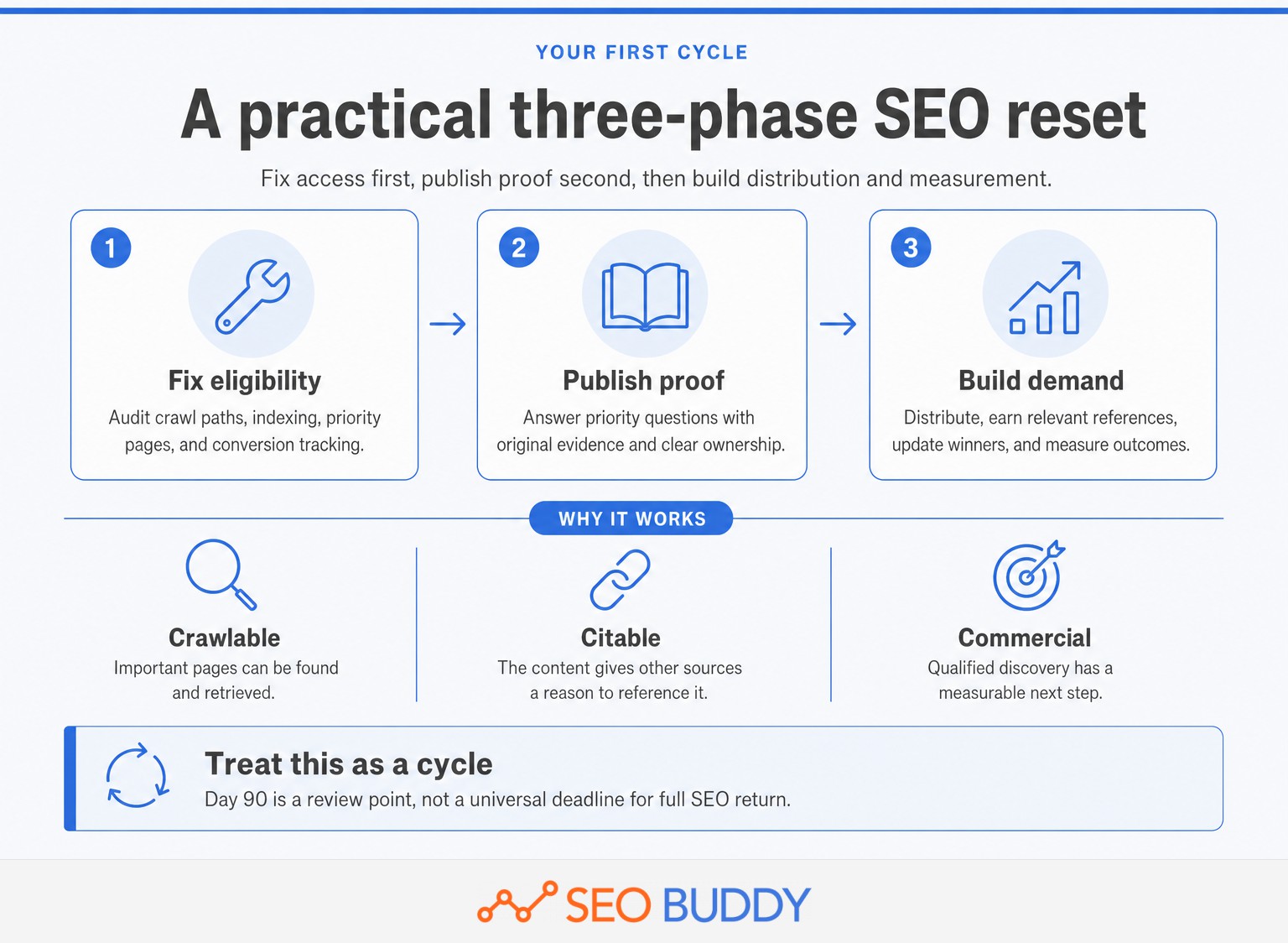
Use the next 90 days as one operating cycle: fix eligibility, publish evidence, then build distribution and measurement. The objective is not to declare SEO successful or unsuccessful on day 90, but to create a system that can produce and evaluate useful search assets.
Days 1 to 30: establish eligibility and a baseline
- Confirm that priority pages can be crawled, indexed, rendered, and linked from the site.
- Review search demand by customer problem, intent, and business relevance.
- Identify existing pages with impressions, links, or conversions that deserve improvement before new production begins.
- Check that lead, sale, subscription, or other conversion tracking reflects useful outcomes.
- Record the starting position for discovery, engagement, outcomes, and production cost.
- Assign owners for technical fixes, content review, publishing, distribution, and updates.
A structured SEO Checklist can help turn the audit into assigned work instead of an unprioritized list of recommendations.
Days 31 to 60: publish evidence, not filler
Select a small set of questions where the business has a realistic right to contribute. For each one, define the audience, decision, source requirements, unique input, visual need, conversion path, and update trigger before drafting.
Prioritize material such as:
- Original explanations from qualified employees or specialists.
- Product or process demonstrations.
- Customer questions answered with specific limitations and examples.
- Comparisons built on a transparent method.
- Templates, calculators, checklists, or decision aids.
- Existing pages that can be refreshed with better evidence rather than replaced.
Every article should have a reason to exist after the search engine or assistant has already supplied a basic summary.
Days 61 to 90: distribute, earn authority, and learn
- Share useful resources with relevant publications, partners, customers, and communities without disguising promotion as participation.
- Pursue links or mentions only where the destination helps the audience of the referring page.
- Improve internal links from established pages to new priority resources.
- Monitor indexing, search visibility, citations, qualified referrals, conversions, and content production cost.
- Compare performance by intent and page type rather than averaging the whole site.
- Update promising pages when query data reveals an unanswered question or weak passage.
- Stop producing formats that repeatedly attract impressions without useful engagement or business outcomes.
At the end of the cycle, decide what to scale, revise, or stop. A page that earns few clicks but contributes qualified leads may be valuable. A page that attracts thousands of irrelevant visits may not be.
A useful 90-day cycle fixes eligibility first, publishes proof second, and builds distribution and measurement third.
Frequently asked questions
SEO's future is uncertain at the interface level, but the practical questions have clearer answers. These answers distinguish the durable work from the labels and tactics that may change.
Is SEO becoming obsolete?
SEO is not becoming obsolete; low-value, search-engine-first tactics are. Google's 2026 guidance says the same foundations support standard results and generative search: original content, technical accessibility, clear relevance, and trustworthy evidence. The work is expanding beyond rankings rather than disappearing.
Is SEO still worth it in 2026?
SEO is still worth it in 2026 when customers search before buying, the site can offer useful evidence, and organic discovery can lead to measurable business outcomes. It is a weaker priority when demand is absent, the offer is undifferentiated, or the business cannot maintain the site and content.
What is now replacing SEO?
Nothing has replaced SEO with one new discipline. Search optimization now includes classic rankings, AI-generated answers, video and community discovery, entity clarity, and conversion measurement. Terms such as AEO and GEO describe parts of that expanded work, but Google treats generative search optimization as SEO.
Will SEO exist in 5 years?
SEO will probably exist in five years because retrieval systems still need to discover, interpret, compare, and select sources. The interfaces and metrics will keep changing, so future SEO will focus less on isolated keyword positions and more on trusted evidence, multi-format visibility, qualified visits, citations, and conversions.
SEO's future is broader than rankings, but it still starts with useful, accessible, trustworthy web content.
What should you do next?
Start by identifying whether the main constraint is technical eligibility, weak evidence, limited publishing capacity, insufficient authority, or poor conversion alignment. Fixing the wrong constraint faster will not improve the return.
If content research and production are the bottleneck, SEO Buddy's AI Content Engine uses a site's sitemap, optional Search Console data, competitors, business priorities, and brand inputs to select opportunities, create illustrated articles, add internal links and SEO fields, and deliver drafts to supported publishing destinations.
The next move is not to abandon SEO; it is to rebuild the plan around qualified discovery and proof.

CEO & Founder at SEO Buddy






Get the SEO work done, not just read about it
Create a free account and run your first content plan, keyword research and link-building campaign. No card, and setup is free until your first article.
Free to start. We never sell your address.