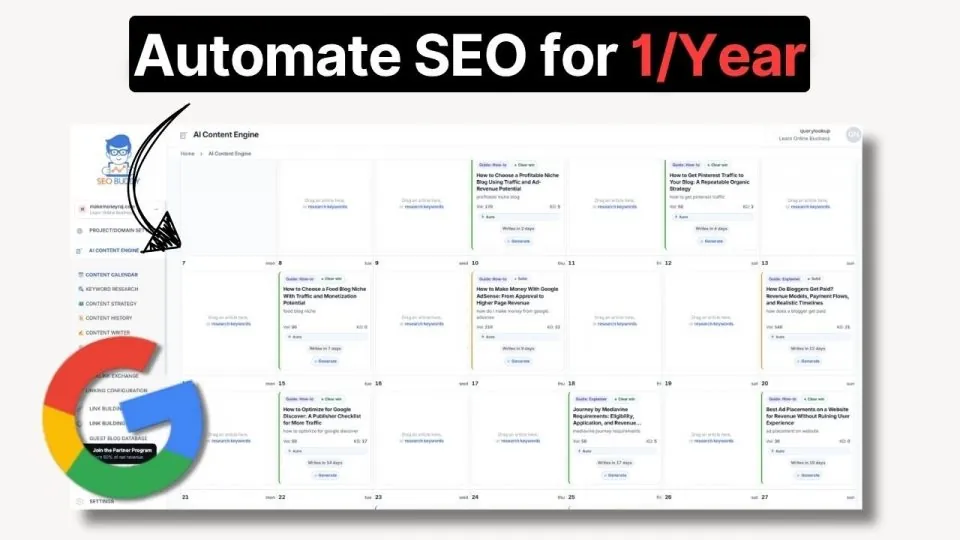
AI Content Engine

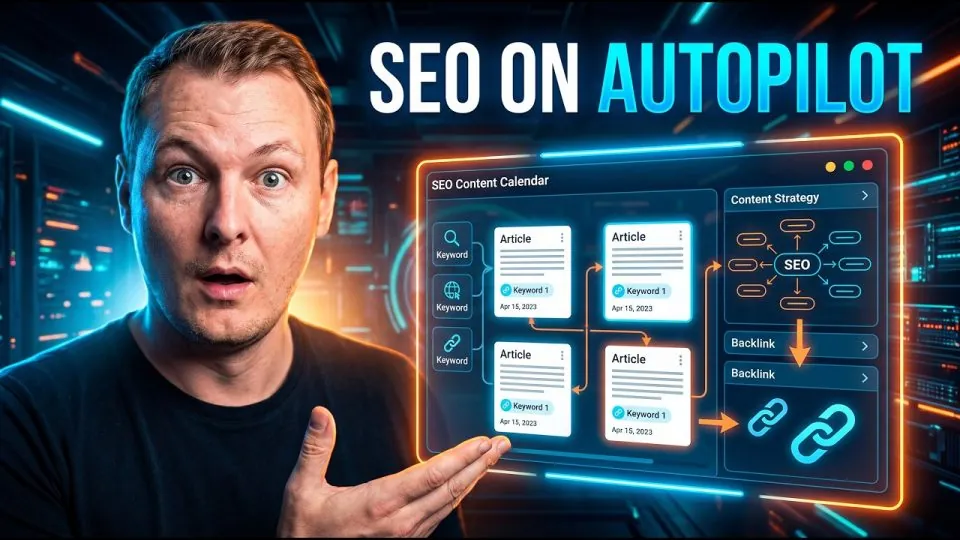
Grow yourOrganic TrafficDomain AuthorityBlogon Autopilot

Get Found on Google, and Quoted by ChatGPT

Anybody can generate an article now. Knowing which article is worth writing is the part that takes a person, and that is the part we automated: your Search Console, your sitemap and your competitors' ranking pages decide the month's plan, and the articles arrive on your blog written to it.

Twenty years of SEO sits behind how they are written. The prompts are engineered rather than typed, each stage runs on the model that is genuinely good at it, and everything checkable is checked in code before you ever see a word. That is the part you cannot get out of a text box.

Why this is not another article generator

The article is not the hard part.

A generator asks you for a topic. If you knew the right topic, you would not need it. The engine works the other way round: it reads what you already rank for, what you nearly rank for, and what your competitors are winning, and the topics fall out of that.

What the engine reads before it writes anything

  • Your Search Console: every page with traffic, and every page sitting on page two.
  • Your sitemap: every page that exists, which is what new articles link to.
  • Your competitors, found by the read of your own site, and the pages they rank with.
  • What you sell, in the order you told us matters, so the articles point somewhere.
  • What you do not sell, so no article ever implies you offer something you do not.
  • Your brand: colours, fonts, logo, so the pictures look like they came from you.

What a generator asks you for

  • A topic. Which is the decision you wanted help with.
  • A keyword, and the volume you hope it has.
  • A tone, chosen from a list, applied to a subject it knows nothing about.
  • Nothing about what you sell, so the article ends without a reason to buy.
  • Nothing about what you do not, so it happily promises what you cannot deliver.
  • A copy and paste into your blog, every time, forever.

Seven screens, once

Setting it up is answering seven questions, and most of them are already answered.

We read your site before you arrive, so the blog address, your best articles, your competitors and what you sell are filled in when you get there. Every screen can be skipped, and every field already has a working answer.

🌐Your website

Where the articles land, and what it runs on. No blog yet is a fine answer, and there are two ways round it.

🔍Google Search Console

Optional, and worth the click. It shows what you already nearly rank for, sets your difficulty benchmark from what you have actually beaten, and finds the pages quietly decaying.

Optional
Best articles

Your sitemap, and the three pieces you are proudest of, so new ones sound like they came from the same place.

AI pre-filled
🛍️What you sell

Dragged into the order that matters. The top of that list is what the articles point at.

AI pre-filled
⚙️Article settings

Tone, internal links, pictures, and the structure that gets an article quoted rather than skimmed.

Pre-filled
🔌Integration

Sixteen places to publish, each connected with your own credentials, or a signed webhook if you would rather handle it yourself. Or keep them here and publish by hand.

2-3 clicks
📅Pace and quality

How often it publishes, and how much thinking goes into each piece.

Then nothing

It plans the month, writes, illustrates, and publishes. You read what turns up.

Where the content strategy comes from

It all starts with keyword research.

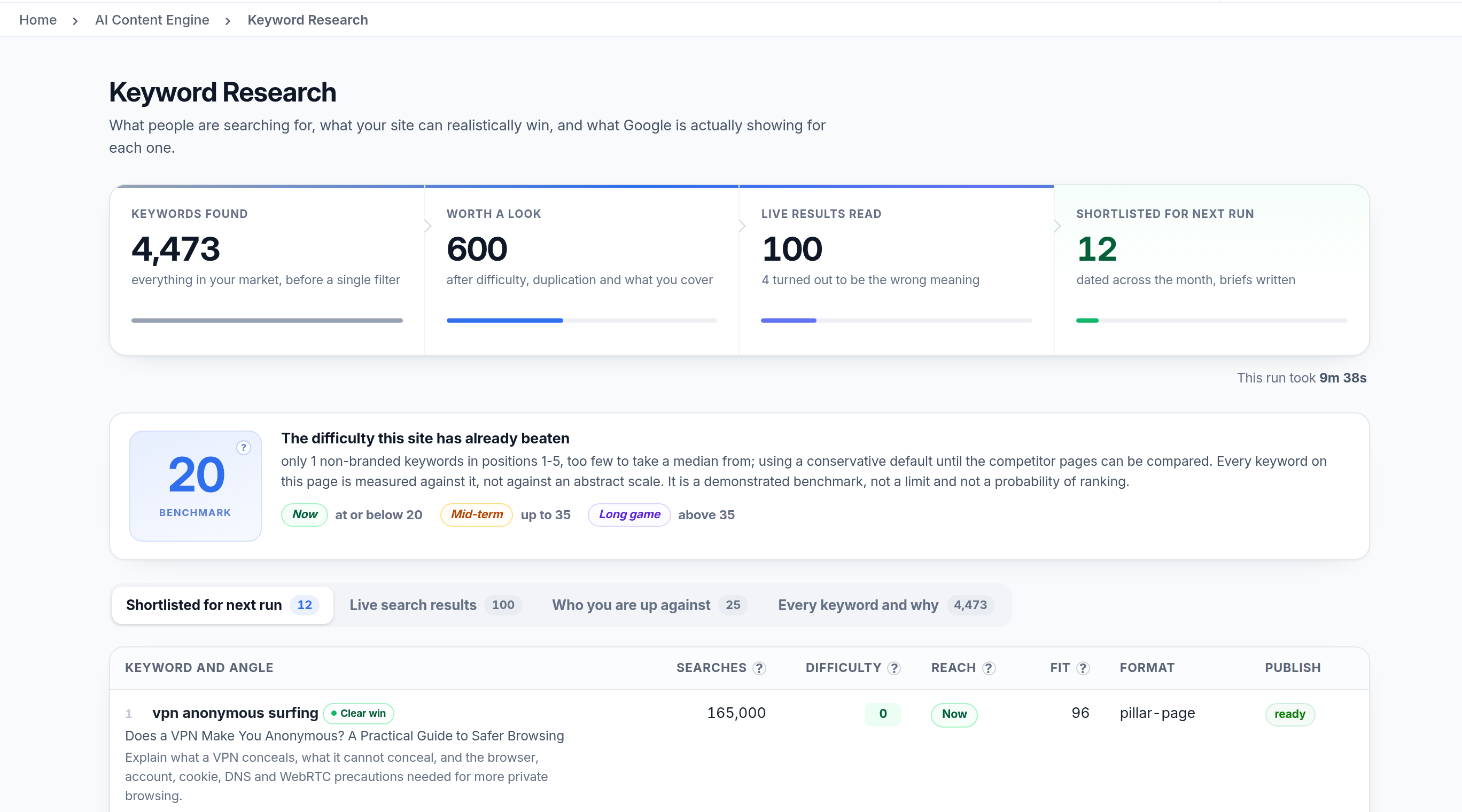
Picking the topic is the decision that makes an article worth writing or a waste of a month. This is the part that runs before a single word is drafted, and it takes about ten minutes because it is doing real work rather than asking a model for ideas.

The keyword research screen: 4,473 keywords found, 600 worth a look, 100 live
                results read, 12 shortlisted for the next run
A real run: 4,473 keywords down to the 12 worth writing, in 9 minutes 38 seconds.
  • We start from your own data, not a seed listSearch Console tells us what you already nearly rank for. Your sitemap tells us what you have covered. Your competitors' ranking pages tell us what is winning without you.
  • Then we widen it the way a person wouldRelated searches, suggestions and the phrasings people use before they know your product exists. That last group is where most of the cheap wins are, because nobody optimises for the question that comes before the purchase.
  • Zero-click keywords are dropped earlyIf Google answers it in the results page, ranking first buys you nothing. We read what is actually on the page for each keyword and throw those out before they cost you an article.
  • Difficulty is measured against YOUR siteNot an abstract 0-100 scale. We take the median difficulty of the keywords you already rank for in positions 1-5, and when there are too few of those, we compare your backlink profile to the pages currently ranking. The result is a benchmark you have already beaten, not a guess.
  • Every survivor is read against your businessA keyword with volume and low difficulty is still worthless if it is about something you do not sell. A model reads each one against your profile and says which it is, and why, in a sentence you can disagree with.
  • The winners are checked against live resultsFor the shortlist we fetch the actual search results and read the pages that rank, so the brief knows what it has to beat rather than guessing.
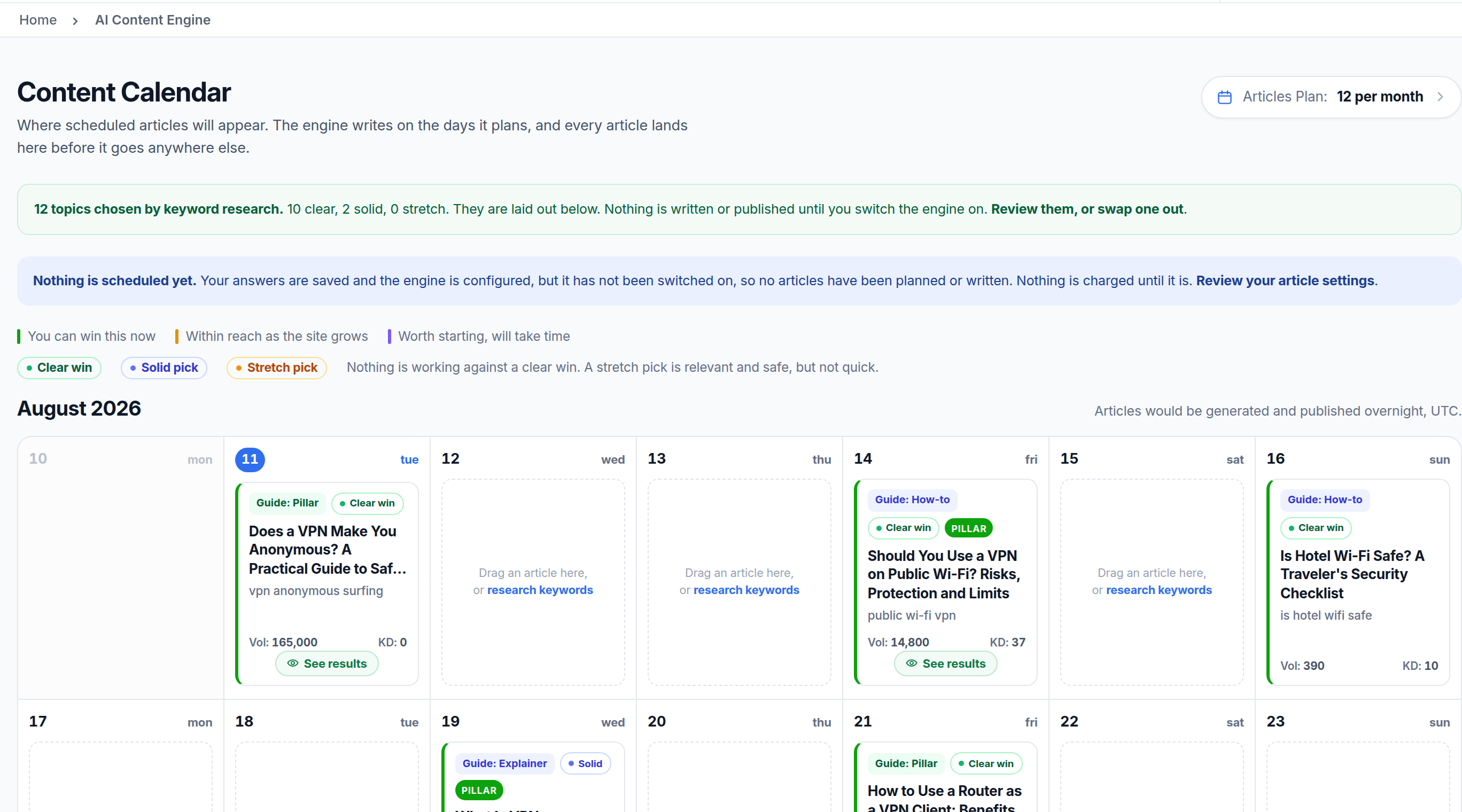
  • Then they are dated across the monthSpaced evenly rather than dumped on the first, each with a working title, a format and a brief already written.
  • What turns up

    One article, and everything attached to it.

    Not a wall of text with a stock photograph on top. The parts that make a piece rank, and the parts that make it get quoted, are built in rather than asked for.

    • A quotable opening answerThe first paragraph answers the question outright, in the form an assistant can lift straight into a reply.
    • Infographics set as real type, not paintedProcess diagrams, comparisons and checklists are laid out from structured content and rendered in your brand colour, so every label is sharp and spelled correctly. Image models cannot do this reliably and we stopped asking them to.
    • Charts drawn from the numbers in the pieceInline SVG, so they stay crisp at any size and weigh almost nothing. A number with no comparison in it stays a sentence.
    • A featured image in your own styleSketch, watercolour, realistic, illustration, or your brand colours and type. Measured after it is drawn and drawn again if it comes back too dark to read.
    • Internal links to pages you already haveFrom your own sitemap, chosen for relevance rather than filled in to a quota.
    • An FAQ block before the conclusionThe expandable questions and answers Google can show underneath your result.
    • Meta description, focus keyword and alt textWritten for Yoast, Rank Math and All in One SEO, whichever you use.
    • A reason to buy at the endPointed at the thing you put at the top of what you sell, not at a generic call to action.

    Before anything goes anywhere

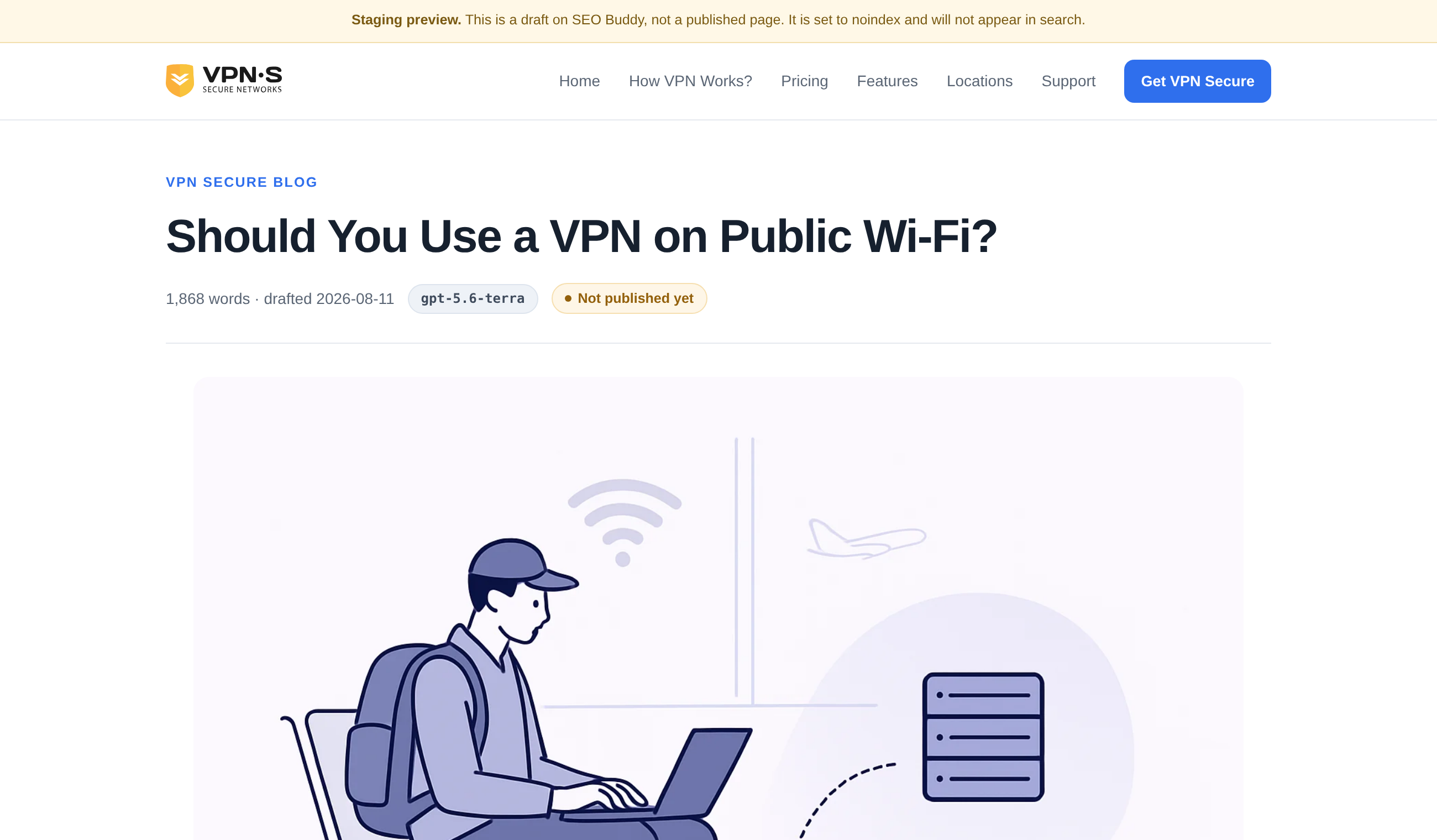
    Every article gets a page of its own first, wearing your brand.

    The moment a piece is written it appears on a private preview: your logo, your colour, your navigation, your footer, read at the width a person actually reads at. Nothing touches your site until you have seen it there. The link is safe to send to a client or a colleague, and it unfurls with the article's own picture and title.

    A delivered article playing past: the customer's header and navigation, the
                  title, an illustration, key takeaways, a table of contents, two sections
                  citing sources, an infographic in their brand colours and a comparison
                  table
    A real delivered article, playing end to end. Your header, your colours, cited sources, and infographics set as type rather than drawn by an image model.
  • Your chrome, not oursThe header, the navigation and the footer are read off your own site, so the preview looks like your blog rather than like a tool.
  • Set to noindexA draft of an article about to go live on your domain must never compete with it in search. The preview cannot be indexed, but it can still be shared.
  • Written the day before it is dueA run takes minutes and can fail. Writing tomorrow’s article today leaves a whole day to notice, rather than finding out on the morning it was meant to publish.
  • A full historyEvery article this project has produced, with its picture, its keyword, its difficulty and where to read it. Searchable, and it does not forget.
  • Links, not just words

    Publishing is half of it. The other half is who links to you.

    Every project on the engine can join the backlink exchange. When one of your articles carries a link to another member, you earn credits. When a member links to you, it costs them. The rates are the site’s Domain Rating, so a link is priced at what it is worth rather than counted as one of a bundle.

    The backlink exchange screen: participation, minimum domain rating, credits and
                the links earned
    Your Domain Rating, your terms, and every link the network has sent you.
  • You earn your Domain Rating, capped at 40A DR20 site earns 20 credits for a link it gives; a DR70 site earns 40. The cap is deliberate: without it, one strong site could farm the whole network.
  • You pay the giver’s Domain Rating, uncappedA link from a DR70 site costs 70. Strong links cost what they are worth, so nobody gets one by accident.
  • One credit per dollar of your plan, every monthYour subscription funds your side of the exchange. Spend them on the links you want.
  • Refuse anything below a rating you chooseA slider from DR0 to DR30. It limits what you accept and never what you can earn, so you can hold a standard without leaving the network.
  • Say where the links should landPoint them at the pages that make you money rather than at the blog we wrote. Star the ones that matter and they go first.
  • Every link is checkedWe fetch the page and confirm the link is really there. Anything that cannot be found is listed for you to fix, and no credit changes hands until it is.
  • Participation is on by default and can be switched off in one click. The rules above are live; the network is opening to projects as they finish setup.

    Where it publishes

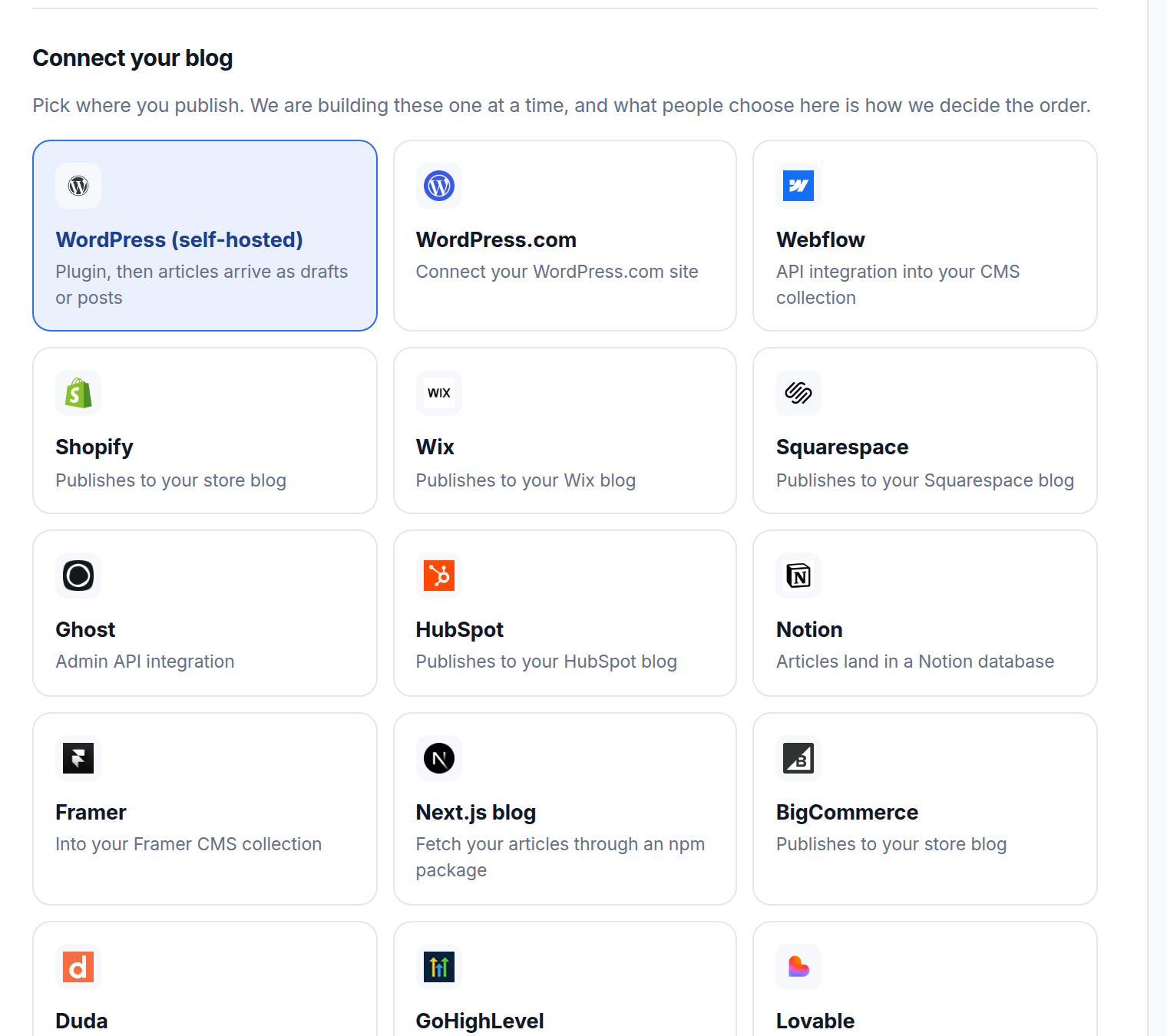
    Sixteen places to send it, whatever your site is built on.

    Each one connects with its own credentials and is verified before you rely on it: our own WordPress plugin, the hosted platforms, the headless ones, and a signed webhook that hands you the whole article as JSON if you would rather do it yourself. Articles arrive as drafts, with the picture, the tags and the SEO description already filled in.

    WordPress Webhook WordPress.com Webflow Shopify Wix Squarespace Ghost HubSpot Notion Framer Next.js BigCommerce Duda GoHighLevel Lovable

    What it costs

    You are paying per article, not for the words.

    Research, writing, pictures and publishing, on your blog, every month. Cancel whenever. Nothing is written and nothing is charged until you switch it on.

    4 articles a month
    $19
    a month
    $4.75 an article
    About one every 8 days
    8 articles a month
    $34
    a month
    $4.25 an article
    About one every 4 days
    12 articles a month
    $49
    a month
    $4.09 an article
    About one every 3 days
    20 articles a month
    $70
    a month
    $3.50 an article
    About one every 2 days
    Best value
    30 articles a month
    $99
    a month
    $3.30 an article
    One a day

    The questions everybody asks

    Will it publish without me seeing it first?

    Not unless you turn that on. Articles arrive as drafts, and publishing straight away is a setting you have to choose.

    Where can it publish? Do I need WordPress?

    No. Sixteen destinations connect with your own credentials: WordPress and WordPress.com, Webflow, Shopify, Wix, Squarespace, Ghost, HubSpot, Notion, Framer, Next.js, BigCommerce, Duda, GoHighLevel and Lovable. If yours is not on that list, the webhook posts the whole article to a URL you control, as JSON, signed so you can verify it came from us. And you can connect nothing at all: the articles wait on your preview for you to copy out by hand.

    What if it writes something wrong about my business?

    It works from a read of your own site, and from a list of things you do not sell that you confirm during setup. That list is a hard boundary: no article implies you offer something on it.

    Who owns the articles?

    You do. They are on your site, in your media library, in your own words. Cancel and they stay exactly where they are.

    Does it need Search Console?

    It is much better with it, because that is how it knows what you nearly rank for. Without it the engine works from your sitemap and your competitors instead, and the step can be skipped.

    Can I change my mind about how many?

    Yes, from Project and Domain Settings, whenever you like. The next month follows the new number.

    Is the writing any good, honestly?

    It is briefed better than most freelance work and it is not going to win a prize. Every article is written against the pages that currently rank for the keyword, so it knows what it has to beat; it opens with a direct answer, carries its own diagrams and charts, and links to your existing pages. Read one before you decide: every article gets a preview page and you can send yourself the link.

    What happens when it gets something wrong?

    You see it on the preview before it goes anywhere, and nothing publishes without you turning that on. The list of things you do not sell is a hard boundary rather than a hint, so the common failure - an article implying you offer something you do not - is the one thing it will not do.

    How is this different from the cheap AI writing tools?

    Those start when you give them a keyword. The keyword is the decision that matters, and picking it badly is how people end up with thirty articles and no traffic. The research above runs first, measured against what your site has actually beaten rather than an abstract difficulty score.

    Do the pictures cost extra?

    No. Illustrations, infographics and charts are included in the monthly price, however many an article needs. Infographics are laid out and rendered rather than drawn by an image model, which is why the labels are sharp and spelled correctly.

    Will the backlink exchange get my site penalised?

    The links are editorial, inside real articles on real sites, pointing at pages you chose. There is no reciprocal pairing, no ring, and no money changing hands for a link. Every placement is verified on the live page, and you can set a minimum Domain Rating or leave the network entirely in one click.

    What if my blog is somewhere I do not want links?

    Say so in Linking Configuration. A sitemap can be marked validation only: we read it to confirm a backlink is live but never send links to it. Your money pages, on another sitemap, collect the value.

    What happens if I cancel?

    The articles stay where they are, on your site, in your media library. You keep them. What stops is the research, the writing and the exchange.

    Rather speak to a human first? Telegram