
Reciprocal Linking and SEO: When Link Exchanges Help or Hurt

In short
Reciprocal links are not automatically bad for SEO. A relevant link that helps readers can be natural even when the other site later links back, but an arranged pattern created mainly to influence rankings can violate Google's spam policies. Judge each exchange by reader value, editorial independence, relevance, anchor choice, and scale.
Key takeaways
- Google's current spam policy does not prohibit every reciprocal link; it identifies excessive exchanges and partner pages created only for cross-linking as link spam.
- Google publishes no safe percentage or monthly quota for reciprocal links, so intent and campaign pattern matter more than a made-up number.
- The strongest test is counterfactual: both links should still help readers if neither link passed ranking credit.
- Three-way exchanges are not automatically safer because adding another website does not change a ranking-manipulation purpose.
- Paid or sponsored links should be disclosed and qualified appropriately; Google prefers
rel="sponsored"and still acceptsnofollowfor paid placements.
Table of contents
- Are reciprocal links safe for SEO?
- What is a reciprocal link in SEO?
- When does reciprocal linking become a link scheme?
- How can you judge a link exchange before saying yes?
- What does a safe reciprocal linking example look like?
- Should you use a three-way link exchange instead?
- What should you do if past exchanges look risky?
- What are safer alternatives to reciprocal linking?
- What else do people ask about reciprocal links?
- What should you do next?
The difficult part is not spotting a two-way link. It is deciding whether the two links exist because they complete useful pages or because each site has agreed to manufacture a ranking signal.
Are reciprocal links safe for SEO?
Reciprocal links can be safe when each link has independent editorial value, but they are not a protected tactic or a guaranteed ranking benefit. Risk rises when the return link is required, irrelevant, commercially undisclosed, optimized around a requested keyword, or repeated as a system.
As of August 2026, Google Search's spam policies define link spam as creating links to or from a site primarily to manipulate rankings. The examples specifically include excessive link exchanges and partner pages maintained only for cross-linking.
The word excessive matters, but it is not a numerical allowance. Google does not publish a percentage of reciprocal backlinks, a monthly exchange quota, or a domain-level ratio that automatically makes a campaign safe.
Backlinks remain relevant. Google's Search ranking systems guide, last updated in December 2025, says link analysis helps its systems understand pages and that PageRank continues to be part of its core ranking systems. That makes earned links useful and manufactured signals tempting, which is why intent matters.
A risky exchange may simply be neutralized by automated systems rather than producing a visible penalty. A sufficiently manipulative pattern can also contribute to a manual action, so the absence of an immediate traffic drop is not proof that a campaign is acceptable.
A reciprocal link is defensible when reader value explains both links more convincingly than a ranking deal does.
Anybody can generate an article. Knowing which one is worth writing is the hard part.
The AI Content Engine reads your site and your competitors, then builds a ranked content plan and writes it. Setup is free, and you see your plan before you pay for anything.
See your content plan freeWhat is a reciprocal link in SEO?
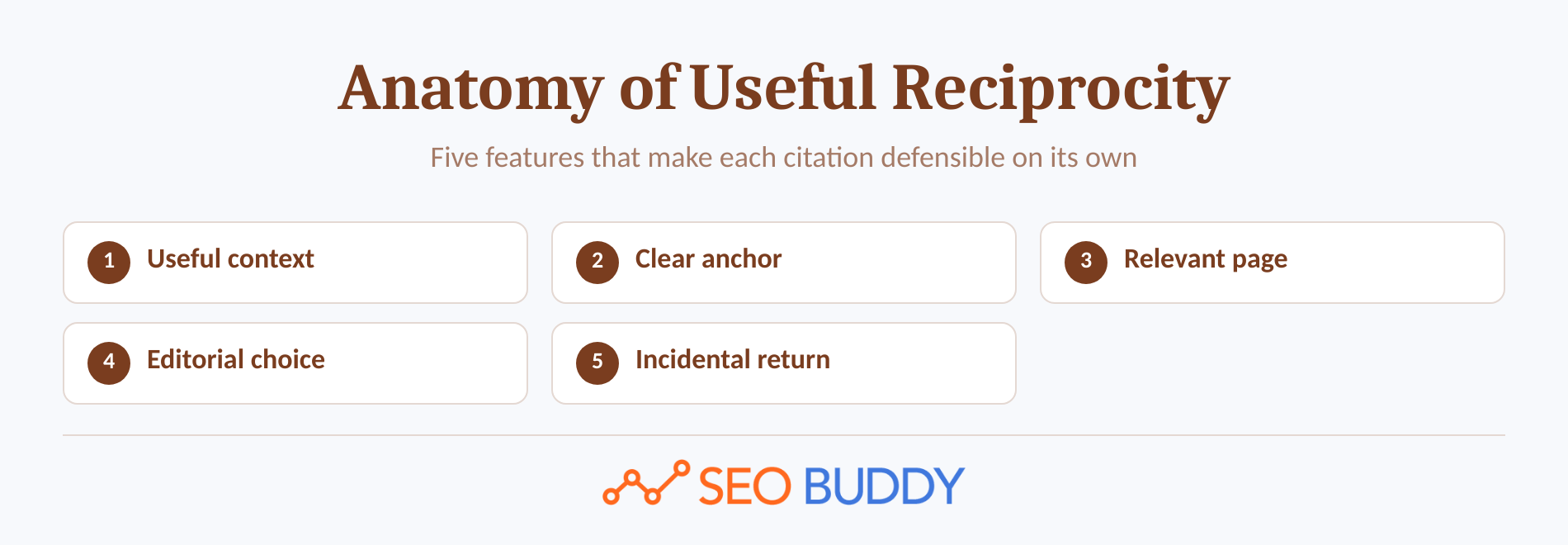
A reciprocal link exists when one website links to a second website and the second website links back. Reciprocity describes the resulting link pattern, not the reason the links were created.
| Pattern | What happens | The question that matters |
|---|---|---|
| Natural reciprocity | Two publishers independently cite each other's useful resources | Would each editor keep the link without receiving one back? |
| Negotiated exchange | Two sites agree that each will publish a link to the other | Is the agreement serving readers, or is the return link the real consideration? |
A natural reciprocal link might appear months after the first citation because another editor later discovers a useful resource. A negotiated swap can appear just as natural in page source, so timing and appearance alone do not establish whether the links are legitimate.
The destination also matters. Two websites may cover the same broad industry while the linked pages have no useful relationship. Topic labels do not rescue an irrelevant citation.
Reciprocity describes where the links point; editorial purpose determines whether the pattern is useful or manipulative.
When does reciprocal linking become a link scheme?
Reciprocal linking becomes a link scheme when the links are created primarily to influence rankings rather than to help the audiences of the two pages. No single footprint proves manipulation, but several coordinated warning signs can reveal the campaign's actual purpose.
Watch for these signs:
- The outbound link is conditional on receiving a return link.
- The two linked pages solve unrelated problems or target unrelated audiences.
- One party dictates an exact-match anchor that does not fit the sentence naturally.
- The exchange is repeated across many sites, clients, partner pages, or controlled domains.
- Editors are not free to change the anchor, destination, placement, or decision to link.
- The arrangement promises followed links, rankings, or a fixed number of swaps.
- Money, services, products, credits, or sponsorship are involved but not disclosed or qualified.
A single reciprocal link between useful pages is different from a spreadsheet-driven campaign in which every placement requires repayment. The latter creates a repeatable pattern whose only stable explanation may be the exchange itself.
Google says policy violations can be detected through automated systems and human review. Search Console's documentation also distinguishes an algorithm that discounts links from a manual action, which can cause affected pages or sites to rank lower or be omitted from results.
Reciprocal linking becomes dangerous when the return-link obligation, rather than the reader's need, explains why the links exist.
How can you judge a link exchange before saying yes?
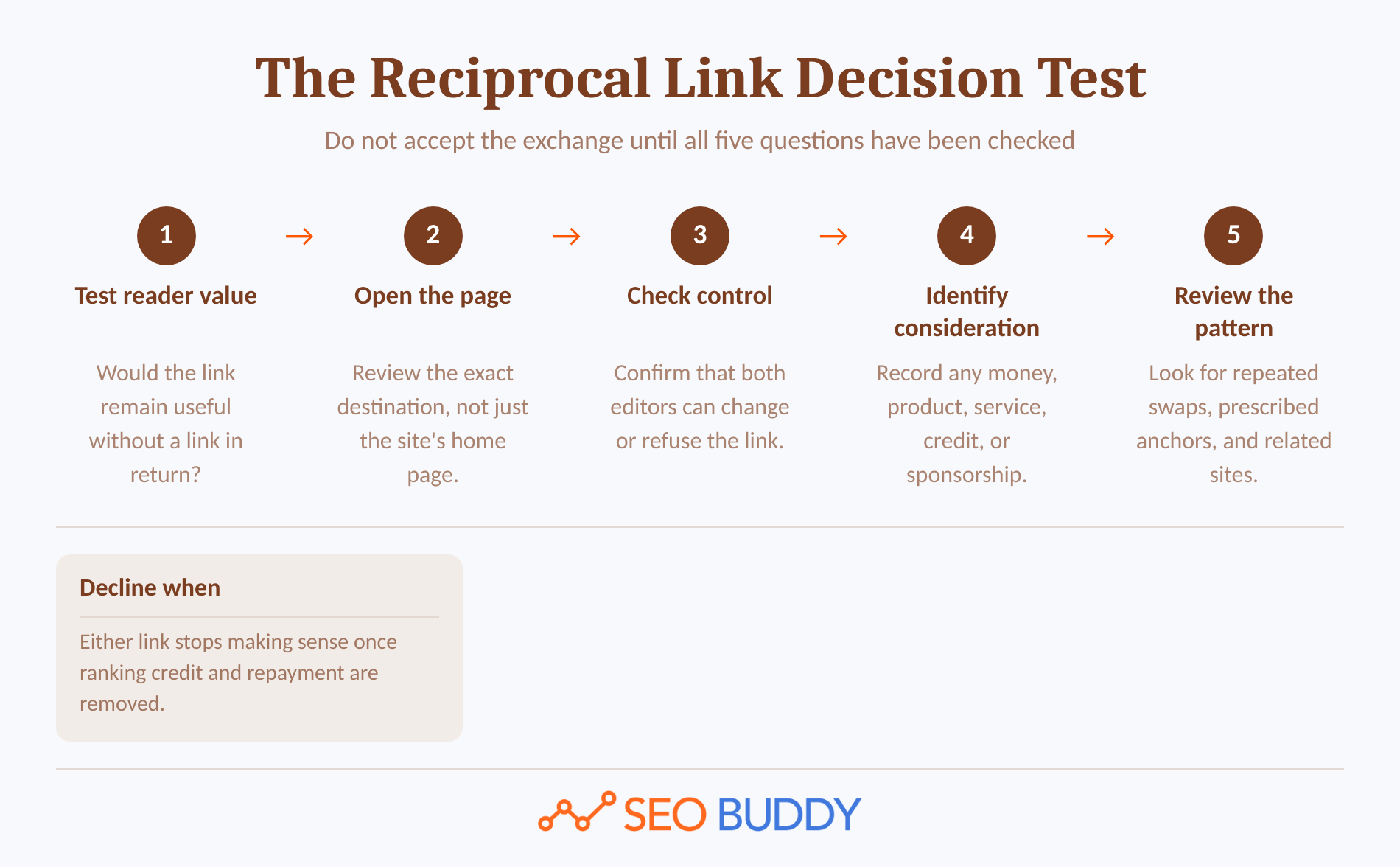
Judge an exchange by asking whether each publisher could make the same editorial decision without the promise of repayment. The following five checks reveal more than a third-party authority score or an arbitrary reciprocal-link ratio.
- Would the outbound link be published without a return link? If the answer is no, the deal begins with a ranking transaction rather than an editorial decision.
- Does the destination answer the next question on the page? Open the exact proposed URL, not just the domain's home page, and assess the fit for the surrounding paragraph.
- Can each editor say no or change the link? Independent editors should be able to reject the destination, rewrite the anchor, choose another source, or remove a stale citation.
- Is there a commercial relationship? Identify money, services, products, affiliate compensation, sponsorship, credits, or contractual obligations before publication.
- What pattern will this create? Review previous exchanges involving the domain, target page, anchor, campaign, and any related sites rather than judging the placement in isolation.
Decline the opportunity if either link would make little sense without ranking credit. If the pages are genuinely complementary but compensation or sponsorship is involved, follow Google Search Central's link-qualification guidance and document the relationship.
An opportunity source such as Link Chest can reduce prospecting work, but inclusion in a database is not editorial approval. Every domain, page, destination, anchor, and relationship still needs an individual review.
Accept an exchange only when both links pass independent reader-value and editorial-control checks.
What does a safe reciprocal linking example look like?
A defensible example involves two relevant pages whose citations make sense independently. A risky example makes publication conditional on receiving a specified link in return.
Consider two software publishers serving finance teams:
- An expense-management guide cites a payroll provider's resource explaining payroll cutoff dates because that resource completes a section on month-end expenses.
- Months later, the payroll provider updates a reconciliation guide and independently cites the expense publisher's downloadable close checklist.
- Both editors choose descriptive anchors, link to the most useful page, and remain free to remove or replace the citation.
Now change the arrangement: one publisher offers to add a followed link only if the other publishes an exact-match anchor by Friday. The topical relationship has not disappeared, but the conditional return and dictated implementation make ranking manipulation a much stronger explanation.
Do reciprocal links need special HTML?
Google does not require a special reciprocal-link attribute for an ordinary editorial link. The page can use a normal crawlable link:
“`html
guide to payroll cutoff dates
“`
If the link is a paid placement or advertisement, Google prefers the sponsored value:
“`html
nofollow remains acceptable for flagging a paid link, although sponsored is more specific. Adding an attribute does not make an irrelevant page useful, but it can prevent a commercial relationship from being presented as an unqualified editorial signal.
Can you use a reciprocal linking outreach template?
A template should suggest a useful source without promising a trade. Keep any resource sent in return subject to a separate editorial review.
“`text Subject: Possible source for [topic]
Hello [Name],
Your guide on [topic] covers [specific point]. This resource adds [evidence, tool, or example] and may help readers who need [outcome]. Please use it only if it improves the page; no reciprocal link is expected.
Any relevant resource sent in return will receive the same independent editorial review. “`
A link-exchange template is not made safe by polite wording if the underlying offer still requires repayment.
A safe example contains two independently useful citations, not one conditional bargain disguised as editorial outreach.
Should you use a three-way link exchange instead?
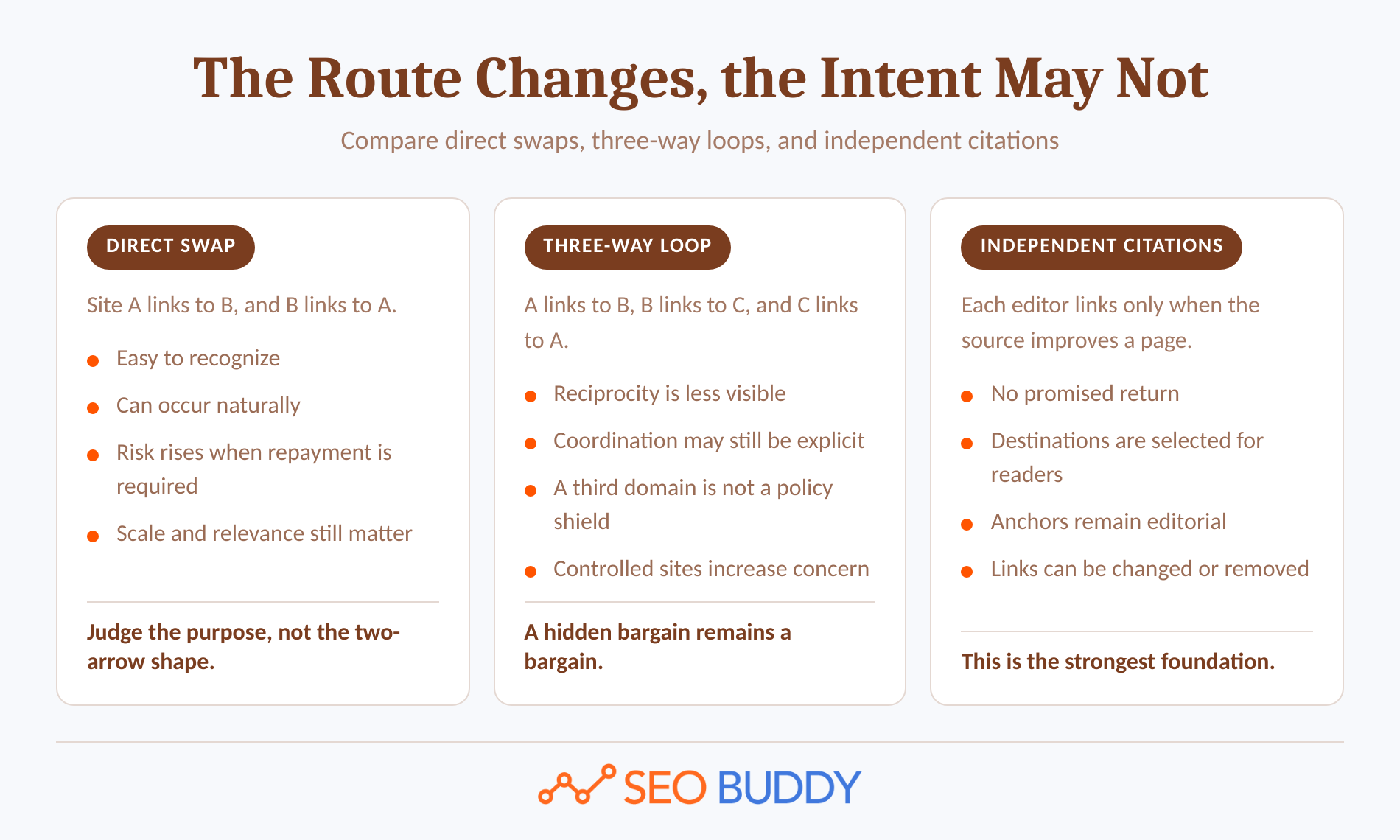
A three-way exchange is not automatically safer than a direct swap. If sites A, B, and C coordinate links to conceal reciprocity and influence rankings, adding a third domain changes the route but not the purpose.
Three-site citation patterns can occur naturally when several publishers independently reference useful resources. The warning sign is coordination: promised placements, controlled domains, prescribed anchors, link credits, or a closed loop whose participants would not link without the arrangement.
Delaying publication, linking from different articles, varying anchors, or adding another website should not be treated as a loophole. Google's policy focuses on links created primarily for ranking manipulation, not only on visually obvious A-to-B swaps.
A third website does not make an exchange safe when all three links depend on the same ranking bargain.
What should you do if past exchanges look risky?
Start by separating legitimate reciprocal citations from links created under a conditional or systematic agreement. Do not remove every two-way link merely because a backlink report labels it reciprocal.
- Create a record of the source page, destination, anchor, date, relationship, and reason each link was published.
- Remove or replace outbound links that are irrelevant, hidden, sitewide, keyword-stuffed, or maintained only to satisfy an exchange.
- Qualify outbound links where payment, sponsorship, or another commercial relationship requires it.
- Ask the other publisher to remove or qualify inbound links that were created as part of a manipulative arrangement.
- Check Search Console's Manual Actions report and document every correction if a manual action exists.
Google's disavow links guidance says the tool should be considered when a considerable number of artificial or low-quality links have caused, or are likely to cause, a manual action. It is not a routine tool for deleting every unfamiliar backlink, and disavowing a link does not remove it from the publisher's page.
Keep independently earned links that still help readers. A reciprocal pattern alone is not a reason to erase a legitimate citation.
Clean up the manipulative agreement and irrelevant links, not every natural citation between two useful websites.
What are safer alternatives to reciprocal linking?
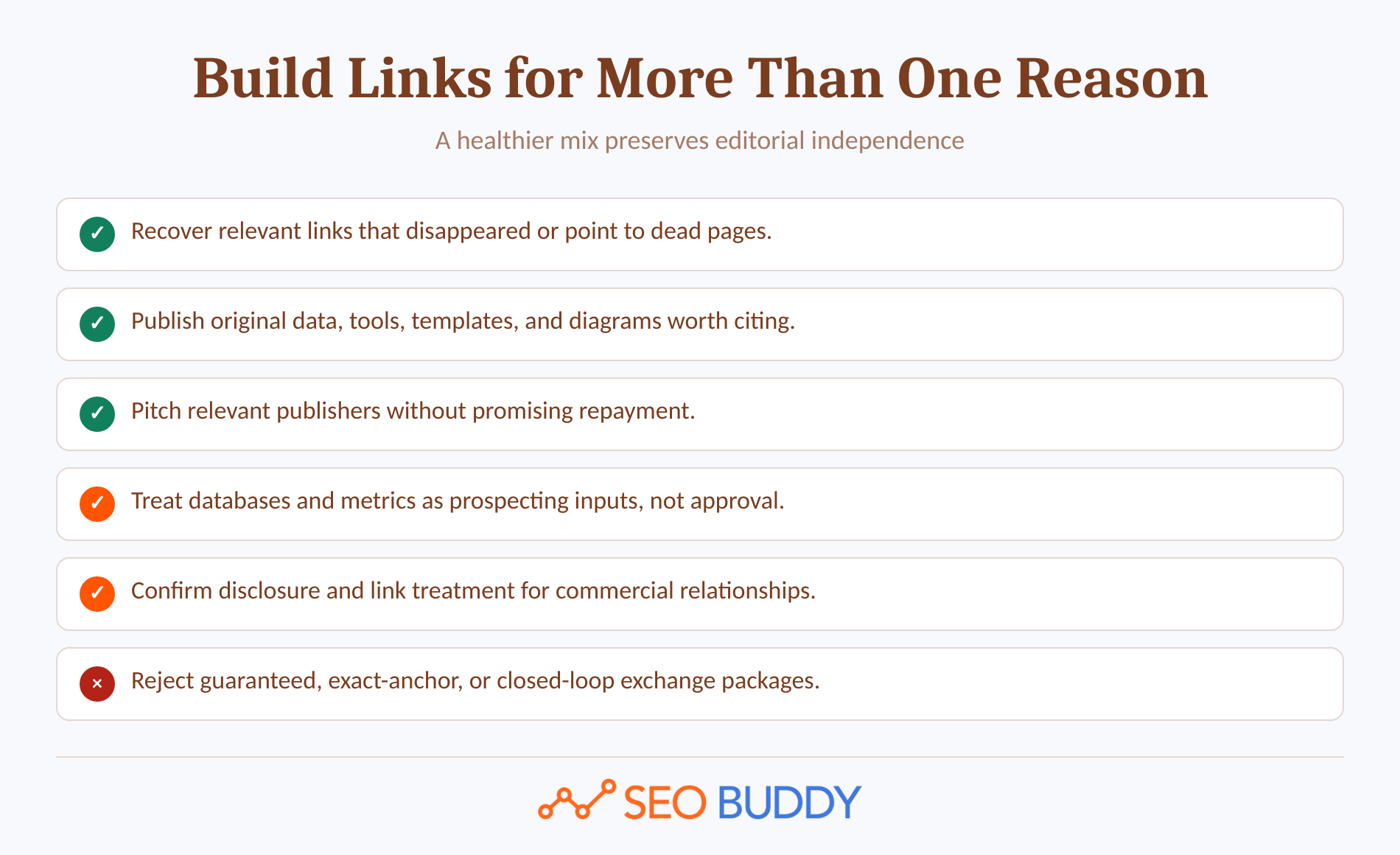
A healthier backlink strategy earns links for several different reasons instead of relying on swaps. Start with methods that preserve editorial independence and create value even when no publisher promises a return link.
Useful alternatives include:
- Recovering earned authority through link reclamation when a valid backlink disappears, points to a dead URL, or references the wrong destination.
- Publishing original data, calculators, templates, diagrams, or research that gives writers a specific reason to cite the page.
- Running controlled link building outreach to publishers already covering the subject, without making a return link part of the pitch.
- Contributing expert material to relevant publications when the article serves the host audience and any citation remains an editorial choice.
- Providing quotable expertise or original examples to journalists, researchers, and industry publishers.
Outsourcing the work does not transfer responsibility for relevance, disclosure, or link treatment. The SaaS link building agency guide explains how to examine site approval rights, anchor governance, reporting, and delivery terms before selecting outside support.
A healthier link profile reflects independent editorial reasons, not one exchange mechanism repeated across the site.
What else do people ask about reciprocal links?
The questions below place reciprocal exchanges within the wider role of links in SEO. Backlinks and external citations still have legitimate uses, but neither should be treated as permission to manufacture ranking signals.
Are backlinks still relevant in 2026?
Yes. Google's Search ranking systems guide, last updated in December 2025, says PageRank continues to be part of its core ranking systems and that link analysis helps Google understand pages. Backlinks still matter in 2026, but deserved, relevant links are different from exchanges created mainly to influence rankings.
Is external linking good for SEO?
External linking is useful when the destination supports a claim, explains a missing step, or gives the reader a better primary source. Google advises site owners to make links crawlable and to qualify sponsored, paid, or untrusted links appropriately. External links should serve the reader, not operate as bargaining chips.
What is the 80/20 rule in SEO?
The 80/20 rule is a prioritization heuristic, not a Google rule or a safe reciprocal-link ratio. In practice, link builders can use it to spend most effort on relevant, independently earned opportunities and only a small amount of time evaluating exchanges that pass strict reader-value and editorial-independence checks.
Backlinks and external links remain useful in 2026, but no SEO rule turns a reciprocal-link ratio into a safe strategy.
What should you do next?
Review each proposed exchange with one question: would both links still deserve publication if search engines ignored them? Decline the arrangement when the answer is no, then invest the time in independently earned opportunities.
For teams that want prospect research, outreach, and placement work handled, review SEO Buddy's Link Building Services. Customers can approve or reject proposed sites, but no placement guarantees rankings, so confirm how each link is earned and whether any relationship requires qualification before approval.
Start by rejecting any exchange that needs the ranking benefit to make sense.

CEO & Founder at SEO Buddy


 How to Improve Organic Traffic: A Prioritized SEO Action Plan
General SEO
How to Improve Organic Traffic: A Prioritized SEO Action Plan
General SEO
 Best AI Writing Tools for SEO Content: What to Use and Avoid
General SEO
Best AI Writing Tools for SEO Content: What to Use and Avoid
General SEO
 Best SEO Tools of 2025: Which Ones Are Still Worth Using in 2026?
General SEO
Best SEO Tools of 2025: Which Ones Are Still Worth Using in 2026?
General SEO
 AI SEO Services: What Providers Do, What They Cost, and How to Choose
General SEO
AI SEO Services: What Providers Do, What They Cost, and How to Choose
General SEO
Get the SEO work done, not just read about it
Create a free account and run your first content plan, keyword research and link-building campaign. No card, and setup is free until your first article.
Free to start. We never sell your address.