
How to Choose the Best SaaS Link Building Agency in 2026

In short
A SaaS link building agency is worth shortlisting when it proves topical relevance, explains how placements are earned, lets the client approve sites, reports live URLs and link attributes, and prices work without hiding delivery risk. For most SaaS buyers, those controls matter more than a promised link count or a high Domain Rating floor.
Key takeaways
- Google’s December 2025 ranking systems guide says PageRank remains part of its core systems, but links are only one group of signals used to rank pages. (developers.google.com)
- Google’s spam policies, updated May 15, 2026, classify links created primarily to manipulate rankings as link spam and require paid advertising links to be appropriately qualified. (developers.google.com)
- A provider should pass four hard gates before price is compared: a defensible acquisition method, relevant placements, client approval rights, and verifiable reporting.
- The US CAN-SPAM Act covers business-to-business commercial email, and hiring an agency does not remove the client’s responsibility for compliance. (ftc.gov)
- As of August 12, 2026, SEO Buddy publicly lists per-placement prices from $79 for a minimum DR 20 site to $399 for a minimum DR 60 site; those rates are a first-party example, not a market benchmark. (seobuddy.com)
Table of contents
- Which agencies are the best for link building for SaaS companies?
- Which engagement model fits your SaaS growth stage?
- What placement standards reduce avoidable risk?
- How should you compare SaaS link-building pricing?
- What should reporting and delivery include?
- What legal questions should you ask about outreach?
- What questions expose a weak agency?
- How do you run a low-risk pilot?
- What is SaaS link building?
- What should you do next?
Which agencies are the best for link building for SaaS companies?
The best agency is the provider that fits the SaaS company’s target pages, internal capacity, growth stage, and tolerance for placement risk. A client-logo strip, a traffic screenshot, or a promised number of links is not enough evidence on its own.
Use the following scorecard as a set of pass-or-fail checks rather than an invented numerical ranking.
| Criterion | Minimum evidence to request | Warning sign |
|---|---|---|
| SaaS relevance | Examples involving software products, technical topics, or long B2B buying journeys | The provider treats every niche as interchangeable |
| Acquisition method | A written explanation of how prospects are found, contacted, and converted into placements | The method is described only as proprietary inventory |
| Topical fit | A reason each proposed site and article is relevant to the destination page | Relevance is reduced to an authority score |
| Site quality | Current traffic, indexation, ranking topics, editorial ownership, and a sample article | A high metric is offered without evidence of a real audience |
| Search-policy fit | A clear answer about publisher compensation, reciprocal consideration, and link attributes | The sales representative says every link is safe by definition |
| Target-page strategy | A plan for product, comparison, category, and supporting content pages | Every link points to the home page or one blog post |
| Anchor governance | Client approval and a rationale for branded, URL, topical, and exact-match anchors | Repeated keyword-rich anchors are treated as a default |
| Site approval | The right to approve or reject a proposed site without being charged | Sites appear only after publication or invoicing |
| Reporting | Live URL, destination, anchor, attribute, publication date, and verification status | A monthly total is supplied without placement-level records |
| Pricing | A defined billing trigger and a list of what the fee includes | The headline price excludes content, edits, or replacement work |
| Delivery and replacement | Deadlines, cancellation rules, monitoring period, and removal policy | Delivery dates and replacement terms are left to discretion |
| Outreach compliance | Sender identity, contact-source rules, suppression process, and jurisdictional responsibility | The provider says business email is exempt everywhere |
A useful shortlist starts with the hard gates. Reject a provider that will not disclose its acquisition path, publisher-compensation model, approval process, or placement report. A low price should not rescue a failed policy or compliance check.
Case studies are supporting evidence, not a substitute for the operating process. Ask for a redacted proposal, a redacted placement report, and examples of sites the agency rejected. Rejected sites can reveal more about quality control than the best placements selected for a sales page.
SaaS link building agency reviews also need context. A provider may have delivered exactly what one client purchased while still being unsuitable for a different target market, destination page, or legal jurisdiction. Verify the contract and workflow instead of treating a testimonial as transferable proof.
A provider that cannot pass the method, policy, approval, and reporting checks does not belong on the shortlist.
Anybody can generate an article. Knowing which one is worth writing is the hard part.
The AI Content Engine reads your site and your competitors, then builds a ranked content plan and writes it. Setup is free, and you see your plan before you pay for anything.
See your content plan freeWhich engagement model fits your SaaS growth stage?
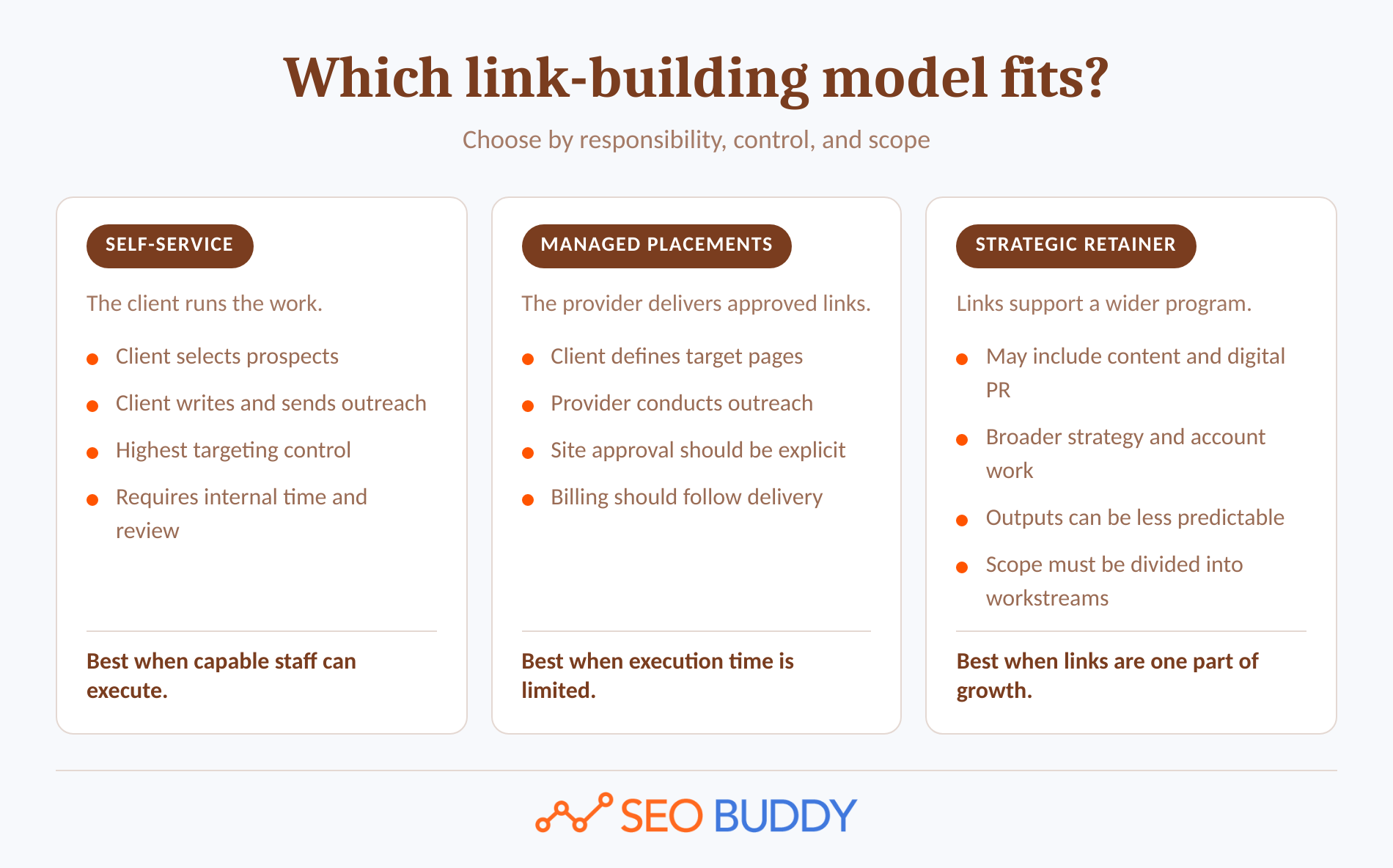
The right engagement model depends on who will research prospects, write outreach, approve sites, create content, and monitor placements. Decide which responsibilities should remain in-house before comparing agencies or link building packages.
Self-service prospecting and outreach
Self-service is appropriate when an internal marketer can judge topical fit, write credible messages, and manage replies. It provides greater control over the prospect list and sender identity, but it also leaves research, compliance, follow-up, and relationship management with the client.
A newer site may begin with curated link prospecting opportunities that can be assessed and completed internally. A team with outreach capacity can instead run a link building campaign from its company mailbox, retaining control over targeting and messages.
SEO Buddy’s Link Building Campaign currently finds prospects through keyword mentions or links to competing pages, searches for published contact addresses, and sends a three-email sequence from a connected customer mailbox. It uses prepaid, pay-per-use billing rather than a subscription, but the customer remains responsible for targeting, mailbox authentication, message content, and legal compliance. (seobuddy.com)
Managed placement delivery
A managed placement service fits a team that can define target pages and approve publishers but does not want to conduct outreach or write placement content. The contract should specify when a placement becomes chargeable, what the client approves, and what happens when a proposed site or delivered link is rejected or removed.
SEO Buddy’s current managed model is one documented example. The client chooses a minimum Domain Rating tier, approves or rejects each proposed site, and is charged after the placement is published and verified. SEO Buddy states that its team conducts outreach instead of buying inventory from a paid placement network. (seobuddy.com)
Strategic agency retainer
A broader retainer can make sense when link acquisition is part of digital PR, research production, content strategy, or category positioning. The risk is that a broad scope can obscure what will actually be delivered each month.
Ask the provider to divide the retainer into named workstreams. A proposal should distinguish prospecting, content creation, media outreach, placement delivery, reporting, and account management. It should also state which workstreams have output commitments and which depend on publisher decisions.
Authority metrics can help segment prospects, but they should not determine the operating model alone. Content quality, brand recognition, current referring domains, internal capacity, target-page readiness, and the cost of a poor placement all affect the decision.
Choose the delivery model that matches internal capacity and growth stage before comparing agency claims.
What placement standards reduce avoidable risk?
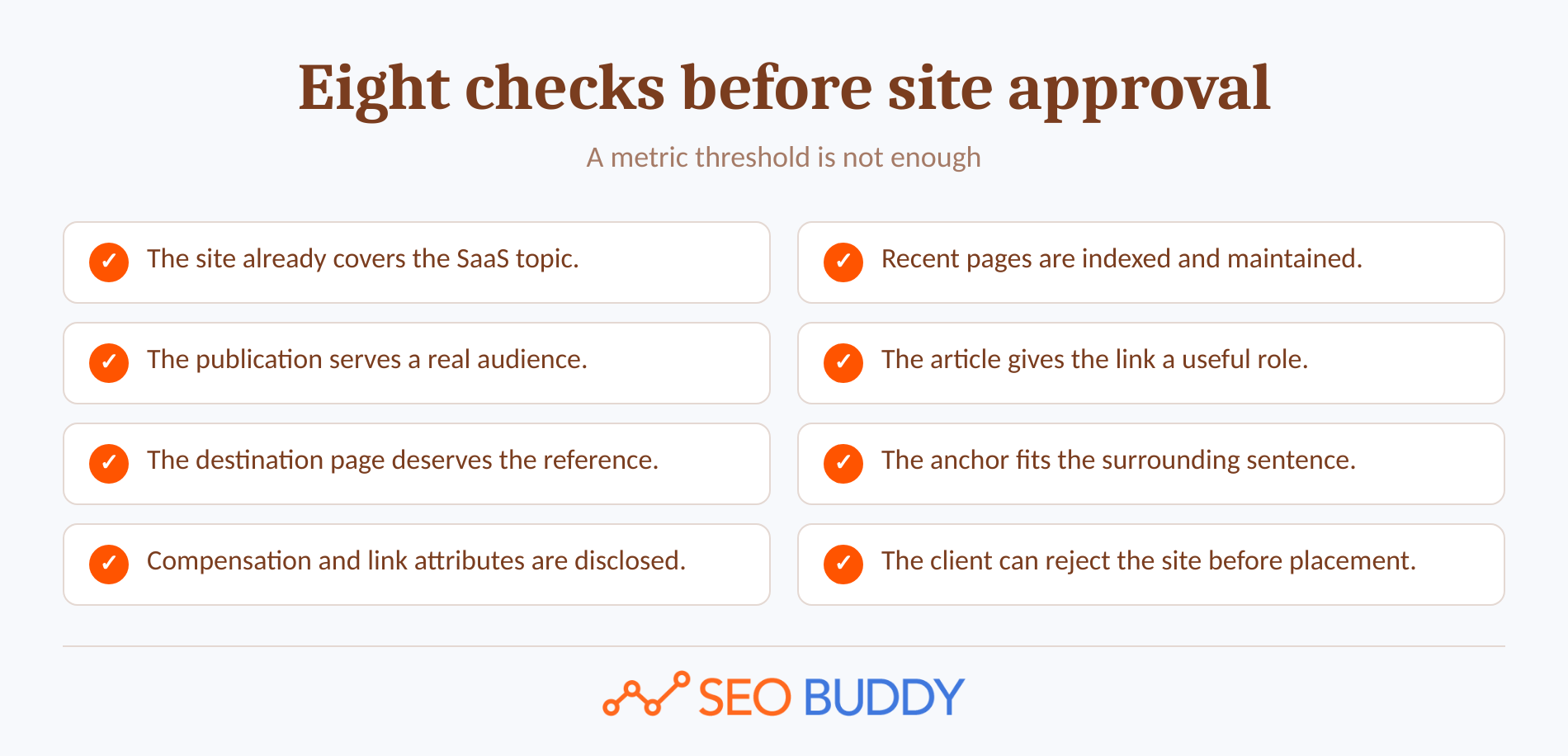
A defensible backlink belongs in a useful article on a site that genuinely covers the subject and serves a real audience. A metric threshold can support screening, but it cannot prove relevance, editorial merit, policy compliance, or ranking impact.
Google’s December 2025 ranking systems guide says link analysis and PageRank continue to help Google understand pages and determine which may be useful. The existence of link signals does not make every acquisition method acceptable. (developers.google.com)
Google’s spam policies, updated May 15, 2026, define link spam as creating links primarily to manipulate rankings. The examples include exchanging money, goods, or services for ranking links, excessive exchanges, automated link creation, low-quality directory links, and paid articles that pass ranking credit. Google says advertising and sponsorship links should use an appropriate qualification such as rel='nofollow' or rel='sponsored'. (developers.google.com)
An agency fee for research and outreach does not, by itself, prove that the publisher received payment. The buyer still needs a written answer about where the money goes and whether a publisher receives cash, a product, a service, a reciprocal link, or another benefit in return for publication.
SEO Buddy states that its managed service asks editors for placements through outreach and does not buy links from a network. Its public terms also say placements are dofollow and normally lack a sponsored attribute unless the publisher’s policy requires one. Buyers should therefore verify publisher compensation and link-attribute treatment for each proposed placement rather than relying on labels such as editorial or outreach-earned. (seobuddy.com)
Check the site, page, and sentence separately
A legitimate site can still be a poor placement. Check whether the publication already covers the SaaS category, whether the specific article serves the same audience, and whether the link helps the reader answer a question raised in the surrounding sentence.
Traffic estimates and authority scores can be useful filters, but request their source and check date. Ask whether the site has indexed pages, current rankings related to the subject, identifiable editorial ownership, and recent original content. A strong aggregate score should not override an irrelevant topic or an abandoned publication.
Check the destination and anchor
The destination page must be useful enough to deserve the reference. Product pages may be appropriate when the surrounding article is comparing solutions or explaining a workflow. A research page, template, glossary entry, or detailed guide may be a more natural destination when the publisher is supporting an informational claim.
Review the anchor text before publication. Repeated exact-match commercial anchors can create an unnatural pattern, while vague anchors may provide little context to readers. The agency should explain the proposed anchor in relation to the sentence, page, and wider backlink profile.
Treat AI visibility claims as unproven deliverables
Links and brand mentions may help information discovery, but an agency cannot guarantee that a specific assistant or search feature will cite a company. SEO Buddy’s own service terms explicitly state that a verified placement does not guarantee rankings, traffic, or visibility in AI-generated answers. (seobuddy.com)
A strong placement is relevant, editorially useful, and defensible under current search policies.
How should you compare SaaS link-building pricing?
Compare the billing model, charge trigger, inclusions, and failure terms before comparing the headline amount. A cheaper link can cost more if it requires replacement, appears on an irrelevant site, or is invoiced before the client can review it.
Common commercial models include:
- Monthly retainer: The client pays for ongoing strategy and activity, which may or may not include a fixed placement commitment.
- Per placement: A fee becomes due for each delivered link that meets defined criteria.
- Project fee: Research, content, digital PR, or outreach is priced as a finite campaign.
- Pay-per-use prospecting: The client pays for data, contact discovery, or sending activity while managing the campaign internally.
Because this article is published by SEO Buddy, the following figures are a documented first-party example, not an independent market average. SEO Buddy’s prices checked on August 12, 2026 are $79 for minimum DR 20, $129 for minimum DR 30, $189 for minimum DR 40, $319 for minimum DR 50, and $399 for minimum DR 60. A specified content type adds 20%, and express delivery adds 20%. (seobuddy.com)
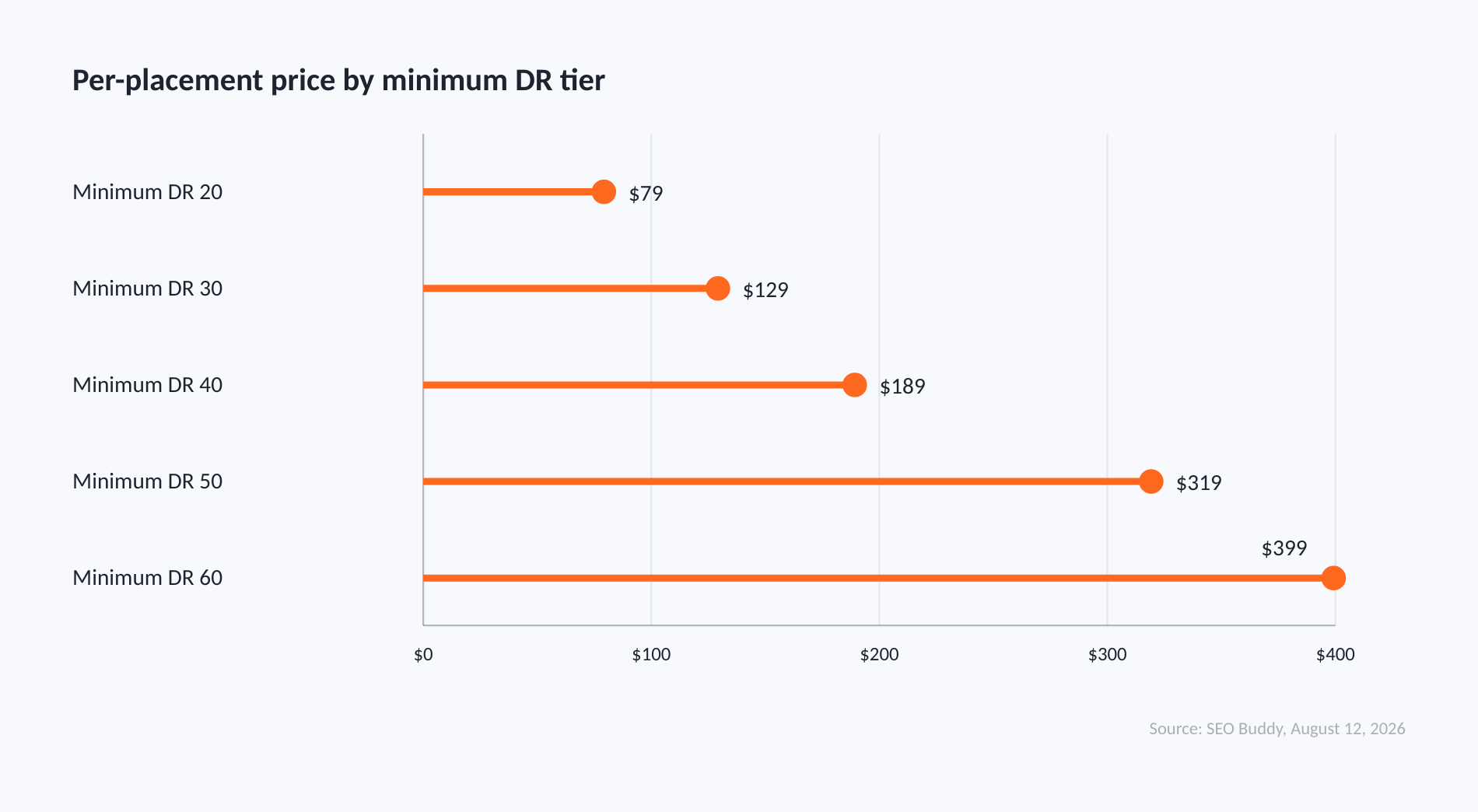
Five minimum DR 40 placements at the posted rate would total $945. Adding the 20% express option would make the same five placements $1,134. That arithmetic illustrates the posted model; it is not a quote, a recommendation, or a forecast of results.
Ask the following questions before comparing totals:
- Is the fee charged at order, site approval, publication, verification, or the end of the month?
- Are research, outreach, content, editing, account management, and monitoring included?
- Can the client reject a site without losing a placement credit or paying a fee?
- Does the contract define what happens when the provider misses the deadline?
- Is a removed link replaced, refunded, or treated as completed delivery?
- Do content-type requirements or accelerated delivery create additional charges?
- Are taxes, currency conversion, platform fees, or minimum commitments added later?
Compare the billing trigger and total delivered cost, not the cheapest headline price.
What should reporting and delivery include?
A placement report should prove what was delivered, when it became chargeable, and whether it still meets the agreed criteria. Performance reporting should be kept separate because no agency can prove that one backlink caused a specific ranking, signup, or revenue change.
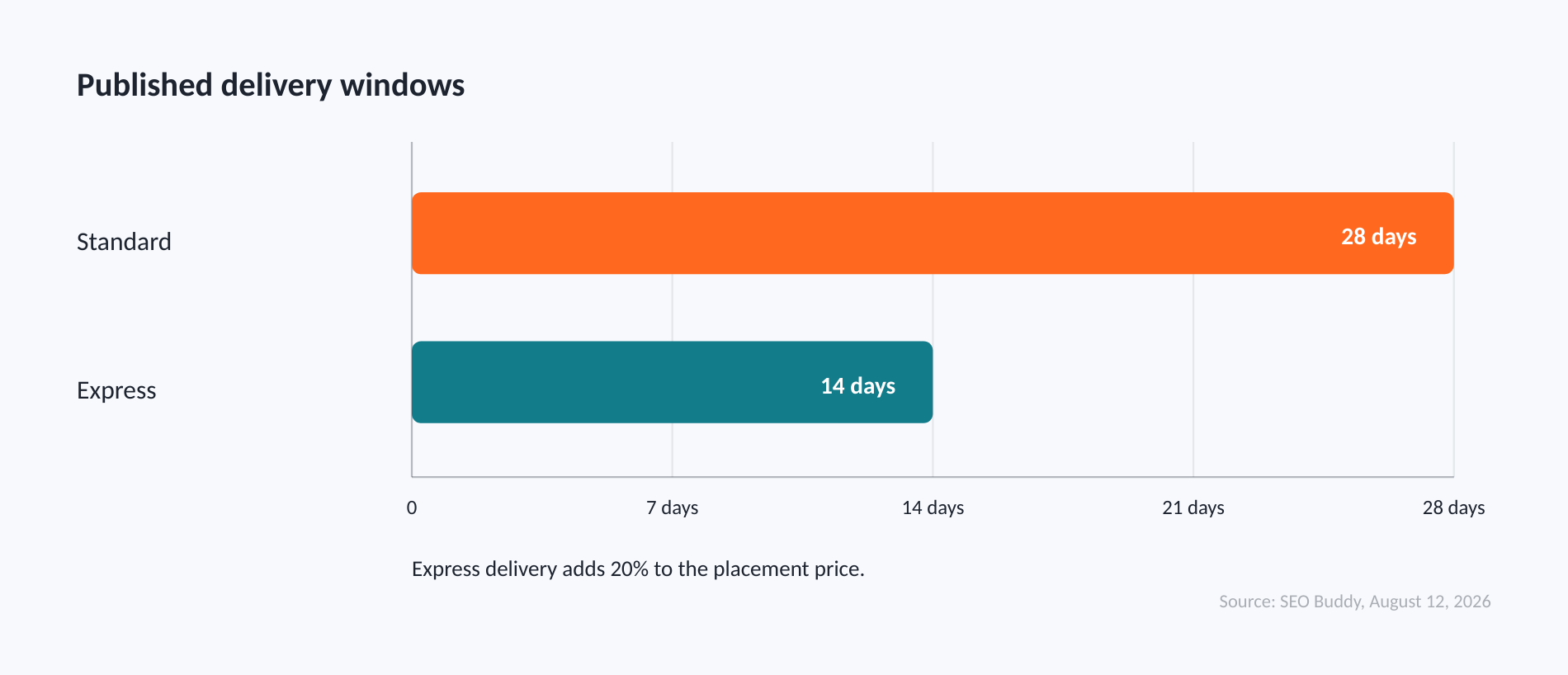
SEO Buddy’s public terms provide a concrete delivery example. Standard delivery is 28 calendar days, express delivery is 14 calendar days and adds 20%, and funds for a late unpublished placement are released. The service re-checks published placements for 90 days. (seobuddy.com)
A complete placement-level report should contain:
- The proposed and approved domain.
- The site-selection rationale.
- The authority metric, source, and check date.
- Evidence of relevant rankings, traffic, and indexation.
- The destination page and approved anchor text.
- The article title and final live URL.
- The link attribute at verification.
- The publication and verification dates.
- The invoice or placement-credit status.
- The monitoring deadline and current link status.
- The action required if the link or page disappears.
Define approval rights precisely. SEO Buddy’s managed service lets the client approve or reject the proposed site, but it does not include a separate article-draft approval stage. The client supplies the destination page and anchor, while SEO Buddy writes the placement article after site approval. (seobuddy.com)
That distinction may be acceptable for one buyer and unsuitable for another. A regulated SaaS company, a security platform, or a business with strict brand terminology may require content approval in addition to site approval. Put that requirement in the contract rather than assuming it is standard.
The report should also distinguish verification from search performance. Verification can confirm that the page is live, the link points to the agreed URL, and the page is not visibly blocked from indexing at the time of the check. Verification cannot guarantee that a search engine will index the page, assign value to the link, or improve the destination page’s position.
Reporting should prove what was placed, where, under which terms, and what happens if it disappears.
What legal questions should you ask about outreach?
An agency should document who sends outreach, where contact details come from, how opt-outs are processed, and which party is responsible in each jurisdiction. Outsourcing prospecting or email delivery does not automatically transfer the client’s legal obligations.
For US commercial email, the FTC’s CAN-SPAM compliance guide says the law has no business-to-business exception. The guide requires accurate sender information, nondeceptive subject lines, a valid postal address, an opt-out method, and completion of opt-out requests within 10 business days. It also says a company cannot contract away responsibility when another business sends email on its behalf. (ftc.gov)
UK rules are different and depend partly on whether the recipient is a corporate subscriber, an individual, or a sole trader. The UK ICO’s business marketing guidance says PECR and data-protection rules may both apply, personal business contact data remains personal data, and every marketing message must identify the sender and offer an opt-out. (ico.org.uk)
This is not legal advice. A global SaaS company should have qualified counsel confirm the rules for its sender, recipients, data sources, and message content.
Ask the agency to document:
- The legal entity and domain used as the sender.
- Whether messages come from the client’s mailbox or an agency-controlled identity.
- How contact addresses are collected and recorded.
- How the agency distinguishes corporate contacts, individuals, and sole traders where required.
- Which lawful basis or permission rule is used in each target jurisdiction.
- How unsubscribe requests, replies, and hard bounces suppress future messages.
- Whether suppression records survive the end of the campaign.
- Who supplies any required postal address or disclosure.
- The mailbox limits, sending windows, and authentication requirements.
- Who acts when a recipient submits a privacy request or complaint.
A documented sending control is not the same as legal compliance, but it makes responsibility visible. SEO Buddy’s self-managed campaign tool, for example, publicly documents a one-click unsubscribe option enabled by default, a default limit of 40 emails per mailbox per day, reply-based sequence stopping, and bounce suppression. The same page states that the customer remains responsible for targeting, disclosures, and legality. (seobuddy.com)
Outsourcing outreach does not outsource the buyer’s legal responsibility.
What questions expose a weak agency?
The best sales-call questions force the provider to supply a process, record, date, or contract term. Vague adjectives and promises should not be accepted where a concrete answer exists.
Ask these questions in writing:
- How is each link acquired from the first prospect search to publication?
- Does any publisher receive money, products, services, reciprocal links, or another benefit?
- Can a redacted example show why a proposed site passed the quality review?
- Can a second example show a site that was rejected and the reason for rejection?
- Can every proposed site be rejected without a fee or lost placement credit?
- Which traffic, authority, indexation, and relevance checks are performed, and on what date?
- Who chooses the destination page and anchor text?
- Who decides whether a link is followed, nofollowed, or sponsored?
- At which event does a placement become billable?
- What happens if the deadline is missed or the link disappears?
- What fields appear in the placement report, and how often is the link rechecked?
- Which outcomes does the agency explicitly refuse to guarantee?
The final question matters. A credible provider should refuse to guarantee rankings, traffic, pipeline, or AI citations because those outcomes depend on systems and buyer behavior outside the agency’s control.
Request the answers before the sales call ends, then compare them with the contract. If the written agreement weakens an approval, deadline, or replacement promise made during the call, the contract is the version that matters.
Specific answers, sample records, and written terms matter more than confident sales language.
How do you run a low-risk pilot?
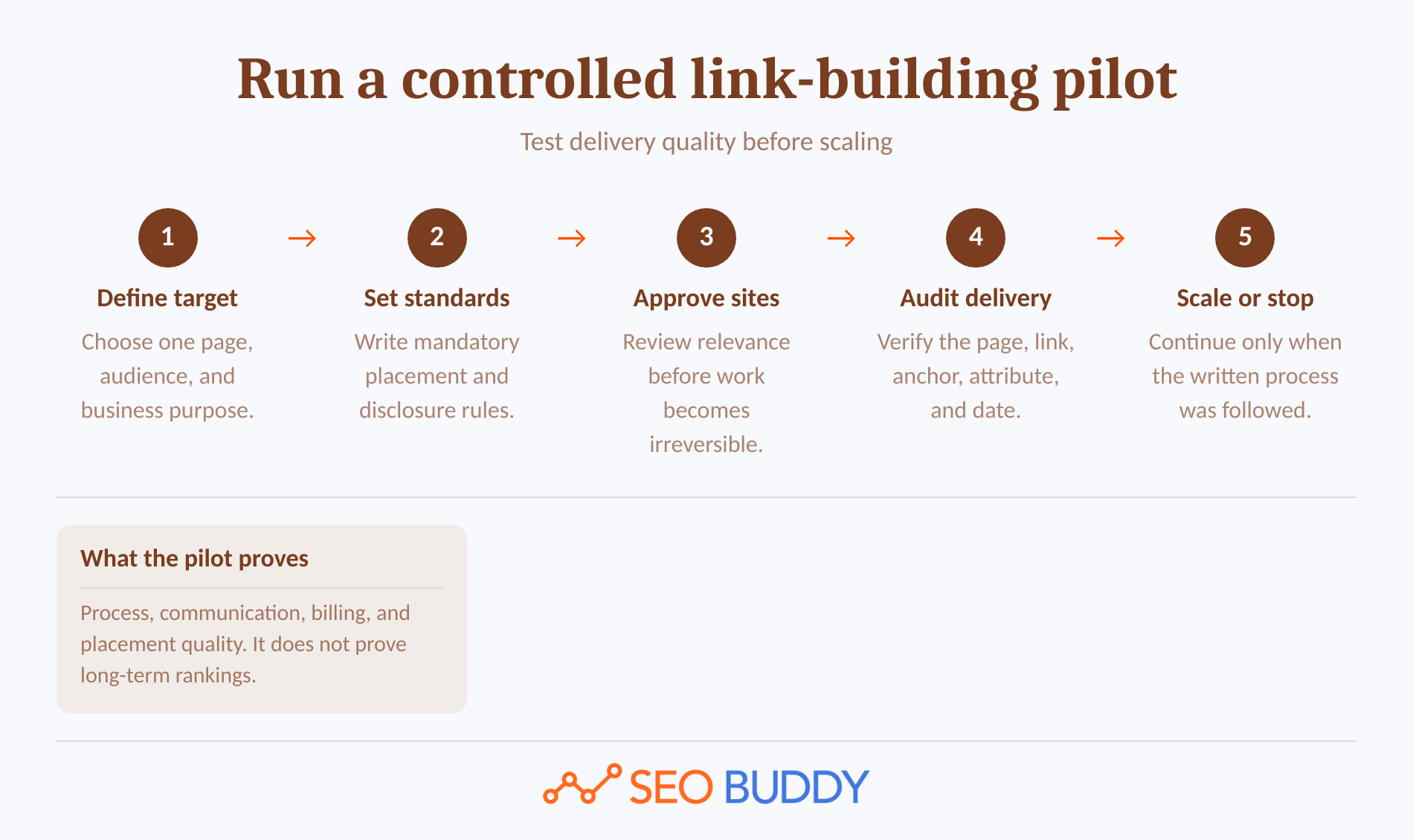
A pilot should test one defined target, one acceptance standard, and a small placement batch before the relationship expands. The objective is to evaluate delivery quality and working practices, not to prove long-term organic growth from a few links.
1. Define the target page and business purpose
Choose one page with a clear audience and conversion path. Record whether the placement is intended to support category discovery, a comparison decision, product education, referral traffic, or a specific search topic.
The destination should already be accurate, useful, indexable, and internally linked. Link acquisition cannot repair a thin page, a confusing offer, or a technical indexing problem.
2. Write the acceptance policy
List the subjects, countries, languages, site types, authority floors, traffic requirements, excluded niches, anchor restrictions, and disclosure rules. Define which conditions are mandatory and which can be discussed.
Put the steps in an SEO execution checklist so the same rules are applied by marketing, legal, and procurement. If the team needs method references while drafting the policy, use established SEO blog resources rather than inventing criteria during site approval.
3. Approve sites before work becomes irreversible
Require the provider to explain why each site fits the target page and audience. Check a sample of recent articles manually. Look beyond the home page and authority metric to confirm that the publication still produces original, relevant material.
Record every rejection and reason. Rejection data can reveal whether the agency learns the client’s standards or repeatedly submits sites that fail the same check.
4. Audit the delivered placement
Confirm the live URL, article topic, destination, anchor, attribute, publication date, indexability settings, and invoice status. Compare the delivered record with the original proposal and contract.
Also review the content around the link. The placement should make sense to a reader who has no knowledge of the campaign. A technically correct link in an irrelevant paragraph is still a failed editorial placement.
5. Make a documented scale-or-stop decision
Continue only if the provider followed the approval process, met the deadline, supplied complete records, handled feedback correctly, and delivered placements that passed the written standard. Do not scale merely because the allotted number of links arrived.
A pilot cannot establish the long-term ranking effect of the work. It can establish whether the provider’s process, communication, billing, and quality controls deserve a larger commitment.
A controlled pilot turns agency selection from a reputation contest into a delivery test.
What is SaaS link building?
The following answers cover the basic questions buyers ask before comparing a SaaS link building agency. Each answer separates what link building can support from what a provider cannot guarantee.
What is SaaS link building?
SaaS link building is the process of earning links from relevant websites to pages on a software company’s site. The work can include editorial outreach, digital PR, linkable content, unlinked mention recovery, and partnerships. The goal is not a raw link count, but credible references that support discovery, authority, and qualified referral traffic.
What is a link building agency?
A link building agency plans and executes work intended to earn backlinks for a client. Depending on the engagement, the agency may research prospects, create assets, contact publishers, manage placements, and report results. A responsible agency also explains acquisition methods, approval rights, link attributes, delivery terms, and what outcomes it cannot guarantee.
Does link building still work?
Link building still matters because Google says link analysis and PageRank remain part of its core ranking systems. Links are only one set of signals, and manipulative links may be ignored or penalized under Google’s spam policies. Link building works best when placements are relevant, editorially defensible, and useful to the reader. (developers.google.com)
SaaS link building is useful only when the acquisition method, placement, and target page can withstand scrutiny.
What should you do next?
Start with one target page and turn the twelve selection criteria into written pass-or-fail requirements. Send the same questions to every shortlisted provider so price and reputation cannot hide differences in method, approval rights, and delivery terms.
If the site is ready for handled editorial outreach and the team wants per-site approval with per-published-placement billing, review SEO Buddy’s Link Building Services and confirm that the current placement, attribute, delivery, and monitoring terms fit the company’s requirements.
Choose the provider only after its written process passes the same standard expected from its links.

CEO & Founder at SEO Buddy


 How to Improve Organic Traffic: A Prioritized SEO Action Plan
General SEO
How to Improve Organic Traffic: A Prioritized SEO Action Plan
General SEO
 Best AI Writing Tools for SEO Content: What to Use and Avoid
General SEO
Best AI Writing Tools for SEO Content: What to Use and Avoid
General SEO
 Best SEO Tools of 2025: Which Ones Are Still Worth Using in 2026?
General SEO
Best SEO Tools of 2025: Which Ones Are Still Worth Using in 2026?
General SEO
 AI SEO Services: What Providers Do, What They Cost, and How to Choose
General SEO
AI SEO Services: What Providers Do, What They Cost, and How to Choose
General SEO
Get the SEO work done, not just read about it
Create a free account and run your first content plan, keyword research and link-building campaign. No card, and setup is free until your first article.
Free to start. We never sell your address.