
My SEO Journey [Pro Edition]: Thibault Louis-Lucas from Outrank – From Failed Startups to 12.5M Impressions: Scaling SaaS Growth with Programmatic SEO & Free Tools

My SEO Journey [PRO Edition] is a series where professionals in the SEO Industry, Digital Marketing, or Web Design share their honest SEO Journey filled with failure, success, and most importantly, proven results. Episode #171 features Thibault Louis-Lucas from Outrank.
Hey, I’m Tibo (Thibault Louis-Lucas). I’m a indie maker, father of 2, and I run a portfolio of 5 bootstrapped SaaS products: Revid.ai (AI short-form video creation), Outrank.so (automated SEO content and backlinks), SuperX.so (X/Twitter growth toolkit), PostSyncer.com (cross-platform content publishing), and Feather.so (turn Notion pages into SEO-optimized blogs).
Before this, I built Tweet Hunter and Taplio, two creator growth tools that I sold in 2022 for $8M to Lempire. I was Product Hunt’s Maker of the Year in 2022.
My mission is pretty simple: build tools that help founders and creators grow, without hiring agencies, without raising money, and without spending months figuring things out. I want every product I build to be something a solo founder can set up and see results from quickly.
SEO has been at the core of how I grow every single one of these businesses.
What’s your backstory and how did you come up with the idea?
I’m from France. I failed at startups multiple times before anything worked. One of my previous companies went bankrupt. After that, I got a regular job, saved up, and in 2020 I quit to travel. Then COVID happened and I was stuck at home with my friend Tom, and we said, “let’s build something.”
We committed to launching a new product every week until something got traction. We shipped 11 products in about 4 months. most of them went nowhere.
Then we built Tweet Hunter, which was basically a feed of viral tweets to inspire content creators, it took off almost immediately.
The real SEO lesson came during the Tweet Hunter days. Early on, we were building mini-tools focused on virality, things that would spread on social media.
But then we had a shift. we started building mini-tools that were SEO-oriented instead.
Things like “download video from tweets“, “convert tweet to image“, “convert thread to carousel”
These were search terms people were actually typing into Google. Some of those free tools ended up generating an insane amount of organic traffic that became a huge growth driver for Tweet Hunter.
That was the lightbulb moment.
I realized that free tools targeting specific search queries could be the top of a massive funnel, and I’ve used that exact playbook for every product since.
After selling Tweet Hunter and Taplio, I got back to work in 2024 with a new portfolio.
I knew from day one that SEO would be the growth engine again.
That’s why I built Outrank, it’s literally the system I wished I had when I was doing all of this manually.
Anybody can generate an article. Knowing which one is worth writing is the hard part.
The AI Content Engine reads your site and your competitors, then builds a ranked content plan and writes it. Setup is free, and you see your plan before you pay for anything.
See your content plan freeSince launch, what has worked to attract more organic traffic?
1. Free tools as an SEO channel
This has been the single biggest lever. for every product, we build free tools that target specific search queries in our niche.
Outrank alone has a full SEO Toolbox with free keyword research, meta description generators, robots.txt checkers, slug generators, alt text generators, and more. Revid has free video-related tools. PostSyncer has publishing-related utilities.
The logic is simple: someone searches “meta description generator” or “keyword research tool free” they land on our tool. They use it. They see the product. Some of them sign up. Even if they don’t, we get the backlink value, the domain authority boost, and the brand impression.
This is the same playbook I ran at Tweet Hunter with those single pages were driving thousands of visits per month.
I just scaled the approach across 5 products.
Outrank now has a dedicated Tools Builder that lets our users do the same thing, build free SEO tools on autopilot for their own sites.
2. Consistent, automated blog content (30 articles per month)
Across the portfolio, we publish roughly 30 blog posts per month per product. some of these are generated through Outrank’s own automated pipeline, where the system handles keyword research, content planning, writing, and publishing.
Others go through Outrank’s human-curated service, which works more like an agency, especially for our higher-end clients.
For Outrank specifically, we eat our own cooking.
The blog you see on Outrank is powered by our own product. one post alone, “Search Google or Type a URL“, pulls in over 30,000 organic visits per month. That single article drives more traffic than most SaaS blogs get in total.
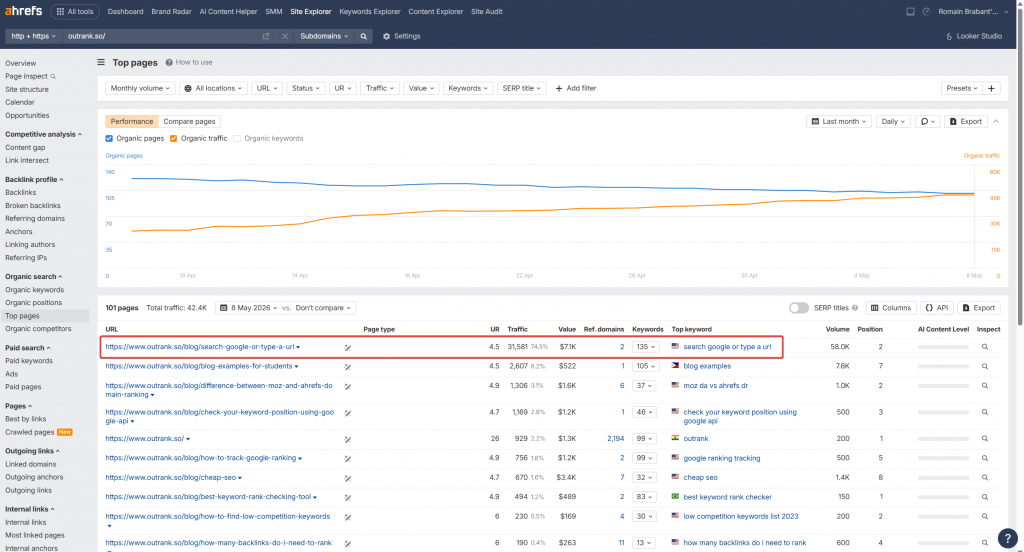
Here’s what the top pages look like for Outrank right now (Ahrefs data, May 2026):
- “Search Google or Type a URL” — ~30,300 monthly visits, ranking #2
- “Blog Examples for Students” — ~2,600 monthly visits
- “Check Keyword Position Using Google API” — ~1,170 monthly visits
- “Moz vs Ahrefs Domain Ranking” — ~1,090 monthly visits
- Homepage branded traffic — ~930 monthly visits
The key insight here: we still target long-tail keywords phrased as questions. “how many backlinks do I need to rank,” “how to find low competition keywords,” “how to track Google ranking.” these are the exact things our target users are searching for. we create comprehensive answers, and Google rewards us with traffic that converts.
3. Backlink building at scale
I’ve always believed that domain rating is the backbone of organic traffic. higher DR means Google trusts you more, which means every new article has a better chance of ranking.
Here’s where the portfolio stands today:
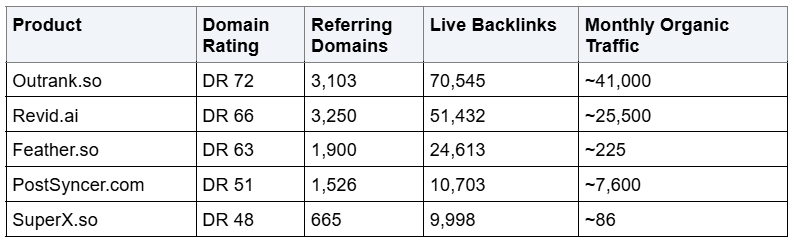
Outrank at DR 72 with over 3,000 referring domains is the strongest in the portfolio. Revid is close behind. we’ve built these through a combination of directory submissions, content partnerships, startup listings (we submitted to 400+ directories), and the natural backlinks that come from publishing useful free tools and content that people want to reference.
We also built a backlink exchange feature inside Outrank itself, so our users can earn relevant links from each other’s domains. it creates a network effect where everyone’s DR grows together.
The Link Chest is a collection of high-quality, easy-to-win backlink opportunities. It’s the smart way to kickstart your SEO mission and improve the rank of your website in Google.

“This is such a simple idea but very well executed. I’ve been powering through this giant list of backlinks for a few hours and already have loads pointing to my site. Link Chest is an essential tool for early stage link building.”
4. Cross-linking the portfolio
One underrated advantage of running multiple products: you can cross-link them.
- Feather blogs link to Outrank.
- Outrank articles reference Revid for video content.
- PostSyncer content mentions the whole ecosystem.
This internal network of real, relevant links across multiple domains gives each product a boost that a single-product company can’t replicate.
Have you learned anything particularly helpful in your SEO Journey?
Consistency beats intensity.
The biggest mistake I made early on was not publishing regularly.
I’d go hard for a few weeks, publish a bunch, then stop for a month. SEO compounds, but only if you keep feeding it. The moment we systemized content to 30 posts per month on autopilot, everything changed. that’s literally why I built Outrank, to solve this problem for myself first.
Vanity keywords are a trap.
Early on, I wasted time going after high-volume, high-competition keywords. “best AI tools” or “social media marketing” type stuff.
We’d write a great article and it would sit on page 5 forever.
The breakthrough came when we focused exclusively on long-tail, question-based keywords with lower competition. “how to check keyword position using Google API” gets way less search volume than “SEO tools” but it ranks #3 and brings in qualified traffic that actually converts.
Free tools are the best content marketing you can do.
I keep coming back to this because it’s the single biggest insight from my entire SEO journey.
A blog post might rank and get reads. A free tool ranks, gets used, gets bookmarked, gets shared, and earns backlinks naturally.
The ROI on building a simple free tool versus writing another blog post is 10x.
SEO is not dead, it’s shifting.
I hear founders say “SEO is dead because of AI” all the time.
I disagree.
What’s changing is that you need to optimize not just for Google but for AI recommendations too.
The founders who build strong topical authority today will be the ones AI models reference tomorrow.
What’s your most impressive SEO case study?
I want to share 2 — our own (Outrank’s), and a customer’s (Bright Brands).
Both make a different point about what SEO can actually do when you stop treating it as a one-off project.
Case 1: Outrank’s own SEO journey
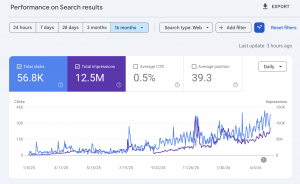
Outrank has been live for ~16 months, in that window, our blog and programmatic pages have driven:
- 56,800 clicks from Google organic search
- 12.5 million impressions
- Consistent week-over-week growth despite zero paid SEO spend on our own site
The strategy wasn’t clever, it was boring on purpose:
- Dogfood the product. Outrank writes its own blog. every article is generated, edited, and published using the exact same pipeline customers use. if we can’t rank with our own tool, we shouldn’t sell it. this also gives us the fastest possible feedback loop on what’s working.
- Build topical clusters, not random posts. Instead of chasing 50 unrelated keywords, we picked a few core topics (programmatic SEO, AI content, content automation, internal linking) and built deep coverage. Google rewards topical authority, not topical chaos.
- Internal linking on autopilot. Every new article links back to the relevant cluster pillars and to product pages with intent. compound interest, but for SEO.
- Don’t wait for traffic to monetize. we put product CTAs on every post from day one. Signups happen even at 200 monthly visitors per page if the intent matches.
- Backlinks. We built links the same way we’d recommend any SaaS does it: directory submissions to relevant SaaS and SEO directories, guest posts on real publications, partnerships with adjacent tools, and earning mentions by being genuinely useful (free tools, public playbooks, case studies).
The lesson: a SaaS product is a content marketing case study. You don’t need to wait until you’re “big enough” to do SEO.
You need to start before you have authority, because the only way to build authority is to publish.
Case 2: Bright Brands — 40-50 hours per client to a scalable process
This one matters more for the SEO Buddy audience, because most readers run agencies or freelance.
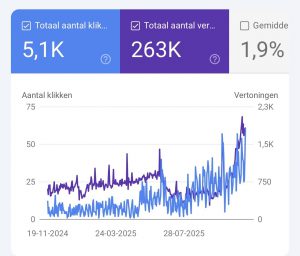
The setup. Bright Brands is a web design and digital marketing agency in Eindhoven, Netherlands, run by Olaf van Gastel. They have a portfolio of ~200 clients. Their problem wasn’t getting clients, it was delivering quality SEO at scale without burning out.
The before state, in Olaf’s own words:
“Every client deserved a proper content strategy, but the reality was brutal: I’d spend hours in Google, manually searching dozens of keywords, opening competitor sites one by one, copying data into spreadsheets, and trying to spot patterns in what was ranking. Then came the writing — crafting unique, SEO-optimized texts for every service page, every location page, every blog post. For one client alone, that could mean writing 20-30 pieces of content from scratch, each requiring its own keyword research cycle.“
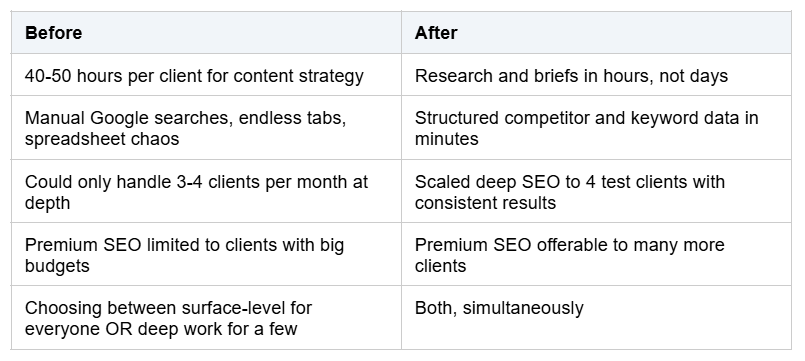
The math was brutal. 40-50 hours of SEO work per client meant Olaf could deliver deep SEO to maybe 3-4 clients per month. For an agency with 200 clients, that’s a structural ceiling, you either water down the service, or only sell it to clients with budget to justify the time.
What Olaf did (and what I think every agency should copy).
He didn’t roll Outrank out to clients first, he tested it on Bright Brands’ own website. His logic: “if it doesn’t work for us, why would we sell it to clients?” this is the right move every single time. Agencies that sell tools they haven’t dogfooded lose trust the first time the tool underperforms.
The results on Bright Brands’ own site. Rankings and traffic grew significantly. content briefs that used to take days were getting produced in hours. Olaf was doing in hours what used to take days.
Then — and only then — he expanded to a controlled test group of 4 clients. all 4 saw real growth. now Bright Brands is rolling Outrank out across the 200-client portfolio for clients who want premium SEO.
The shift in business model.
Olaf’s quote that I think every agency owner should sit with:
“I can now maintain Bright Brands’ standards — authentic, quality work — while actually scaling. We’re not just working faster; we’re delivering better results because the tool handles the data grunt work, freeing me to focus on strategy and genuine client growth.”
The lesson for SEO professionals. the bottleneck in agency SEO is almost never strategy. it’s the time tax of executing strategy at scale. the agencies that win the next 5 years won’t be the ones who hire 50 writers. they’ll be the ones who automate the data and content grunt work and redirect their best people to strategy and client outcomes.
What SEO tools do you use for your business?
My main stack:
- Outrank.so — obviously I use my own product. it handles keyword research, content planning, automated article generation and publishing, and backlink tracking across all 5 products. it’s the core of the operation.
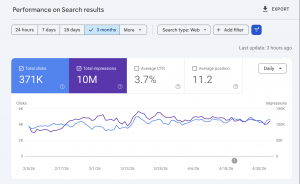
- Google Search Console — non-negotiable. this is where I check indexing, impressions, click-through rates, and spot ranking opportunities. across just Outrank and Revid alone, we’re looking at 371K clicks and 10M impressions (Revid, 3 months) and 56.8K clicks and 12.5M impressions (Outrank, 16 months).
- Ahrefs — for competitive analysis, domain rating tracking, and understanding what’s working across the portfolio. I check DR trends and referring domain growth regularly.
- Feather.so — we use Feather for some of our blogs since it turns Notion pages into SEO-ready blog posts. it handles sitemap generation, meta tags, and clean URLs automatically.
I keep the stack intentionally lean. Too many SEO tools create analysis paralysis. You need one system for content production (Outrank), one source of truth for search data (GSC), and one competitive intelligence tool (Ahrefs). Everything else is a distraction.
Can you share your efforts related to Link-Building?
Startup directory submissions.
We built a list of 400+ startup directories and submitted all 5 products to each of them. This is grunt work, but it builds a solid foundation of referring domains quickly. Most directories are free, some are paid. The key is doing it systematically, not submitting to 10 and calling it done.
Free tools earn links naturally.
Every free tool we publish becomes a link magnet. makers and content creators reference useful free tools in their roundup posts. our SEO Toolbox gets linked to from “best free SEO tools” articles we never even pitched to.
Content partnerships and interviews.
Features like this one with SEO Buddy are a great example. Contributing genuine, useful content to established publications gets you a quality backlink on a trusted domain. I’ve always prioritized these over automated link schemes.
Backlink exchange within Outrank.
We built a feature where Outrank users can exchange backlinks with each other. It’s like a marketplace where everyone helps each other build domain authority. It creates a win-win network that grows with our user base.
Cross-portfolio linking.
Having 5 products means 5 domains that can link to each other in contextually relevant way, this is a genuine advantage of the portfolio approach.
What have been the most influential books, podcasts, or other resources?
I learn more from watching what other great builders are doing than from reading SEO textbooks.
A few people whose content I pay attention to regularly in the space:
- Dany Postma — His approach to building programmatic SEO pages and shipping fast resonates a lot with how I think. He proved you can build SEO assets without a massive team.
- Lily Ray — One of the sharpest voices on Google algorithm updates, E-E-A-T, and what actually matters for ranking. If you want to understand where search is going, follow her.
- Ilias Ism — Great content on SEO strategy, especially around building topical authority and scaling organic growth for startups.
Beyond specific people, I’d say the biggest “resource” has been my own experience running Tweet Hunter and Taplio.
Building, selling, and then rebuilding from scratch taught me more about what works in SEO than any course or book ever could.
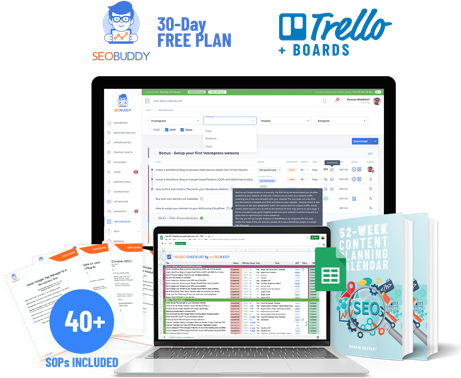
Now it’s time to discover the other 102 steps that will get more organic traffic flowing to your website. Get the SEO Checklist here — it’s free now, and so is the SOP Collection that goes with it. All you need is an account.
Want a look before you sign up?
Enter your email and I’ll send you the demo version.
What’s the next step in your SEO Journey?
Better schema and structured data.
We’re improving how all 5 products handle schema markup. Better FAQ schema, summary overviews early in articles, proper structured data for tools and software. This is especially important as Google’s search results become more feature-rich with AI overviews and rich snippets.
More free tools.
The free tools strategy has been the highest-ROI channel across the portfolio. We’re doubling down on this for every product.
More tools, more coverage of niche use cases, more reasons for people to discover us through search.
Deeper industry coverage.
Instead of just targeting keywords, I want each product’s blog to become the go-to resource in its domain. Outrank should be where people learn about SEO. Revid should be where people learn about short-form video.
This means more comprehensive guides, more comparisons, more thought leadership content.
Long-tail questions as a content pillar.
We’re systematically covering question-based keywords. “how to,” “what is,” “best way to,” “how many.” These convert incredibly well because the searcher has clear intent. We’re building content clusters around these question keywords with supporting interlinked articles.
Reddit and community content.
There’s a growing opportunity in Reddit SEO. Google is surfacing Reddit threads more and more in search results. We’re starting to engage more genuinely in relevant subreddits, which creates both direct traffic and SEO signals.
GEO and AEO (Generative Engine Optimization / AI Engine Optimization).
This is the big frontier. as AI chatbots like ChatGPT, Perplexity, and others start recommending products and resources, the question becomes: how do you get your product recommended? Outrank is already built around this idea. Strong topical authority, comprehensive content, and high domain rating are exactly what AI models look for when deciding what to reference.
The founders investing in SEO today aren’t just ranking on Google. they’re building the foundation for AI discovery.
Where can we go to learn more?
- Products: Outrank.so | Revid.ai | SuperX.so | PostSyncer.com | Feather.so
- Personal newsletter: tmaker.io
- X (Twitter): @tibo_maker
LinkedIn: linkedin.com/in/tibo-the-maker


 My SEO Journey: Hussain Jatoi from hussainjatoi.com – Why I Stopped Treating SEO…
My SEO Journey
My SEO Journey: Hussain Jatoi from hussainjatoi.com – Why I Stopped Treating SEO…
My SEO Journey
 My SEO Journey [Pro Edition]: Sanket Parmar from cmarix.com – How We Built…
My SEO Journey
My SEO Journey [Pro Edition]: Sanket Parmar from cmarix.com – How We Built…
My SEO Journey
 My SEO Journey [Pro Edition]: Breanna Golub from safaridigital.com.au – From Content Writer…
My SEO Journey
My SEO Journey [Pro Edition]: Breanna Golub from safaridigital.com.au – From Content Writer…
My SEO Journey
 My SEO Journey [Pro Edition]: Gethin Davies from futurmedia.co.uk – Building a DR48…
My SEO Journey
My SEO Journey [Pro Edition]: Gethin Davies from futurmedia.co.uk – Building a DR48…
My SEO Journey
Get the SEO work done, not just read about it
Create a free account and run your first content plan, keyword research and link-building campaign. No card, and setup is free until your first article.
Free to start. We never sell your address.