
Guest Post Services Compared: How to Choose a Safe Provider

In short
Guest post services are safest when buyers control site approval, topical relevance, link attributes, content standards, payment timing, and replacement terms. Compare the service model before comparing prices. No provider can guarantee rankings, and any payment to a publisher for ranking credit must be assessed against Google’s link-spam and disclosure guidance.
Key takeaways
- As of November 2026, Google treats buying or selling links for ranking purposes as link spam, including paid guest posts that pass ranking credit.
- An authority score is only a screening metric; topical fit, real traffic, indexation, editorial standards, and outbound-link patterns require separate checks.
- Site approval before publication gives the buyer a meaningful opportunity to reject an off-topic or low-quality placement.
- A contract should define the charge event, link attribute, delivery deadline, monitoring period, and replacement or refund trigger.
- A provider that guarantees rankings or refuses to explain its placement method should fail the evaluation.
Table of contents
- Which guest post service model fits your campaign?
- What should a safe provider let you approve?
- How can you tell whether a placement site is worth considering?
- Which red flags suggest link spam?
- What contract terms protect your budget?
- How should you compare guest post services before buying?
- What are the most common questions about guest post services?
- What should you do next?
Most guest post services pages begin with a ranked vendor list. That is the wrong first decision because a managed outreach service, a publisher marketplace, and self-serve outreach give the buyer different levels of control, labor, speed, and policy exposure.
Which guest post service model fits your campaign?
Start by deciding how much control and campaign work should remain with the buyer. Managed outreach, publisher marketplaces, and self-serve outreach solve different problems, so the right choice depends on the team’s capacity and risk policy.
The three service models at a glance
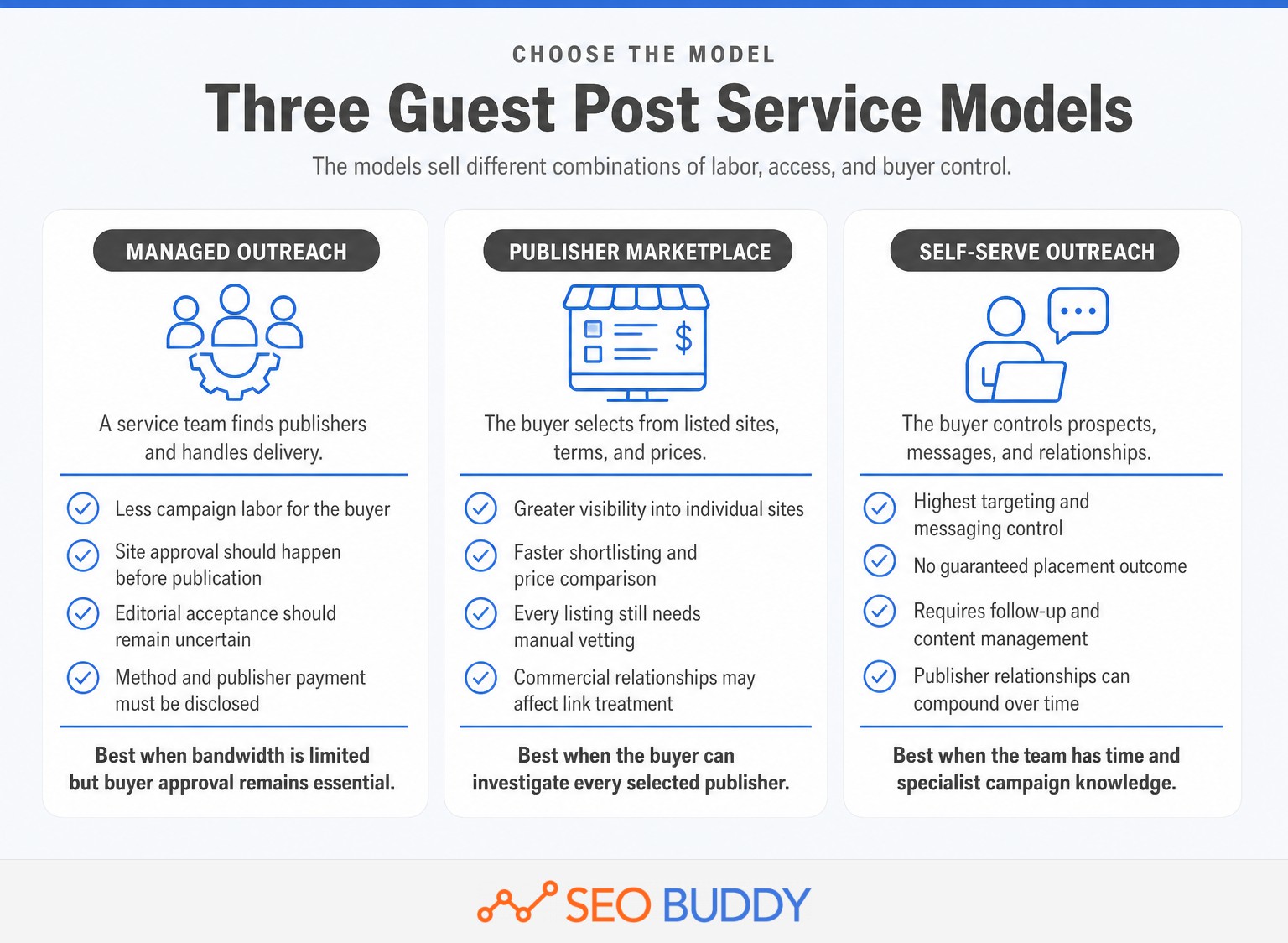
Managed outreach assigns prospecting, editor contact, content coordination, placement, and reporting to a service team. It fits a business that lacks outreach capacity, but the provider should explain whether editors make an independent publication decision or the service is drawing from prearranged paid inventory.
A managed provider should also show the proposed site before publication. Without that checkpoint, the buyer may pay for a technically live link on a website that is irrelevant, declining, or filled with unrelated commercial posts.
A publisher marketplace displays sites, metrics, categories, prices, and placement conditions so the buyer can select individual publishers. This model offers more site-level visibility and can shorten prospecting, but a listed price does not establish editorial quality or policy compliance.
As of November 2026, SEO Buddy’s Guest Blog Database states that it contains 121,386 sites. Buyers can browse guest-post sites by niche, language, traffic, and price, but every shortlisted site still requires individual review. A large catalog creates choice, not safety.
Self-serve outreach gives the buyer control over prospect selection, contact research, messages, negotiation, and content. It requires more work, but the buyer can target genuine editorial relationships instead of accepting whatever inventory a provider already controls.
Self-serve outreach is often the clearest model when a brand has specialist knowledge, a defensible reason to contribute, and enough time to build publisher relationships. It is a poor fit when nobody owns follow-ups, content delivery, or campaign records.
Choose the service model by the control and work it gives you, not by the lowest price per link.
Anybody can generate an article. Knowing which one is worth writing is the hard part.
The AI Content Engine reads your site and your competitors, then builds a ranked content plan and writes it. Setup is free, and you see your plan before you pay for anything.
See your content plan freeWhat should a safe provider let you approve?
A safe buying process should let the customer approve or reject the proposed site before content is published or the placement becomes chargeable. The provider should also disclose the destination page, anchor approach, link treatment, content process, and final verification method.
A buyer-controlled placement workflow
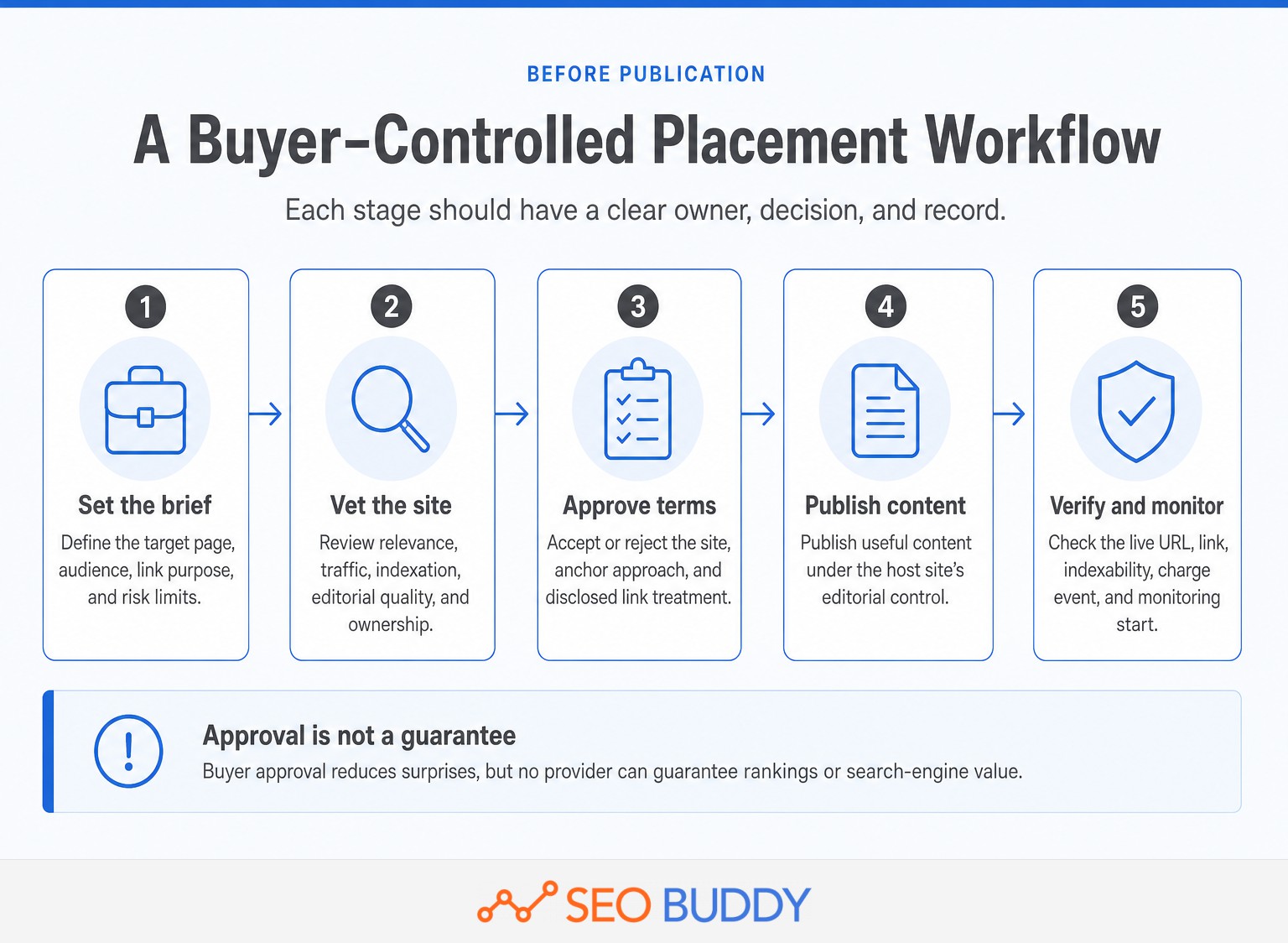
At minimum, retain control over these decisions:
- Campaign purpose: Define the page being promoted, the intended audience, and why a link would help the host publication’s readers.
- Proposed site: Review topical fit, language, market, traffic, indexation, recent content, and editorial ownership.
- Anchor and context: Confirm that the wording is natural and accurately describes the destination page.
- Link treatment: Know whether the link will be regular, sponsored, nofollow, or subject to another publisher policy.
- Content scope: Establish who writes the article, whether draft approval is available, and how factual or brand errors will be corrected.
- Verification: Require the live URL, final link destination, attribute, indexability status, and publication date.
Full draft approval is useful, but it is not offered by every legitimate service. If the provider does not offer it, the contract should state who controls editorial changes, what content standards apply, and what happens when the published article misrepresents the business.
Approval is valuable only when rejection has no hidden penalty. A provider should not pressure the buyer to accept an unsuitable site because prospecting work has already started or because a monthly quota must be filled.
For a broader due-diligence script covering methods, ownership, reporting, and exit terms, use the checklist on how to hire a link building agency.
A safe buying process gives the customer a meaningful chance to reject the site before publication.
How can you tell whether a placement site is worth considering?
A worthwhile placement site has a plausible audience for the linked page and evidence that search engines and readers engage with its normal editorial content. No single authority metric can establish those qualities by itself.
Six signals to check on every site
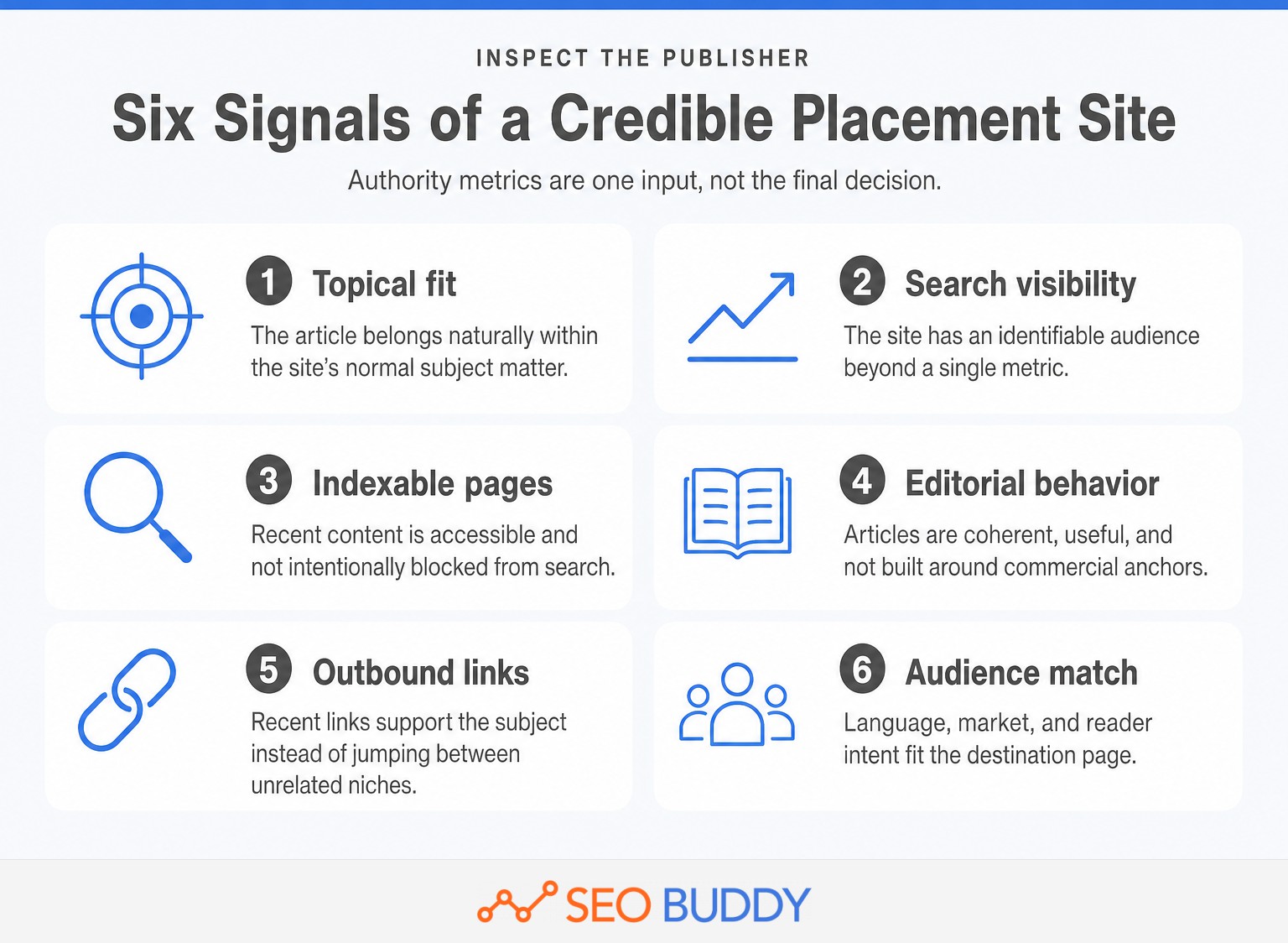
1. Topical fit
Read the site’s recent posts and category structure. The subject of the proposed article should fit the publication without forcing a connection between unrelated industries.
Page-level relevance matters too. A broad business publication may have a suitable software section, while a highly rated general site may have no natural context for a specialist legal, medical, or technical link.
2. Organic visibility
Ask when the traffic estimate was checked and which sections attract visits. A single traffic number can hide a decline, traffic concentrated in an unrelated topic, or a small group of pages carrying the entire domain.
Traffic estimates are imperfect, but a provider should be able to explain why the site appears to have a real search audience. Treat an authority score without traffic evidence as an incomplete review.
3. Indexation and page accessibility
The publication should have recent pages appearing in search and should not block the proposed article with noindex, authentication, or other access restrictions. Verification at publication is useful, but it does not guarantee that a search engine will keep the page indexed.
4. Editorial behavior
Look for coherent topics, readable articles, sensible internal links, identifiable ownership, and evidence that posts are written for people rather than assembled around commercial anchors. Poor grammar alone is not a definitive spam signal, but repetitive templates and unrelated subjects deserve scrutiny.
5. Outbound-link patterns
Review several recent articles. A site that repeatedly links to unrelated commercial pages with aggressive anchors is a weaker candidate than one whose external links support the subject being discussed.
6. Audience and market fit
Language, geography, expertise level, and reader intent should match the destination page. Referral visits are more plausible when the host audience can actually use the linked resource, product, or service.
The broader guide to links for seo explains why editorial choice and reader usefulness matter more than the label attached to a link type.
Relevance, readership, indexation, and editorial behavior matter more than one authority score.
Which red flags suggest link spam?
Link spam risk rises when the placement exists mainly to manufacture ranking credit rather than serve the host site’s audience. The clearest warning signs are guaranteed outcomes, hidden sites, unexplained payments, forced anchors, and publishers that accept unrelated topics without meaningful review.
As of November 2026, Google’s spam policies define buying or selling links for ranking purposes as link spam. The examples include payment for posts containing links and optimized anchor text in guest posts that pass ranking credit.
Google’s outbound-link guidance says advertisements and paid placements should use rel="sponsored"; nofollow remains acceptable. This makes one question essential: does the fee pay only for prospecting, writing, and outreach labor, or does a publisher receive compensation for providing the article and link?
Paying a service team to conduct genuine outreach is not automatically identical to paying a publisher for ranking credit. The buyer still needs a clear answer about where the money goes, whether the editor can decline, and how any commercial relationship affects disclosure and link attributes.
Pause the purchase when a provider:
- Guarantees rankings, traffic, authority growth, or visibility in AI-generated answers.
- Refuses to identify the proposed site before publication.
- Sells every niche on the same group of general websites.
- Requires an exact-match commercial anchor regardless of sentence context.
- Shows only an authority score and withholds traffic or indexation evidence.
- Cannot explain whether a publisher, broker, writer, or outreach team receives the fee.
- Publishes near-identical articles across multiple sites.
- Has no written policy for removed links, changed attributes, or deindexed pages.
Google’s site reputation policy does not classify all third-party content as a violation. The concern is content placed mainly to exploit a host domain’s existing ranking signals rather than provide value to its readers.
Advertising law is separate from search policy. When a guest article contains an endorsement and a material connection exists, the U.S. Federal Trade Commission’s endorsement guidance says disclosure should be clear, understandable, and hard to miss. Other jurisdictions may impose their own requirements.
If a provider cannot explain who is paid and how the link is treated, the risk is not being disclosed.
What contract terms protect your budget?
A useful contract defines what the buyer is purchasing, when a charge becomes final, and what happens when a placement is late, altered, removed, or blocked from indexing. A vague promise to replace bad links is not enough.
| Term | A clear answer should state | Warning sign |
|---|---|---|
| Site rejection | When the site is shown and whether rejection costs anything | The buyer sees the domain only after publication |
| Payment trigger | Whether payment is held, prepaid, or charged after live verification | A nonrefundable charge before the site is disclosed |
| Delivery | A calendar deadline and the remedy for missed delivery | An estimated turnaround with no late-placement remedy |
| Link treatment | The expected attribute and what happens if the publisher changes it | The attribute is described only as permanent or SEO-safe |
| Monitoring | The exact monitoring period and the conditions checked | Lifetime monitoring with no schedule or defined remedy |
| Replacement | Whether removal, noindex, redirect, or attribute changes qualify |
Replacement is offered only at the provider’s discretion |
| Cancellation | What can be canceled and how unused funds are returned | Unpublished placements remain payable after cancellation |
| Reporting | The live URL, target URL, anchor, attribute, and verification date | A monthly link count without individual URLs |
A replacement promise protects the budget only when the monitoring period, qualifying event, and remedy are written down. Buyers should also ask whether the replacement receives a new monitoring period or merely inherits the remaining days from the original placement.
Price comparisons need the same level of detail. One link building package may include content, outreach, site approval, verification, and monitoring, while another headline price covers only publisher access.
Replacement terms protect a budget only when the trigger, remedy, and monitoring period are written down.
How should you compare guest post services before buying?
Use a pass-or-pause checklist rather than averaging every feature into one score. Method, publisher payment, site approval, and disclosure are critical controls, so a failure in one of those areas should not be canceled out by a low price or high authority metric.
The final pass-or-pause scorecard
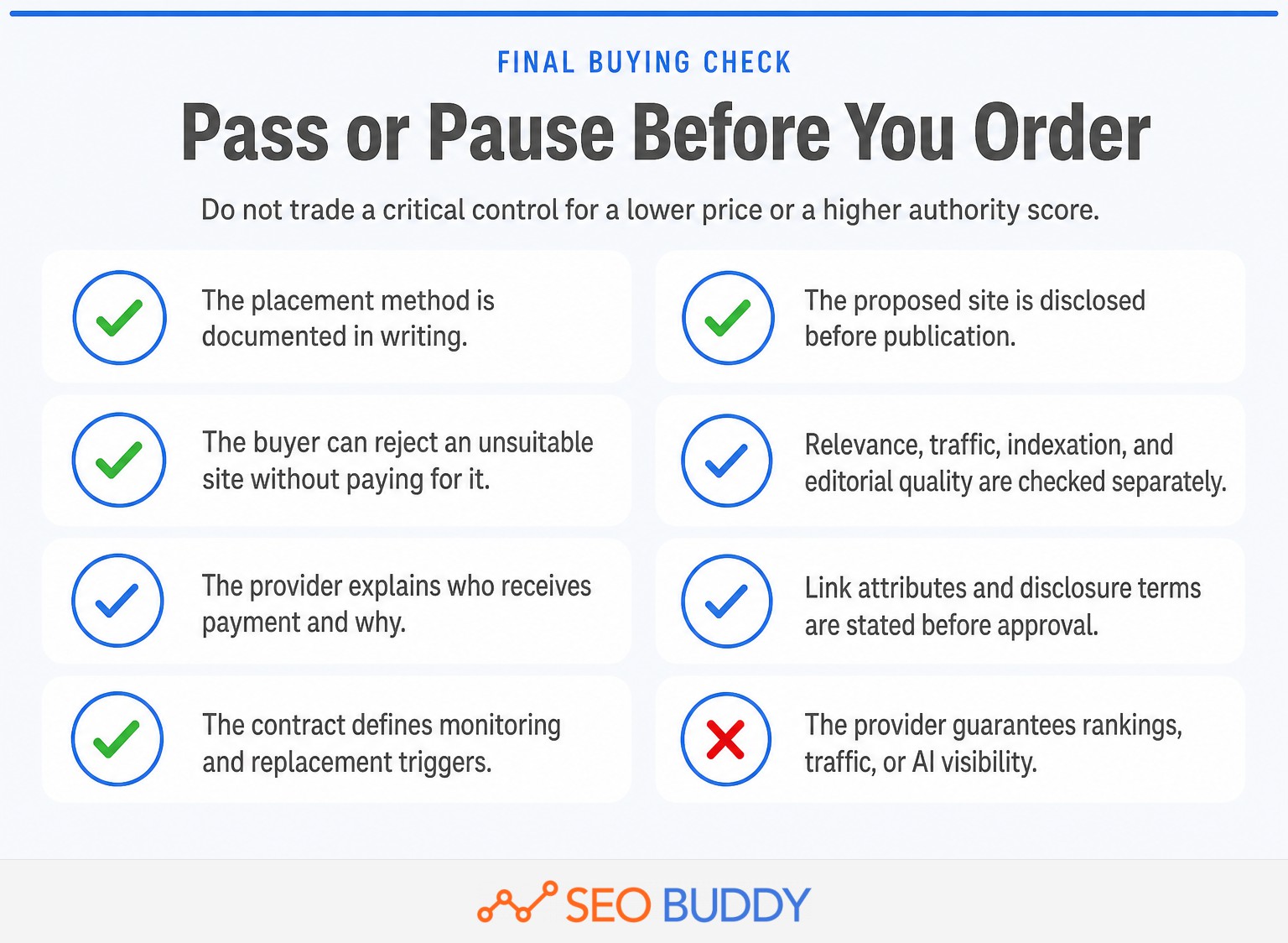
A provider passes the first review when the answer to every question is clear:
- Is the placement method described in writing?
- Will the proposed site be disclosed before publication?
- Can the buyer reject a site without paying for that placement?
- Are topical relevance, traffic, indexation, and editorial quality checked separately?
- Does the provider explain who receives payment?
- Are link attributes and commercial disclosures stated before approval?
- Is the content written for the host audience rather than around an anchor?
- Does the charge event occur at a defined stage?
- Are delivery, cancellation, monitoring, and replacement terms written down?
- Does the provider avoid ranking and traffic guarantees?
After those gates are passed, compare convenience and cost.
Choose managed outreach when the team lacks outreach capacity but still requires site approval and clear verification. The trade-off is less day-to-day control and an outcome that depends on editors accepting the pitch.
Choose a marketplace when the team wants to inspect and select individual publishers. The trade-off is that the buyer must investigate the commercial relationship, editorial quality, and link treatment for every site.
Choose self-serve outreach when the team wants maximum control over targets, messages, and publisher relationships. The trade-off is the time needed for prospecting, follow-up, content delivery, and recordkeeping.
There is no universally best guest post service because the models sell different combinations of labor, access, and control. The safest choice is the one that makes its method inspectable and leaves the buyer able to decline unsuitable placements.
The best guest post service is the model that passes every critical control, not the one with the biggest inventory.
What are the most common questions about guest post services?
Most questions come down to where to publish, what guest blogging means, and whether authority scores are enough. The answers below focus on editorial fit and policy risk rather than static lists of domains.
What are some good websites for guest posting?
Good websites for guest posting are sites whose normal subject matter, readership, language, and geography match the page being promoted. Check that the site has real search visibility, indexed pages, recent editorial activity, and sensible outbound links. A static high-authority list is less useful than a verified, campaign-specific shortlist.
What is guest blogging?
Guest blogging is the practice of creating an article for another website’s audience. It can build brand reach, referral traffic, relationships, and editorial links when the host chooses the content because it serves readers. It becomes risky when publication exists mainly to sell or manufacture ranking credit.
What is the scope of guest posting in 2026?
The scope of guest posting in 2026 includes expert contributions, brand education, referral acquisition, publisher relationships, and link earning. The tactic still has value, but bulk paid placements and optimized anchors face clearer policy scrutiny. Sustainable campaigns prioritize editorial fit, useful content, transparent relationships, and realistic expectations.
What are some websites with high DA and PA for blog submissions?
Websites with high DA and PA are not automatically good submission targets. Authority scores are third-party estimates, not editorial guarantees. Use them only as an initial filter, then check topical relevance, organic traffic, indexation, audience fit, content quality, outbound-link patterns, disclosure rules, and the exact page where the link would appear.
Guest posting remains useful when it serves a real audience and risky when it exists mainly to manufacture ranking credit.
What should you do next?
Select the service model first, then require written answers about method, site approval, publisher payment, link treatment, verification, and replacement. Reject any proposal that makes the website or commercial relationship visible only after publication.
If handled outreach fits the campaign, review SEO Buddy’s approval-based editorial placements. The service page explains site approval, charging after live verification, and 90-day monitoring, but buyers should still read its link-attribute terms, ask who receives any placement payment, and decide whether the process fits their own risk policy.
Choose the provider whose process you can inspect and whose risks you can accept before a placement is made.

CEO & Founder at SEO Buddy


 Why Google Rankings Fluctuate and When to Take Action
General SEO
 Is SEO an Ongoing Process? What to Repeat Monthly, Quarterly, and Annually
General SEO
 Link-Building Packages Explained: Deliverables, Pricing, and Red Flags
General SEO
 Is SEO Dead? What AI Search Changed and What Still Works
General SEO
Get the SEO work done, not just read about it
Create a free account and run your first content plan, keyword research and link-building campaign. No card, and setup is free until your first article.
Free to start. We never sell your address.