
How to Hire a Link-Building Agency: 12 Questions to Ask Before Signing

In short
Hiring a link-building agency starts with control: define the pages and outcomes you want, require a written acquisition method, set placement standards, approve targets before publication, and agree on reporting, replacement, ownership, and exit terms. Reject any provider that guarantees rankings, hides its sites or tactics, or sells unexplained link volume.
Key takeaways
- Set target pages and rejection rules before requesting proposals; otherwise, agencies can quote incomparable deliverables under the same service label.
- As of October 25, 2026, Google's spam policies identify bought ranking links, excessive exchanges, automated link creation, and low-quality directory links as examples of link spam.
- Google's guidance for hiring an SEO says no provider can guarantee a number-one Google ranking.
- Require disclosure of publisher compensation and link attributes instead of accepting a blanket promise of dofollow links.
- Judge a pilot on transparency, placement fit, delivery control, and reporting before committing more budget.
Table of contents
- What should you decide before contacting a link-building agency?
- Which 12 questions should you ask a link-building agency?
- What answers separate legitimate link building from link spam?
- How should you compare pricing and contracts?
- How should you verify case studies and reporting?
- How should you run a link-building pilot?
- What else should you know before hiring?
- What should you do next?
The hiring decision becomes easier when every promise is converted into a method, acceptance rule, deliverable, or contract term. The objective is not to find an agency with the largest site list. It is to find one whose work can be inspected before, during, and after delivery.
What should you decide before contacting a link-building agency?
Decide which pages need support, what business outcome matters, which acquisition methods are acceptable, and how much control the buyer must retain. A clear brief makes proposals comparable and prevents the campaign from defaulting to whichever placements are easiest for the agency to produce.
Write down the following before requesting a quote:
- Target pages: Name the product, service, category, tool, research, or guide pages the campaign may support. Do not assume every link should point to the home page.
- Desired outcomes: Separate referral traffic, publisher relationships, qualified inquiries, brand references, and broader search visibility. An agency should know which outcome has priority.
- Acceptable methods: State whether editorial outreach, contributed articles, resource-page outreach, digital public relations, legitimate directories, or other routes are allowed.
- Non-negotiable exclusions: List tactics such as automated comments, bulk profile links, undisclosed paid links, unrelated directories, compulsory exchanges, or prewritten articles distributed at scale.
- Approval rights: Decide whether the buyer must approve the site, page type, topic, destination, and anchor before publication.
- Internal capacity: Identify who will review proposals, supply expert input, approve drafts, and check completed placements.
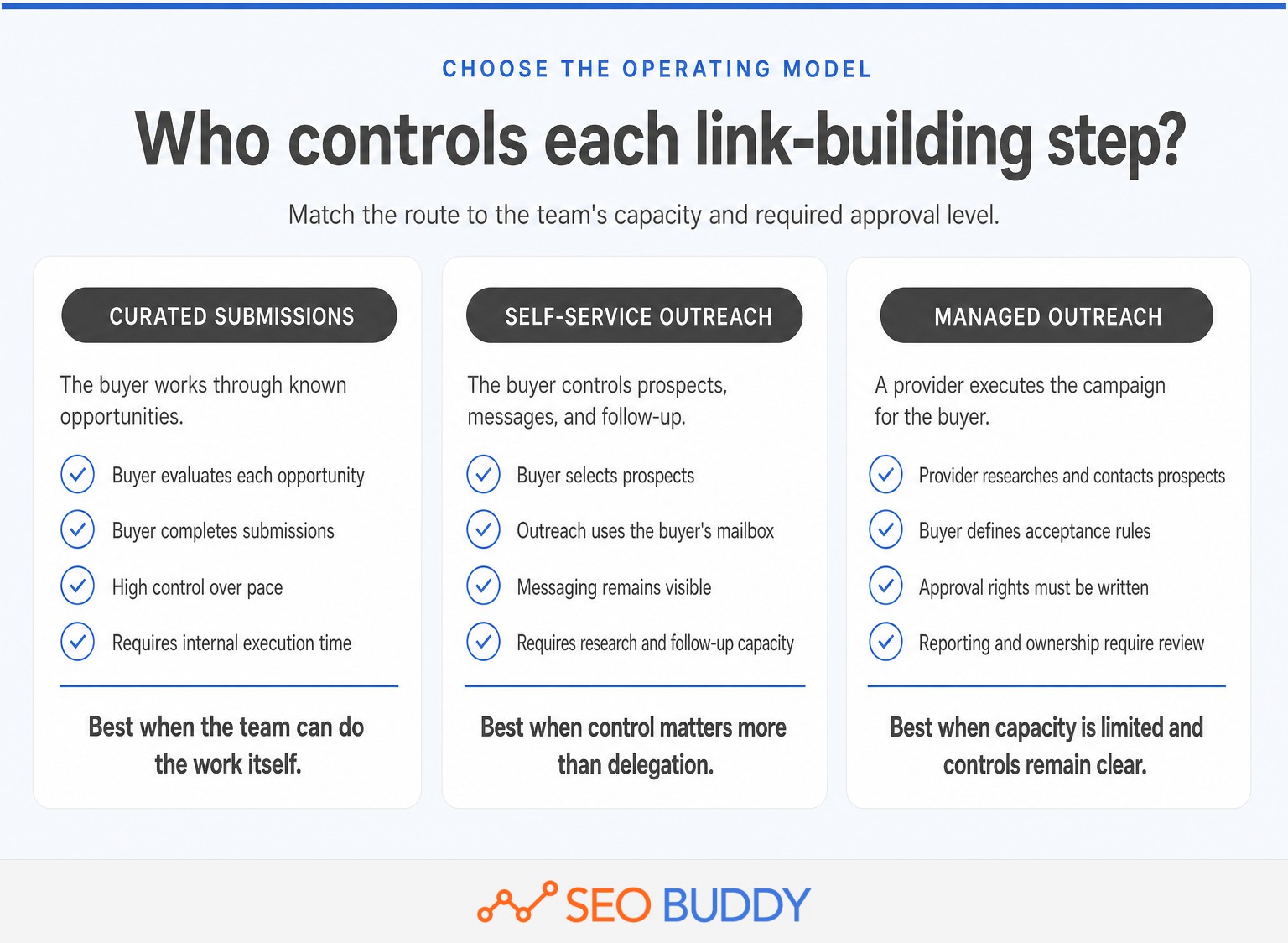
The operating model should also be clear. A submission-led workflow gives the buyer control but requires time to evaluate and complete opportunities. An outreach-led workflow adds prospect research, contact discovery, pitching, and follow-up. A managed service delegates those tasks but should preserve agreed approval and verification rights.
SEO Buddy separates curated link opportunities from a self-service prospecting and outreach workflow, illustrating why buyers should decide which work they want to retain before comparing providers.
Record a baseline for every target page before work begins. At minimum, save its current search impressions, clicks, relevant queries, referring domains, referral visits, and conversions where available. The baseline will not prove that a later change came from one backlink, but it prevents the campaign from being judged through memory and selective screenshots.
A useful agency brief defines the pages, acceptable methods, approval rights, and evidence required before price enters the conversation.
Anybody can generate an article. Knowing which one is worth writing is the hard part.
The AI Content Engine reads your site and your competitors, then builds a ranked content plan and writes it. Setup is free, and you see your plan before you pay for anything.
See your content plan freeWhich 12 questions should you ask a link-building agency?
Ask questions that require evidence, not adjectives. A satisfactory response should explain what the agency will do, how the buyer can verify it, and what happens when a proposed or completed placement fails the agreed standard.
| # | Question | A satisfactory answer includes | Warning sign |
|---|---|---|---|
| 1 | Which pages and business outcomes will the campaign support? | Named target pages, reasons for selecting them, and a clear primary outcome. | A promise to raise authority through links to any convenient page. |
| 2 | Which acquisition methods will you use? | A written list of methods, how each works, and when each method is appropriate. | A secret method, unexplained network, or generic promise of manual outreach. |
| 3 | How do you select prospects? | Topical relevance, page-level context, audience fit, editorial standards, visibility, and indexability checks. | Selection based only on a third-party authority score. |
| 4 | Can the buyer approve or reject proposed placements? | The exact approval stage, information supplied, rejection rules, and any limits. | No inspection rights under a contract priced per placement. |
| 5 | What placement standards and exclusions apply? | Written minimum standards plus categories, tactics, and site types the agency will reject. | A large site list with no page-level quality rules. |
| 6 | Do publishers receive money, products, services, or reciprocal links? | Full disclosure of consideration and the link attribute or disclosure used when required. | Guaranteed dofollow links regardless of the commercial arrangement. |
| 7 | Who creates and reviews the surrounding content? | Named responsibility for research, writing, fact-checking, revisions, and publisher review. | Reused, spun, or thin content created only to carry a link. |
| 8 | How are destination pages and anchors selected? | Descriptive anchors, varied phrasing, suitable destination pages, and room for editorial changes. | Fixed exact-match quotas or every link pointing to the home page. |
| 9 | What does the quoted price include? | Strategy, outreach, writing, publisher charges, revisions, tools, monitoring, and taxes where applicable. | A low headline price followed by undisclosed production or placement fees. |
| 10 | What will the report contain? | Linking URL, target URL, anchor, attribute, publication date, method, status, and relevant cost. | A domain list or link count without page-level evidence. |
| 11 | What happens if a link is removed or changed? | A monitoring period, replacement or credit rules, exclusions, and a response deadline. | No written definition of a lost or unacceptable placement. |
| 12 | Who owns the work, and how can the contract end? | Ownership of approved content and campaign records, export rights, notice periods, unfinished-work rules, and pilot options. | Long lock-in, no data export, or payment for work that cannot be inspected. |
Require the answers in writing. A sales call may clarify the proposal, but the final contract and statement of work should carry the definitions that determine whether the agency has delivered.
Approval rights should match the method being sold. Earned media and digital public relations may not permit the buyer to pre-approve a specific publisher. A placement-based service can usually define the proposed site, target page, topic, price, and rejection process before publication. The contract should not sell one model while delivering the other.
Before scoring the proposed formats, compare them with our guide to links for seo. A label such as guest post, resource link, citation, or editorial link does not establish quality by itself. The linking page, reason for inclusion, audience, attributes, and surrounding context still require review.
Treat authority and traffic estimates as screening inputs rather than automatic acceptance rules. A strong domain-level score cannot prove that the proposed page is relevant, editorially credible, visible to readers, or suitable for the destination being promoted.
The best hiring questions force every promise into a method, acceptance rule, deliverable, or contract term that can be checked.
What answers separate legitimate link building from link spam?

Legitimate answers explain how publishers are found, why a destination deserves inclusion, who makes the editorial decision, and how compensation and attributes are handled. Spam-risk answers emphasize hidden methods, automated creation, guaranteed dofollow links, fixed exact-match anchors, or link volume without a reader-focused reason.
Google defines link spam as creating links to or from a site primarily to manipulate search rankings. Its current examples include buying or selling links for ranking purposes, exchanging goods or services for links, excessive reciprocal linking, automated link creation, low-quality directories, optimized comment links, and widely distributed template or widget links.
Paying an agency for research, writing, and outreach and compensating a publisher for a placement are two different facts. Ask about both. A buyer should know what the agency charges, whether any consideration reaches the publisher, and whether the resulting link requires qualification.
Google's guidance on qualifying outbound links says advertisements and paid placements should use rel=sponsored; nofollow remains acceptable. A provider that promises an unqualified dofollow link regardless of payment or sponsorship is not giving the publisher room to follow that guidance.
A credible answer usually includes these points:
- Prospects are researched for the target subject rather than selected from one fixed list for every client.
- The proposed destination gives the publisher a defensible reason to link.
- Publishers may reject the pitch, change the wording, choose another anchor, or decline the link.
- Any publisher compensation, exchange, sponsorship, or supplied product is disclosed to the buyer.
- Attributes and disclosures follow the nature of the arrangement rather than a blanket dofollow promise.
- Forecasts are presented as estimates, not guaranteed rankings, traffic, or deadlines.
Warning signs include an immediately available inventory of thousands of unrelated sites, identical packages for every niche, automated comments or profiles, exact-match anchor quotas, no way to inspect placement-based work, and a refusal to explain where the buyer's money goes.
An agency can still be legitimate when it cannot promise a specific publication. That uncertainty is normal in genuine editorial outreach. The problem is charging for guaranteed editorial choice while hiding a system that removes editorial choice from the publisher.
A legitimate agency explains the path to each link and rejects tactics built mainly to manufacture ranking credit.
How should you compare pricing and contracts?
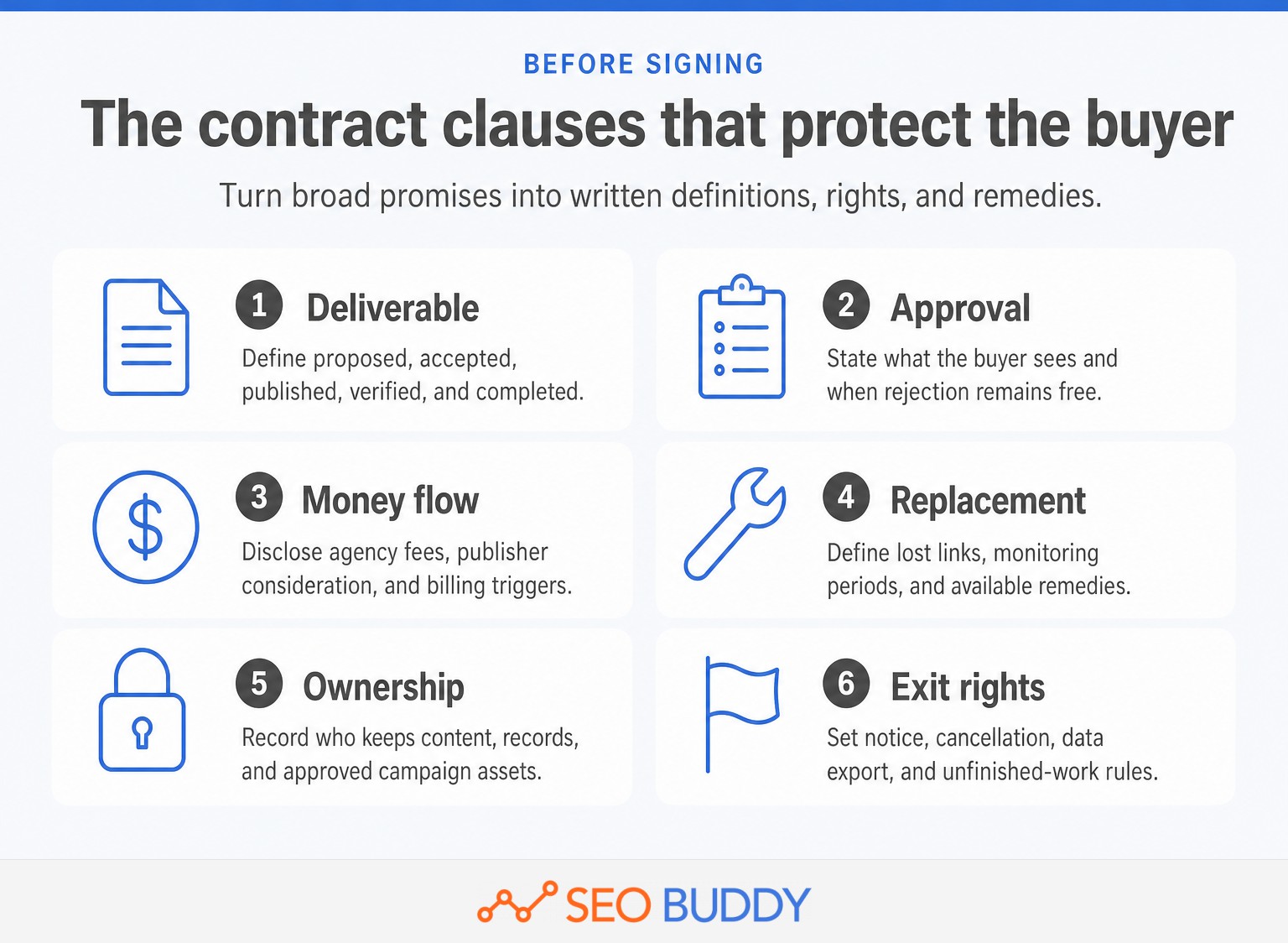
Compare total risk-adjusted cost, not the cheapest advertised price per link. The contract should define acceptance, charges, deadlines, replacements, link attributes, ownership, data access, cancellation, and what happens to unfinished work.
Common pricing structures include retainers, fixed projects, consulting fees, and charges per accepted or published placement. No pricing model proves quality. Each model can work when the deliverable and money flow are clear.
Normalize proposals with the same cost framework:
Total campaign cost = strategy + prospecting + outreach + content + publisher compensation + tools + revisions + monitoring
A component should be counted only when it applies, but none should be hidden. Ask for a sample invoice or order statement showing what becomes chargeable, when the charge occurs, and which costs can change after approval.
Review these contract clauses line by line:
- Deliverable definition: State what counts as proposed, accepted, published, verified, retained, and completed.
- Approval and rejection: Specify the information supplied before approval, how rejections work, and whether rejected proposals consume fees or credits.
- Compensation and attributes: Record whether publishers receive consideration and how sponsored, nofollow, or other attributes are handled.
- Delivery and billing: Define deadlines, billing milestones, late work, rollover rules, and refunds or credits for undelivered work.
- Replacement policy: Define a lost link, monitoring period, remedy, exclusions, and response time.
- Content ownership: State who owns drafts, approved articles, research, and other campaign assets after cancellation.
- Data access: Require an export of prospects, outreach status, approvals, published URLs, and campaign records the buyer is entitled to retain.
- Cancellation: State notice periods, cancellation fees, treatment of work in progress, and whether unused funds expire.
- Subcontractors and conflicts: Require disclosure when material work is delegated and address conflicts involving direct competitors where relevant.
- Remedies: Explain what happens when a placement violates the agreed standard, uses the wrong destination, or changes before verification.
Turn the final requirements into editable SEO procedures for whoever approves proposals, checks links, and reviews reports. A documented review process is especially useful when founders, marketers, agency staff, and clients share responsibility.
Do not accept a contract that uses vague words such as quality, authority, or premium without defining how those words affect acceptance and payment. If the agency refuses measurable definitions because every placement is different, it can still define the evidence supplied and the buyer's decision rights.
A fair price is one attached to a precise deliverable, disclosed money flow, and written remedy when delivery fails.
How should you verify case studies and reporting?
Verify examples at page level and require reporting that separates delivery from outcomes. A useful case study shows dates, target pages, actual placements, material non-link changes, and the limits of what can be attributed to the campaign.
Ask to inspect live examples instead of relying only on client logos, authority-score screenshots, or traffic charts. For each example, review:
- The linking page and its relevance to the destination.
- The publication date and whether the link remains live.
- The surrounding sentence, anchor, destination, and link attribute.
- Whether the content serves the publication's audience without the link.
- Whether major content, technical, brand, advertising, or seasonal changes occurred during the same period.
- Whether the results shown concern the linked pages or unrelated sections of the site.
A case study can demonstrate that an agency completed work and that performance changed afterward. It usually cannot prove that one backlink caused the change. Search visibility can also be affected by content updates, internal links, competition, demand, technical changes, and ranking-system updates.
Require three reporting layers:
- Delivery evidence: Proposed sites, approvals, rejections, live URLs, targets, anchors, attributes, publication dates, acquisition methods, costs, and retention status.
- Visitor and business outcomes: Referral visits, engaged sessions, inquiries, sign-ups, assisted conversions, and useful publisher relationships where measurable.
- Search performance: Target-page impressions, clicks, queries, click-through rates, and landing-page trends from Search Console performance reporting.
The Search Console Links report can show linking sites, linked pages, and common link text. Google states that the report is a sample rather than a complete backlink index, may include links that have disappeared, and does not identify whether a backlink is nofollowed. It should not be the agency's only delivery record.
Agree on reporting frequency and ownership before the campaign starts. The buyer should retain a usable placement record after the contract ends rather than losing access to the only dashboard containing the evidence.
Good reporting proves what was delivered, shows what visitors did, and tracks search changes without pretending one link caused them.
How should you run a link-building pilot?
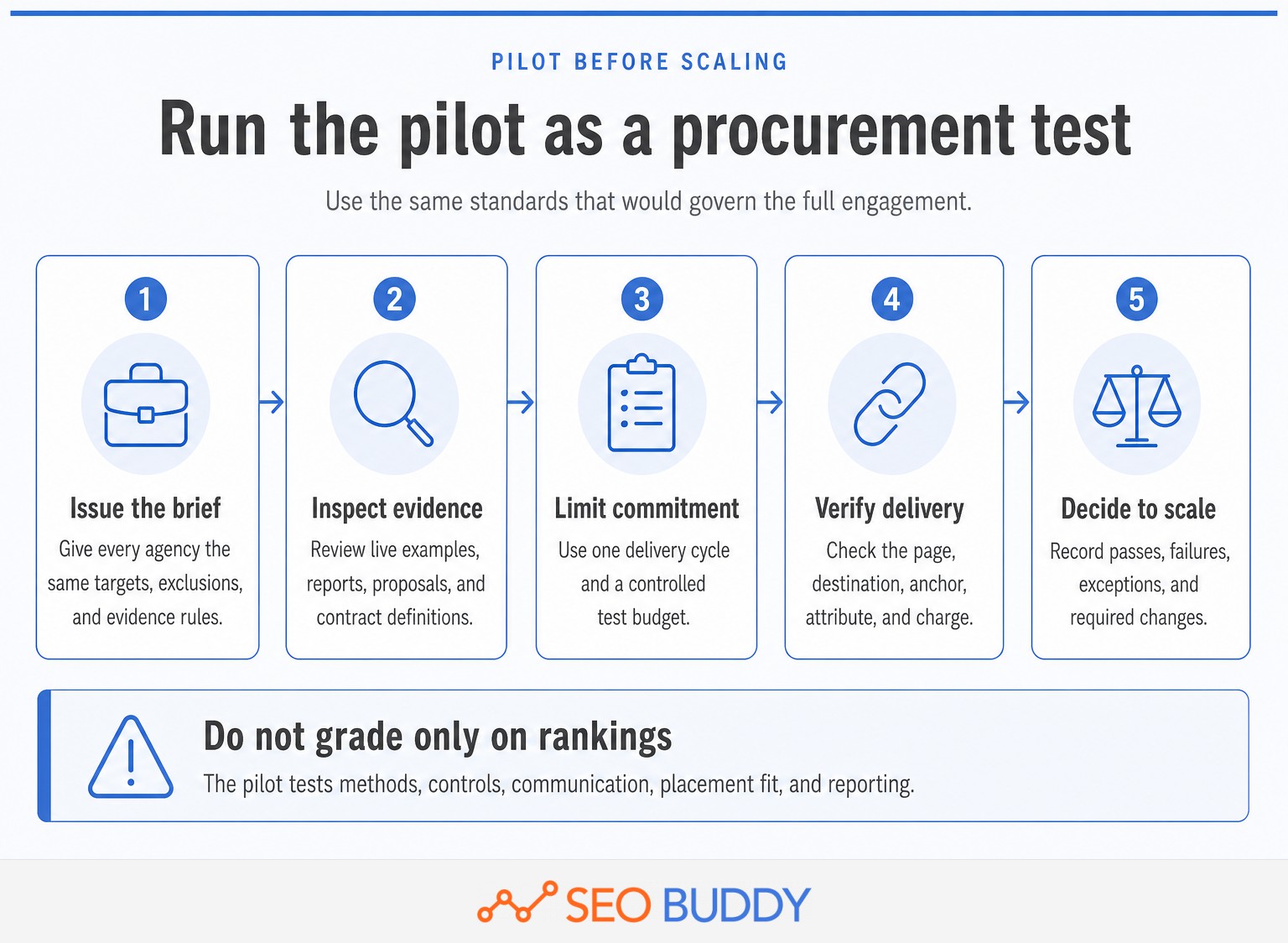
Run a limited pilot using the same standards that would govern a larger engagement and schedule a clear stop, revise, or scale review. The pilot should test process quality, transparency, placement fit, delivery control, and reporting rather than demand an immediate ranking increase.
Use this five-step process:
- Issue one written brief. Give every shortlisted agency the same targets, exclusions, approval requirements, reporting fields, and commercial questions.
- Review sample evidence. Inspect live examples, a redacted report, a sample proposal, and the contract definitions before authorizing work.
- Limit the first commitment. Use one delivery cycle, a small group of target pages, and a budget the business can afford to treat as a procurement test.
- Verify every deliverable. Check the linking page, destination, anchor, attribute, surrounding context, publication status, disclosure, and agreed charge.
- Hold a written retrospective. Record which standards passed, which required exceptions, how communication worked, and what must change before scaling.
A pilot acceptance sheet can remain simple. Mark each non-negotiable as passed or failed, including topical relevance, approval compliance, correct destination, appropriate attribute, complete reporting, disclosed charges, and treatment of rejected or lost placements.
Do not change the acceptance standard merely because the agency has already invested time in outreach or writing. The purpose of defining the standard before work begins is to stop sunk cost from turning an unsuitable proposal into an accepted placement.
Ranking movement can be monitored during and after the pilot, but it should not be the only pass-or-fail condition. The agency does not control every factor affecting search performance, while the agency does control its methods, disclosures, quality checks, communication, and reporting.
A pilot should test the agency's process and controls before the buyer commits more budget, not demand instant ranking proof.
What else should you know before hiring?
These questions cover price, agency value, selection, and the skills involved in professional link building. The first three support the buying decision, while the final question clarifies what competent execution requires.
How much does link building cost?
Link-building cost varies with the work included, the difficulty of reaching relevant publishers, content production, placement standards, and replacement terms. Compare providers using the total cost per accepted, published, and retained placement, not a headline price that excludes strategy, writing, publisher charges, reporting, or failed outreach.
Is it worth hiring an SEO agency?
Hiring an SEO agency can be worthwhile when the agency supplies skills, relationships, tools, or execution capacity that would cost more to build internally. It is not worthwhile when goals are undefined, the provider hides its methods, or the contract shifts risk to the buyer while guaranteeing outcomes it cannot control.
How to choose a link building agency?
Choose a link-building agency by checking its acquisition methods, prospect standards, approval process, link-attribute policy, reporting, replacement terms, ownership, and exit rights. Ask for live examples and a limited pilot. Reject guarantees, undisclosed publisher payments, fixed lists sold repeatedly, and reporting that counts every link as equal.
How to become a link builder?
To become a link builder, learn prospect research, search intent, content evaluation, email outreach, negotiation, anchor text, link attributes, and reporting. Practice by promoting a genuinely useful resource to relevant publishers, document each step, and review outcomes without treating replies, placements, or rankings as guaranteed.
The right agency is worth hiring only when its method, economics, and accountability fit the buyer's goals.
What should you do next?
Turn the 12 questions into a written request for proposal and require every shortlisted agency to answer in the same format. Compare evidence before price, then run a limited pilot with approval, verification, ownership, and cancellation terms already agreed.
For a managed option, SEO Buddy's link-building services let customers approve each proposed site before placement and charge for a placement only after it is published and verified. Submit the target page and acceptance criteria, then use the questions in this guide when reviewing the proposal.
Do not sign until the agency's method, acceptance rules, money flow, ownership, and exit terms are clear in writing.

CEO & Founder at SEO Buddy




Get the SEO work done, not just read about it
Create a free account and run your first content plan, keyword research and link-building campaign. No card, and setup is free until your first article.
Free to start. We never sell your address.