
My SEO Journey: Hussain Jatoi from hussainjatoi.com – Why I Stopped Treating SEO as a Checklist and Started Fixing the Systems Behind Business Growth

My SEO Journey is a series where professionals in the SEO Industry, Digital Marketing, or Web Design share their honest SEO Journey filled with failure, success, and most importantly, proven results. Episode #175 features Hussain Jatoi from hussainjatoi.com.
I’m Hussain Jatoi, an independent Business Growth Systems Architect working with founders, property management companies, service businesses, and agencies that want to improve how their websites and digital systems support business growth.
My work covers WordPress and Elementor development, technical SEO, conversion rate optimization, AI search visibility, and business automation. Most of my target customers are in the United States and United Kingdom, although I work remotely from Pakistan.
My personal website is HussainJatoi.com. It’s where I bring together my services, project experience, case studies, and ideas about building more connected business systems.
I also founded Zahvox, a voice-first writing product designed to help people turn spoken thoughts into usable written content.
The thinking behind both projects is similar. Technology should help people finish useful work, not simply give them more tools to manage.
That’s also how I approach SEO.
I don’t see rankings as the final outcome. I see them as one part of a process that starts when someone searches for a solution and continues through the website experience, inquiry, follow-up, and eventual business result.
What’s your backstory and how did you come up with the idea?
I didn’t begin my career calling myself a Business Growth Systems Architect.
My early work involved social media, website design, and digital marketing. As I gained experience with WordPress, Elementor, and SEO, I started noticing how frequently businesses treated these activities as separate jobs.
One person handled the website. Someone else wrote content. Another person worked on rankings. Lead follow-up might happen in a spreadsheet, an inbox, or a CRM that wasn’t connected properly to anything else.
Each activity could appear successful on its own.
The website might look better. Search impressions might increase. Content might be published consistently.
But those improvements didn’t automatically mean that the business was generating better inquiries or making more sales.
That observation gradually changed the questions I asked when reviewing websites.
Instead of starting with “Which keywords are missing?” I began asking why the website existed, what visitors needed, and what happened after they took an action.
Sometimes SEO was the biggest problem. Sometimes it wasn’t.
A poorly placed CTA, confusing navigation, slow-loading images, or an incomplete follow-up process could prevent a business from getting the full value of its existing traffic.
Over time, I developed a broader approach that I now describe through the Jatoi Growth Framework: visibility, trust, conversion, automation, and scale.
The framework helps me examine how these areas work together instead of recommending the same service to every business.
Starting my independent personal brand was another part of that development.
I wanted my website to represent the work I actually do, the problems I understand, and the results I can substantiate—not just a long collection of service descriptions.
I’m still building that visibility, which makes my own SEO journey an ongoing process rather than a finished success story
Anybody can generate an article. Knowing which one is worth writing is the hard part.
The AI Content Engine reads your site and your competitors, then builds a ranked content plan and writes it. Setup is free, and you see your plan before you pay for anything.
See your content plan freeSince launch, what has worked to attract more organic traffic?
One important distinction: my personal website is still in its authority-building stage, and I don’t have a verified traffic-growth figure that I can responsibly share.
Much of my strongest SEO experience comes from implementing improvements for client websites.
One example is my work on The Westside Group, an Austin apartment rental and property management website.
The website serves people searching for apartments around UT Austin, West Campus, Clarksville, West Downtown, Hyde Park, and North University.
It already contained useful property information, apartment photography, neighborhood pages, blog articles, reviews, floor plans, and application resources.
My responsibility wasn’t to rebuild it.
I needed to improve its SEO structure, performance, mobile usability, and navigation while protecting the existing website and its important business functions.
The first challenge was search intent
The website contained different types of pages that naturally shared many of the same keywords.
A homepage about Austin apartment rentals could mention West Campus. A neighborhood page could also discuss West Campus. Individual buildings in that neighborhood would naturally refer to West Campus and UT Austin.
But those pages served different needs.
I approached the content according to its role.
The homepage remained the broad Austin apartment rental entry point.
Neighborhood pages helped people explore particular areas.
Individual property pages provided details about specific buildings, including photographs, location information, available floor plans, and application options.
Review pages remained focused on resident feedback rather than trying to compete with the main apartment pages.
I then worked through titles, descriptions, internal links, supporting content, and FAQs.
The objective was to make the website easier to understand and navigate—not simply to use the same keywords more often.
The second challenge was performance
The site depended heavily on property photography.
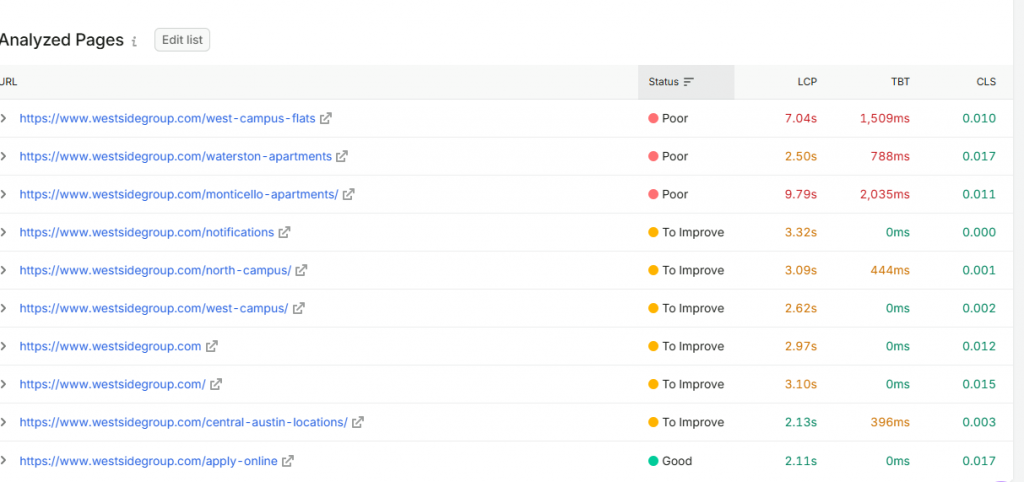
I reviewed more than 400 images, identifying opportunities to reduce unnecessary file weight and improve image metadata.
For images that needed optimization, the work involved downloading source files, converting suitable assets to WebP, adjusting compression, uploading the optimized versions, and reviewing how they appeared on the website.
Many images were targeted toward approximately 100–200 KB where their dimensions and visual quality made that practical.
I also worked on descriptive alt text, image titles, captions, and descriptions.
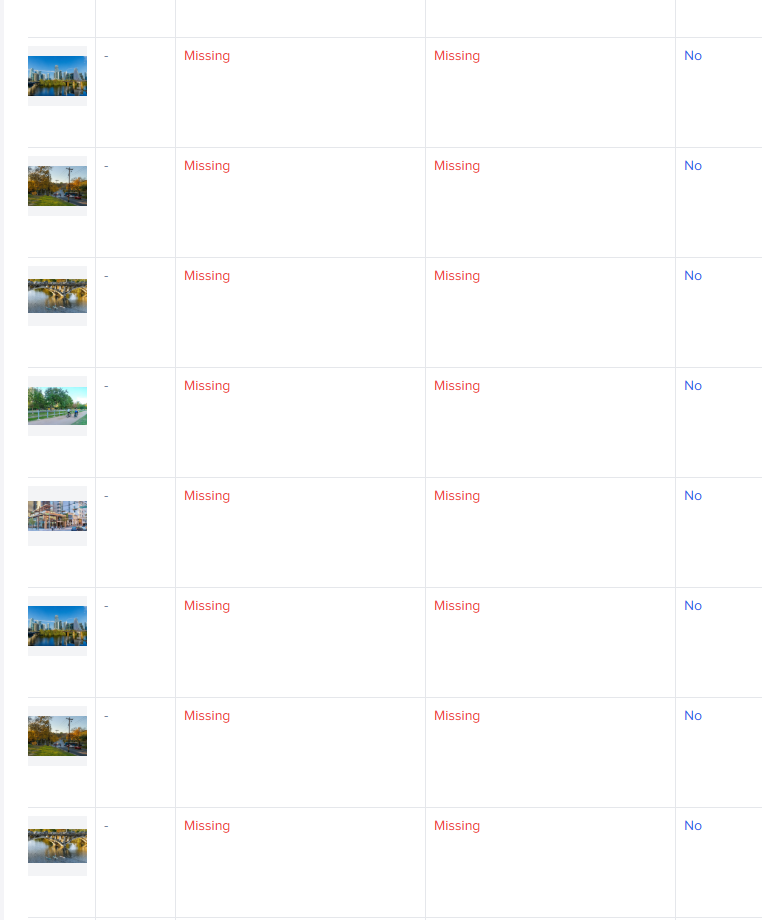
But I avoided inserting identical location keywords into every image.
A photograph needs a useful description first. Search relevance should follow naturally from what the image actually shows.
Larger image 394 KB actual file
Lighter variant 154 KB actual file
Caption: Two versions of an Austin skyline image from my optimization files: approximately 394 KB and 154 KB. The versions also differ in dimensions, so this is an asset-size comparison rather than a controlled performance measurement.
The third challenge was mobile usability
Some sections experienced horizontal movement or overflow on mobile screens.
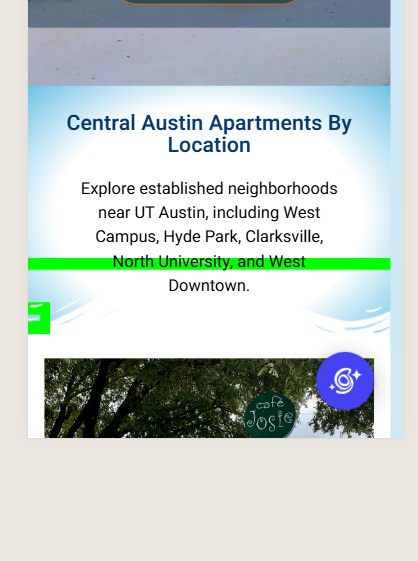
I investigated the Elementor layout and shape-divider behavior involved rather than hiding the problem through a broad sitewide workaround.
The correction needed to resolve the layout problem without interfering with the navigation, dropdowns, or embedded apartment content.
That experience reinforced why performance and usability testing should happen together.
A page may load quickly but still be frustrating to use.
The result
My project case study records a reported 40% improvement in GTmetrix and Google PageSpeed performance assessments.
I regard that as a performance result, not evidence of a 40% increase in traffic, leads, or rental applications.
Those outcomes require different measurements.
The work also included reviewing 13 blog posts, refining page metadata, improving internal linking, addressing technical SEO issues, and documenting the changes for review.
For my own website, I’m applying the same underlying principles: building useful topic-specific pages, publishing real project experience, improving technical quality, and earning relevant editorial mentions.
I would rather build a smaller collection of useful pages than publish hundreds of generic articles that don’t demonstrate anything I actually know.
Have you learned anything particularly helpful in your SEO journey?
One of my biggest lessons came from an unexpected technical setback.
During the Westside Group project, an incident affected the staging environment and a significant amount of recent work appeared to be lost.
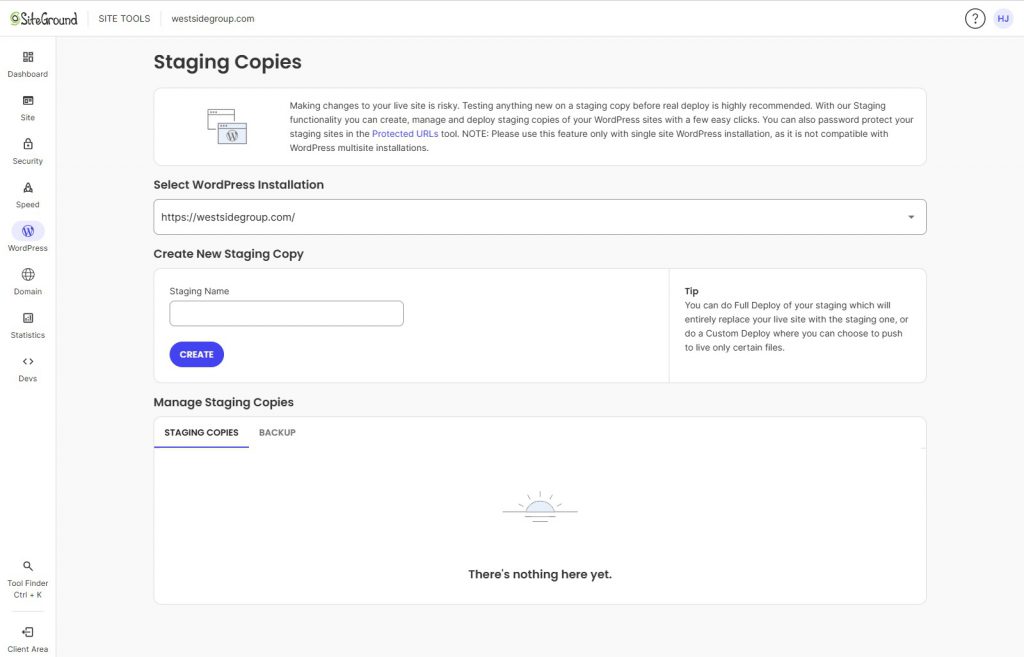
With SiteGround’s assistance, the website was recovered using a backup.
Most of the work returned, but approximately one day of completed optimization had to be recreated.
That included image processing and associated WordPress metadata.
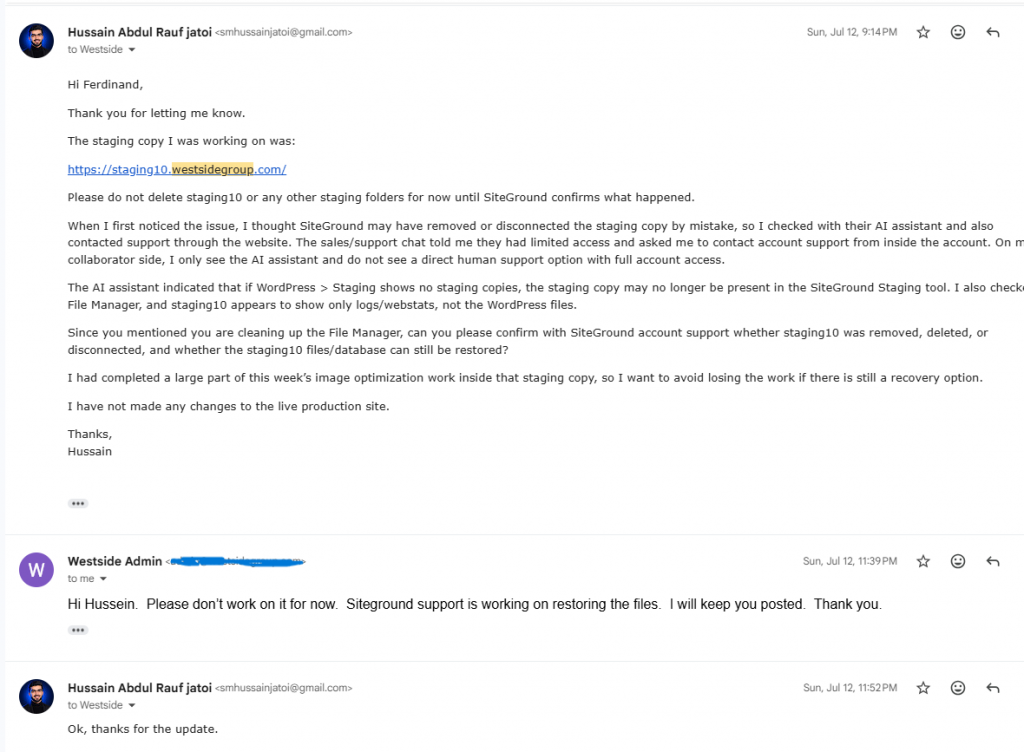
The experience made me think differently about backups.
Having a backup is important, but it doesn’t mean every recent change can automatically be recovered.
Image files, database records, Elementor content, and SEO plugin settings all need to be considered when checking a restored website.
After the restoration, I compared the available pages with my implementation records, identified the missing changes, and repeated the affected work.
I couldn’t assume a page was fully restored simply because it looked correct.
That incident strengthened my approach to staging, documentation, and quality assurance.
Another lesson was learning not to treat SEO tools as unquestionable instructions.
Yoast may identify a keyword warning, but that doesn’t mean an established URL should be changed.
A page may contain a visible address even if a plugin doesn’t recognize its Elementor widget.
An additional paragraph may improve keyword coverage while making the page less pleasant to read.
Technical recommendations need to be evaluated against the actual page and the person using it.
I also learned to distinguish technical improvements from commercial results.
A better performance score is useful. More search clicks can be useful. More people clicking an application button can also be useful.
But none of those measurements automatically proves that a business has gained more customers.
The closer I work to real business operations, the more important that distinction becomes.
What SEO tools do you use for your business? Your SEO tech stack
My tool selection depends on the problem I’m investigating.
For search research and competitive analysis, I use Semrush, and Google’s search tools.
I use Google Search Console to understand actual query performance, indexing, impressions, and clicks when I have access to the relevant website’s data.
For website audits, Screaming Frog SEO Spider is useful for examining URLs, headings, metadata, internal links, and technical signals at scale.
WordPress and Elementor are central to much of my implementation work. I also use Yoast SEO where it’s part of the website’s existing setup.
For performance, I use PageSpeed Insights and GTmetrix.
I don’t rely on a single score. I examine the reported issues, review the affected pages, and check whether a proposed change makes sense for that site’s layout and functionality.
For research and drafting support, I also use tools such as ChatGPT, Claude, Perplexity, and Gemini.
AI can help me explore ideas or examine information, but I don’t treat its output as independently verified evidence.
A tool can suggest a technical solution or identify a potential problem. It doesn’t replace inspecting the website, understanding the business constraints, and validating what actually happened.
My preferred workflow remains straightforward: investigate, document, implement, test, and measure.
Can you share your efforts related to link building?
I’m currently building my personal brand’s backlink profile around relevant publications, useful contributions, case studies, and professional relationships.
My approach is deliberately different from buying large quantities of links or publishing generic guest articles across unrelated websites.
I want links that make sense for the work I do.
For example, if I publish an original article about WordPress performance, technical SEO, or conversion improvements, a relevant technical publication is a more appropriate destination than an unrelated directory.
I’ve also been featured on Connectively.us and DevX.com, and I’m continuing to pursue editorial opportunities where I can contribute genuine professional experience.
My current focus includes writing about technical SEO decisions, practical website fixes, AI-search visibility, and the relationship between search traffic and business outcomes.
I also see original case studies as important linkable assets.
A case study that explains a real technical challenge, provides implementation details, and includes supporting evidence offers readers something more substantial than another general list of SEO tips.
I’m still developing this strategy, so I won’t claim a particular increase in domain rating or referring domains until I have reliable data to support it.
My objective is to earn links as a consequence of publishing valuable material and building relationships with relevant people.
What have been the most influential books, podcasts, or other resources?
Much of my SEO learning has come from combining structured learning with real implementation work.
I completed AI-related learning and early projects under Ali Yasin in 2025, which contributed to the way I began approaching automation and technical problem-solving.
For SEO, I regularly rely on practical documentation and resources such as Google Search Central, web.dev, and the technical guidance available from established SEO platforms.
I value resources that explain why something works, what can go wrong, and how to verify the result.
I also learn a great deal from working through client websites.
Documentation can explain how an optimization is supposed to behave.
A real website introduces complications: existing search visibility, plugin conflicts, hosting configurations, mobile layouts, business constraints, and the need to protect working features.
The combination of documentation, structured learning, and hands-on implementation has been more useful to me than following one SEO personality or copying a fixed checklist.
What’s the next step in your SEO journey?
Over the next six to twelve months, I want to make my personal website a stronger resource for people interested in practical SEO, WordPress, AI search visibility, and connected business systems.
There are several parts to that work.
First, I want to publish more original, evidence-backed project stories.
The Westside Group project is one example, but I want future articles to go further into technical decisions, implementation methods, and the measurable outcomes behind website improvements.
Second, I want to strengthen the content structure of my website.
That includes making sure service pages, articles, case studies, and personal-author information connect naturally without repeating the same subject on multiple pages.
Third, I want to build more relationships with people who work in SEO, WordPress development, technical marketing, and business growth.
I see guest contributions and industry discussions as opportunities to share useful experience and establish credibility, rather than simply collect backlinks.
Finally, I want to measure my personal website’s progress more consistently through Search Console, including relevant non-branded queries, organic clicks, indexing, and the pages attracting qualified visitors.
I have long-term ambitions for my personal brand and the products I’m building, but I don’t want to skip the evidence required to demonstrate progress.
The goal is to become known for work I can explain and substantiate.
That’s the direction I’m taking with HussainJatoi.com.
Where can we go to learn more?
You can find my work, background, services, and published articles on my personal website:
Website: https://hussainjatoi.com
Client reviews: Hussain Jatoi on Clutch
Email: [email protected]
I’m continuing to document what I learn from SEO, website development, AI automation, and business growth projects.
I’m particularly interested in discussing the decisions and complications that don’t always make it into polished success stories.
Those are often where the most useful lessons are found.

Business Growth Systems Architect
 My SEO Journey [Pro Edition]: Sanket Parmar from cmarix.com – How We Built…
My SEO Journey
My SEO Journey [Pro Edition]: Sanket Parmar from cmarix.com – How We Built…
My SEO Journey
 My SEO Journey [Pro Edition]: Breanna Golub from safaridigital.com.au – From Content Writer…
My SEO Journey
My SEO Journey [Pro Edition]: Breanna Golub from safaridigital.com.au – From Content Writer…
My SEO Journey
 My SEO Journey [Pro Edition]: Gethin Davies from futurmedia.co.uk – Building a DR48…
My SEO Journey
My SEO Journey [Pro Edition]: Gethin Davies from futurmedia.co.uk – Building a DR48…
My SEO Journey
 My SEO Journey [Pro Edition]: Thibault Louis-Lucas from Outrank – From Failed Startups…
My SEO Journey
My SEO Journey [Pro Edition]: Thibault Louis-Lucas from Outrank – From Failed Startups…
My SEO Journey
Get the SEO work done, not just read about it
Create a free account and run your first content plan, keyword research and link-building campaign. No card, and setup is free until your first article.
Free to start. We never sell your address.