
My SEO Journey [Pro Edition]: Sanket Parmar from cmarix.com – How We Built an AIO and GEO Strategy for CMARIX

My SEO Journey [PRO Edition] is a series where professionals in the SEO Industry, Digital Marketing, or Web Design share their honest SEO Journey filled with failure, success, and most importantly, proven results. Episode #174 features Sanket Parmar from CMARIX.
I’m Sanket Parmar, a Digital Marketing Executive at CMARIX, where I work across SEO, content, digital PR, and brand building. CMARIX is a software development company helping businesses build and improve digital products across areas such as software development, mobile apps, AI integration, and AI development. Over the past few years, we have worked hard to grow CMARIX’s organic presence, but our SEO journey was not always about steady growth. After the entry of AI, we shifted our SEO strategy to capture AI visibility across the web.
Setting up the Scene
SEO looks simple when you see the results. Traffic goes up. Rankings improve. Leads increase. Everyone is happy.
But the actual journey rarely looks that clean.
My SEO journey at CMARIX has been exactly that. There were months when we worked hard but saw almost no movement. Traffic stayed flat. Rankings did not change much. Leads were consistent, but not growing.
Then the way people search changed.
Google was showing AI-generated answers. People were asking ChatGPT and other AI tools for recommendations instead of only searching Google. That made me realize something important.
Ranking on the first page alone was no longer enough. We also needed to make CMARIX visible in AI-generated answers.
That was the point when we started building our AIO and GEO strategy.
Anybody can generate an article. Knowing which one is worth writing is the hard part.
The AI Content Engine reads your site and your competitors, then builds a ranked content plan and writes it. Setup is free, and you see your plan before you pay for anything.
See your content plan freeThe Begining
When I started working closely on the SEO campaign, CMARIX already had a decent foundation.
Our main target markets were North America and South Africa. We were targeting software and web development, mobile app development, AI software integration, and AI consulting services.
Our focused industries were healthcare, fintech, manufacturing, and education.
The problem was not that we had no visibility.
It was growth.
Organic traffic had stayed almost flat for around six months. Leads were not increasing either. Keyword rankings were also not moving as quickly as we wanted.
We were doing SEO, publishing new content, building links, and working on the usual activities.
Still, something was missing.
Then I Started Looking Beyond Google Rankings
One thing caught my attention.
CMARIX was appearing in Google’s AI Overviews for some searches. But not as much as our competitors
When I looked at AI platforms such as ChatGPT and Claude, the situation was the same.
CMARIX was rarely mentioned when I searched for software development or AI service providers in our target markets.
It was a clear gap.
Our traditional SERP visibility was good, but our visibility inside AI-generated answers was limited.
For me, this was an important shift in thinking about the SEO strategy.
One could search Google, find CMARIX, visit the website, and become a lead.
But another person could ask an AI assistant, “Which companies provide AI consulting?” or “Who can help me build a custom software product?” and never see CMARIX.
That meant we needed to think about how search engines and AI systems discover, understand, and trust a brand.
We Didn’t Do Anything Fancy
There is a lot of hype around AIO and GEO right now.
You will find plenty of complicated strategies, tools, frameworks, and promises.
We kept our approach simple. We started with keyword research.
We looked at the terms we wanted to rank for, and the questions people were asking around those topics. Then we looked at competitors and checked where they appeared in search results and AI-generated answers.
Sometimes, the research was as simple as running Google searches and comparing what we saw.
We asked ourselves a basic question.
Why is this brand being mentioned while CMARIX is not?
That question helped us understand where we had gaps.
Content Became a Bigger Part of the Strategy
The next step was content.
But we did not want to publish content just to increase the number of pages on the website.
We focused on creating useful content around the keywords and topics that mattered to our audience.
That included software development, AI, industry-specific technology, emerging trends, and questions that potential customers might ask before choosing a technology partner.
The goal was simple.
Create content that actually answers the question.
Not content written only for a keyword.
That difference became increasingly important as we started thinking about AI search.
AI systems need information they can understand and use when generating answers. Strong, clear, useful content gives a brand a better chance of becoming part of that conversation.
We Also Worked Outside Our Own Website
AIO and GEO did not mean we stopped doing traditional SEO.
In fact, many of our existing SEO activities became even more important.
We worked on guest posts across relevant industry websites. We focused on digital PR and looked for opportunities to build genuine brand mentions.
We also worked on branding.
This was important because people don’t only trust a website because it ranks.
They also look at what other websites say about a company.
The same applies to AI search.
A brand needs to exist beyond its own website. It needs to have a presence across the wider web.
Then Came the Hardest Part: Waiting
This is probably the part of SEO that doesn’t get talked about enough. Sometimes you do the work and nothing happens. For around six months, we saw very little movement.
Traffic stayed flat. Keyword rankings stayed flat. Sometimes even dropping.
There were days when it was difficult not to question whether the strategy was working.
We kept working anyway.
Then a new Google update came along.
Slowly, things started changing. Traffic began to move. Keyword visibility improved.
More importantly, the traffic became more relevant to the services we were targeting.
Leads started growing too.
That was the point when the months of work finally started making sense.
What Changed?
The biggest change was not one piece of content or one backlink. It was the combined effect of many small activities.
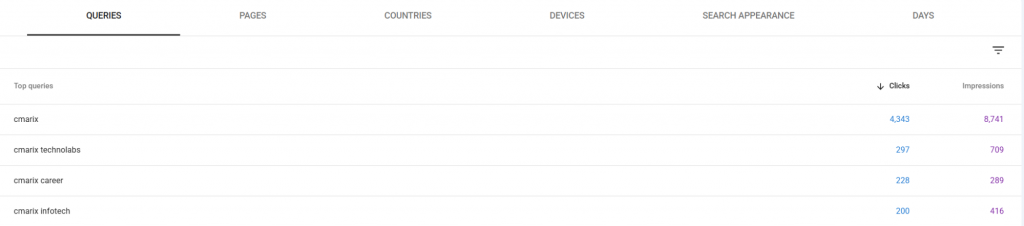
Our organic traffic grew 40%. Our Domain Authority improved from around 35 to 40. We also saw better visibility across AI-generated results.
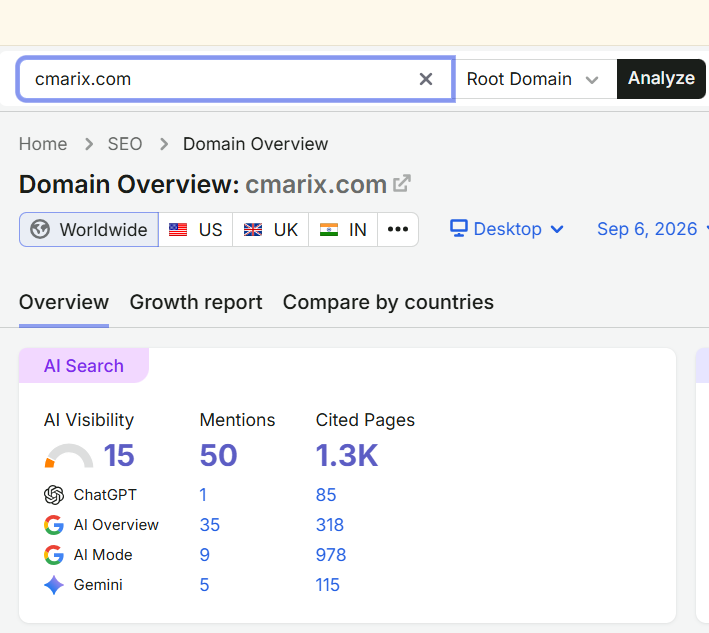
For me, the AI visibility improvement was particularly interesting.
Traditional SEO gave us a way to measure rankings, traffic, and clicks.
AIO and GEO added another question.
Does the brand appear when people ask AI systems for answers?
That became another part of how I looked at SEO.
My Role in the Journey
As a Digital Marketing Executive at CMARIX, I have been involved in several parts of this process.
My work has included guest posting, digital PR, branding, keyword research, and content planning.
Keyword research helps us understand demand. Content helps us answer that demand. Guest posting and PR help build authority outside our website. Branding helps people recognize and trust the company.
Together, they create a stronger online presence.
The Biggest Lesson: Quality Always Wins
If there is one thing I learned, it is quality over quantity.
You can publish hundreds of pages.
You can build thousands of backlinks.
But numbers alone do not create a strong brand.
I have learned that strong branding can be more valuable than millions of random backlinks.
If people, websites, search engines, and AI systems consistently find useful information about your brand, that creates impact.
Useful content is king.
Publishing for the sake of publishing does not work anymore.
The content needs to answer real questions, provide something useful, and support the bigger topic around which you want to build authority.
Our AIO and GEO Journey Has Just Started
I don’t consider this the end of our SEO campaign.
It is actually the beginning of another phase.
Search is changing quickly. AI Overviews are changing how people interact with Google. AI assistants are becoming another way people discover companies and services.
That means we have to keep learning and testing.
Our focus now goes beyond asking whether a page ranks.
We also need to understand whether CMARIX is visible, trusted, and relevant when people search through AI.
There is still a lot to explore.
We will continue testing different content approaches, building brand authority, improving our presence across the web, and watching how AI search evolves.
Looking back, the biggest lesson for me is simple.
SEO takes patience. The work may not show results immediately. Sometimes you have to keep going when the numbers barely move. And sometimes, after months of flat growth, things finally start moving.

Digital Marketing Executive at CMARIX

 My SEO Journey: Hussain Jatoi from hussainjatoi.com – Why I Stopped Treating SEO…
My SEO Journey
My SEO Journey: Hussain Jatoi from hussainjatoi.com – Why I Stopped Treating SEO…
My SEO Journey
 My SEO Journey [Pro Edition]: Breanna Golub from safaridigital.com.au – From Content Writer…
My SEO Journey
My SEO Journey [Pro Edition]: Breanna Golub from safaridigital.com.au – From Content Writer…
My SEO Journey
 My SEO Journey [Pro Edition]: Gethin Davies from futurmedia.co.uk – Building a DR48…
My SEO Journey
My SEO Journey [Pro Edition]: Gethin Davies from futurmedia.co.uk – Building a DR48…
My SEO Journey
 My SEO Journey [Pro Edition]: Thibault Louis-Lucas from Outrank – From Failed Startups…
My SEO Journey
My SEO Journey [Pro Edition]: Thibault Louis-Lucas from Outrank – From Failed Startups…
My SEO Journey
Get the SEO work done, not just read about it
Create a free account and run your first content plan, keyword research and link-building campaign. No card, and setup is free until your first article.
Free to start. We never sell your address.