
Best Link Building Companies in 2026: How to Compare Quality, Pricing, and Risk

In short
The best link building company is the provider whose acquisition method, site-selection rules, approval process, reporting, and pricing match your goals and risk tolerance. Compare companies on evidence, not authority scores alone: require topical relevance, editorial review, clear payment terms, placement-level reporting, and written limits on what the provider can guarantee.
Key takeaways
- Choose the provider model before comparing brands because managed outreach, digital PR, marketplaces, and self-managed outreach solve different problems.
- A useful evaluation covers topical relevance, editorial independence, approval rights, acquisition methods, reporting, pricing, and cancellation terms.
- Compare total cost per accepted, verified placement rather than relying on a low advertised price per link.
- Delivery, replacement, and reporting guarantees are reasonable; ranking, traffic, and risk-free SEO guarantees are not.
- Google's November 2026 policies classify links bought for ranking purposes as link spam unless paid placements are appropriately qualified.
Table of contents
- Which type of link building company fits your situation?
- What should you compare before requesting proposals?
- How do you judge link quality without relying on one metric?
- How should you compare link building pricing?
- What link guarantees are reasonable?
- What red flags should make you walk away?
- How do you test a provider without risking a long contract?
- Which provider model is the best fit for you?
- What else do buyers ask about link building companies?
- What should you do before signing?
Searchers use link building company, link building firm, link building agency, backlink company, and linkbuilding company for overlapping services. The labels matter less than the operating model, because two providers using the same label may source, approve, price, and report links in completely different ways.
Most best link building companies lists begin with names. A safer buying process begins with the work you need performed, the methods you will accept, and the evidence required before a placement counts as delivered.
Which type of link building company fits your situation?
Choose a provider type according to the work your team can perform internally. The right model depends on whether you need ideas and publicity, predictable placement delivery, a broader SEO program, or tools for running outreach yourself.
The main provider types are:
- Managed outreach specialists: The provider researches prospects, contacts publishers, coordinates content, and reports completed placements. Ask whether prospects come from fresh research, established inventory, paid publisher relationships, or a mixture of these sources.
- Content-led and digital PR providers: These teams create research, commentary, tools, or stories intended to earn coverage. The method can generate strong brand exposure, but the number and destination of links may be less predictable.
- Full-service SEO agencies: Link acquisition sits beside technical SEO, content, and strategy. This can improve coordination, but buyers should confirm that a real link team exists and that link reporting is not buried inside a general monthly report.
- Self-managed platforms and databases: The customer controls targeting, selection, messaging, or submissions. Service fees may be lower, but internal labor, mailbox management, publisher communication, and legal compliance remain with the customer.
The three buying models
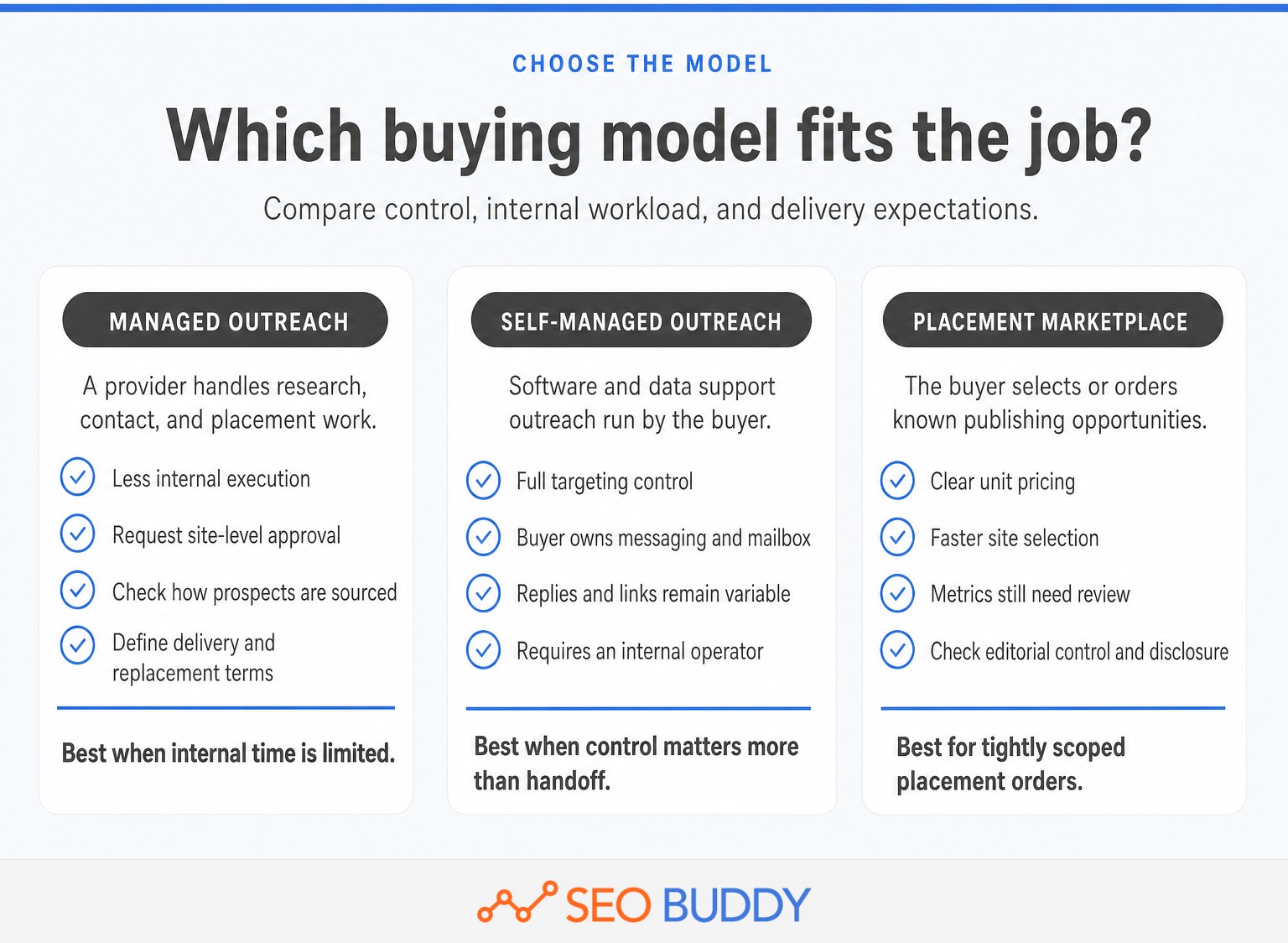
The practical buying decision usually comes down to managed outreach, self-managed outreach, or choosing placements from an established marketplace. Digital PR and full-service SEO can sit inside the managed category, but their deliverables and predictability differ.
A team that wants to control prospecting and email can use SEO Buddy's Link Building Campaign, which finds prospects and contacts and sends a three-email sequence from the customer's mailbox. The customer remains responsible for targeting, messages, and the mailbox. (apps.seobuddy.com)
If guest posting is the main deliverable, compare it as a separate category. The site-selection, content, disclosure, and pricing questions in our guide to guest post services are more specific than the questions used for digital PR or general SEO retainers.
Choose the service model before judging the provider, because the wrong model makes even good execution feel disappointing.
Anybody can generate an article. Knowing which one is worth writing is the hard part.
The AI Content Engine reads your site and your competitors, then builds a ranked content plan and writes it. Setup is free, and you see your plan before you pay for anything.
See your content plan freeWhat should you compare before requesting proposals?
Compare every provider with the same written criteria and request evidence for each answer. A polished sales presentation should not receive credit for a process, control, or result that the provider has not documented.
A 100-point buyer scorecard
Use this suggested scorecard as a starting point, not as an industry standard:
- Topical relevance: 20 points. Full credit requires a documented method for matching the publication, page, audience, and destination URL.
- Editorial independence: 15 points. The publisher should retain the ability to edit, reject, qualify, or decline content and links.
- Acquisition-method disclosure: 15 points. The provider should explain whether links come from outreach, publisher relationships, marketplaces, existing inventory, content campaigns, or paid placements.
- Placement approval: 15 points. Buyers should know whether they can review and reject proposed sites before publication and whether rejection carries a fee.
- Reporting and verification: 10 points. Reports should identify the live URL, destination URL, anchor, link attribute, publication date, status, and any agreed metrics.
- Pricing clarity: 10 points. The proposal should define what triggers a charge and identify content, strategy, outreach, rush, and replacement costs.
- Cancellation and replacement terms: 10 points. Written terms should explain what happens to undelivered, late, changed, or removed placements.
- Measurement plan: 5 points. The provider should separate delivered work from search outcomes it does not control.
Adjust the weights to fit the risk. A regulated brand may place more weight on editorial review and disclosure. An agency handling many client domains may place more weight on approval workflows, reporting consistency, and ownership of publisher communication.
Ask each finalist for an anonymized sample report, an example of an accepted and rejected prospect, the written replacement policy, and the exact definition of a completed placement. Confidential client information is unnecessary. The goal is to see the process, not another customer's campaign.
The strongest proposal is the one that proves how sites are selected, approved, verified, reported, and paid for.
How do you judge link quality without relying on one metric?
Judge a link by its relevance, editorial context, audience, acquisition method, and publication quality before looking at an authority score. No third-party metric can prove that a placement is useful, independently edited, or aligned with search-engine policies.
Check the following factors:
- Site relevance: The publication should cover the subject consistently rather than maintaining one loosely related category among hundreds of unrelated topics.
- Page relevance: The linking page should have a genuine reason to refer readers to the destination page.
- Audience overlap: A link has a clearer business purpose when the publisher's readers could realistically need the linked resource, product, or expertise.
- Editorial standards: Look for identifiable authorship, coherent articles, meaningful editing, and content written for readers rather than placement volume.
- Placement context: The surrounding paragraph should explain why the link is useful. A link inserted into an unrelated sentence is a warning sign.
- Anchor choice: Natural anchors describe the destination without forcing the same commercial phrase across every placement.
- Site patterns: Be cautious when a publication posts large volumes of unrelated sponsored-looking content, uses repeated templates, or appears willing to link any business to any page.
- Verification: Confirm the correct destination, anchor, link attribute, publication date, and indexability settings when delivery is reported.
Authority and traffic estimates can help filter a large prospect list, but they should remain filters. A lower-scoring publication with a real audience and close topical fit can be a more defensible placement than a high-scoring general site with no connection to the subject.
Google Search Central's spam policies define link spam as creating links primarily to manipulate rankings. The examples include bought links that pass ranking credit, excessive exchanges, automated link creation, low-quality directories, and optimized links in paid articles. (developers.google.com)
A worthwhile link is relevant and editorially defensible before any authority score is considered.
How should you compare link building pricing?
Compare the full cost of obtaining accepted, verified placements, including required content and internal review time. The lowest price per link can become expensive when proposed sites are irrelevant, placements need repeated replacement, or the buyer must perform most of the work.
Pricing models at a glance
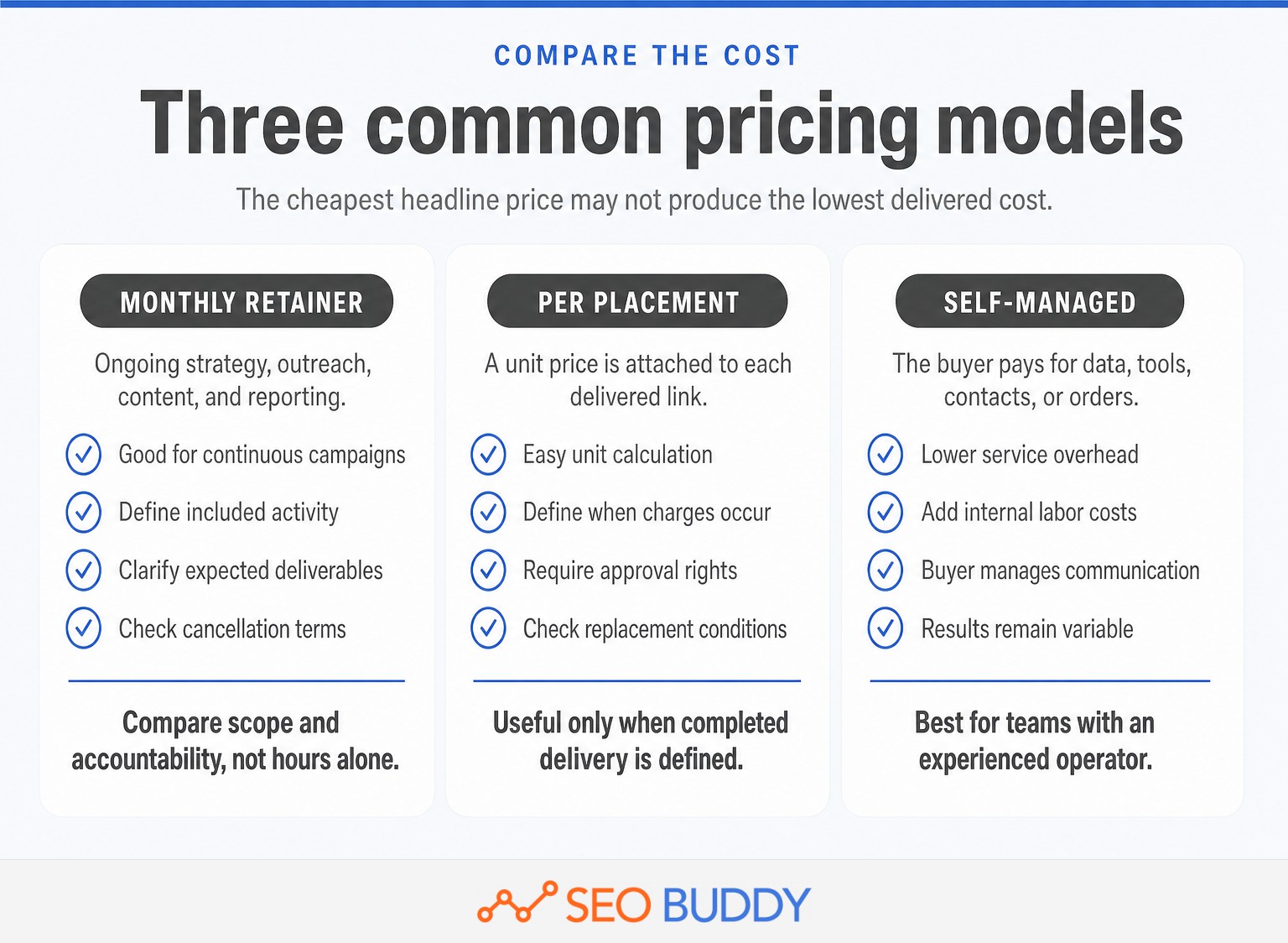
Common pricing structures include:
- Monthly retainer: Appropriate for ongoing strategy, prospecting, content creation, outreach, and reporting. The proposal should define expected activity and deliverables without pretending every month will produce identical outcomes.
- Per published placement: Easy to calculate, but the delivery definition matters. Confirm whether the charge occurs at proposal approval, publication, verification, or the end of a monitoring period.
- Fixed campaign or project: Useful for a content asset, research launch, reclamation project, or tightly defined outreach campaign. Clarify what happens if the campaign earns fewer links than hoped.
- Pay-per-use or self-managed: The customer pays for data, prospect discovery, contact finding, sending, or individual orders. Add the cost of internal staff time before comparing it with managed service fees.
Use this calculation:
Effective cost per accepted live link = (vendor fees + required content costs + internal labor cost) ÷ accepted, verified live links.
This calculation does not measure SEO value. It prevents an apparently cheap offer from hiding expensive review cycles, rejected sites, missing reports, or work shifted back to the customer.
Ask whether the quoted price includes strategy, content, publisher charges, revisions, monitoring, replacements, reporting, taxes, and rush delivery. Also confirm whether unused budget is refundable and whether a rejected proposal consumes part of the order.
When a provider bundles several deliverables together, use the breakdown in the link building package guide to identify what is included, what is merely an activity, and what counts as a completed result.
Compare total cost per accepted, verified placement, not the cheapest headline price.
What link guarantees are reasonable?
Accept guarantees about defined deliverables, deadlines, verification, cancellation, and replacement terms. Reject guarantees about rankings, traffic, conversions, indexing, authority-score increases, or complete protection from search-policy risk.
Reasonable written commitments include:
- The number or scope of deliverables being purchased.
- The buyer's right to approve or reject proposed sites.
- The deadline or delivery window.
- The conditions that make a placement chargeable.
- Verification of the destination, anchor, attribute, and live URL.
- A replacement, credit, or refund rule for undelivered or removed links.
- A reporting schedule and named campaign contact.
Unreasonable promises include a guaranteed position for a keyword, a guaranteed increase in organic traffic, permanent indexing, a fixed authority-score gain, or claims that a method carries no risk. A provider can control its work. It cannot control search systems, publishers, competitors, or every future change to a live page.
As of November 2026, Google's policies state that buying or selling links for ranking purposes is link spam. Google's separate outbound-link guidance says advertisements and paid placements should use the sponsored attribute, while nofollow remains acceptable. (developers.google.com)
A guaranteed dofollow placement is therefore not automatically a quality signal. Ask whether compensation is involved, who receives it, how the publisher exercises editorial control, and how disclosure and link attributes are determined.
Accept guarantees about delivery terms, but reject guarantees about rankings, traffic, or risk-free SEO outcomes.
What red flags should make you walk away?
Walk away when a provider will not explain how links are sourced, prevents site-level review, or presents one metric as complete proof of quality. The same applies when sales claims are precise but delivery definitions and cancellation terms remain vague.
The warning-sign pattern

Common warning signs include:
- A secret or proprietary method that cannot be described even at a process level.
- Guaranteed rankings or immediate traffic growth.
- Large quantities of links from unrelated sites at a uniform price.
- Authority score as the only site-selection standard.
- No examples of reports, verification, or rejected prospects.
- No right to reject a proposed publication before work becomes chargeable.
- Repeated exact-match commercial anchors across placements.
- Reports containing only a URL and authority metric.
- Payment terms that make undelivered work nonrefundable without clear exceptions.
- Replacement terms that exclude most realistic removal scenarios.
- Publisher sites filled with unrelated articles that appear created primarily to carry outbound links.
One weak signal does not always prove a bad service. Several signals appearing together show that the provider's incentives may favor placement volume over relevance, editorial judgment, and customer control.
Walk away when a provider hides the acquisition method, removes approval rights, or treats one metric as proof of quality.
How do you test a provider without risking a long contract?
Start with a small, cancellable pilot using a limited number of target pages and clearly defined acceptance criteria. Judge the provider's research, communication, transparency, and delivery accuracy before increasing the budget.
A five-step pilot
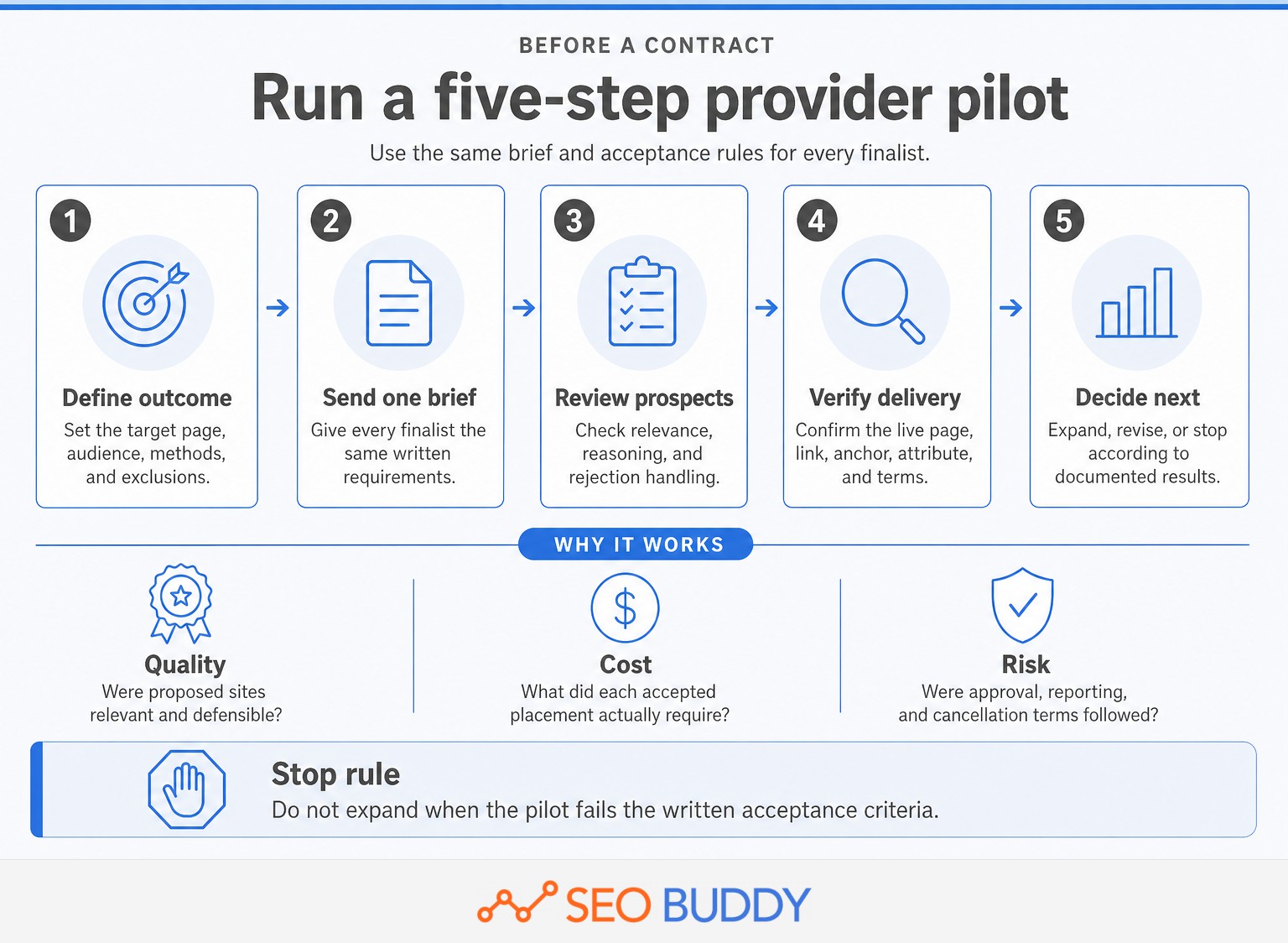
- Define the outcome. Select the destination page, audience, acceptable methods, prohibited methods, and business reason for seeking links.
- Send the same brief. Give every finalist identical requirements so the proposals can be compared fairly.
- Review proposed sites. Record how many prospects are relevant, why each was chosen, and how the provider handles rejection.
- Verify delivery. Check the live URL, destination, anchor, attribute, publication date, content quality, and agreed terms.
- Review and decide. Expand, revise, or stop according to the documented process results rather than pressure to renew.
A useful pilot brief should also identify prohibited industries, competing pages, geographic restrictions, brand language, anchor guidance, reporting fields, and the people authorized to approve a site.
Score the pilot on factors the provider controls:
- Did proposed sites match the topic and audience?
- Did the provider explain why each prospect was selected?
- Were unacceptable sites removed without argument or surprise fees?
- Did the published content and link match the approved requirements?
- Was reporting complete and delivered on time?
- Did the provider follow the cancellation, replacement, and payment terms?
Search performance may be monitored, but it should not be the only pilot verdict. Rankings and traffic can be affected by content changes, technical issues, seasonality, competitors, and search-system updates that occur during the same period.
A small pilot should test the provider's process and honesty before it tests search performance.
Which provider model is the best fit for you?
The best fit is the provider model that closes a real capability gap without removing necessary control. Match the service to the outcome, internal team, budget structure, and level of delivery certainty required.
Use these decision rules:
- Choose a managed outreach specialist when internal time is limited and site-level approval, placement delivery, and detailed reporting matter.
- Choose a content-led or digital PR provider when coverage, brand mentions, research promotion, and journalist relationships matter more than a fixed link count.
- Choose a full-service SEO agency when links must be coordinated with technical fixes, content production, and broader organic strategy.
- Choose a self-managed outreach platform when an internal operator can manage targeting, messages, follow-ups, publisher conversations, and compliance.
- Choose a placement marketplace when the publication, price, and unit deliverable must be selected before ordering, while recognizing that listed metrics still require editorial review.
- Choose a white-label service when an agency needs repeatable approvals, client-ready reports, defined ownership, and clear rules for publisher communication.
Do not choose solely according to company size or the number of sites in a database. A narrow provider with a clear method can be a better match than a broad provider whose process does not fit the campaign.
The best link building company is the one whose operating model matches your internal capacity, target outcome, and risk tolerance.
What else do buyers ask about link building companies?
Buyers commonly ask what providers do, what they should cost, how many links they should deliver, and what results they can promise. The useful answers depend on scope, acquisition method, editorial standards, and the difference between delivered work and search outcomes.
What does a link building company do?
A link building company researches opportunities, contacts publishers, creates or coordinates content, secures or proposes placements, verifies live links, and reports completed work. The exact scope varies. Some companies manage the full process, while others supply data, software, publisher inventory, digital PR, or individual placements.
How much should a link building company cost?
There is no single fair price because retainers, individual placements, campaigns, and self-managed tools include different work. Compare the total cost of strategy, content, outreach, publisher charges, internal review, reporting, and replacements. Then divide that total by the number of accepted, verified placements delivered under the agreed terms.
How many links should a provider build each month?
There is no universally correct monthly link count. A realistic volume depends on the acquisition method, niche, target publications, content assets, approval standards, and budget. Ask the provider to explain the work required and expected range, but avoid treating a fixed link number as proof of quality or future rankings.
Is a high authority score enough to prove link quality?
No. An authority score is a third-party estimate that can help filter prospects, but it does not prove topical relevance, editorial independence, real readership, contextual fit, or policy compliance. Review the publication, linking page, surrounding content, audience, acquisition method, and placement terms before approving a site.
Can a link building agency guarantee results?
A link building agency can guarantee work it controls, such as prospect research, approved deliverables, publication checks, reports, deadlines, or replacement terms. It cannot responsibly guarantee rankings, traffic, conversions, permanent indexing, or a specific authority increase because publishers, search systems, competitors, and the customer's website also affect those outcomes.
Good buyers ask about process, cost, quality, volume, and guarantees before discussing a long contract.
What should you do before signing?
Send every shortlisted provider the same brief and score the answers against evidence rather than sales language. Start with a small pilot that can be stopped if the proposed sites, reporting, or delivery terms do not meet the written requirements.
The brief should state the target pages, audience, acceptable and prohibited methods, approval process, anchor guidance, reporting fields, delivery definition, payment trigger, replacement window, and cancellation terms. For a deeper contract checklist, use the questions in how to hire a link building agency before approving the final proposal.
If approval-based handled placements fit the selected model, review SEO Buddy's link building services. The current order flow lets buyers provide a target page and anchor requirements, approve or reject proposed sites, and manage payment through their account; rejecting a proposed placement costs nothing. (seobuddy.com)
Send every finalist the same brief, score the answers, and begin with a cancellable pilot.

CEO & Founder at SEO Buddy






Get the SEO work done, not just read about it
Create a free account and run your first content plan, keyword research and link-building campaign. No card, and setup is free until your first article.
Free to start. We never sell your address.