
How to Choose Keywords for Search Engine Optimization

In short
SEO keywords are the words and phrases people use when they search for information, products, or services. Choose them by checking business value, search intent, the current results page, ranking difficulty, existing site coverage, and the page you can realistically create, then map each keyword cluster to one clear destination.
Key takeaways
- Search volume is a demand estimate, not a priority score, so a smaller relevant query may be more valuable than a large unrelated one.
- Search intent and the live search results should determine the page type before content production starts.
- A new page should not be commissioned until existing URLs have been checked for the same topic and intent.
- One page can target a cluster of close variations when those searches expect substantially the same answer.
- Exact-match repetition is unnecessary; keywords should make the page clearer for readers rather than making the writing sound mechanical.
Table of contents
- What are SEO keywords, and what makes one worth targeting?
- Which keyword ideas deserve priority?
- How do you find keyword ideas your customers actually use?
- How do you judge search intent and SERP fit?
- How much should search volume and keyword difficulty matter?
- How do you account for pages your site already has?
- How do you map keywords to the right pages?
- Where should keywords appear on the page?
- How do you measure whether the keyword choice worked?
- Which keyword selection mistakes waste the most time?
- What else do people ask about SEO keywords?
- What should you do next?
A keyword list is not an SEO strategy. The list becomes useful only after each phrase has been connected to a business goal, a specific search intent, a suitable page type, and a decision to create, update, consolidate, or reject a page.
The best keywords for search-engine optimization are therefore not always the phrases with the largest numbers beside them. They are the searches for which the business can produce a credible answer and help the reader take a relevant next step.
What are SEO keywords, and what makes one worth targeting?
SEO keywords are search queries or query themes that a page may answer. A keyword is worth targeting when the search represents a relevant need, the expected page fits the website, and ranking could contribute to a meaningful business outcome.
A keyword is not an instruction to repeat a phrase a certain number of times. It is a planning label for the subject, audience need, and search context a page must address.
Although some people search for “key words in SEO,” the standard spelling is keywords. The term can describe an exact query, such as invoice template for freelancers, or a cluster of close searches that expect the same fundamental answer.
As of November 2026, Google Search Essentials recommends using words people would use to find the content and placing them in prominent, descriptive locations. That guidance supports clear topic alignment, but it does not turn keyword repetition into a substitute for a useful page.
For a wider explanation of how content, on-page foundations, and authority work together, start with these SEO fundamentals.
How does a keyword connect a query to a page?

Think of the connection as a chain:
- A person has a problem, goal, or task.
- The person expresses that need as a query.
- The results page sets an expectation about the answer and its format.
- A suitable page fulfills that expectation.
- The page gives the reader a relevant next step.
The phrase project management software is broad and could indicate several needs. The phrase project management software for construction teams narrows the audience and use case, making the expected page and business relevance easier to assess.
Keyword labels can also describe different dimensions of the same query:
- Primary and secondary keywords identify the main topic and close supporting variations for a page.
- Head and long-tail keywords distinguish broad topics from more specific searches.
- Branded and unbranded keywords separate searches that name a business or product from those that do not.
- Informational, commercial, transactional, and navigational keywords describe the searcher's goal.
- Local, seasonal, product, problem, and question keywords add context that can change the right page type.
These categories help organize research. They do not decide whether a keyword deserves a page.
A useful SEO keyword names a real search need that the business can answer with a suitable page.
Anybody can generate an article. Knowing which one is worth writing is the hard part.
The AI Content Engine reads your site and your competitors, then builds a ranked content plan and writes it. Setup is free, and you see your plan before you pay for anything.
See your content plan freeWhich keyword ideas deserve priority?
Prioritize keywords by applying the same decision criteria to every idea rather than sorting the spreadsheet by volume. The strongest opportunities combine business value, clear intent, SERP fit, attainability, a genuine content gap, and a suitable destination page.
What are the six filters?
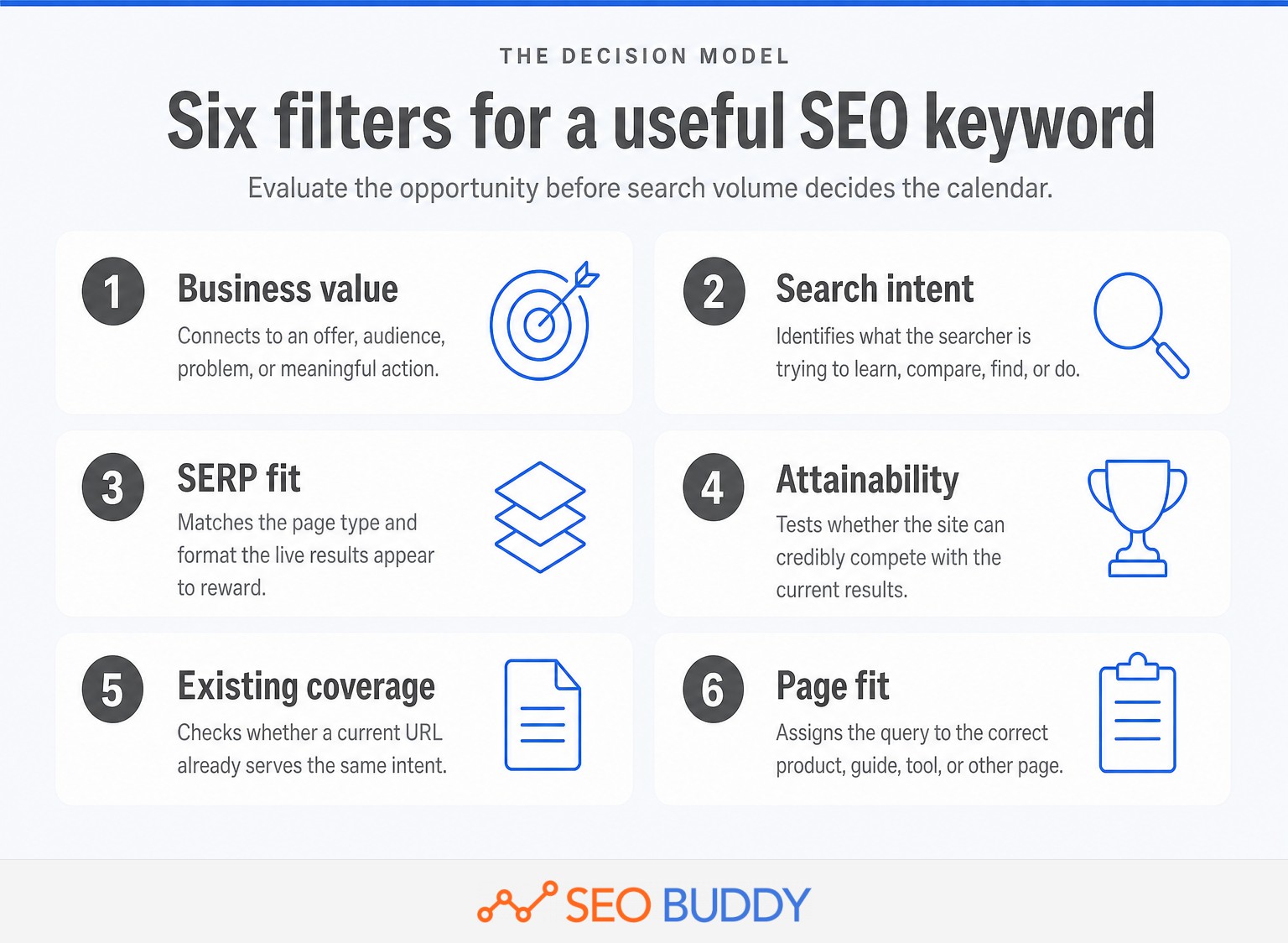
Use these six filters in order:
- Business value: Does the search relate to an offer, audience, use case, problem, or action that matters to the organization?
- Search intent: What is the searcher trying to learn, compare, find, or do?
- SERP fit: What kinds of pages currently satisfy the query, and can the website credibly create that kind of result?
- Attainability: How strong, specialized, and well established are the pages already ranking?
- Existing coverage: Does the site already have a page that serves the same intent?
- Page fit: Is the correct destination a product page, service page, category page, guide, comparison, template, tool, or another format?
Record High, Medium, or Low for each filter. A keyword with high volume but low business value should normally be rejected, while a lower-volume query with clear commercial relevance and a realistic page opportunity may deserve immediate attention.
Three decision groups keep the list usable:
- Publish or update now: The query is relevant, its intent is clear, the expected page fits the site, and the results leave room for a stronger answer.
- Validate first: The idea appears relevant, but the SERP is mixed, existing coverage is uncertain, or the right page format is unclear.
- Reject or defer: The query is outside the offer, expects a page the business cannot credibly produce, duplicates an existing destination, or has weak organic click potential.
This approach also prevents a common mistake: treating a tool's output as the content calendar. Research tools generate candidates. Editorial and business judgment decide which candidates become pages.
For teams that need to connect keyword decisions with the rest of the work, an SEO planning checklist can provide the broader sequence around research, content, on-page work, and authority building.
A keyword becomes a priority only when the business, the searcher, the results page, and the planned destination all align.
How do you find keyword ideas your customers actually use?
Start with the business and its customers, then use search data to expand and validate their language. This order produces a more relevant list than opening a keyword tool with a broad industry term and accepting every suggestion.
What is the fastest research sequence?
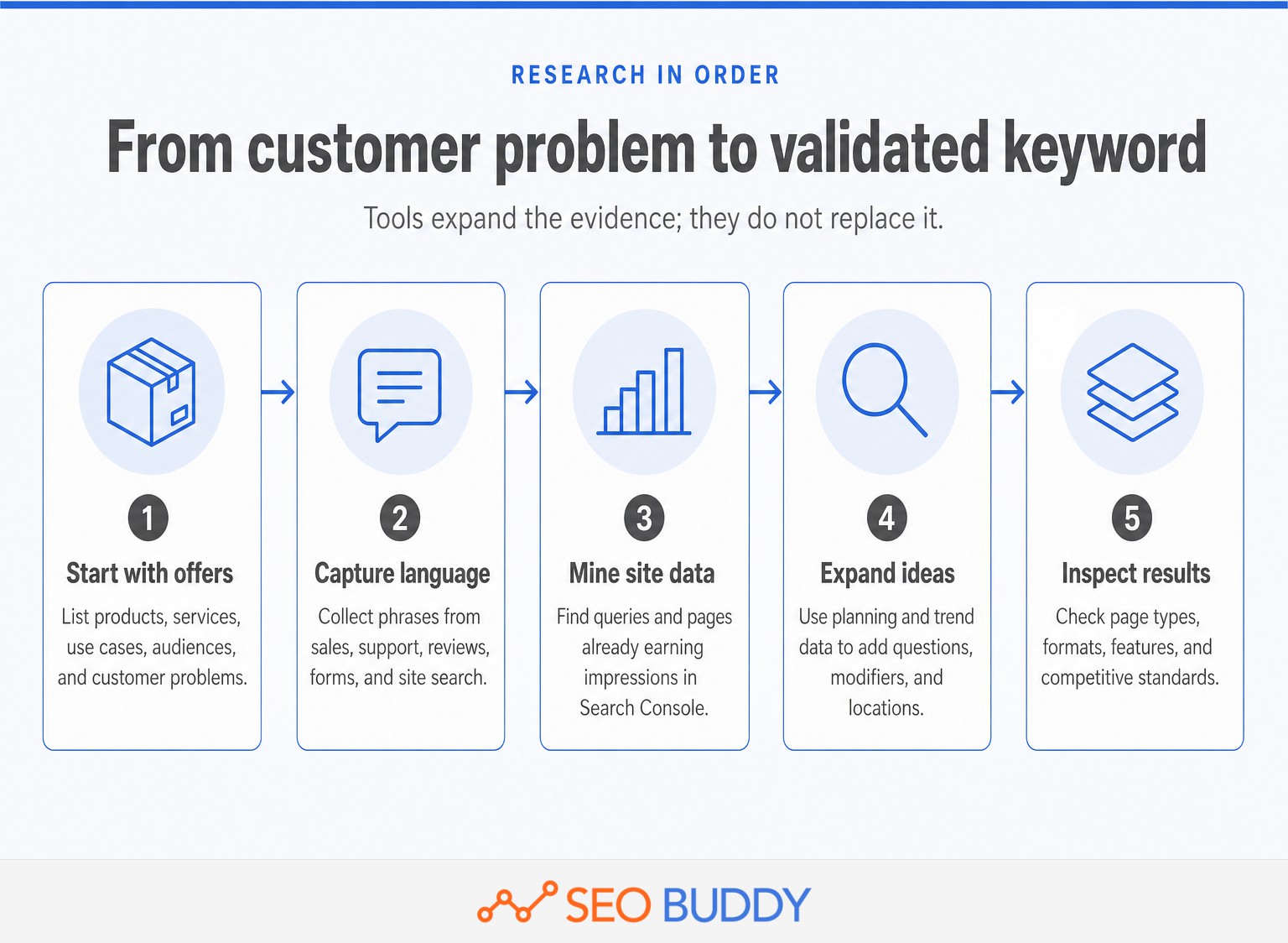
A practical research sequence has five stages.
- List offers and problems. Record products, services, features, use cases, audiences, pain points, objections, and outcomes.
- Capture customer language. Review sales questions, support tickets, site search, forms, reviews, call notes, and community discussions for recurring phrasing.
- Mine existing search data. Look for queries and pages already earning impressions, including terms that were not deliberately targeted.
- Expand the seeds. Use keyword and trend tools to find related searches, modifiers, questions, locations, and seasonal patterns.
- Inspect the results. Search the shortlisted terms and record the page types, formats, features, and angles that appear.
Google's Search Console performance documentation defines queries as the terms people used when the site appeared in Google Search. This makes Search Console particularly valuable for established sites because it reveals demand already connected to the domain.
For new ideas, Google's Keyword Planner help explains how to start with words, a website, or an uploaded list. Keyword Planner is designed for advertising, so its search estimates and competition fields should inform research rather than predict organic rankings.
Google Trends help explains how to compare terms, examine regional interest, and find related searches. Trends is most useful for comparing wording, locations, and seasonality, not for reading absolute monthly search volume.
Search the seed terms manually as well. Autocomplete, related questions, recurring subtopics, result-page features, and the language used in ranking titles can reveal how a broad subject divides into distinct needs.
Keep a source column in the research sheet. A phrase taken from a customer question carries different evidence from a tool suggestion, an existing Search Console query, or a result-page observation.
Readers who need more instruction on the underlying tasks can use SEO Buddy's free SEO education, including lessons on keywords, content, on-page work, and technical foundations.
The best keyword lists begin with customer and business evidence, then use search tools to expand and test that evidence.
How do you judge search intent and SERP fit?
Search intent is the task behind the query, while SERP fit is the test of whether the proposed page matches what the results currently reward. A keyword should not move into production until both the intended task and the expected page format are clear.
What does each intent usually require?
| Search intent | What the searcher wants | Typical destination | Common query clues | Planning decision |
|---|---|---|---|---|
| Informational | An explanation, instruction, or answer | Guide, tutorial, glossary entry, research page | what, why, how, guide, definition | Cover the task completely and answer early |
| Commercial investigation | Help comparing possible solutions | Comparison, category page, use-case guide, evaluation framework | best, review, compare, alternatives, cost | Help the reader make a decision without disguising a sales page as neutral research |
| Transactional | A way to act, buy, book, download, or request | Product, service, pricing, booking, tool, or template page | buy, pricing, quote, book, download, software | Make the action and offer clear |
| Navigational | A known site, product, login, or resource | Official destination page | brand, product name, login, support | Ensure the expected page is easy to find and understand |
| Local or visit-in-person | Options within a geographic area | Location page, directory, local service page, or local guide | near me, in a place, open now, nearby | Match the location, category, and visit intent precisely |
Location can completely change the expected result. Date-night restaurants is broad, while date-night restaurants in Greenville, SC asks for geographically relevant options; a Greenville guide to restaurants for drinks and small plates illustrates the type of destination that local search intent can call for.
Next, inspect the live results page for five signals:
- Dominant page type: Are the results mainly products, categories, articles, tools, videos, local listings, or discussions?
- Dominant format: Do the pages use step-by-step instructions, lists, comparisons, calculators, templates, or concise definitions?
- Expected specificity: Does the query require an industry, audience, location, price range, platform, or current year?
- Competitive standard: Can the site contribute stronger evidence, clearer structure, firsthand material, a better tool, or a more useful visual?
- Click environment: Do maps, answer panels, videos, shopping features, or other result elements reduce the likely share of organic clicks?
A mixed results page often signals an ambiguous query. Instead of forcing one page to satisfy several unrelated needs, narrow the keyword or choose the intent that most closely matches the business.
Google's guidance on people-first content says content should primarily help visitors rather than exist mainly to attract search traffic. SERP analysis should therefore identify the reader's expected task, not provide a template for copying ranking pages.
A keyword passes the intent test only when the planned page performs the task the searcher expects from that results page.
How much should search volume and keyword difficulty matter?
Search volume and difficulty are useful screening signals, but neither should make the final decision. Volume estimates possible demand, while difficulty prompts a closer look at the pages and sites that must be surpassed.
Google Ads defines average monthly searches using the selected date range, location, language, and network settings, and it can group a term with close variants. The number is an estimate within those settings, not a guarantee of visits to an organic result.
No visible volume is not proof that nobody searches the phrase. Keyword Planner may not show very low-volume terms, while the Google Trends data FAQ explains that low-interest terms can appear as zero and that Trends values are normalized on a relative scale from 0 to 100.
Treat any keyword difficulty score as a reason to inspect the results, not as a forecast. Ask:
- Are the ranking pages from sites with much stronger topical authority?
- Do the top results have direct experience, original data, tools, or assets the proposed page cannot match?
- Is the results page stable, or are newer and smaller sites also appearing?
- Does the query require links, brand recognition, inventory, local presence, or specialist credentials?
- Can the page serve a narrower audience or use case more effectively than the broad results?
Also consider cluster potential. A page built around one clear intent may earn visibility for many close queries, so the opportunity can be larger than the volume shown beside a single phrase.
Volume estimates demand, but relevance, intent, page quality, and realistic competitiveness decide whether that demand is worth pursuing.
How do you account for pages your site already has?
Audit existing URLs before assigning a keyword to a new page. The correct action may be to update, consolidate, redirect, differentiate, or internally support an existing destination rather than publish another article.
Build a basic URL inventory from the sitemap, content management system, and analytics data. For each important page, record its title, URL, primary intent, page type, target topic, organic queries, clicks, impressions, conversions, and last substantial update when those fields are available.
Search Console's advanced query and URL filters can help compare pages and query groups. The report will not provide a perfect inventory, but it can reveal which URL Google already associates with a topic.
Use this decision tree for each shortlisted keyword:
- A suitable page already performs well: Keep the destination and strengthen it only where evidence shows a gap.
- A suitable page exists but performs weakly: Check intent, depth, freshness, internal links, title, evidence, and authority before replacing it.
- Several pages target the same intent: Select the strongest destination, then consolidate, redirect, or give each page a genuinely distinct job.
- A related page exists for a different intent: Keep both only when the searcher tasks and page formats are clearly different.
- No suitable page exists: Create a new destination and define how existing pages will link to it.
This audit protects more than rankings. It prevents duplicated briefs, scattered internal links, inconsistent calls to action, and several teams updating different pages for the same goal.
Do not create a new URL until the site has proved that no existing page is a better destination for the keyword's intent.
How do you map keywords to the right pages?
Map one primary search intent and its close variants to one clear destination page. The map should also record the page type, current URL or planned slug, business goal, supporting topics, internal-link sources, and production action.
How should the keyword map be built?
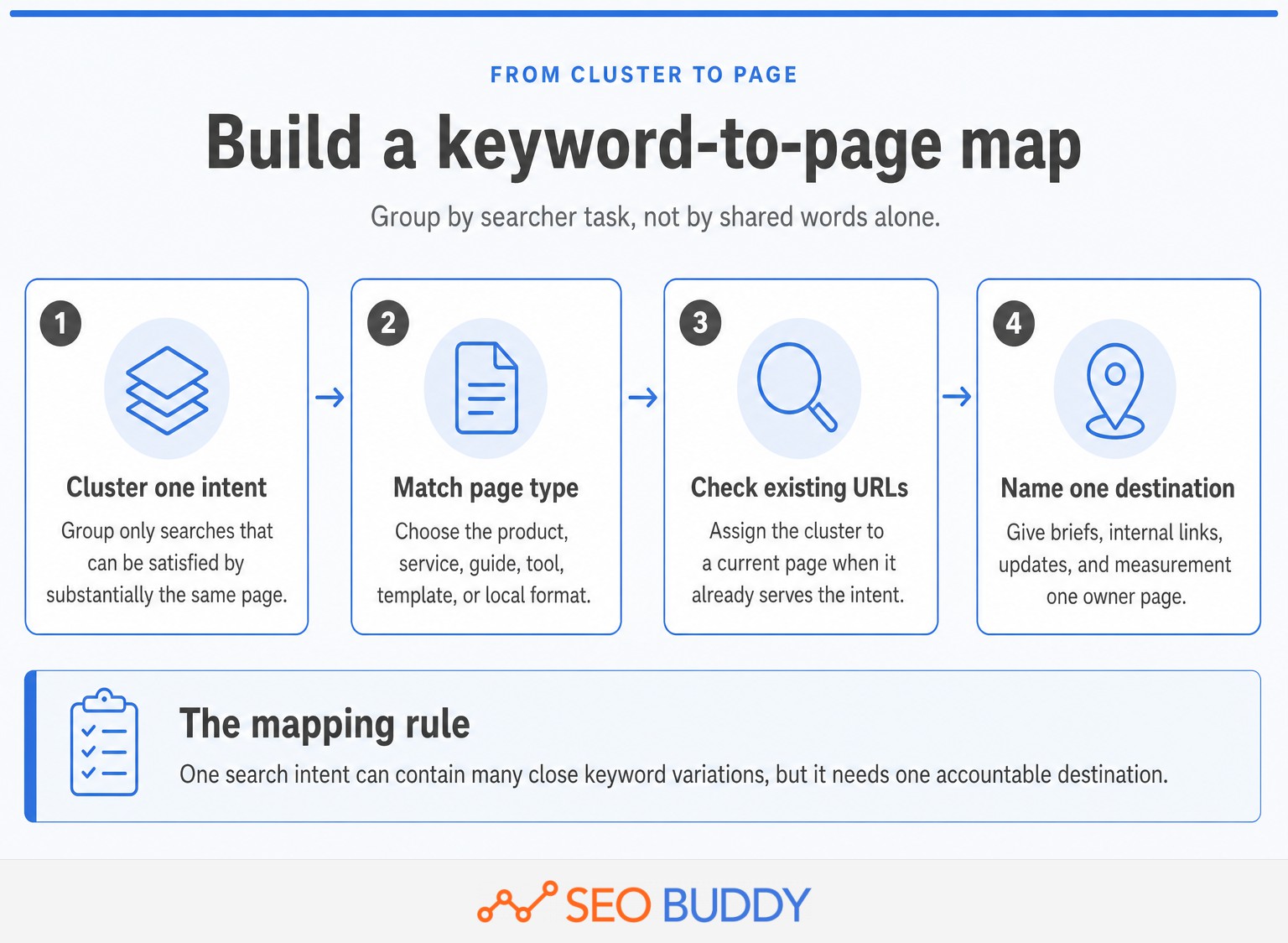
Follow four steps:
- Cluster searches by task. Group terms only when the same reader would be satisfied by substantially the same page.
- Choose the page type. Match the cluster to a product, service, category, guide, comparison, tool, template, or local page.
- Check existing destinations. Assign the cluster to a current URL when it already serves the intent.
- Name one owner page. Give every cluster a primary destination so briefs, internal links, and updates point in the same direction.
Do not group keywords merely because they share words. Invoice software for freelancers, best invoicing software for freelancers, how to create an invoice, and freelance invoice template all concern invoicing, but they suggest different tasks and page formats.
A hypothetical map could look like this:
| Keyword cluster | Intent | Page type | Destination | Action |
|---|---|---|---|---|
| invoice software for freelancers | Transactional | Product or use-case page | /freelancer-invoicing/ |
Create or optimize the offer page |
| best invoicing software for freelancers | Commercial investigation | Comparison guide | /blog/best-invoicing-software-freelancers/ |
Publish an evidence-led comparison |
| how to create an invoice | Informational | Tutorial | /blog/how-to-create-an-invoice/ |
Update the existing guide if present |
| freelance invoice template | Task completion | Downloadable template | /templates/freelance-invoice/ |
Build a useful template destination |
A keyword map should include enough context for the next person to act without repeating the research. Useful columns include:
- Primary keyword or cluster name
- Secondary variations and questions
- Search intent
- Funnel or customer-journey stage
- Business value
- Recommended page type
- Existing or planned URL
- Create, update, consolidate, redirect, or reject
- Internal pages that should link to the destination
- Evidence or differentiation required
- Owner and status
Once the map is approved, use it to create the content brief. SEO Buddy's SEO content resources provide further guidance on research, writing, on-page work, and related search tasks.
A good keyword map gives every search intent one accountable destination and every destination a clear reason to exist.
Where should keywords appear on the page?
Use the primary topic in the places that help readers and search systems understand the page, then write naturally around related questions and subtopics. The goal is descriptive consistency, not a fixed density or an exact-match phrase in every element.
For a new page, consider the keyword or a natural variation in:
- The title tag and H1 when it accurately describes the page
- The opening answer or introduction
- A short, descriptive URL slug
- Relevant H2 or H3 headings
- Body copy where the term clarifies the subject
- Internal-link anchor text on related pages
- Image alt text only when the words accurately describe the image
- The meta description when it helps a searcher understand the result
Do not change a stable, performing URL merely to insert a keyword. The possible disruption is rarely justified by a cosmetically improved slug.
There is no useful universal keyword-density target. Google's keyword-stuffing policy identifies unnatural, out-of-context repetition as spam, including repeated phrases and blocks of locations designed to manipulate rankings.
Use synonyms and related concepts when they improve precision. Do not add a list of variations simply to prove that the page contains them.
Keyword placement works when it makes the page easier to identify, scan, understand, and link to.
How do you measure whether the keyword choice worked?
Measure the page against the job assigned in the keyword map, not rankings alone. A useful review combines indexation, impressions, clicks, query relevance, engagement, conversions, and the business action the page was intended to support.
Start by recording a baseline for an updated page or a publication date for a new one. Then review:
- Whether the intended URL is indexed and appearing for relevant queries
- Impressions for the target topic and close variations
- Clicks and click-through rate
- The direction of average position, treated as context rather than the only result
- Leads, sales, sign-ups, downloads, bookings, or assisted conversions
- Queries that reveal missing sections or a different intent
- Other URLs appearing for the same cluster
As of November 2026, Search Console documentation states that some queries are anonymized and that query tables can be truncated. Search Console is valuable first-party evidence, but the visible query list is not a complete record of every search.
Use the pattern in the data to choose the next action:
- Few or no relevant impressions: Recheck indexation, intent, page type, internal links, topic fit, and competitiveness.
- Impressions but few clicks: Review the ranking range, title, snippet, result features, and whether the page promises the expected answer.
- Clicks but weak business results: Recheck whether the keyword attracts the right audience and whether the page offers a relevant next step.
- Several URLs appear for the same queries: Revisit the keyword map and clarify which page should own the intent.
- Unexpected relevant queries grow: Expand the page when the additional subject belongs to the same intent, or map a separate page when it does not.
A successful keyword choice attracts the intended audience to the intended page and helps that audience complete a useful next step.
Which keyword selection mistakes waste the most time?
The most expensive keyword mistakes happen before writing begins. They send production toward irrelevant, duplicate, unrealistic, or poorly matched pages that better wording cannot rescue later.
Avoid these errors:
- Sorting by volume first. Begin with offers, audiences, and customer problems before examining demand estimates.
- Treating difficulty as a verdict. Inspect the actual results and the capabilities required to compete.
- Skipping intent analysis. A guide will struggle when searchers expect a product, tool, directory, or local result.
- Ignoring organic click potential. A large query can still offer limited clicks when the results page satisfies much of the need directly.
- Publishing without a URL inventory. A new page may duplicate a destination that should have been improved.
- Assigning every variation to a separate page. Close searches that expect the same answer usually belong in one coherent cluster.
- Forcing an offer into an unrelated topic. If the business cannot provide a natural next step, the keyword's commercial value is probably weak.
- Optimizing the phrase instead of the answer. Repetition cannot compensate for missing evidence, unclear structure, or the wrong page type.
- Failing to define success. Every mapped page needs a measurable search and business objective.
The fastest way to waste an SEO budget is to publish before relevance, intent, site coverage, and page ownership have been settled.
What else do people ask about SEO keywords?
The questions below address common rules and lists that can distract from the practical selection process. Each answer separates a useful planning principle from a fixed rule that does not exist.
How do I improve my search engine optimization?
Improve SEO by making important pages crawlable, matching each page to a clear search intent, publishing genuinely useful content, linking related pages, and earning credible mentions. Start with the pages closest to revenue, fix technical barriers, then measure impressions, clicks, and conversions instead of chasing rankings alone.
What are the 10 most googled words?
There is no single timeless list of the 10 most Googled words. The answer changes by country, period, category, and whether a source measures exact terms or broader topics. For keyword strategy, current searches relevant to the business are more useful than a global popularity list.
What are the 16 types of SEO keywords?
There is no official set of 16 SEO keyword types. Useful classifications include intent, branded versus unbranded, head versus long-tail, local, seasonal, question, product, problem, comparison, and primary versus secondary terms. These labels help organize research, but intent and page fit matter more than reaching a particular count.
What is the 80/20 rule for SEO?
The 80/20 rule for SEO is a planning heuristic, not a Google rule. It suggests that a small share of pages, queries, or tasks may produce most results. Use it to prioritize high-value opportunities, but verify the pattern with Search Console and conversion data before cutting work.
Treat keyword rules as planning aids, then test them against the business, the live results, and first-party performance data.
What should you do next?
Choose one offer or customer problem and build a short list of searches around it. Apply the six filters, inspect the results, audit existing URLs, and assign the strongest cluster to one destination before commissioning any content.
The immediate workflow is simple:
- Collect phrases from customers, the site, Search Console, and research tools.
- Reject ideas that do not fit the business or a credible page.
- Validate intent, SERP fit, demand, and competitiveness.
- Map the surviving cluster to a new or existing URL.
- Publish, measure, and update the map with what the site learns.
If research and page planning are the bottlenecks, AI-assisted content planning can use a site's sitemap, optional Search Console data, competitors, business priorities, and brand inputs to rank opportunities and turn approved topics into publishable drafts.
The next step is to turn the strongest validated opportunity into one mapped page, publish it, and measure the result.

CEO & Founder at SEO Buddy





Get the SEO work done, not just read about it
Create a free account and run your first content plan, keyword research and link-building campaign. No card, and setup is free until your first article.
Free to start. We never sell your address.