
AI SEO Services: What Providers Do, What They Cost, and How to Choose

In short
AI SEO services help a business improve visibility in traditional search and AI-generated answers, but the label can mean an agency retainer, a specialist AI-search program, content-production software, or a monitoring platform. Before signing, define the outcome, verify the deliverables and data access, and compare prices only between providers selling the same kind of work.
Key takeaways
- AI SEO is not one standardized service; the label covers managed SEO, AI-search specialization, content-production software, and visibility monitoring.
- Google's 2026 guidance says established SEO practices remain the foundation for visibility in AI Overviews and AI Mode. (developers.google.com)
- Compare the total six-month cost only after matching deliverables, implementation responsibilities, data access, and contract terms.
- Reporting should connect completed work to first-party search visibility data and, ultimately, qualified leads, sales, or another business outcome.
- SEO Buddy's AI Content Engine handles content opportunity research, planning, writing, illustration, and publishing; it is not a comprehensive AI SEO agency or an AI visibility monitoring platform.
Table of contents
- What are AI SEO services?
- What should an AI SEO provider actually deliver?
- How much does AI SEO cost?
- When should you hire an agency instead of using software?
- How should you compare AI SEO proposals?
- What red flags should stop you from signing?
- How should AI SEO results be measured?
- What questions should you ask before signing a contract?
- What else do buyers ask about AI SEO services?
- What should you do next?
The central buying mistake is assuming that every company using the AI SEO label sells the same result. One may provide a team that changes your website, another may produce articles, and a third may only show where your brand appeared in a tracked set of AI answers.
That distinction matters because the correct scope, price, and performance measure change with the product. Google Search Central's May 2026 guidance also states that established SEO remains relevant to generative search, so buyers should be skeptical of providers presenting AI visibility as a separate system with no connection to crawling, indexing, content quality, or authority. (developers.google.com)
What are AI SEO services?
AI SEO services are products or professional engagements intended to improve search performance using artificial intelligence, improve visibility inside AI-generated answers, or both. The work may involve strategy, technical SEO, content, authority building, automation, monitoring, or a narrowly defined combination of those tasks.
Which type are you actually buying?
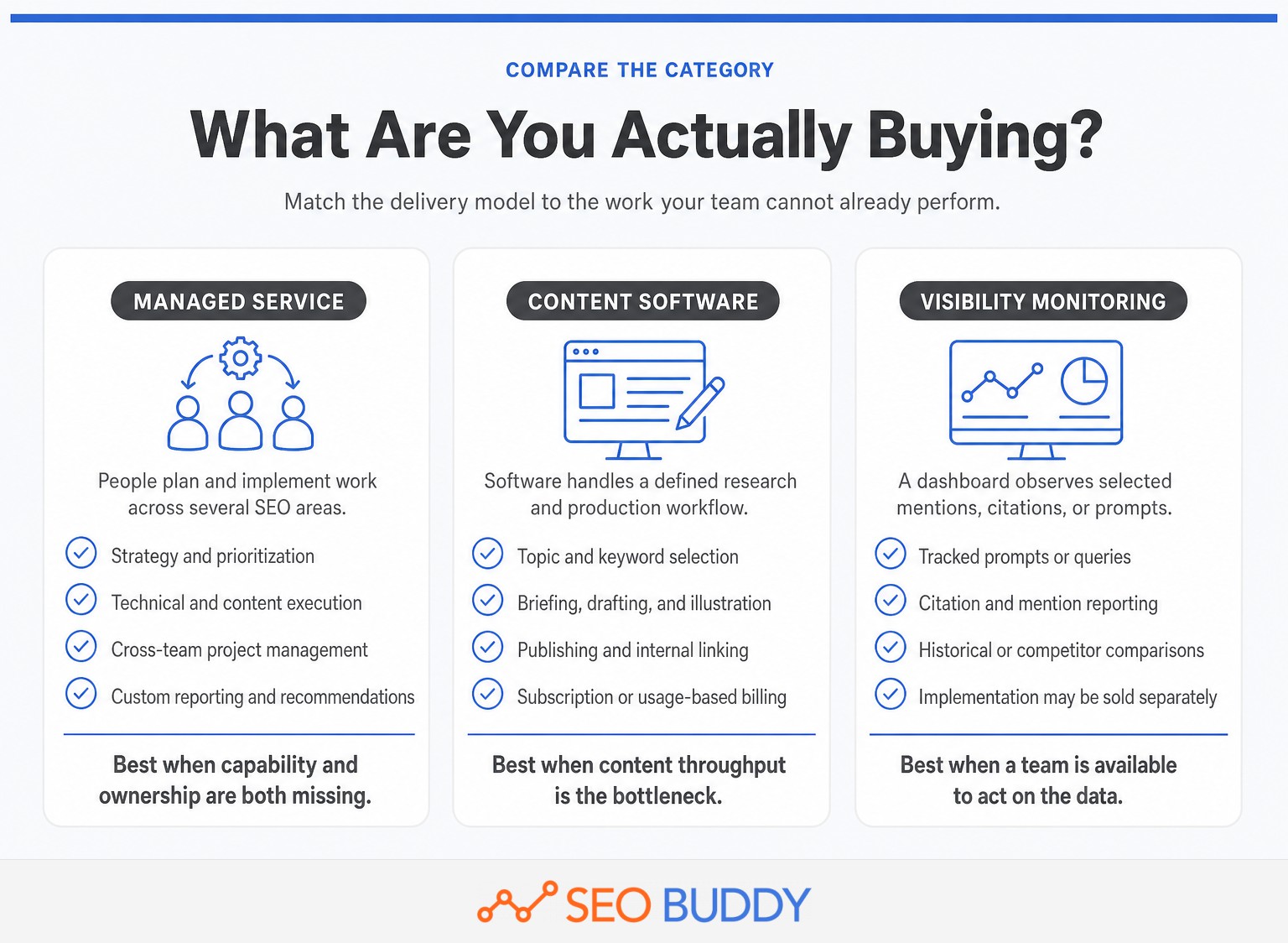
Four different offers regularly appear under the same label:
- A conventional SEO service that uses AI internally. The provider may use AI for research, clustering, forecasting, drafting, analysis, or reporting, while people remain responsible for strategy and implementation. The client is still buying an SEO service, not necessarily a specialized AI-search program.
- A specialist AI-search, GEO, or AEO service. This work focuses on how a brand, product, or source appears in generated answers. It may include entity clarification, content improvements, digital authority work, technical checks, and monitoring across defined search experiences.
- Content-production or workflow software. The product may research topics, produce briefs and drafts, add internal links, create images, or publish articles. It can solve a production bottleneck without providing technical remediation, public relations, ongoing consulting, or visibility monitoring.
- An AI visibility monitoring platform. The platform tracks selected prompts, mentions, citations, sentiment, or competitors. Monitoring tells a team what happened, but it does not necessarily perform the work required to change the result.
Some providers combine two or more categories. Buyers should still ask which capabilities are included, which require another product, and which depend on the client's own team.
The same distinction applies when assessing the provider's software stack. Reviewing categories of AI SEO tools can help identify whether a proposal contains research tools, execution software, or monitoring products rather than treating every AI feature as equivalent.
The label matters less than whether the provider's actual product matches the bottleneck.
Anybody can generate an article. Knowing which one is worth writing is the hard part.
The AI Content Engine reads your site and your competitors, then builds a ranked content plan and writes it. Setup is free, and you see your plan before you pay for anything.
See your content plan freeWhat should an AI SEO provider actually deliver?
An AI SEO provider should deliver named outputs tied to a defined problem, not a broad promise to improve AI visibility. Each workstream should identify the work, the responsible party, the delivery frequency, the approval process, and the evidence used to judge it.
What should appear in the scope?
| Workstream | Concrete deliverable | Evidence to request |
|---|---|---|
| Baseline and strategy | Current-state assessment, priority topics, target audiences, and a 90-day action plan | Baseline report, prioritization method, assumptions, and decision dates |
| Technical foundations | Crawl and index review, template recommendations, structured data review, or developer tickets | Affected URLs, issue severity, implementation owner, and validation method |
| Content | Topic map, briefs, new pages, revisions, source requirements, and editorial approvals | Content calendar, sample brief, revision policy, and quality checklist |
| Entity and brand clarity | Consistent product descriptions, organization facts, author information, and supporting source material | Entity inventory, conflicting statements found, and approved reference copy |
| Authority and distribution | Outreach, digital PR, expert contributions, or other specified acquisition work | Target criteria, approval rules, placement records, and prohibited methods |
| Measurement | Baseline metrics, tracked search experiences, dashboard, and monthly interpretation | Data sources, prompt or query set, methodology, exports, and change log |
| Governance | Access rules, data handling, review responsibilities, and escalation process | Named owners, service levels, approval deadlines, and exit procedure |
A focused product does not need to include every row. It does need to say which rows it covers.
For example, a content service should explain how topics are selected, who checks claims, what happens after publication, and whether revisions are included. A complete SEO content process includes more than generating prose, while automated SEO tools should be judged by the specific repeatable tasks they perform.
Technical claims deserve particular scrutiny. Google says pages appearing in AI Overviews or AI Mode must be indexed and eligible to appear in normal search with a snippet, but there are no separate technical requirements created only for those AI features. A provider can still improve technical foundations, but it should not invent a special AI-only eligibility layer. (developers.google.com)
A useful proposal names the work, the owner, the output, and the evidence for every workstream in scope.
How much does AI SEO cost?
AI SEO costs vary because software, monitoring, audits, content production, and managed implementation require different resources. A credible comparison starts with scope and responsibility, then examines price.
As of October 2026, a public 2026 managed-service price sheet starts at $3,000 USD per month with a six-month commitment. That figure is one provider's disclosed price, not a market median, and the package includes both software and professional services. (webfx.com)
Common billing structures include:
- Monthly software subscription: Usually based on domains, users, prompts, tracked engines, credits, or content volume.
- One-time audit or strategy project: A fixed fee for a baseline review, prioritized plan, or implementation specification.
- Monthly managed service: A retainer covering recurring strategy, implementation, production, reporting, and account management.
- Usage-based execution: Charges per article, page, placement, report, or another completed unit.
- Hybrid pricing: A software fee combined with consulting, production, or implementation charges.
Ask every provider to show the expected six-month cost, including:
- Setup and onboarding
- Recurring platform or retainer fees
- Content, design, development, and outreach costs
- Extra charges for implementation
- Minimum commitments and cancellation fees
- Internal staff time required for reviews and approvals
- Ownership and export costs if the contract ends
A low monthly price can still be expensive if the client must supply strategy, technical work, editing, and reporting. A higher retainer can be reasonable when it replaces several specialist roles and includes implementation, but only if those responsibilities are written into the contract.
Compare the six-month cost of equivalent scopes, not the monthly price of unlike products.
When should you hire an agency instead of using software?
Hire a managed provider when the business lacks both the specialist capability and the person who will coordinate implementation. Choose software when the problem is a repeatable workflow that an existing team can supervise and act on.
Which delivery model fits the bottleneck?

A managed service is usually the better fit when:
- The website has unresolved crawling, indexing, migration, or template issues.
- Several departments must coordinate content, development, analytics, legal review, and public relations.
- The business needs a strategy and people to execute it.
- Nobody internally can evaluate recommendations or maintain the work.
- Reporting must be interpreted and converted into priorities each month.
Software-led execution is usually the better fit when:
- The strategy is understood, but content or another repeatable task is moving too slowly.
- An internal marketer can approve topics, claims, and final output.
- Technical SEO and analytics are already handled elsewhere.
- The team wants control over priorities, publishing, and costs.
- The output can be inspected before it affects the live site.
Monitoring software is useful when:
- A team is already available to act on the findings.
- The prompt or query set is clearly defined.
- Historical changes and exports are needed.
- The platform documents which engines, locations, and response conditions it measures.
Some businesses need a combination. A provider might manage technical and authority work while software supports content production. A monitoring platform can then assess selected visibility signals, but it should not be mistaken for execution.
The same decision applies to high-volume publishing. Programmatic SEO can be appropriate when pages are supported by useful structured data and distinct intent, but neither automation nor an agency label makes repetitive, low-value pages safe.
SEO Buddy's AI Content Engine belongs in the software-led content category. It addresses research, planning, writing, illustration, internal linking, SEO fields, and publishing, but it should not be evaluated as a technical crawler, rank tracker, full agency engagement, or AI citation monitor.
Choose the delivery model that fills the missing capability, not the one with the most impressive label.
How should you compare AI SEO proposals?
Compare proposals by translating every promise into an output, owner, evidence source, and review date. If two proposals cannot be reduced to the same categories, they are not comparable yet.
What should every proposal make explicit?
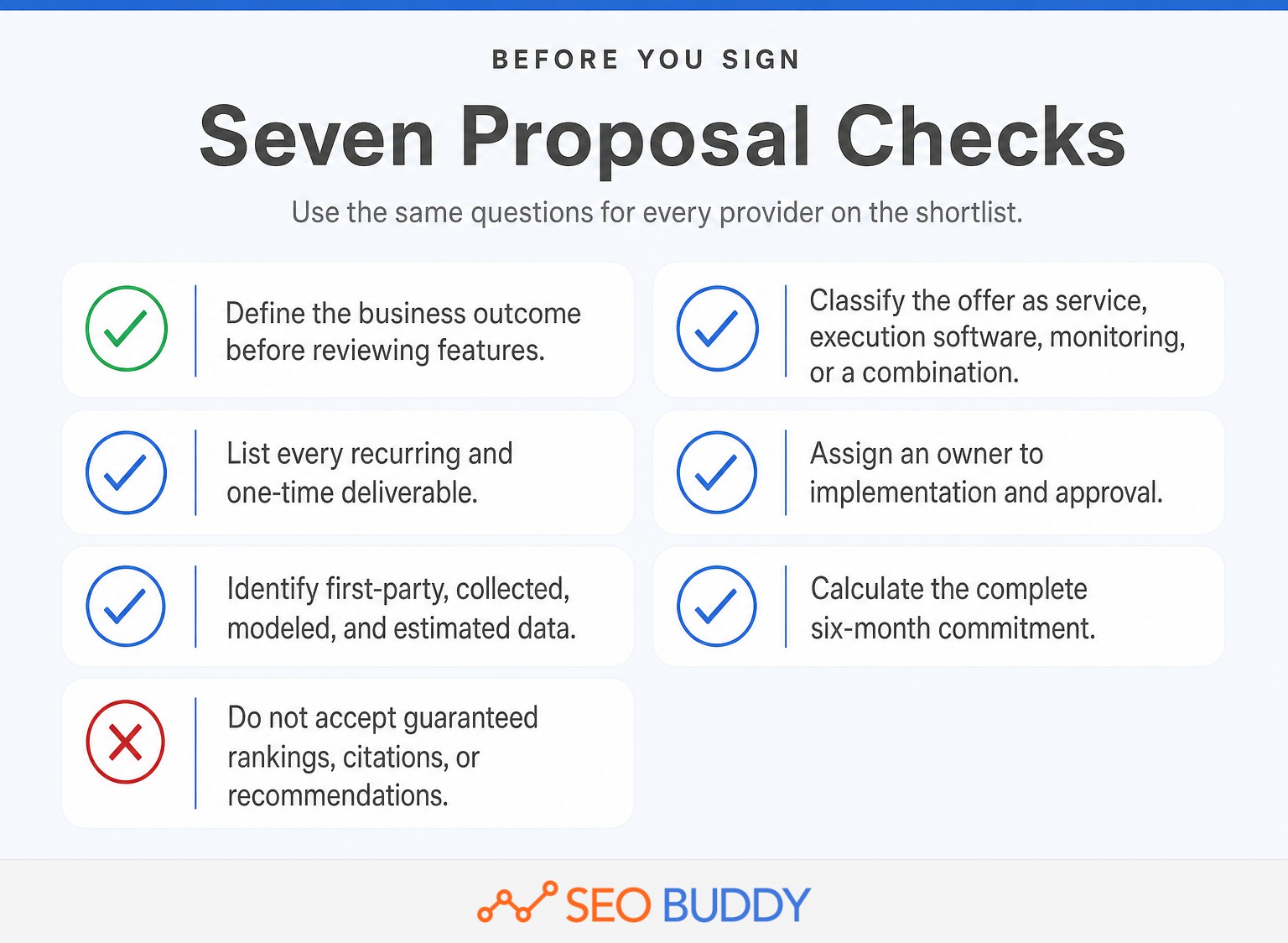
Use this process:
- Write the business outcome first. Examples include qualified leads from organic discovery, increased non-branded visibility for a product category, or more search-assisted sales. Avoid using article count or citations as the final outcome.
- Classify the offer. Mark it as managed service, specialist AI-search engagement, execution software, monitoring software, or a documented combination.
- List the recurring deliverables. Record the number and type of audits, pages, content assets, technical tickets, outreach campaigns, reports, and meetings.
- Assign implementation ownership. A recommendation has little value if neither the provider nor the client is responsible for putting it live.
- Inspect the evidence. Ask which data is first-party platform data, which is collected by the provider, and which is modeled or estimated.
- Request a sample report. Check whether it explains causes, limitations, completed work, and next decisions rather than presenting a collection of screenshots.
- Calculate the complete commitment. Include setup, minimum term, software, production, development, internal review time, and exit costs.
Google's guidance for hiring an SEO recommends asking for previous work, expected results, measurement methods, market experience, and confirmation that the provider follows Search Essentials. Its 2026 version also tells buyers to check whether AEO or GEO advice aligns with Google's official generative AI guidance. (developers.google.com)
Case studies can help, but examine what they prove. A traffic increase does not prove AI visibility work caused it. A citation screenshot does not prove commercial value. A useful case study gives the baseline, dates, work completed, relevant business outcome, and limits on attribution.
A comparable proposal turns promises into named deliverables, owners, data sources, and decision dates.
What red flags should stop you from signing?
Stop the buying process when a provider guarantees rankings, citations, recommendations, or revenue from systems it does not control. Also pause when the proposal depends on secret methods, unexplained data, or content volume without editorial accountability.
Watch for these warning signs:
- Guaranteed inclusion in AI answers. Search and answer systems decide what to display, and responses may vary by query wording, time, location, personalization, and source availability.
- A secret technical switch. Google's 2026 guidance says established SEO remains foundational and specifically advises site owners to prioritize effective SEO over supposed GEO tricks such as unnecessary AI text files or artificial content chunking. (developers.google.com)
- Content volume presented as the result. Publishing more pages is an activity. The provider must explain why each page deserves to exist and how quality is checked.
- No human approval or correction path. Factual, legal, medical, financial, product, and brand claims need an accountable review process.
- No access to source data. The client should know which queries or prompts were tracked, when they ran, which engines were tested, and how results can be exported.
- Reporting built around favorable screenshots. A provider-selected answer is not a representative measurement method.
- Unclear authority-building methods. Ask how mentions and links are earned, which tactics are prohibited, and whether placements require client approval.
- A contract that hides implementation. Recommendations, development, writing, editing, publishing, and outreach should not be silently pushed back to the client.
Google's generative AI content guidance says AI can assist research and structure, but generating many pages without adding value may violate the scaled content abuse policy. The risk comes from unoriginal, low-value production, not from the mere use of an AI tool. (developers.google.com)
Walk away when a provider sells guaranteed visibility, secret access, or volume without accountability.
How should AI SEO results be measured?
AI SEO measurement should combine business outcomes, traditional search performance, AI visibility signals, and completed work. No single citation count or prompt ranking can explain the commercial effect of a program.
Which metrics belong in the reporting stack?
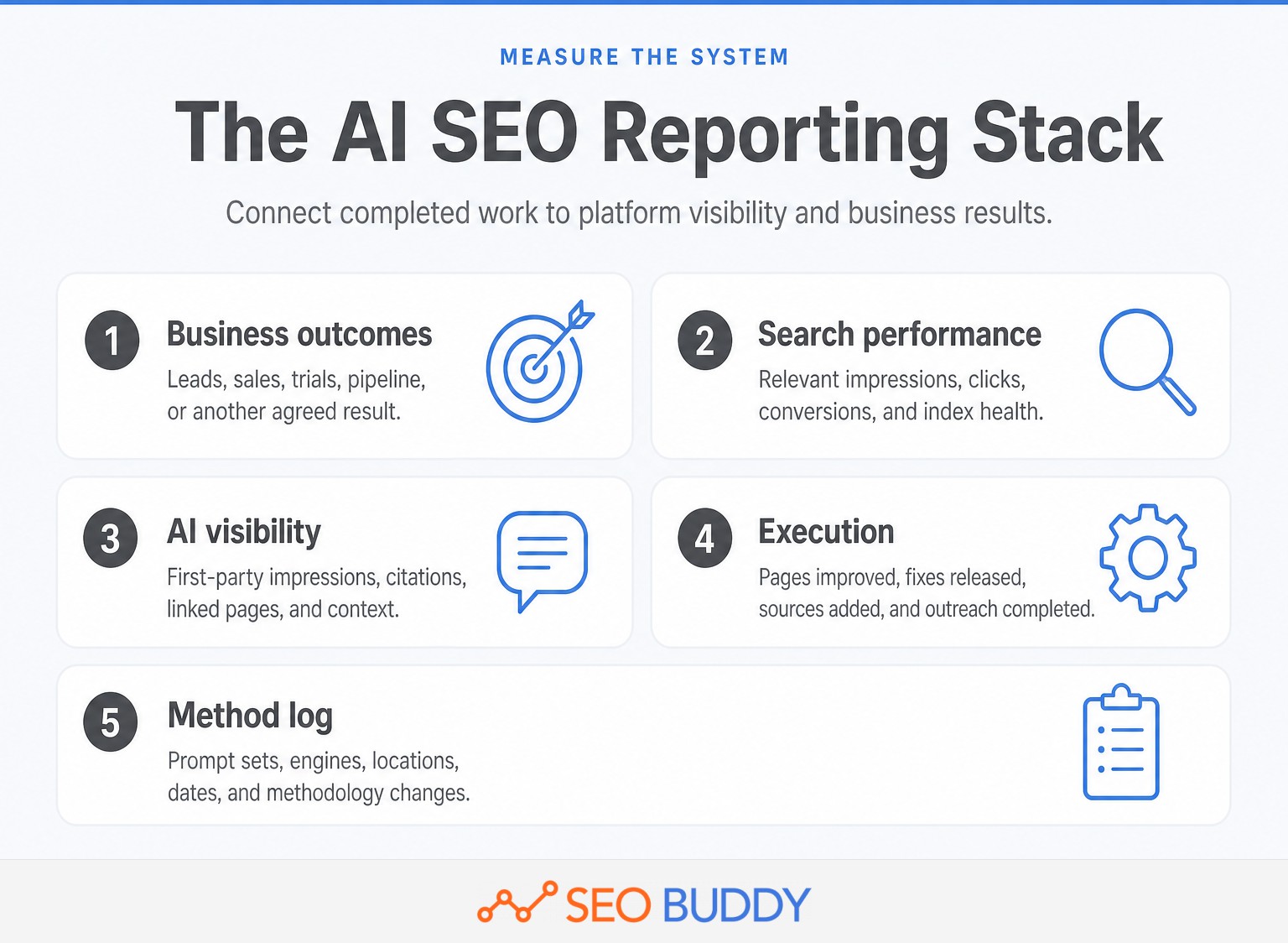
A practical reporting stack has four levels:
- Business outcomes: Qualified leads, trials, sales, assisted conversions, pipeline, or another result the organization already uses.
- Search performance: Relevant impressions, clicks, landing-page engagement, non-branded query visibility, conversions, and indexing health.
- AI visibility: Impressions or citations reported by first-party platforms, appearances for a documented prompt set, linked pages, mention context, and changes over time.
- Execution: Technical fixes released, pages created or improved, source material added, outreach completed, and experiments concluded.
As of August 31, 2026, Google Search Console's Generative AI performance report had rolled out worldwide. The Search report covers impressions in AI Overviews and AI Mode and can break results down by pages, countries, devices, and dates. (support.google.com)
Bing Webmaster Tools' AI Performance announcement introduced first-party reporting for total citations, cited pages, grounding queries, and visibility trends across supported Microsoft AI experiences. These reports are useful because they come from the platforms, although each report only describes its own supported ecosystem. (blogs.bing.com)
Third-party monitoring can broaden coverage, but the provider should disclose:
- The exact prompt or query set
- Engine and model coverage
- Country, language, device, and account conditions
- Run frequency
- Whether responses are fresh or cached
- How citations, mentions, sentiment, and recommendations are classified
- How changes to the method are recorded
There is no universal AI rank comparable to one stable keyword position. A repeatable measurement method is more useful than a large number of unrepeatable checks.
The best measurement system connects execution to first-party visibility data and then to business outcomes.
What questions should you ask before signing a contract?
Ask questions that expose scope, implementation ownership, evidence, and commercial risk. The answers should be specific enough to copy into the final statement of work.
Use this list during the sales call:
- Which category best describes the offer: managed SEO, specialist AI-search work, content software, monitoring software, or a combination?
- What business problem will the first 90 days address?
- Which deliverables arrive every month, and which are one-time setup work?
- Who implements technical changes and publishes approved content?
- Which search engines, AI experiences, countries, languages, and devices are included?
- Which metrics come from first-party platform reports, and which are collected or estimated by the provider?
- Can the client see and export the tracked prompt set, results, and change history?
- How are factual claims, brand statements, and regulated topics reviewed?
- What does the provider need from developers, subject-matter experts, executives, or legal reviewers?
- Can the provider show a relevant case study with baseline dates, completed work, and an outcome beyond content volume?
- What practices are prohibited for content, links, mentions, and outreach?
- Who owns the content, reports, accounts, data, and configurations after cancellation?
- What is the minimum term, total committed cost, and cancellation process?
- What evidence would cause the provider to change or stop the strategy?
Do not accept a sales answer that depends on terminology alone. GEO, AEO, LLM optimization, and AI SEO may describe useful work, but the contract must still state what will be done to which assets, by whom, and how the result will be evaluated.
A contract is safer when scope, ownership, evidence, approval, and exit terms are explicit before work begins.
What else do buyers ask about AI SEO services?
The most common questions concern what the label means, how much it costs, and whether software can replace professional support. The answers depend on the work being purchased rather than the presence of AI in the product name.
Is there an AI for SEO?
Yes. AI can assist with keyword research, content planning, technical analysis, internal linking, reporting, and production. It does not replace the need for business context, source checking, editorial approval, or technical judgment. The useful question is which task needs help and who remains accountable for the result.
How much does AI SEO cost?
AI SEO costs depend on whether the buyer is purchasing software, monitoring, an audit, or managed implementation. As of October 2026, one public managed plan starts at $3,000 USD per month with a six-month commitment, but that is one example, not a market average. Compare total cost against identical deliverables and responsibilities. (webfx.com)
Which AI SEO service is the best?
The best AI SEO service is the one that addresses the buyer's actual constraint, states what is included, uses verifiable data, and assigns implementation responsibility. A business with a content bottleneck may need production software, while a site with technical and organizational problems may need a managed team.
What are AI SEO services?
AI SEO services use artificial intelligence within search optimization workflows, target visibility in AI-generated answers, or combine both goals. The category includes full-service SEO providers, specialist GEO or AEO engagements, content-production products, and visibility monitoring platforms. Those offers should be compared separately because their deliverables and prices are not equivalent.
The best AI SEO service is the one whose scope matches the job and whose reporting proves the work.
What should you do next?
Write one sentence naming the current constraint before requesting proposals. For example: “The technical foundation is stable, but the team cannot research, produce, review, and publish enough useful articles.”
Then shortlist only the delivery models that solve that problem. Ask every seller for a scope mapped to outputs, owners, evidence sources, and six-month cost.
If content planning and production are the bottleneck, review AI Content Engine as a software-led option. It researches opportunities, plans, writes, illustrates, and publishes articles, but it is not a comprehensive AI SEO agency, technical auditing platform, rank tracker, or AI visibility monitor. (shop.seobuddy.com)
Buy the smallest clearly defined engagement that solves the real constraint, then expand only when the evidence supports it.

CEO & Founder at SEO Buddy


 Programmatic SEO: How It Works, When to Use It, and When Not To
General SEO
Programmatic SEO: How It Works, When to Use It, and When Not To
General SEO
 A Repeatable SEO Workflow Process: From Research to Reporting
General SEO
A Repeatable SEO Workflow Process: From Research to Reporting
General SEO
 Off-Page SEO: 8 Strategies to Build Authority Beyond Your Website
General SEO
Off-Page SEO: 8 Strategies to Build Authority Beyond Your Website
General SEO
 12 Automated SEO Tools for Research, Content, Publishing, and Reporting
General SEO
12 Automated SEO Tools for Research, Content, Publishing, and Reporting
General SEO
Get the SEO work done, not just read about it
Create a free account and run your first content plan, keyword research and link-building campaign. No card, and setup is free until your first article.
Free to start. We never sell your address.