
SEO Competitor Analysis: How to Find and Prioritize Content Gaps

In short
SEO competitor analysis identifies the sites repeatedly outranking your domain, exports the keywords and pages behind that visibility, then filters those gaps by business relevance, search intent, ranking feasibility, and value. The output should be a prioritized content plan, not a spreadsheet of every query another site happens to rank for.
Key takeaways
- A business rival is not automatically an organic search competitor; repeated overlap across priority queries is the stronger signal.
- Page-level exports are more useful than domain totals because the ranking URL reveals the intent, format, and topic cluster behind each keyword.
- A keyword gap should be rejected when it does not serve the audience, support the business, or fit a distinct page on the existing site.
- Competitor estimates should be checked against live search results, first-party Search Console data, and a clearly recorded market and date.
- The finished analysis must assign an action such as create, update, consolidate, or defer to every validated opportunity.
Table of contents
- Who actually counts as an SEO competitor?
- How do you find competitor keywords without collecting junk?
- Which keyword gaps are actually relevant to your business?
- How do you validate the gap against live search results?
- How do you decide whether you can beat the current pages?
- How do you prioritize gaps and map them to pages?
- How do you make the analysis repeatable?
- What else do people ask about SEO competitor analysis?
People often start by asking how to check competitor website keywords or how to find competitor keywords. The export is the easy part. The strategic work is deciding which domains matter, which apparent gaps deserve a page, and which opportunities should be rejected before they consume writing, design, and promotion time.
A useful SEO competitor analysis ends with a roadmap. Each surviving topic has a reason to exist, a target page or proposed URL, an evidence requirement, an owner, and a decision date.
Who actually counts as an SEO competitor?
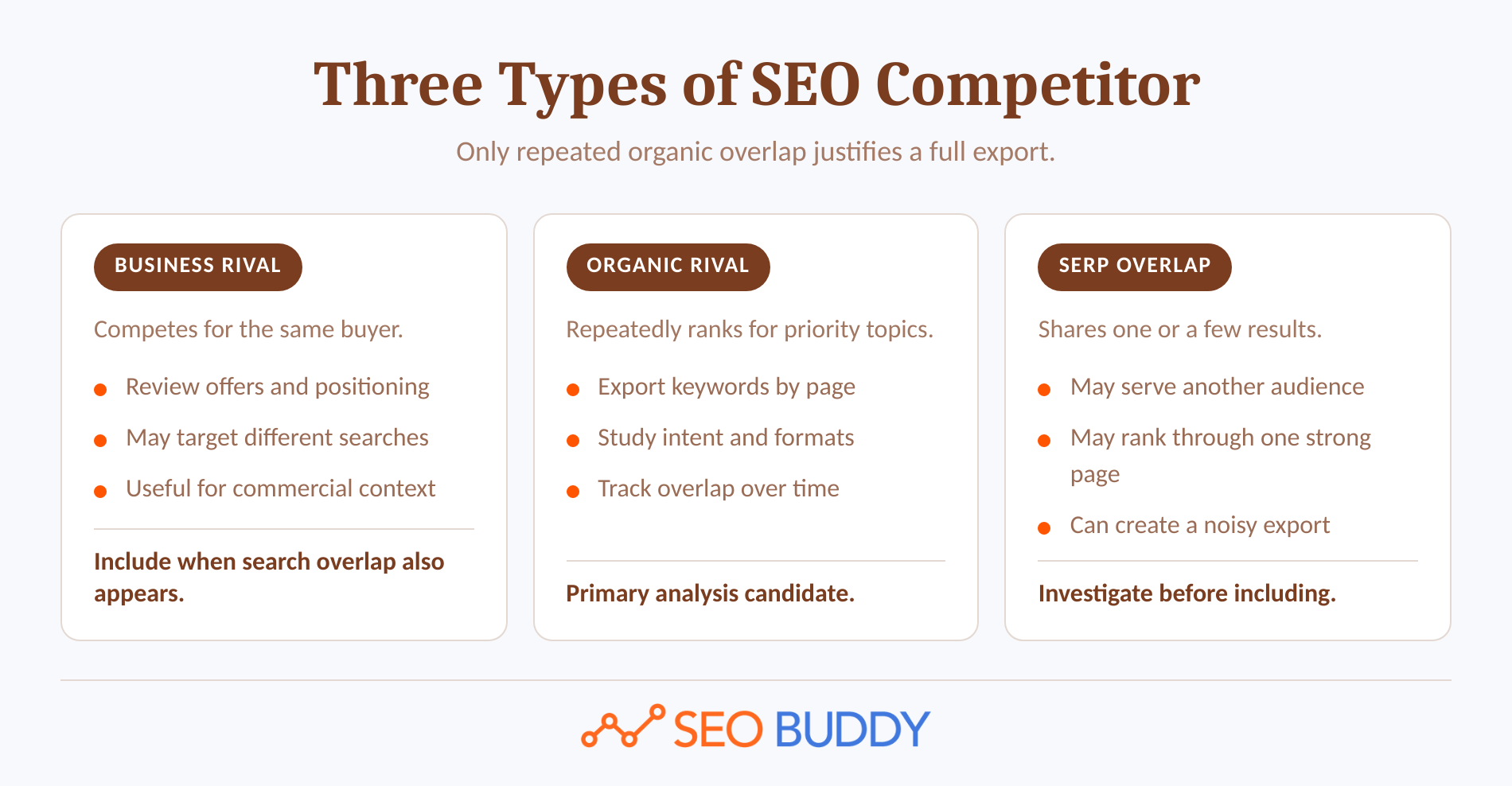
An SEO competitor is a domain that repeatedly appears for searches connected to your audience, products, services, or expertise. Known business rivals still matter, but they should not define the search competitor set by themselves.
Separate potential competitors into three groups:
- Business rivals sell a similar solution to a similar buyer. Review them for positioning, commercial pages, messaging, and the subjects they use to support a sale.
- Recurring organic rivals appear across several topics central to the business. These domains are the strongest candidates for a full keyword and content analysis.
- One-query overlaps share a result page with you once or twice. A publisher, forum, marketplace, reference site, or unrelated brand can rank for a query without competing for the same customer.
Build the working set from a representative group of priority searches. Record which domains appear, how often they recur, and which pages rank. A domain that repeatedly appears across a topic cluster deserves investigation; a domain seen once should remain a lead until further overlap appears.
This distinction prevents a common failure. Exporting every keyword from a large publication or marketplace can produce thousands of rows that have no relationship to the site being planned. The size of the export creates an illusion of opportunity while hiding the few topics that could produce relevant visibility.
Treat repeated search overlap as evidence; treat a single shared result as a lead to investigate.
Anybody can generate an article. Knowing which one is worth writing is the hard part.
The AI Content Engine reads your site and your competitors, then builds a ranked content plan and writes it. Setup is free, and you see your plan before you pay for anything.
See your content plan freeHow do you find competitor keywords without collecting junk?
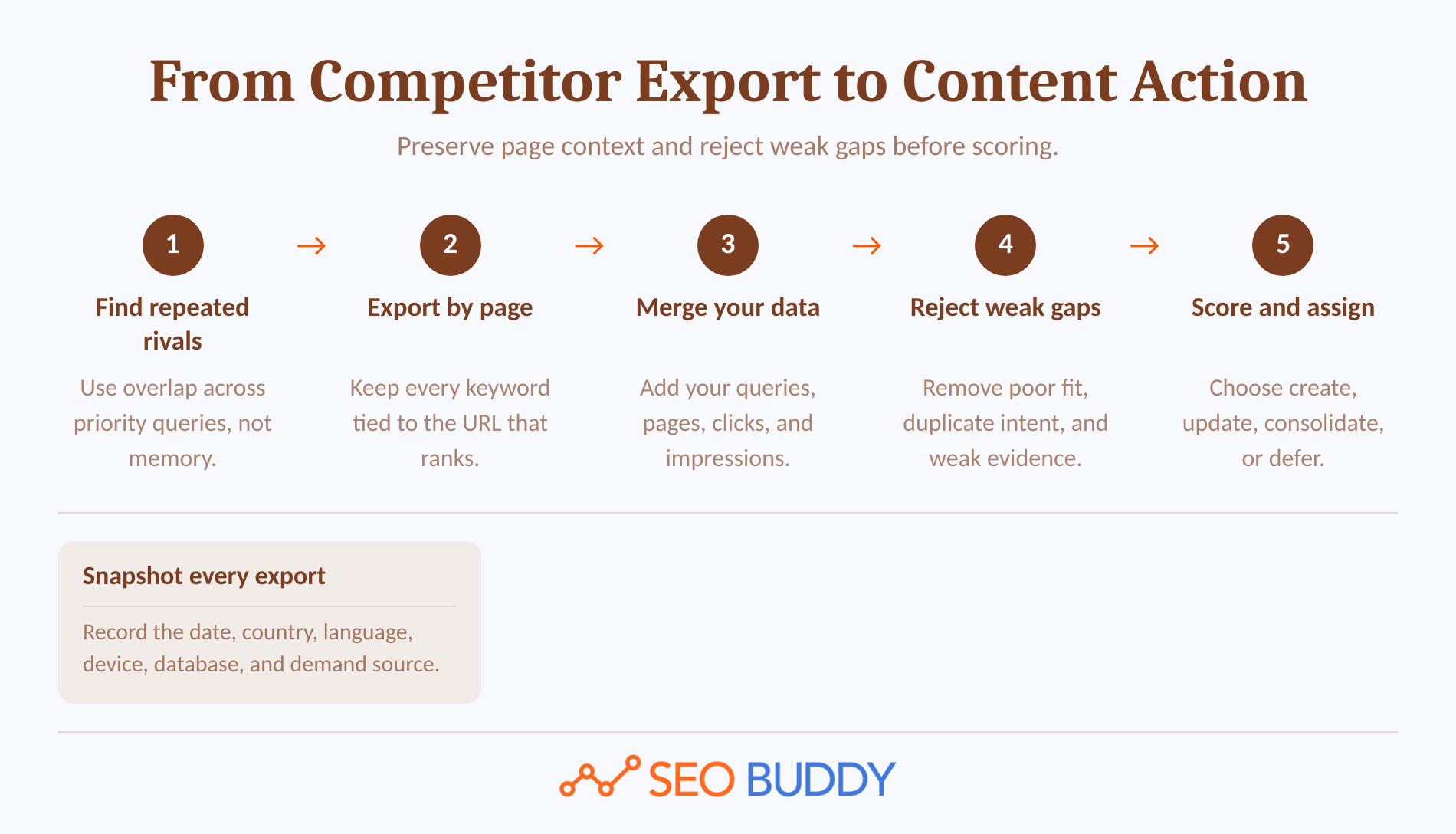
Find competitor keywords by exporting the organic queries and ranking URLs of the recurring search competitors, then merging that export with your own query and page data. Preserve the market, device, source, and snapshot date so later comparisons remain meaningful.
Most domain research platforms make it easy to see competitor keywords. To analyse competitor keywords rather than merely download them, keep every query attached to the page that ranks for it.
Export at least these fields:
- Keyword or query.
- Competitor domain and ranking URL.
- Reported position and estimated demand.
- Country, language, device, and database.
- Search intent and visible result features, when available.
- Export date.
Next, export the top competitor pages. Page-level data reveals whether a domain earns visibility through product pages, category pages, definitions, tools, templates, research, or long-form guides. It also shows when hundreds of keywords are simply variations of one underlying topic rather than hundreds of separate content opportunities.
Add your own search data after the competitor export. As of September 2026, Google Search Console documentation describes the Performance report as a source for query, page, country, impression, and click data for the verified property. Search Console does not reveal a rival's rankings, but it can show whether an apparent gap is truly missing or whether an existing page already receives impressions for it. (developers.google.com)
Search Console is not an exhaustive query list. Google's Performance report documentation says some queries are omitted to protect privacy, so treat the export as first-party evidence rather than a complete record of every search. (support.google.com)
Do not get competitor keywords from several databases and compare their estimates as if they were measured identically. Use one consistent competitor source for relative comparisons, then label every external metric with its provider, market, and date.
The same caution applies to demand data. Google's Keyword Planner forecast documentation says average monthly searches can include close variants and depend on the selected date range, location, and search network. Its Competition column measures advertiser activity, so it should not be treated as an organic ranking-difficulty score. (support.google.com)
Finding competitor keywords is inventory work; the useful export preserves the keyword, the ranking page, the market, and the date.
Which keyword gaps are actually relevant to your business?
A keyword gap is relevant only when the query serves an intended audience, supports the business, and fits a distinct page or section of an existing page. Search volume and competitor rankings cannot rescue a topic that fails those tests.
Run every candidate through these rejection questions before judging difficulty:
- Does the searcher belong to the audience? Reject topics used mainly by a different profession, market, age group, jurisdiction, or buying situation.
- Can the business help with the underlying problem? The topic can be educational, but it should connect naturally to the site's expertise or offer.
- Does an existing page already target the same intent? If yes, the likely action is update, expand, merge, or improve internal linking rather than create another URL.
- Does the intended page type fit the site? A query dominated by free tools, live data, marketplaces, or user discussions may require an asset the site cannot honestly provide.
- Can the article add evidence or utility? Reject a topic when the only plan is to restate the pages that already rank.
- Is there a legitimate next step? A useful article does not need to force a sale, but it should have a sensible relationship to the reader's broader goal.
Google's Search Essentials recommends using the words people use to find content, while its people-first content guidance asks whether a page offers original information, substantial value, and a satisfying result for its intended audience. Keyword matching and audience value belong in the same decision. (developers.google.com)
This filter also protects the site from producing a collection of shallow near-duplicates. Google's current spam policies define scaled content abuse around producing many low-value or unoriginal pages primarily to manipulate rankings, regardless of how those pages were created. (developers.google.com)
Teams that need a shared foundation before reviewing intent and topic fit can use SEO University to align the people evaluating the export.
A keyword gap is publishable only when it fits the audience, the offer, the site, and the intent.
How do you validate the gap against live search results?
Validate each shortlisted gap by inspecting the current results in the target market and recording what kind of answer searchers are being shown. The live result page determines the practical content requirement; the keyword label alone does not.
Create a short SERP brief for each topic cluster:
- Dominant intent: Is the searcher learning, comparing, locating a site, or trying to complete an action?
- Dominant page type: Do guides, product pages, categories, tools, templates, videos, or discussions hold most prominent positions?
- Recurring questions: Which subquestions appear across several ranking pages or visible search features?
- Evidence standard: Do the strongest pages cite original data, official documentation, expert review, first-hand testing, or working examples?
- Freshness requirement: Are dates prominent, and would regulations, interfaces, prices, or product capabilities make an older answer unreliable?
- Missing value: What decision, workflow, audience, caveat, example, or visual remains poorly served?
- Result-page competition: Which search features could answer the query before a user reaches a conventional organic listing?
Record the date, country, language, and device used for the review. Search results change, and an undated observation becomes difficult to audit when priorities are reconsidered later.
Use trend data only for the job it can perform. The Google Trends data FAQ says Trends uses sampled, aggregated search data and normalizes results to a scale from 0 to 100. That makes it useful for direction, seasonality, and relative comparisons, but not as a substitute for absolute search volume. (support.google.com)
The validation stage can change the proposed action. A broad keyword may split into two intentions, several keywords may collapse into one page, or an attractive term may be deferred because the winning format requires functionality or evidence the business cannot provide.
Do not copy the heading order of the ranking pages. Extract the questions that must be answered, then restructure the page around the reader's decision and the specific gap the new content can fill.
Validate the opportunity in the live results before estimating its value.
How do you decide whether you can beat the current pages?

A feasible keyword gap gives the site a credible way to produce a more useful result and support it after publication. A weak gap may be relevant and popular but still demand authority, functionality, evidence, or production resources the site does not have.
Assess feasibility at the page level:
- Format fit: Can the site create the type of page the result set rewards?
- Topical support: Does the site already cover related concepts, or will the proposed page be isolated?
- Evidence advantage: Can the page add clearer sourcing, current specifications, original data, a better example, or a more useful visual?
- Authority requirement: Do the ranking pages appear to rely on substantial editorial reputation or links that the new page will also need?
- Existing foothold: Does Search Console show impressions or page-two visibility for a related query or URL?
- Production cost: Does the page require software, expert review, original research, legal review, or continuous updates?
- Maintenance burden: Can the business keep a time-sensitive page accurate after publication?
Do not reduce this decision to one domain-level score. A site can be competitive in one topic and poorly prepared in another. A narrower page with clear audience fit and stronger evidence may be more realistic than a high-volume topic that requires an entirely new product, dataset, or reputation.
When a validated page also needs publisher outreach, SEO Buddy's competitor-link prospecting workflow can follow the content decision. It finds prospects through keyword mentions or links to competing pages, but it does not replace the initial feasibility review.
Greenlight a gap only when the site can add something materially better and support the page after publication.
How do you prioritize gaps and map them to pages?
Prioritize validated gaps by scoring business fit, intent, demand evidence, feasibility, differentiation, and the commercial path. Then assign each cluster to create, update, consolidate, or defer so the score produces a page decision rather than another sorted keyword list.
Use one target URL for keywords that share the same intent and substantially similar result sets. Separate keywords when they represent different decisions, audiences, formats, or stages of the buying process.
| Factor | 0 points | 1 point | 2 points | 3 points |
|---|---|---|---|---|
| Business fit | Unrelated to the business | Loosely adjacent | Supports a priority area | Directly supports a priority offer or audience |
| Intent fit | Wrong page type or purpose | Mixed or uncertain intent | Clear informational fit | Clear intent and natural page format |
| Demand evidence | No reliable signal | One weak estimate | Multiple consistent signals | First-party impressions plus external demand |
| Ranking feasibility | Requires unavailable assets | Major authority or production gap | Credible with added support | Strong fit with an identifiable advantage |
| Differentiation | Would repeat current results | Small structural improvement | Clear missing step or audience | Original evidence, utility, or distinct solution |
| Commercial path | No sensible next step | Distant relationship | Supports consideration | Direct, useful route to an offered solution |
This 0-to-18 rubric is a suggested operating model, not an industry standard. Calibrate it against the kinds of keywords and pages the site has already been able to rank.
Suggested decision bands can make planning meetings faster:
- 15 to 18: Schedule the page, confirm the brief, and assign an owner.
- 11 to 14: Keep the topic in the active queue, but resolve the weakest factor before production.
- 7 to 10: Look for an existing page to update, a narrower angle, or stronger evidence.
- 0 to 6: Reject or defer the opportunity unless the business strategy changes.
The score should not override judgment. A time-sensitive regulatory topic may require review even with a high score. A lower-volume topic may move first because it supports a product launch, fills a necessary cluster gap, or can be answered with unique first-party evidence.
Once the topics are ordered, create a brief for each one. Include the primary reader question, target intent, proposed page action, evidence requirements, competing page types, missing angle, internal links, visual requirements, and the next step the reader can take.
Use the SEO Checklist to keep competitor-driven content work in proportion with the other on-page, technical, and authority tasks the site still requires.
The final priority score should decide a page action, not merely sort a keyword list.
How do you make the analysis repeatable?
Make SEO competitor analysis repeatable by keeping dated snapshots, defining each spreadsheet field, and scheduling both lightweight reviews and periodic competitor resets. A repeatable process lets another operator understand why a keyword was accepted, rejected, or assigned to a specific URL.
| Worksheet field | What it should record |
|---|---|
| Snapshot date and market | Export date, country, language, device, and database |
| Competitor classification | Business rival, recurring organic rival, or one-query overlap |
| Keyword and cluster | Original query plus the shared topic or intent group |
| Competitor URL | The exact page ranking, not only the root domain |
| Demand source | Provider, scope, date range, and reported value |
| SERP intent and format | Dominant need, page type, and visible result features |
| Existing site URL | Current page targeting the topic, if one exists |
| First-party performance | Impressions, clicks, CTR, and average position where available |
| Proposed action | Create, update, consolidate, defer, or reject |
| Score and rationale | Factor scores plus the sentence explaining the decision |
| Evidence requirement | Source, expert, example, dataset, or visual still needed |
| Owner and review date | Person responsible, status, and next decision date |
Do not overwrite the prior month's ranking and demand estimates. Preserve snapshots so changes can be compared on the same basis and unexplained priority shifts can be traced back to their source.
A practical cadence is a lightweight monthly review and a deeper quarterly reset. The monthly review checks new queries, emerging pages, declining clicks, page-two opportunities, and material result-page changes. The deeper reset reassesses the competitor set, business priorities, scoring thresholds, and content map.
Google's Search Console guidance suggests checking the account around once a month or when site content changes. For teams using exports or an API, the Search Analytics API documentation also warns that recent rows can be incomplete and identifies the first incomplete date or hour when that metadata is available. (developers.google.com)
When several people perform the review, turn the steps, field definitions, and decision rules into editable SEO SOPs. The procedure should state who exports each source, which market settings to use, who validates intent, and who approves the final roadmap.
A dated spreadsheet and a fixed review cadence turn one analysis into an operating process.
What else do people ask about SEO competitor analysis?
The best answers distinguish data collection from the decisions made with that data. No single platform or framework can identify competitors, validate intent, estimate demand, assess feasibility, and assign a page action without human review.
What is the best tool for competitor analysis in SEO?
The best tool for competitor analysis in SEO is the one that can identify recurring organic rivals, export page-level keyword rankings, compare those rankings with your domain, and preserve market and date settings. Tool data still needs manual SERP review and first-party Search Console validation before it becomes a publishing decision.
What are the 5 steps of a competitive analysis?
The five practical steps are: identify recurring search competitors, export their ranking keywords and pages, remove irrelevant or duplicate opportunities, validate intent and feasibility in the live results, and score the survivors for a content roadmap. The fifth step must assign an action, owner, and target URL, or the analysis remains research.
What are the four P's of competitor analysis?
The four Ps are product, price, place, and promotion, according to the American Marketing Association's explanation of the four Ps. They help judge how a business competes, but they do not replace SEO-specific checks such as keyword overlap, search intent, ranking pages, content quality, and authority requirements. (ama.org)
Which tool is best for competitor analysis?
Which tool is best depends on the decision being made. A domain research platform is best for competitor exports, Search Console is best for your own impressions and clicks, Keyword Planner helps frame demand under selected targeting, and Google Trends helps test direction or seasonality. No single source answers every part of the analysis.
What should you do with the shortlist now?
Assign the highest-scoring opportunity to a target URL, a brief, an owner, and a publication or review date. Do not reopen the full export until the accepted work has entered production.
If the bottleneck is turning competitor signals into a monthly plan and finished drafts, review the AI Content Engine. It reads a site's sitemap, optional Search Console data, business priorities, and ranking pages before selecting, writing, illustrating, and preparing articles for publication. (seobuddy.com)
The analysis is complete only when the first validated page is assigned and moving toward publication.

CEO & Founder at SEO Buddy


 Best AI Writing Tools for SEO Content: What to Use and Avoid
General SEO
Best AI Writing Tools for SEO Content: What to Use and Avoid
General SEO
 Best SEO Tools of 2025: Which Ones Are Still Worth Using in 2026?
General SEO
Best SEO Tools of 2025: Which Ones Are Still Worth Using in 2026?
General SEO
 AI SEO Services: What Providers Do, What They Cost, and How to Choose
General SEO
AI SEO Services: What Providers Do, What They Cost, and How to Choose
General SEO
 Programmatic SEO: How It Works, When to Use It, and When Not To
General SEO
Programmatic SEO: How It Works, When to Use It, and When Not To
General SEO
Get the SEO work done, not just read about it
Create a free account and run your first content plan, keyword research and link-building campaign. No card, and setup is free until your first article.
Free to start. We never sell your address.