
Links for SEO: Which Link Types Actually Improve Visibility?

In short
Links for SEO are most valuable when they help people discover relevant pages and exist because a publisher, editor, or site owner genuinely chose them. Prioritize editorial backlinks and useful internal links. Treat sponsored, guest-post, directory, exchange, and user-generated links according to their purpose, attributes, and manipulation risk.
Key takeaways
- As of October 2026, Google's ranking systems guide says PageRank remains part of its core ranking systems, but links are only one group of signals used to rank pages.
- The best general backlink target is an independent editorial link from a relevant page whose audience benefits from the destination.
- Internal links help people and search engines discover important pages and understand how the pages relate to one another.
- An ordinary editorial link needs no
dofollowattribute; compensated links should userel="sponsored"ornofollow, while user-added links can userel="ugc"ornofollow. - Buying ranking credit, automating placements, spamming comments, and conducting excessive exchanges are riskier than earning a smaller number of relevant links.
Table of contents
- What counts as a link for SEO?
- Which links are worth pursuing, and which should you avoid?
- Which type of link is considered the most valuable for SEO?
- How should you judge the quality of a backlink?
- Why can internal links improve visibility without new backlinks?
- Do outbound links improve SEO?
- What do follow, nofollow, sponsored, and UGC actually mean?
- Are guest posts, resource links, and citations safe?
- Which link-building tactics create the most risk?
- How do you build a practical link strategy from scratch?
- How should you measure whether links are helping?
- What else should you know about links for SEO?
- What should you do next?
Not every link has the same job. A backlink can act as an independent recommendation, an internal link can make a valuable page easier to find, and a sponsored link may be useful advertising without being an appropriate source of ranking credit.
The useful question is not simply, “Is this a backlink?” Ask why the link exists, who chose it, which page it serves, what a reader gains from following it, and whether the arrangement follows search-engine policies.
What counts as a link for SEO?
An SEO link is a clickable route between two web pages that can help users and search engines discover and understand content. The origin and destination of the route determine whether it is an inbound backlink, an internal link, or an outbound link.
- Backlinks, also called inbound links, point to your page from a different website.
- Internal links connect pages on the same website.
- Outbound links point from your website to a page on another website.
A standard crawlable link normally uses an HTML anchor element with an href destination:
“`html
Google's current link best practices state that links help it find pages and act as a relevance signal. The visible anchor text and the words surrounding a link also provide information about what the destination contains.
Links can therefore perform three different jobs. They create discovery routes, add contextual information, and, in some circumstances, contribute to link-analysis systems such as PageRank. A link can perform one job without performing all three.
Treat links as routes for discovery and context first, then assess whether any ranking value is justified.
Anybody can generate an article. Knowing which one is worth writing is the hard part.
The AI Content Engine reads your site and your competitors, then builds a ranked content plan and writes it. Setup is free, and you see your plan before you pay for anything.
See your content plan freeWhich links are worth pursuing, and which should you avoid?
Prioritize links that serve a real audience, connect relevant pages, and reflect an independent or properly disclosed decision. Avoid placements whose main purpose is manufacturing ranking credit through payment, automation, forced anchors, or scale.
| Link type | Primary purpose | General decision | Main risk |
|---|---|---|---|
| Editorial backlink | Independent recommendation, discovery, referral traffic | Pursue | Low when a publisher genuinely chooses it |
| Internal link | Navigation, discovery, and page context | Essential | Low unless implemented deceptively |
| Resource-page link | Help readers find a useful reference | Pursue selectively | Medium when the resource page exists mainly to sell links |
| Citation or directory link | Verification and discovery | Pursue selectively | Weak upside when directories are irrelevant or indiscriminate |
| Guest-post link | Reach an audience and support useful contributed content | Use selectively | Medium when the article exists mainly to pass ranking credit |
| Sponsored or paid link | Advertising, sponsorship, or referral traffic | Accept when qualified | High when payment is concealed or ranking credit is the product |
| User-generated link | Discussion, attribution, or community participation | Treat as a byproduct, not a quota | Medium when comments or profiles are spammed |
| Reciprocal link | Legitimate partnership or mutual reference | Use occasionally | High when exchanges become excessive or compulsory |
| Sitewide, widget, or comment-spam link | Usually scalable promotion or manipulation | Avoid | High when anchors and placements are designed to influence rankings |
Google's current spam policies, checked in October 2026, identify bought ranking links, excessive exchanges, automated link creation, low-quality directory links, optimized comment links, and widely distributed widget or template links as examples of link spam.
The format alone does not decide value. A guest article written for a genuine specialist audience can be useful, while a thin guest article distributed only to carry an optimized anchor can create risk. A directory that customers actually use can aid discovery, while hundreds of unrelated directory submissions usually add little.
Pursue links for a clear reader or business purpose, not because a format has been labeled good.
Which type of link is considered the most valuable for SEO?
The best general target is an editorial backlink from a relevant, reputable page that naturally recommends the destination to its readers. No domain extension, placement label, or third-party authority score makes a link valuable by itself.
A strong editorial backlink usually has several characteristics:
- The linking page covers a topic connected to the destination.
- A publisher or editor chooses the link rather than being contractually forced to include it.
- The surrounding sentence explains why the destination is useful.
- The anchor accurately sets the reader's expectation without stuffing keywords.
- The destination is the most appropriate page on the site, not automatically the home page.
- The linking page reaches people who could realistically benefit from the destination.
Useful tools, original data, clear definitions, expert resources, and unusually practical guides often provide a natural reason for another publisher to link. The asset still has to reach the right people. Publishing something “linkable” without distribution does not create editorial decisions elsewhere.
Third-party authority and traffic estimates can help screen prospects, but they cannot prove that a particular page is relevant, trusted, indexed, or capable of sending useful visitors. Review the page itself.
A qualified nofollow link can also have business value if it sends interested readers or establishes a verifiable reference. Record that as referral or visibility value rather than assuming it passes ranking credit.
The most valuable backlink is an independent, relevant recommendation to the page that best answers the reader's need.
How should you judge the quality of a backlink?
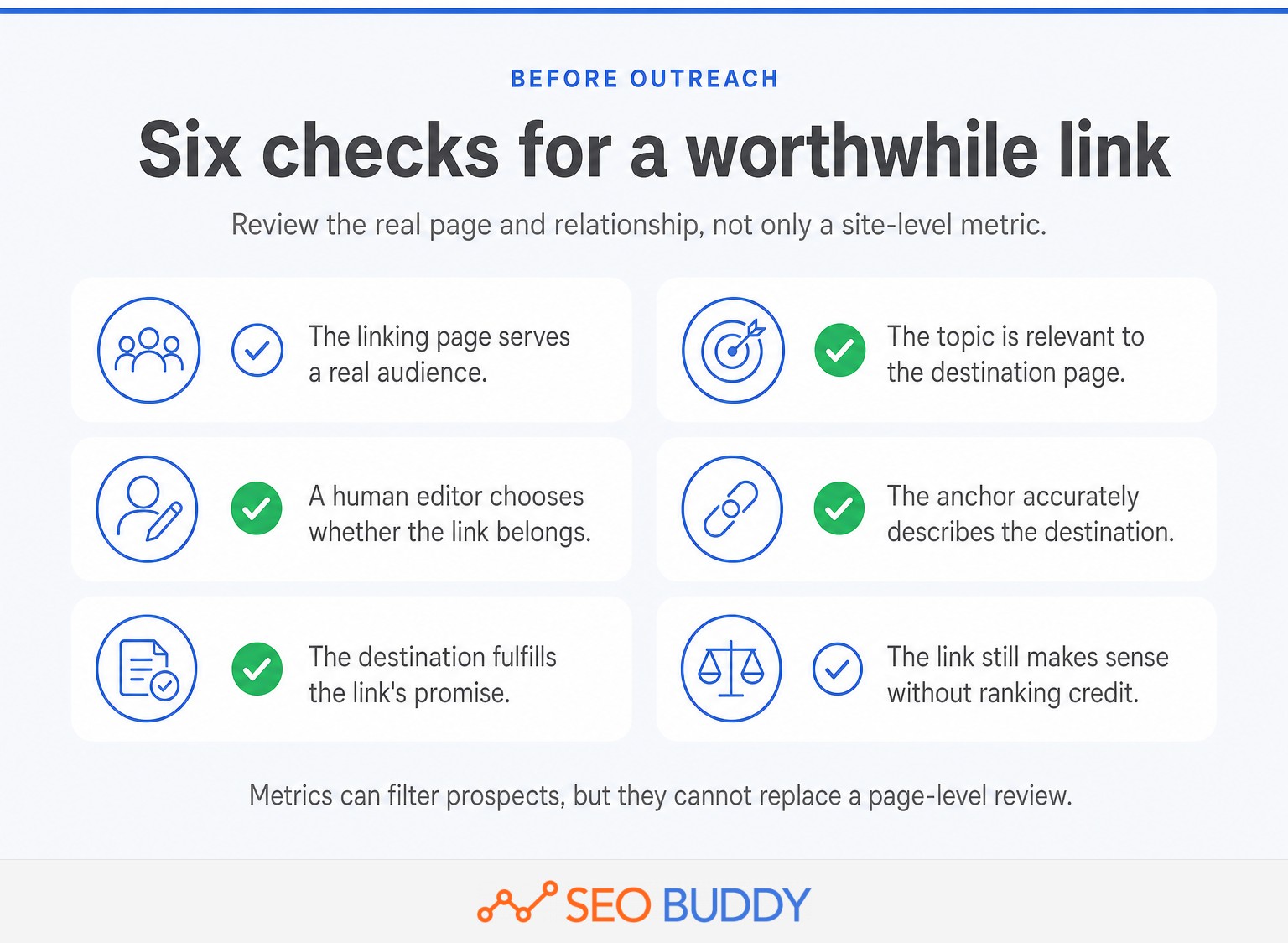
Judge a backlink by reader value, topical fit, editorial choice, destination quality, anchor context, and policy risk. Metrics can narrow a prospect list, but the final decision requires reviewing the actual page and arrangement.
Use these six questions before investing time or money:
- Does the linking page serve a real audience? Look for maintained content, a coherent topic, visible editorial standards, and evidence that the page exists for readers rather than placements.
- Is the topic relevant to the target page? Broad site-level similarity is less useful than a clear connection between the two specific pages.
- Who controls the decision? Independent editorial review is a healthier signal than guaranteed approval or a contract requiring an unqualified link.
- Does the destination fulfill the promise? A link about pricing should not land on a vague home page. A definition should point to the relevant definition or guide.
- Is the anchor natural and accurate? Descriptive anchors help readers. Repeated exact-match commercial anchors across unrelated sites are a warning sign.
- Would the link still make sense without ranking credit? A useful answer is often yes because the link supports evidence, navigation, referral traffic, attribution, or audience education.
Do not confuse the reputation of an entire domain with the quality of every page it publishes. A weak, unrelated, or rarely maintained page does not become a strong prospect because a site-level score is high.
A worthwhile backlink passes the reader-value test before it passes any metric threshold.
Why can internal links improve visibility without new backlinks?

Internal links make important pages easier to discover and clarify the relationships between pages on the same site. They are fully under the site owner's control, which makes them the logical starting point before external outreach.
Google recommends that every page you care about receive a link from at least one other page on your site. Those links should use standard crawlable anchor elements and concise text that tells the reader what the destination contains.
Start with the pages that matter to both the audience and the business. Link to them from relevant guides, category pages, navigation routes, and supporting articles where the connection genuinely helps the reader.
Avoid stuffing a paragraph with several competing links or repeating the same keyword-heavy anchor everywhere. Google says there is no magical ideal number of links on a page. Use enough to create useful routes without making the page difficult to read.
Teams that need to coordinate internal linking with content, technical work, and other priorities can place it within a broader SEO checklist.
Internal links are the link-building work a site can control, so important pages should never be left isolated.
Do outbound links improve SEO?
Outbound links help readers verify claims, understand context, and reach sources or resources that the current page cannot replace. They should not be treated as a mechanical tactic that guarantees higher rankings.
Google's link guidance says relevant external citations can help establish trustworthiness. That is a reason to cite the best source available, not a reason to add arbitrary links to well-known domains.
Use an ordinary link when the destination is trusted and the citation belongs in the article. Google's outbound-link qualification guidance recommends nofollow when other values do not fit and association is not intended, sponsored for compensated placements, and ugc for links added by users.
Blanket nofollowing every external citation removes useful information about the relationship between pages. Qualify a link because of the actual relationship, not because it leaves your website.
Use outbound links to support the reader and document evidence, not as a mechanical ranking trick.
What do follow, nofollow, sponsored, and UGC actually mean?
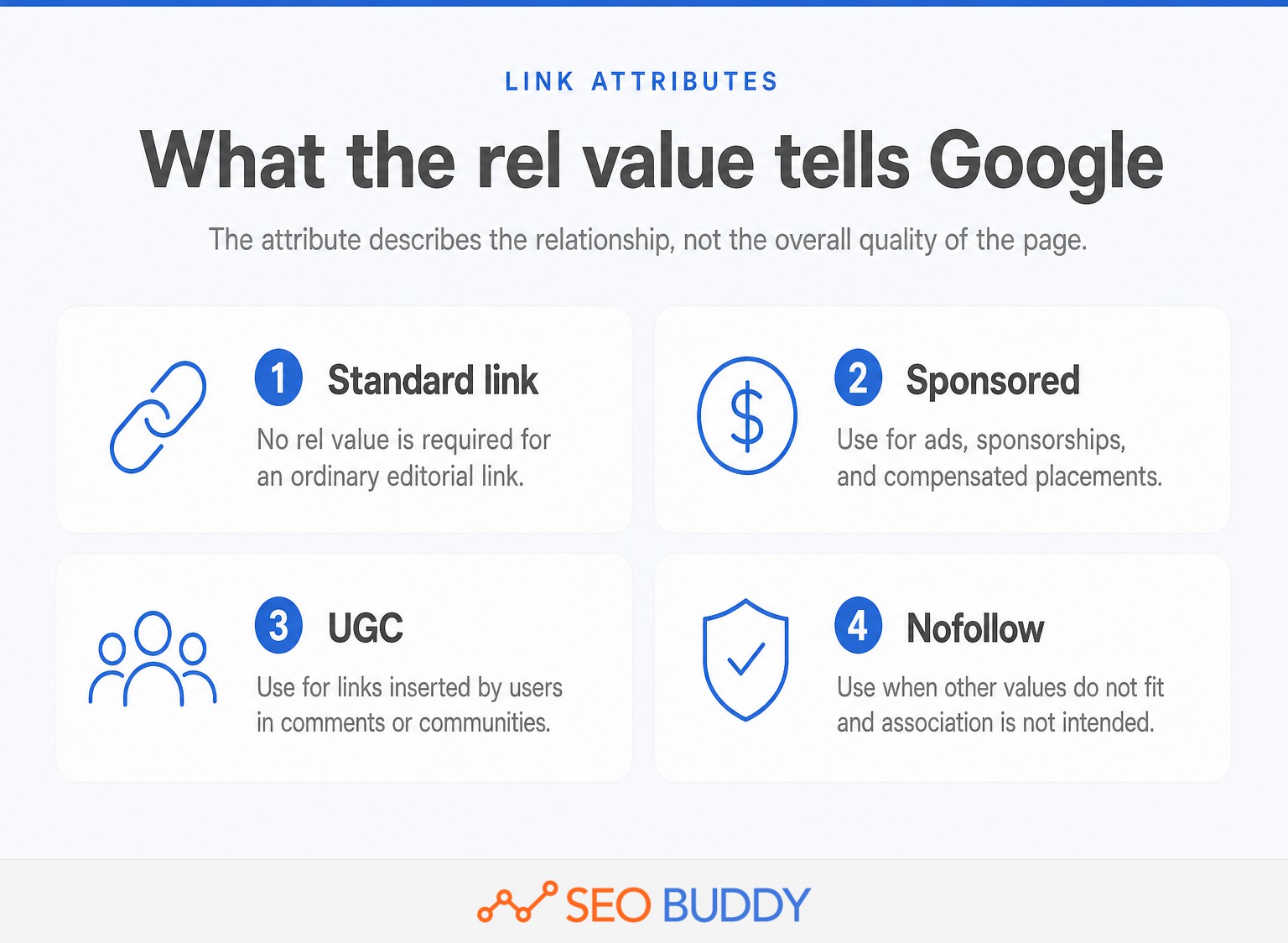
A standard editorial link needs no special rel value and is often informally called a follow or dofollow link. Sponsored, ugc, and nofollow are relationship signals that help Google interpret links that should not look like ordinary editorial endorsements.
- Standard link: No rel attribute is required for an ordinary link that the publisher is willing to associate with.
rel="sponsored": Use this for advertising, sponsorships, paid placements, or another compensation agreement.rel="ugc": Use this for links inserted by users, such as links in comments, community posts, or forum profiles.rel="nofollow": Use this when the other values do not fit and the publisher would rather Google not associate the site with, or crawl through, the destination.
Google's 2019 nofollow update explains that these values are treated as hints about which links its systems should consider or exclude. A qualified link may still be useful to a person who clicks it, but it should not be sold or reported as guaranteed ranking credit.
Multiple values can be used when more than one relationship applies, such as rel="ugc nofollow". Adding or removing an attribute does not fix an irrelevant page, a misleading anchor, or a poor destination.
A standard link is unqualified, while sponsored, ugc, and nofollow explain why Google should treat a qualified link differently.
Are guest posts, resource links, and citations safe?
Guest posts, resource links, and citations can be legitimate when they inform a relevant audience and accurately disclose any commercial relationship. The risk comes from manufacturing placements primarily to influence rankings, not from the label attached to the format.
When is a guest post useful?
A guest contribution is useful when the host publication genuinely serves the intended audience, the article adds information the publication would otherwise lack, and an editor controls acceptance. The author's identity and any compensation should be transparent.
Google's spam policies specifically warn about paid or widely distributed guest posts that pass ranking credit or use optimized anchor text. If compensation influenced the placement, the link should use sponsored or nofollow.
What makes a resource link worth pursuing?
A resource-page link is worth pursuing when the page is maintained for people who need a curated set of references. The proposed destination should fill a real gap, replace a broken or outdated reference, or explain the topic better than the existing options.
Be cautious when every submission is approved, unrelated industries appear together, prices are the main editorial criterion, or the page has little purpose beyond listing outbound links.
Do citations count as backlinks?
A linked citation from another website is a backlink. An unlinked mention is still a reference to the business or source, but it is not a clickable backlink.
Directory and profile citations can help people verify details or find a website when the platform is legitimate and relevant. Their value falls quickly when submissions are duplicated across unrelated directories or created only to inflate a link count.
Press releases can distribute news and help journalists find a source. Google nevertheless lists optimized links in widely distributed press releases among its link-spam examples, so distribution should not be treated as a shortcut to ranking credit.
Guest posts, resource links, and citations are safe when their audience value is real and their commercial relationship is disclosed.
Which link-building tactics create the most risk?
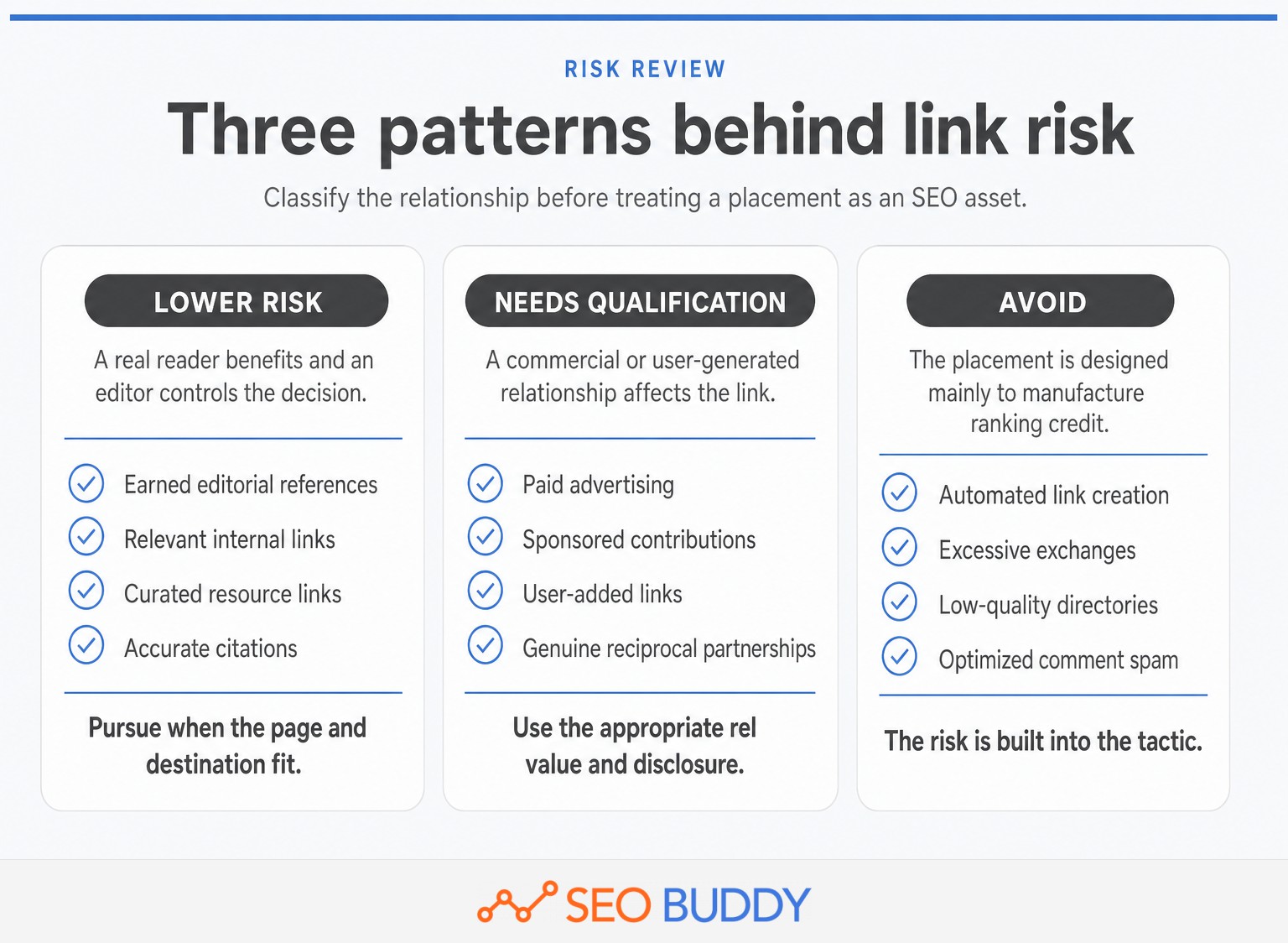
The riskiest tactics create or sell links mainly to manipulate rankings while disguising the reason the links exist. Compensation, automation, guaranteed approval, excessive scale, and forced commercial anchors are recurring warning signs.
Avoid campaigns built around:
- Buying or selling unqualified links for ranking purposes.
- Exchanging products or services for links without appropriate qualification.
- Excessive reciprocal linking or partner pages created only for cross-linking.
- Automated programs that create links across directories, profiles, comments, or generated sites.
- Low-quality bookmark and directory submissions.
- Keyword-rich links inserted into distributed widgets, templates, press releases, or paid articles.
- Forum comments and signatures written primarily to carry optimized anchors.
- Low-value articles created mainly to host or exchange links.
Paid online visibility is not automatically prohibited. Advertising, sponsorships, and paid collaborations are normal commercial activities when links are appropriately qualified and readers are not misled.
Risk also accumulates at campaign level. One genuine reciprocal reference between related organizations is different from hundreds of patterned exchanges. One specialist contribution is different from distributing near-identical articles across any site that accepts payment.
Teams conducting repeated outreach should document qualification, disclosure, anchor, and approval rules in clear link-building SOPs rather than leaving each decision to memory.
If a tactic depends on payment, automation, scale, or forced anchors to create ranking credit, the risk is the strategy itself.
How do you build a practical link strategy from scratch?
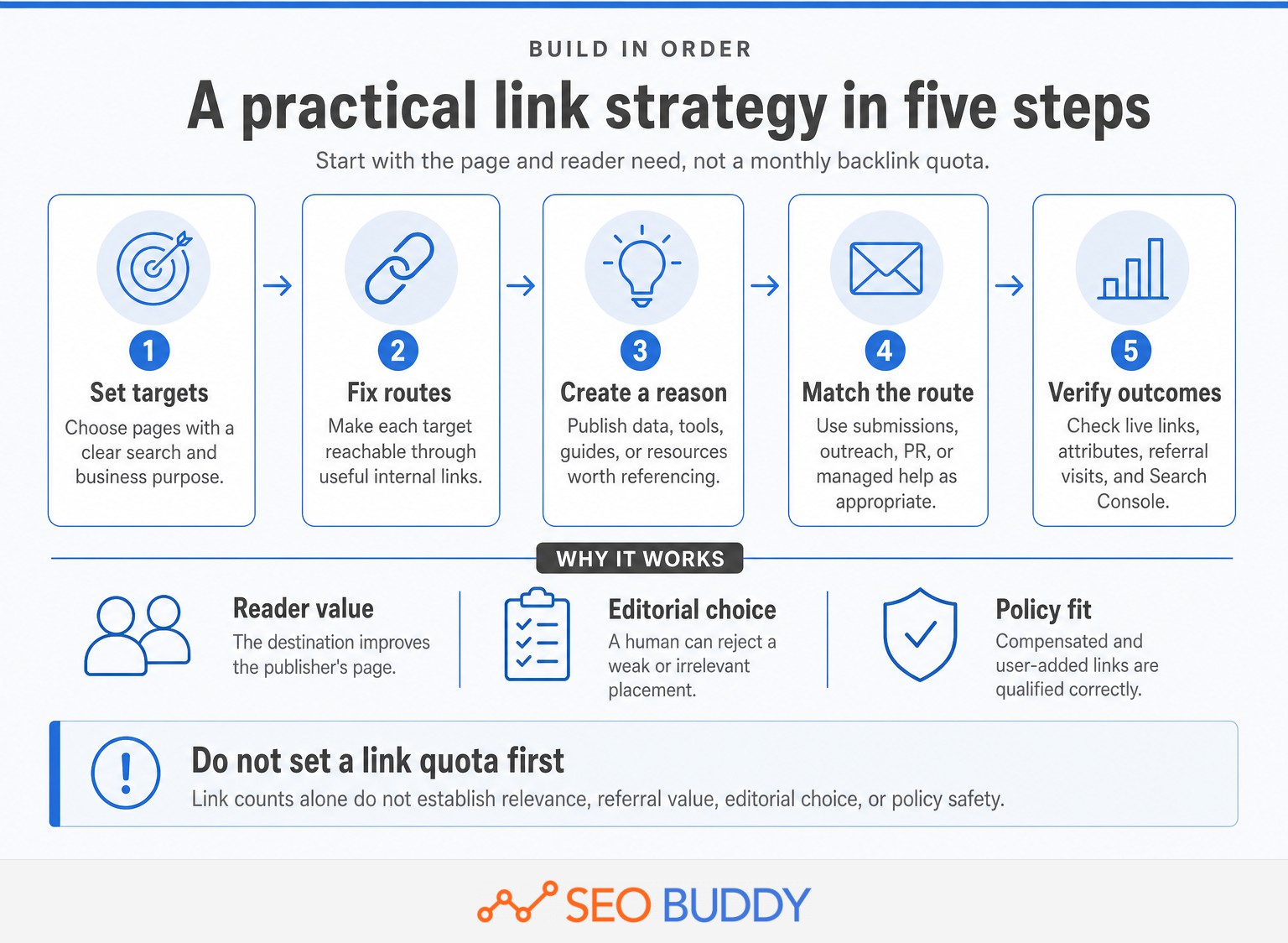
Build a link strategy by choosing target pages, fixing internal routes, creating a genuine reason to link, selecting an appropriate acquisition method, and verifying the result. Starting with a monthly link quota reverses that order and encourages weak opportunities.
1. Choose the pages that deserve support
Select pages with a clear search purpose and a useful next action for the reader. A campaign that sends every link to the home page misses opportunities to support the guide, tool, category, research page, or service page that best matches the linking context.
Record the purpose of each target. The desired outcome may be discovery, qualified referral traffic, stronger internal navigation, independent editorial references, or broader search visibility.
2. Fix the internal route first
Confirm that relevant pages on the site already link to the target with clear anchors. If a target is difficult to find from the site's own content, external outreach is compensating for a structural problem rather than solving it.
3. Create a defensible reason to link
The reason may be original research, a reusable template, a concise definition, a free tool, a visual explanation, an expert quotation, a better-maintained resource, or a guide that resolves a recurring question.
The asset does not have to be large. It has to be useful enough that the proposed link improves the publisher's page.
4. Match the acquisition route to the asset
Different assets require different routes:
- Legitimate directories, associations, and resource submissions fit verifiable business or reference information.
- Journalist and publisher outreach fits research, data, expert commentary, tools, and strong resources.
- Teams that want control over prospect selection and messaging can use a prospect discovery and outreach workflow.
- Teams without the capacity to conduct outreach can consider managed editorial link-building services, provided they retain approval over sites and destinations.
The route should not change the quality standard. A self-service submission and a managed campaign both need relevance, disclosure, accurate anchors, and a useful destination.
5. Verify and record the outcome
Check that the link is live, reaches the correct URL, uses the agreed anchor, carries the appropriate rel value, and appears in meaningful context. Record the publication date, linking URL, target URL, attribute, acquisition route, cost or compensation, and any referral visits.
Do not report a link as successful merely because it exists. A placement can be live and still be irrelevant, undiscoverable, incorrectly attributed, or unable to send a useful visitor.
Build links only after the target page, internal route, and reason to link are clear.
How should you measure whether links are helping?
Measure links in three layers: whether the placement was executed correctly, whether people used it, and whether the supported pages improved over time. No single metric can prove that one backlink caused a ranking or traffic change.
Execution measures include:
- Live and retained placements.
- Correct destinations and anchors.
- Appropriate link attributes.
- Relevant surrounding context.
- Distribution across useful target pages rather than only the home page.
Visitor and business measures include referral visits, engaged sessions, sign-ups, inquiries, assisted conversions, and new publisher relationships. A qualified sponsored or nofollow link can perform well at this layer even when ranking credit is not the purpose.
Search measures include changes in impressions, clicks, queries, and landing-page performance in Google Search Console. Compare the supported page with its own earlier performance and with similar pages that did not receive the same work, while recognizing that content changes, competition, seasonality, and ranking-system updates can also affect results.
The Search Console Links report can show top linking sites, linked pages, anchor text, and internal-link targets. Google states that the report is a sample rather than a complete backlink index, may include links that have since disappeared, and does not identify whether a link is nofollowed.
Do not upload a disavow file simply because an unfamiliar or low-quality site links to you. Google's current disavow links guidance says most sites do not need the tool. Google recommends it only when a considerable number of artificial or low-quality links exist and those links have caused, or are likely to cause, a manual action.
Measure links as placements, visits, and search outcomes, and use disavow only for exceptional risk.
What else should you know about links for SEO?
These common questions separate basic link terminology from decisions about link quality and search visibility. Each answer depends on where the link originates, where it points, why it exists, and how the publisher qualifies it.
What are backlinks on a website?
Backlinks are links from pages on other websites to pages on your website. They can help people and search engines discover your content, provide contextual information about the destination, send referral traffic, and contribute to link-analysis systems when search engines consider the links appropriate and trustworthy.
What does 10 blue links mean?
Ten blue links is an old shorthand for a search results page dominated by conventional organic text results. Modern Google results may also contain images, videos, rich results, local features, and related questions. Google's Visual Elements gallery now calls the conventional format a text result.
What is a link example?
A link example is clickable text such as Beginner SEO guide that points to another URL. In HTML, it can be written as <a href='https://example.com/guide'>Beginner SEO guide</a>. The visible anchor tells readers and search engines what they should expect to find on the destination page.
Which type of link is considered the most valuable for SEO?
The most valuable general backlink is an independent editorial link from a relevant, reputable page to the destination that best serves the reader. The link should use accurate context and a natural anchor. No directory category, domain extension, authority score, or link label guarantees value on its own.
SEO link terminology becomes simpler when each link is classified by origin, destination, purpose, and attribute.
What should you do next?
Choose one page that deserves greater visibility, confirm that useful internal routes lead to it, and define why an independent publisher would recommend it. Then identify a small set of relevant pages and organizations whose audiences genuinely need that resource.
If a repeatable self-service route fits the team, review SEO Buddy's curated link opportunities. Apply the same relevance, editorial-choice, destination, attribute, and risk checks to every opportunity before submitting anything.
The right next link is the one a real reader would value even if ranking credit disappeared.

CEO & Founder at SEO Buddy


 How to Improve Organic Traffic: A Prioritized SEO Action Plan
General SEO
 Best AI Writing Tools for SEO Content: What to Use and Avoid
General SEO
 Best SEO Tools of 2025: Which Ones Are Still Worth Using in 2026?
General SEO
 AI SEO Services: What Providers Do, What They Cost, and How to Choose
General SEO
Get the SEO work done, not just read about it
Create a free account and run your first content plan, keyword research and link-building campaign. No card, and setup is free until your first article.
Free to start. We never sell your address.