
How to Improve Organic Traffic: A Prioritized SEO Action Plan

In short
To improve organic traffic, diagnose the bottleneck before choosing tactics: confirm important pages can be indexed, identify pages with impressions but weak rankings or click-through rates, strengthen content and internal links, then pursue authority. Prioritize the smallest fix that can move an already visible, commercially relevant page.
Key takeaways
- Organic traffic work should follow the search funnel: discovery, indexation, visibility, clicks, and conversions.
- Pages already earning relevant impressions usually offer faster opportunities than topics requiring a completely new URL.
- Internal links help search engines discover pages and understand context, but they cannot compensate for content that misses the searcher's need.
- Create a new page only when the intended query requires a meaningfully different answer, audience, format, or next step.
- Measure clicks and business outcomes over comparable periods instead of treating daily ranking changes as the primary result.
Table of contents
- Where should you start if organic traffic is not growing?
- Is the problem discovery, rankings, clicks, or conversions?
- What should you fix when Google cannot find or index important pages?
- What should you do when pages are indexed but rarely appear?
- How do you improve pages that rank but attract too few clicks?
- How do you turn impressions into qualified organic traffic?
- When should you prioritize internal links?
- When should you create new content instead of updating an old page?
- When do backlinks become the priority?
- How should you plan the first 90 days?
- How do you measure progress without chasing rankings?
- Frequently asked questions
- What should you do next?
Anyone asking how to increase organic search traffic usually receives the same list: publish content, fix technical SEO, add links, improve speed, and earn backlinks. Every item may be valid, but the list does not reveal which action deserves attention first.
The useful question is not simply how to get more organic search traffic. It is where qualified visitors are being lost between publication and conversion. The answer determines whether the next hour belongs to a developer, writer, editor, outreach specialist, or conversion owner.
Where should you start if organic traffic is not growing?
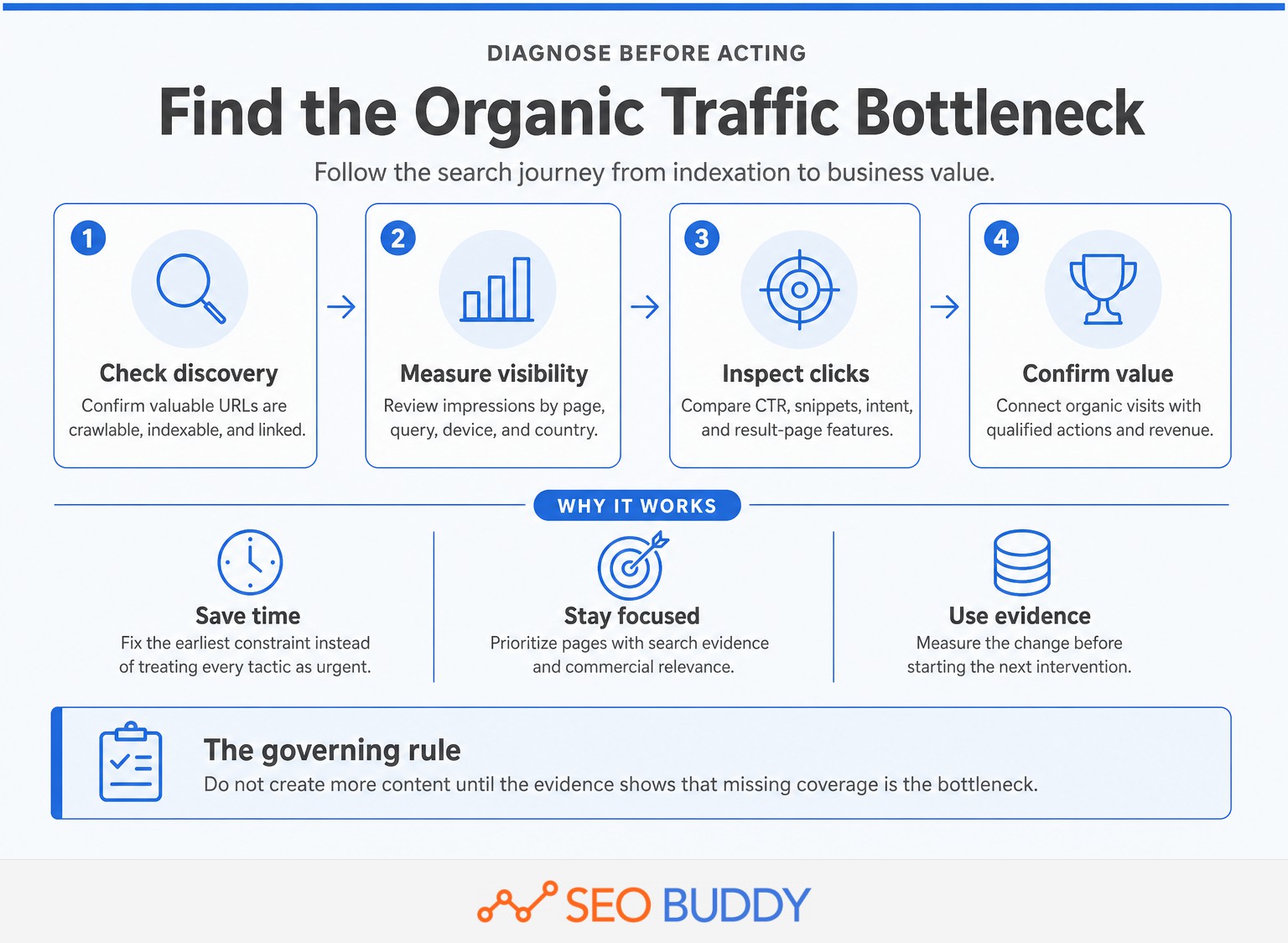
Start with a page-and-query diagnosis in Google Search Console, then connect the findings to landing-page behavior and conversions. Find the earliest stage where valuable pages stop progressing and address that bottleneck before adding more work downstream.
Use a consistent comparison period, such as the latest 28 days against the preceding 28 days, and separate brand from non-brand traffic when the property has enough data. Google's current Search Console Performance report documentation explains how to segment clicks, impressions, click-through rate, position, pages, queries, countries, and devices. (support.google.com)
Run the diagnosis in this order:
- Define value. Identify the products, services, signups, or other actions organic search should support.
- Find visible pages. Export pages and queries with impressions, including pages that receive few clicks.
- Check access. Confirm that commercially useful pages are crawlable, indexable, canonical, and internally linked.
- Classify the constraint. Decide whether each opportunity concerns discovery, relevance, click-through rate, conversion, or authority.
- Choose the smallest coherent intervention. Make one related set of changes, record the date, and measure the result before rewriting everything again.
SEO Buddy's site-planning snapshot generated on October 15, 2026 provides a useful example. Its Facebook Ad Library article had 155,961 impressions, one click, an average position of 10.7, and no identified internal links in the supplied data. Those figures do not prove a single cause, but they rule out a basic lack-of-discovery diagnosis. Query relevance, result features, snippet quality, intent, and internal support deserve inspection before another article is commissioned.
The first SEO priority is the first measurable bottleneck between indexation and business value.
Anybody can generate an article. Knowing which one is worth writing is the hard part.
The AI Content Engine reads your site and your competitors, then builds a ranked content plan and writes it. Setup is free, and you see your plan before you pay for anything.
See your content plan freeIs the problem discovery, rankings, clicks, or conversions?
Classify the symptom before selecting a tactic because the same traffic total can hide very different problems. A page with no impressions needs a different response from a page that appears thousands of times but attracts almost no clicks.
| Evidence in the data | Likely bottleneck | First investigation |
|---|---|---|
| The URL is not indexed | Discovery or indexation | Status code, robots rules, noindex, canonical, internal links, sitemap |
| The URL is indexed but has almost no impressions | Demand, relevance, or intent | Target queries, content purpose, search-result format |
| Impressions exist but average position is weak | Relevance, depth, internal support, or authority | Query groups, competing result types, missing sections, links |
| The page appears near page one but CTR is weak | Snippet or intent alignment | Title, description, query mix, SERP features, freshness |
| Clicks rise but conversions do not | Landing-page or audience fit | Offer, next step, mobile experience, form, query qualification |
| Many pages decline at once | Sitewide, seasonal, technical, or market change | Date comparison, indexing reports, affected page groups, demand trends |
Average position needs careful interpretation. Google's documentation defines it as the average position of the topmost result from the site across impressions, not a permanent rank for one keyword. Google recommends monitoring changes while focusing more heavily on impressions and clicks. (support.google.com)
The supplied October 2026 snapshot illustrates the distinction. SEO Buddy's SOP Collection page showed 6,466 impressions, 33 clicks, a 0.51% CTR, and an average position of 8.7. That combination makes title, snippet, query intent, and result-page competition immediate review areas. By contrast, a page with no impressions would first require an indexation and relevance check.
Do not assign one diagnosis from an aggregate CTR alone. A page may appear for a mix of branded, unbranded, relevant, and marginal queries across different countries and devices. Segment first.
A symptom-led diagnosis prevents content production from becoming the default answer to every traffic problem.
What should you fix when Google cannot find or index important pages?
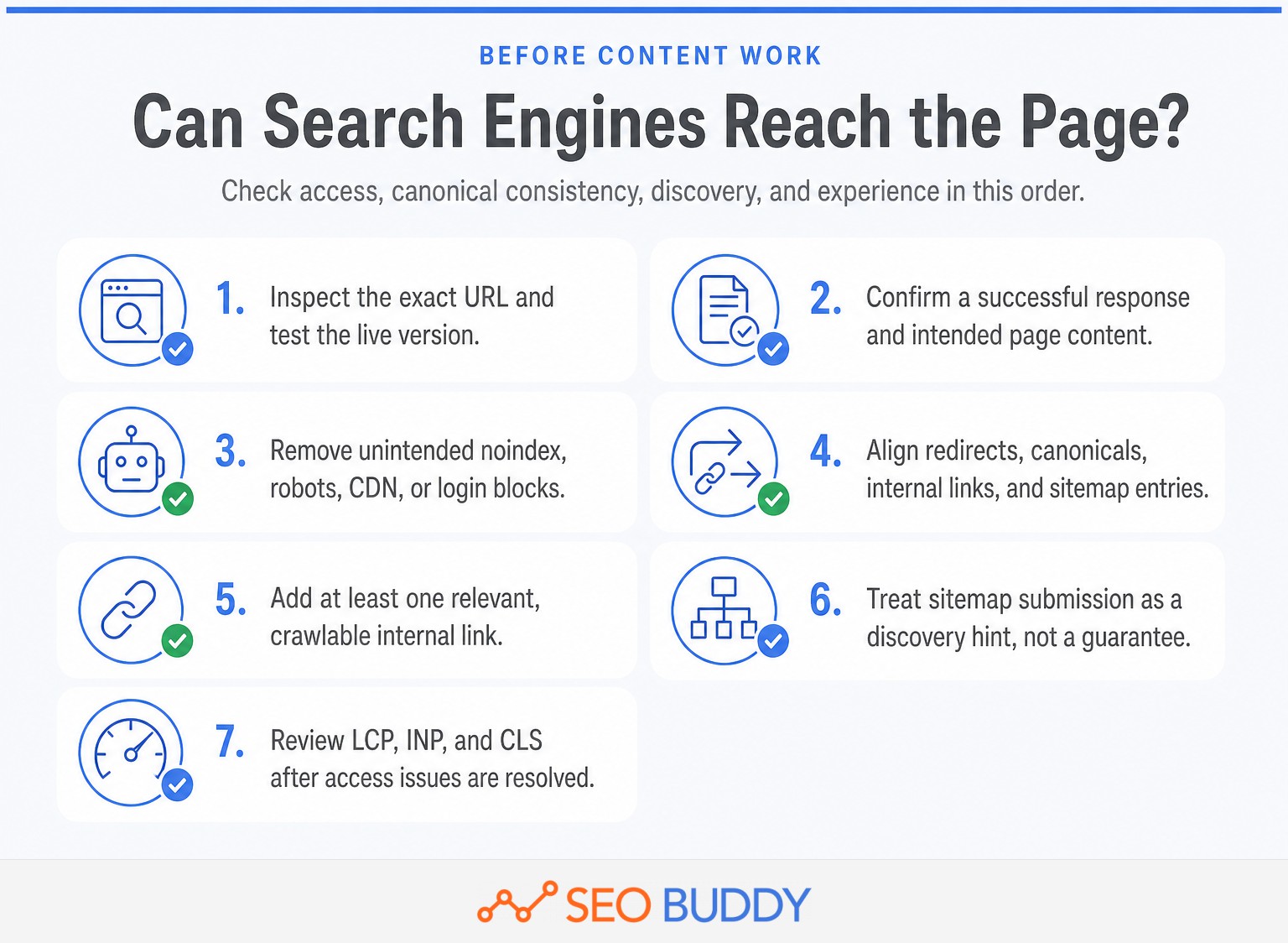
Restore access, canonical consistency, and internal discovery before working on copy or backlinks. A page that cannot be reliably crawled or selected for indexing has no dependable path to organic visibility.
Check the following in order:
- Inspect the exact URL. Google's URL Inspection and indexing guidance explains how to check the current index status, test a live URL, inspect loaded resources, and request crawling. (developers.google.com)
- Confirm the response. The preferred URL should return the intended content with a successful status rather than redirecting through a chain, returning an error, or behaving like a soft 404.
- Review access controls. Look for unintended
noindexdirectives, robots restrictions, CDN blocks, login requirements, and JavaScript rendering failures. - Check the canonical. Make sure internal links, redirects, canonical tags, and sitemap entries consistently reference the preferred version.
- Add a crawlable internal link. Google says every page a site cares about should receive a link from at least one other page, using descriptive anchor text that provides context. Google's link best practices also explain that standard links help Google discover pages. (developers.google.com)
- Include the canonical URL in the sitemap. Google's sitemap guidance describes submission as a hint, not a guarantee that a URL will be crawled or indexed. (developers.google.com)
Page experience comes after basic access, but it still deserves attention. Google's December 2025 Core Web Vitals documentation defines good performance as Largest Contentful Paint within 2.5 seconds, Interaction to Next Paint below 200 milliseconds, and Cumulative Layout Shift below 0.1. These metrics should be evaluated with the broader page experience rather than treated as the only ranking inputs. (developers.google.com)
If the terminology is unfamiliar, the free SEO fundamentals lessons organize learning by the task in front of the reader rather than requiring a complete course first. (seobuddy.com)
Fix access and indexation before spending time polishing content or earning links.
What should you do when pages are indexed but rarely appear?
Start with the queries the page should answer and compare them with the queries for which it actually earns impressions. An indexed page can remain invisible when its purpose is unclear, its answer is too generic, or another URL on the site addresses the same need more convincingly.
Export the page's queries and group them by underlying task. A keyword list may contain several phrases that describe the same intent, while two nearly identical phrases can sometimes require different formats or levels of detail.
Review the live result page for each important query and record:
- The dominant format, such as a guide, category, product page, tool, discussion, or video.
- The level of specificity in the leading titles and introductions.
- The questions answered directly on the page.
- The evidence, examples, visuals, or firsthand material that make results distinctive.
- The apparent audience and stage of awareness.
Google's current people-first content guidance asks whether a page provides original information or analysis, adds substantial value beyond other results, and leaves the reader able to achieve the intended goal. (developers.google.com)
Do not respond by producing one page for every keyword variation. Google's May 2026 generative AI optimization guide says its systems can understand relevant pages without exact-match variations and warns against creating large numbers of pages primarily to manipulate rankings or AI responses. (developers.google.com)
An indexed page earns impressions only when it answers a query better and more specifically than the alternatives.
How do you improve pages that rank but attract too few clicks?
Inspect the queries, devices, countries, and result features behind the low CTR before rewriting the title. The best change makes the result a more accurate and compelling description of the page, not a louder promise than the content can fulfill.
Google's current guidance for identifying low-CTR pages recommends sorting pages by CTR and considering changes to the title, description, or content when a result does not appear to answer the associated queries. (support.google.com)
Prioritize pages that have meaningful business value, substantial impressions, and a realistic path to better visibility. Then:
- Compare CTR by query rather than relying only on the page average.
- Check whether the title names the actual task, audience, constraint, or outcome.
- Remove dates unless the page is genuinely maintained for that year.
- Align the introduction and headings with the promise made in the result.
- Check whether an AI answer, featured result, local pack, video, or other feature changes what a click-worthy result must offer.
- Use structured data only when it accurately describes visible page content. Google does not guarantee a rich result even when markup is valid. (developers.google.com)
A low CTR is not automatically a copywriting problem. The page may be appearing for irrelevant queries, ranking below visually dominant features, or serving users in a country where the offer is unavailable.
For visible pages, better query alignment and a clearer result snippet can outperform another round of publishing.
How do you turn impressions into qualified organic traffic?
Match the page to a specific user problem and give the right visitor a logical next step. Qualified organic traffic is not the largest possible audience; it is search traffic that can benefit from the page and continue toward a useful business outcome.
A strong search landing page usually contains six elements:
- A direct answer. Resolve the central question before background information.
- Clear scope. State who the guidance applies to and where its limits begin.
- Useful evidence. Add source-backed facts, firsthand data, examples, or a mechanism the reader can inspect.
- Task completion. Include the steps, comparison, checklist, or decision rule needed to act.
- Relevant navigation. Link to the next internal resource when the reader needs deeper detail.
- An appropriate conversion path. Offer a tool, product, consultation, signup, or other next step only after the page has earned the request.
Specificity matters. A broad article about driving confidence and a focused guide for someone returning to driving after an accident address different needs, even though the general topic overlaps. The same distinction applies to business content: define the precise situation before choosing the keyword, format, and offer.
Google's people-first guidance also asks whether the site has an intended audience, whether the content demonstrates real knowledge, and whether readers leave with enough information to achieve their goal. (developers.google.com)
Qualified organic traffic comes from matching a specific need and giving the visitor a relevant next step.
When should you prioritize internal links?
Prioritize internal links when a valuable page is isolated, newly published, buried deep in the architecture, or already earning impressions without enough contextual support. Internal linking is often a lower-effort first move than creating another page or starting an outreach campaign.
Look for these opportunities:
- Important pages with no inbound internal links.
- Pages ranking just outside the positions that generate consistent clicks.
- New supporting articles that should point to a broader hub or commercial page.
- Older articles that mention a subject now covered by a stronger resource.
- High-authority pages whose readers would genuinely benefit from the target page.
Use concise anchors that explain the destination. Avoid forcing the same exact-match phrase into many pages, placing links in unrelated paragraphs, or adding large blocks of links without editorial context.
The October 15, 2026 SEO Buddy snapshot flagged multiple ranking articles as carrying their own weight without identified internal links. That is a practical priority list: start with pages already demonstrating search demand, then add links from genuinely related pages.
Internal links are highest priority when a valuable page is isolated or almost competitive.
When should you create new content instead of updating an old page?
Update an existing page when the searcher wants the same fundamental answer and the current URL can satisfy it after improvement. Create a new page when the query represents a distinct task, audience, format, stage, or business destination that would make the existing page unfocused.
When evaluating whether content matches search intent, look for a clear response to a specific problem rather than a broad topic. For example, a guide to [a gradual plan for returning to driving after a car accident](https://anxietychecklist.com/blog/driving-anxiety-after-car-accident/) addresses a distinct concern with a focused, practical structure.
| Evidence | Default action | Reason |
|---|---|---|
| The existing URL matches the intent but is incomplete or stale | Update | The page has history and can provide a stronger version of the same answer |
| The new query requires a different task, audience, or page type | Create | Combining both needs would weaken clarity and conversion alignment |
| Several URLs compete for the same query and provide similar answers | Consolidate | One authoritative page is clearer for readers and internal linking |
| The page is strong but lacks contextual internal links | Link internally | The bottleneck is discovery or site context, not missing content |
| The page satisfies the intent but remains weak against established results | Build authority | More copy may not address the competitive disadvantage |
Before publishing, write a one-sentence purpose for the proposed URL. If that sentence substantially duplicates the purpose of an existing page, update or consolidate instead.
Automation does not remove the need for this decision. Google's guidance on generative AI content says AI can help with research and structure, but producing many pages without added value may violate its scaled content abuse policy. (developers.google.com)
For teams with a genuine coverage gap, SEO Buddy's content planning and publishing workflow is designed to select opportunities before drafting, then write, illustrate, internally link, and deliver the resulting article. (seobuddy.com)
Create a new URL only when the search intent is genuinely different from what the site already covers.
When do backlinks become the priority?
Prioritize backlinks after the target page is indexable, useful, aligned with the query, and supported by relevant internal links. Authority work is difficult to justify when the destination itself still needs foundational repairs.
Backlinks deserve attention when:
- A complete page repeatedly stalls below established, relevant results.
- Competing resources receive citations because they contain original evidence, tools, templates, or examples that the page lacks.
- A new topic cluster has strong internal coverage but little external recognition.
- Relevant publishers have a clear editorial reason to reference the resource.
Start by improving what the outreach will promote. Original data, a useful template, a transparent methodology, a detailed comparison, or a well-designed visual gives another publisher a reason to cite the page.
SEO Buddy's self-service prospecting and outreach workflow finds relevant sites and contacts, then sends a three-email sequence from the customer's connected mailbox. Targeting, messaging, mailbox management, and legal compliance remain the user's responsibility. (seobuddy.com)
Avoid tactics whose primary purpose is manipulating rankings. Google's current spam policies identify paid ranking links, excessive exchanges, automated link creation, and optimized links in compensated articles as examples of link spam. (developers.google.com)
Authority work pays best after the page is indexable, useful, internally supported, and worth citing.
How should you plan the first 90 days?
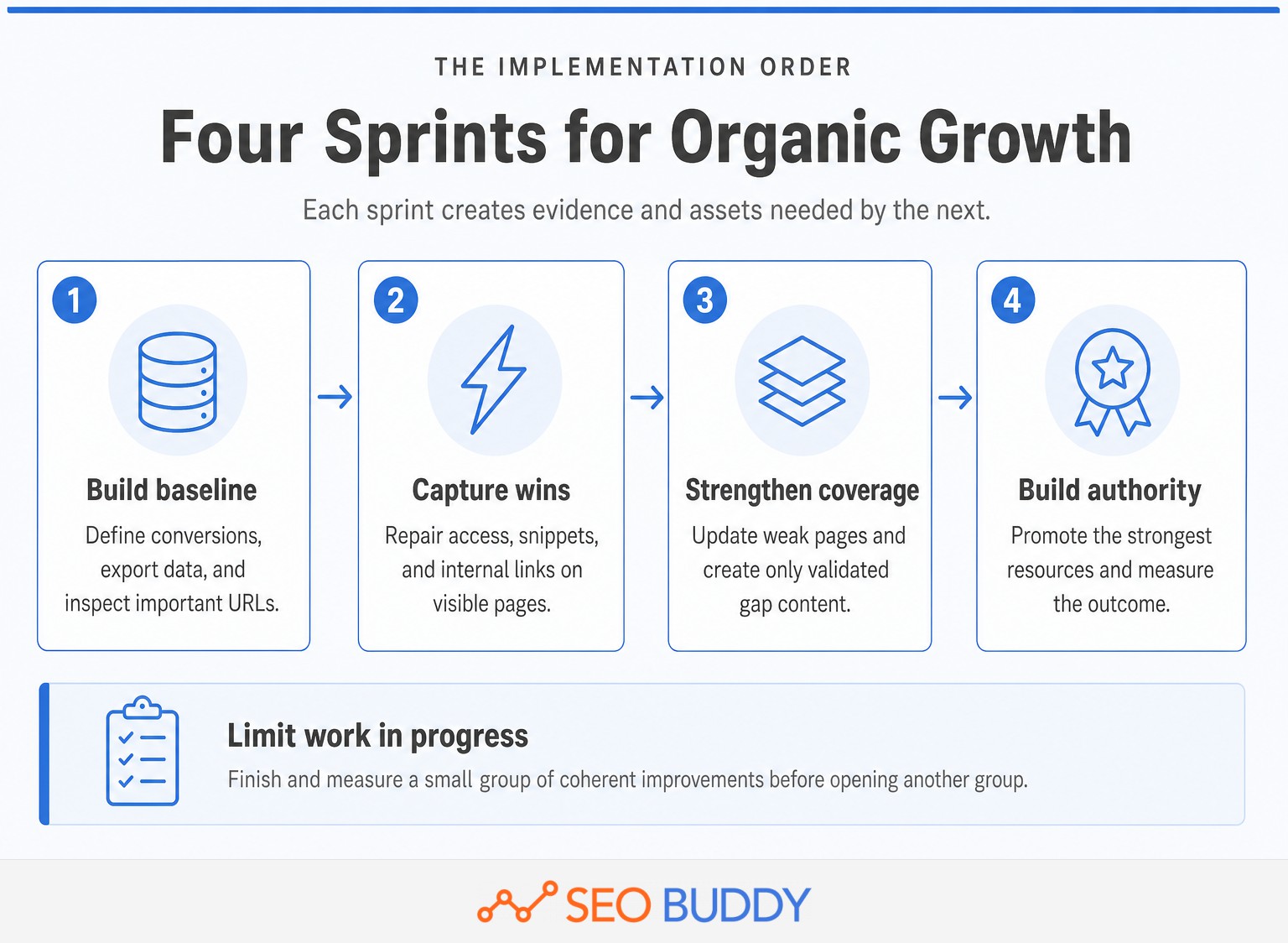
Sequence the work so each phase improves the evidence available for the next decision. The first month should establish measurement and capture existing opportunities before the plan expands into new content and authority work.
| Period | Primary objective | Actions |
|---|---|---|
| Days 1 to 14 | Establish the baseline | Confirm conversions, export page and query data, inspect indexation, map important pages, record current titles and internal links |
| Days 15 to 30 | Capture quick wins | Repair blocked URLs, improve high-impression low-CTR pages, add contextual internal links, update pages already near useful visibility |
| Days 31 to 60 | Strengthen coverage | Refresh incomplete pages, consolidate overlap, create only validated gap pages, add original evidence and supporting visuals |
| Days 61 to 90 | Build authority and review | Promote the strongest resources, run relevant outreach, compare results with the baseline, retain successful changes, and revise weak assumptions |
Limit work in progress. Five finished improvements with measured results provide more information than 30 half-completed tasks spread across every part of the site.
Assign one owner, expected completion date, and success measure to each action. A technical fix might use valid indexation as its measure, a title test might use query-level CTR, and a commercial page might use qualified leads or sales.
As of October 2026, the clearest next step is to create a free account and work through the 122-step SEO Checklist in impact order, using the 66 mapped SOPs when a task needs a repeatable procedure. Both resources are available in full with a free account. (seobuddy.com)
The first 90 days should move from diagnosis to quick wins, then coverage and authority.
How do you measure progress without chasing rankings?
Use rankings as diagnostic context, then judge progress through impressions, clicks, qualified sessions, and conversions. A successful SEO program attracts more of the right visitors and creates business value, even when individual query positions fluctuate.
Maintain a compact scorecard:
| Layer | Metrics to review | Diagnostic question |
|---|---|---|
| Discovery | Indexed pages, exclusions, inspected URLs | Can search engines access the pages that matter? |
| Visibility | Impressions, queries, page groups, countries, devices | Is relevant search demand finding the site? |
| Clicks | Clicks and CTR by page and query | Do visible results earn visits from the intended audience? |
| Experience | Engaged sessions and landing-page behavior | Do visitors find the page useful after clicking? |
| Business value | Leads, signups, sales, or another defined conversion | Does organic traffic support the site's objective? |
| Execution | URLs changed, work completed, and change dates | Which actions could have produced the observed movement? |
Compare equivalent periods and annotate major releases, migrations, promotions, and content updates. For seasonal businesses, year-over-year context may be more informative than comparing two adjacent months.
Google's guide to using Search Console and Google Analytics together explains that Search Console measures discovery and clicks before the visit, while analytics data helps evaluate landing-page engagement and conversions after arrival. (developers.google.com)
Do not report an average ranking without impressions, clicks, or business context. A ranking for an irrelevant or low-value query is not a useful organic growth result.
Measure organic growth with clicks and business outcomes, using rankings only as diagnostic context.
Frequently asked questions
These answers address common questions associated with improving organic traffic. Each answer is self-contained so it can be understood without the surrounding action plan.
Is SEO dead now with AI?
No. As of October 2026, Google's May 15, 2026 guidance says established SEO practices remain relevant to generative AI features because those experiences draw on Google's Search index and ranking systems. Sites still need indexable pages, useful original content, clear internal links, good page experience, and accurate visible information. (developers.google.com)
What is the 80/20 rule in SEO?
The SEO 80/20 rule is a prioritization heuristic, not a formal search-engine standard. It suggests that a minority of pages and actions may create most measurable gains. Apply it by finding commercially relevant pages already receiving impressions, then fixing their clearest constraint before spreading effort across low-potential tasks.
Why is organic traffic decreasing?
Organic traffic can decrease because search demand changed, rankings declined, pages lost indexation, competitors became more relevant, result features reduced clicks, snippets weakened, or tracking changed. Google's debugging guidance recommends comparing periods, identifying affected queries and pages, checking whether the decline is sitewide, and reviewing indexing when groups of pages fall together. (developers.google.com)
What does organic traffic mean?
Organic traffic consists of visits earned through unpaid search results rather than advertisements. Search Console records Google impressions and clicks, while analytics platforms record sessions and behavior after the visit. Organic does not mean cost-free because research, content, development, measurement, and authority building still require time or money.
What should you do next?
Choose one commercially relevant page with enough data to diagnose and identify the earliest point where progress stops. Make one coherent set of changes, record the date, and compare the result over a suitable period before moving to the next bottleneck.
The useful habit is simple: diagnose first, prioritize second, and produce more only when the evidence says more is needed.

CEO & Founder at SEO Buddy


 Best AI Writing Tools for SEO Content: What to Use and Avoid
General SEO
Best AI Writing Tools for SEO Content: What to Use and Avoid
General SEO
 Best SEO Tools of 2025: Which Ones Are Still Worth Using in 2026?
General SEO
Best SEO Tools of 2025: Which Ones Are Still Worth Using in 2026?
General SEO
 AI SEO Services: What Providers Do, What They Cost, and How to Choose
General SEO
AI SEO Services: What Providers Do, What They Cost, and How to Choose
General SEO
 Programmatic SEO: How It Works, When to Use It, and When Not To
General SEO
Programmatic SEO: How It Works, When to Use It, and When Not To
General SEO
Get the SEO work done, not just read about it
Create a free account and run your first content plan, keyword research and link-building campaign. No card, and setup is free until your first article.
Free to start. We never sell your address.