
How to Buy Backlinks Safely: Costs, Risks, and Provider Red Flags

In short
Buying backlinks safely does not mean finding a penalty-proof paid link. Google classifies links bought for ranking purposes as link spam. A lower-risk purchase pays for legitimate outreach, editorial work, or advertising while preserving site approval, topical relevance, traffic evidence, and clear use of rel=sponsored or rel=nofollow when payment buys the placement.
Key takeaways
- Google classifies buying or selling links for ranking purposes as link spam, while qualified advertising and sponsorship links are permitted.
- A buyer should know the exact domain, page context, destination, proposed anchor and link attribute before approving a paid placement.
- A September 15, 2026 SEO Buddy catalogue snapshot showed that 41,637 of 105,141 priced listings were under $50, but a low price does not prove value.
- Guaranteed followed links, hidden domains, bulk packages and ranking promises are reasons to reject a provider.
- Payment should buy documented work, audience access or an approved deliverable, not an unverifiable promise of higher rankings.
Table of contents
- Is buying backlinks illegal, and what does Google actually prohibit?
- Should you buy backlinks at all?
- How can you vet a backlink before paying?
- What should you expect to pay for a backlink?
- What provider red flags should make you walk away?
- What should a safe purchase agreement include?
- What can you do instead of buying ranking credit?
- What else should you know about buying backlinks?
- What is the next step if you still want help?
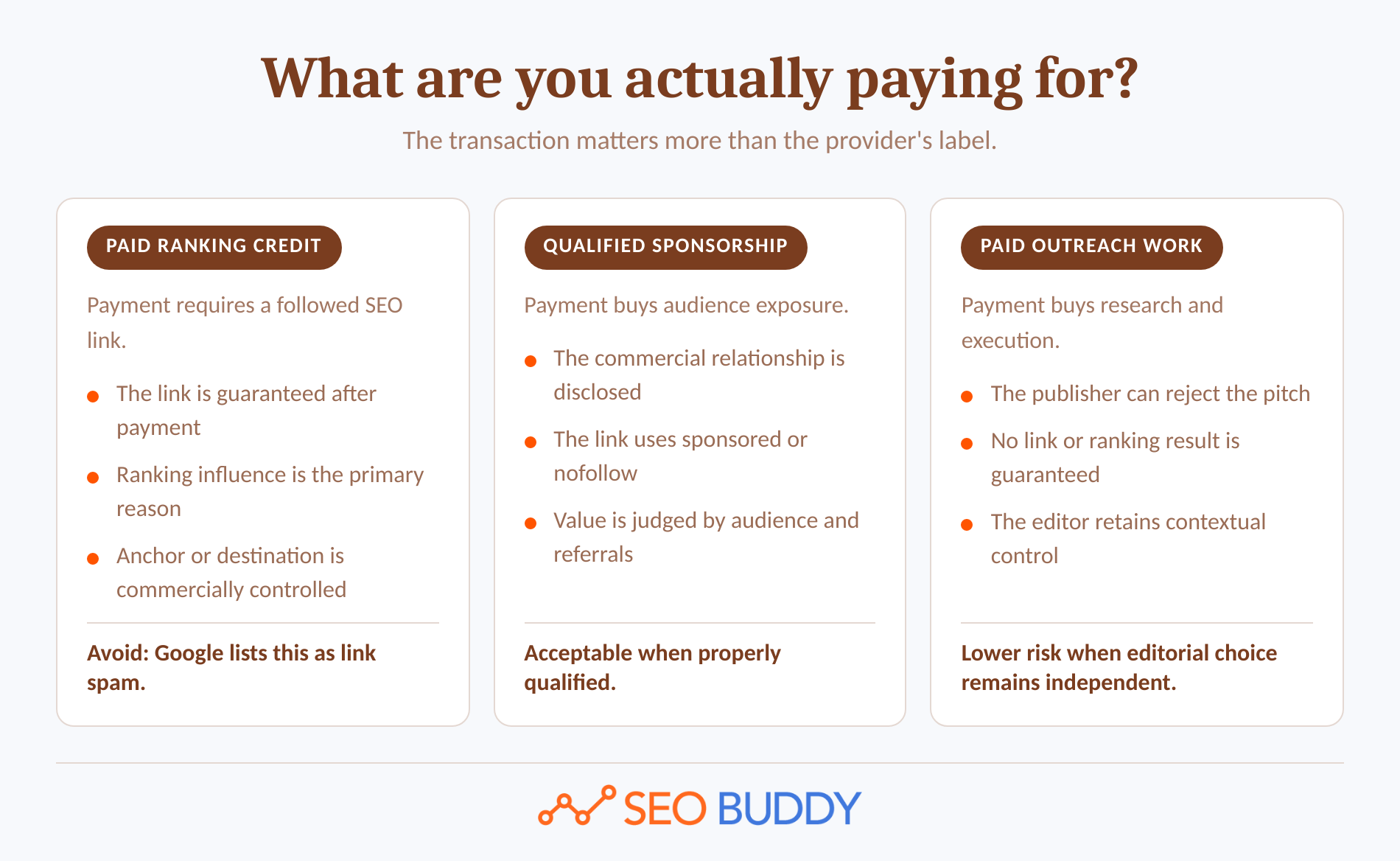
The phrase buying backlinks hides three different transactions: paying for ranking credit, paying for disclosed sponsorship and paying someone to research and conduct outreach. Those transactions are not equivalent. A responsible buying decision begins by identifying which one is actually being sold.
Is buying backlinks illegal, and what does Google actually prohibit?
Buying backlinks is not automatically illegal in the United States, but a paid placement can create advertising-law obligations when it acts as an endorsement. Separately, Google treats links bought for ranking purposes as link spam and says violations can lead to lower rankings, omission from results or a manual action.
Google's spam policies for Google Web Search, accessed September 15, 2026, define link spam as creating links primarily to manipulate rankings. The examples expressly include exchanging money, goods or services for links or posts containing links.
Google also recognizes that advertising and sponsorship are normal commercial activities. Its outbound-link guidance says paid placements should use rel=sponsored; nofollow remains acceptable.
Google policy is not U.S. law. The FTC's 2023 Endorsement Guides Q&A says material connections that could affect how consumers evaluate an endorsement should be disclosed clearly and conspicuously. Other jurisdictions and regulated industries may impose additional requirements, so this is general information rather than legal advice.
Sales language does not change the transaction. A placement can be called editorial or outreach-led, but if payment guarantees a followed link intended to influence rankings, the arrangement remains close to Google's explicit paid-link example. Paying for research and outreach is different when a publisher can reject the pitch, edit the context or qualify the link.
Google's Manual Actions report states that buying links to manipulate rankings can result in a manual action affecting some or all of a site. A link can also fail to produce any measurable improvement without a visible warning.
The safe dividing line is what payment buys: ranking credit violates Google policy, while qualified sponsorship and independent outreach are different transactions.
Anybody can generate an article. Knowing which one is worth writing is the hard part.
The AI Content Engine reads your site and your competitors, then builds a ranked content plan and writes it. Setup is free, and you see your plan before you pay for anything.
See your content plan freeShould you buy backlinks at all?
Buy only if the transaction still makes business sense without purchased ranking credit. Sponsorship can buy relevant audience access, while outreach services can buy research and labor; neither should be justified by a promise of rankings.
Backlinks still matter. Google's current ranking-systems guide says PageRank continues to be part of its core ranking systems, and its link best practices say links help Google determine page relevance and discover pages.
That does not make every backlink useful. Test the purchase with four questions:
- Would the placement remain worthwhile if the link were marked
sponsored? - Does the linking page reach people who could reasonably need the destination page?
- Can the provider reveal the site and evidence before payment becomes final?
- Can the budget tolerate no ranking movement from the placement?
A no to the first or fourth question usually means the purchase depends too heavily on ranking credit. A no to the second or third means the buyer lacks evidence that the link deserves approval.
If the purchase only works when a paid link passes ranking credit, the business case is carrying more policy risk than value.
How can you vet a backlink before paying?
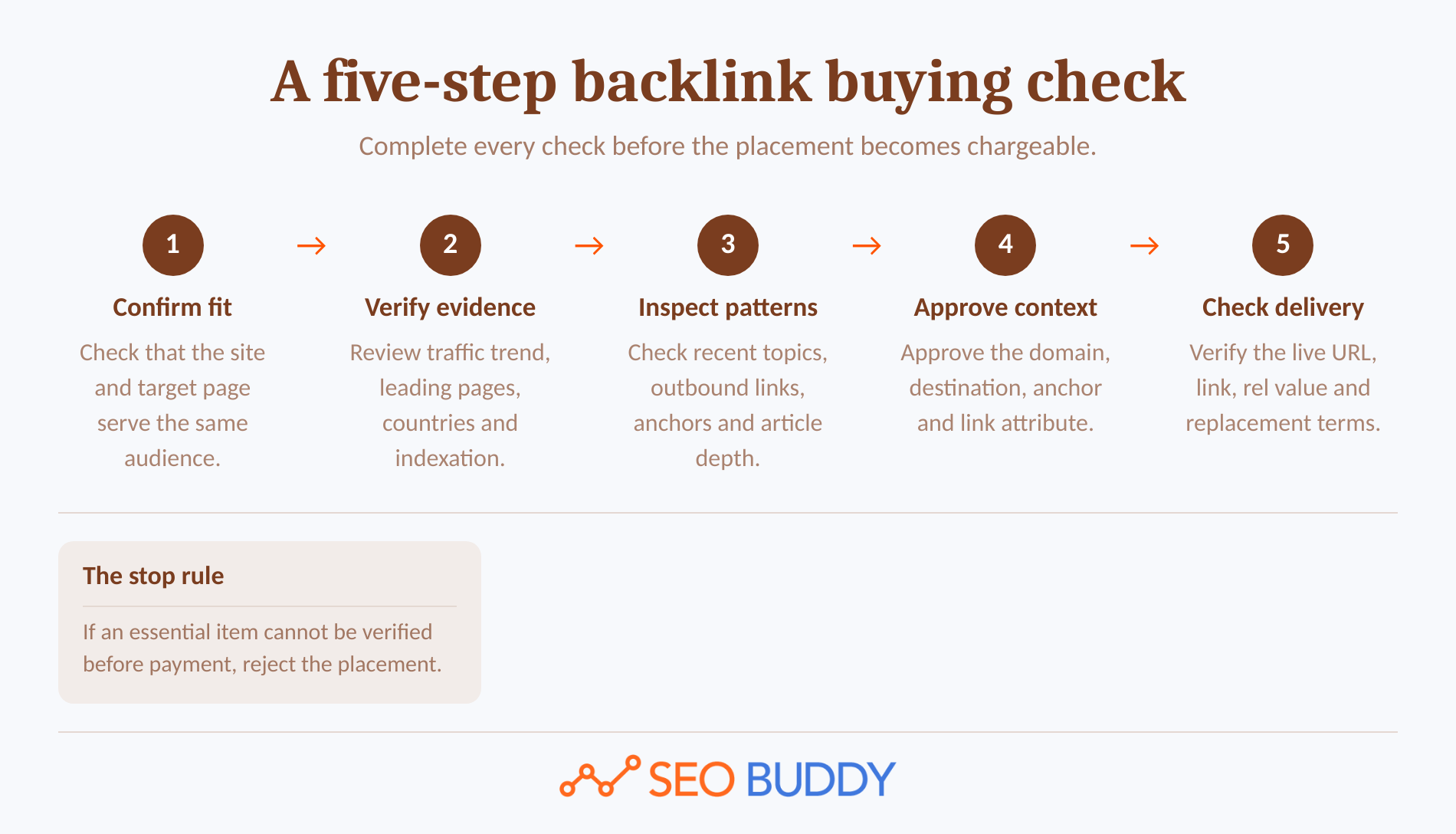
Vet the publisher, the exact page and the transaction before paying. A high authority score cannot replace evidence that the site has a real audience, publishes on the subject and gives the buyer approval over context.
Does the site reach the right audience?
Open the site and read several recent articles, not just the proposed page. Check whether the publication regularly covers the target topic and whether a reader could move from the article to the linked page without a sudden change of subject.
A business software link placed on a general lifestyle article may be indexable, but the context gives readers little reason to click. Topic and audience fit should pass before authority metrics enter the discussion.
Is the traffic evidence relevant?
Ask for current estimated traffic, its trend, leading countries and the pages that attract it. A single cropped traffic number does not reveal whether the audience comes from relevant articles, unrelated celebrity queries or a temporary spike.
Traffic estimates differ between data sources, so treat the number as directional evidence. Look for consistency across several months, indexed pages and rankings connected to the site's stated subject.
Does the site appear to exist mainly to sell links?
Read the latest posts and inspect their outbound links. Warning patterns include abrupt jumps between unrelated commercial subjects, repetitive keyword-heavy anchors, thin articles and a steady stream of links to industries that have no relationship with the publication.
Google's spam policy specifically identifies automated links, low-quality directories, optimized anchors in paid articles and low-value content created mainly to manipulate linking signals.
Can you approve the exact context?
Do not accept a mystery bundle. The buyer should approve the domain, page topic, destination URL, suggested anchor, disclosure and link attribute before the placement becomes chargeable.
The publisher should remain free to improve wording and reject a poor fit. Businesses that want to manage those conversations directly can use self-managed link-building campaigns for prospecting and outreach rather than purchasing a blind package.
Can you verify what was published?
After publication, confirm that the URL loads, the page can be indexed, the link points to the agreed destination and the rel value matches the agreement. Save a dated record and recheck the placement during any stated replacement period.
A provider should explain what happens if the article changes, the link disappears or the page becomes unavailable. Permanent should never mean that no removal process exists.
A backlink is buyable only after the buyer can verify the site, audience, context, terms and live implementation.
What should you expect to pay for a backlink?
No universal price makes a backlink safe. Current provider data shows a broad market, but the price should be considered only after relevance, editorial quality, disclosure and approval controls pass.
What does transparent marketplace pricing look like?
A live SEO Buddy Guest Blog Database snapshot viewed September 15, 2026 listed 105,141 priced sites, with a minimum price of $20 and an average of $269. Of those listings, 41,637, or 39.6%, were under $50; the remaining 63,504, or 60.4%, were $50 or more.
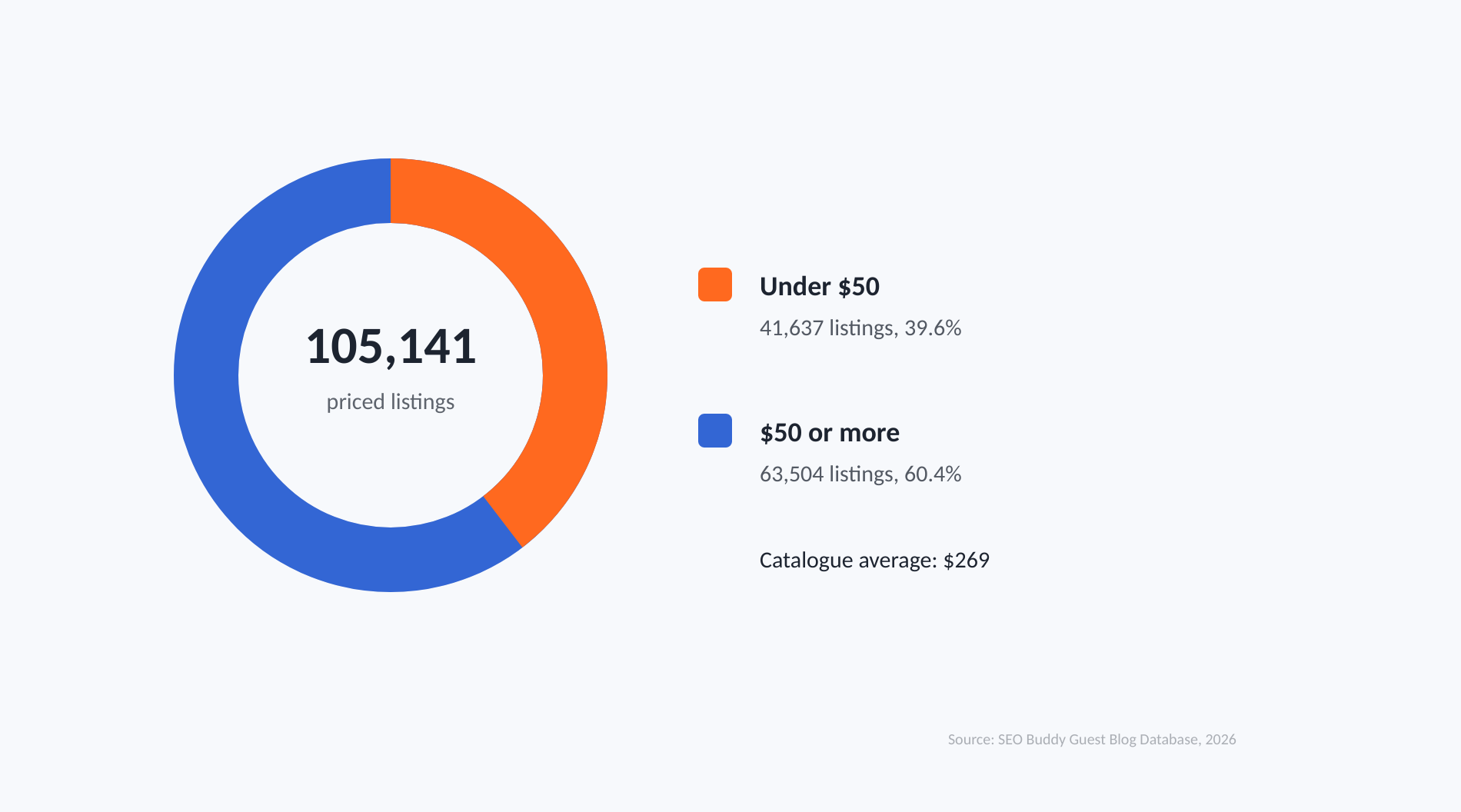
The snapshot describes available inventory, not outcomes. It does not prove that a $20 placement is harmful or that a $269 placement is good. The site, article and transaction still need to pass the same checks.
How do managed placement prices change by tier?
SEO Buddy's managed-service page, viewed September 15, 2026, listed $79 for DR20+, $129 for DR30+, $189 for DR40+, $319 for DR50+ and $399 for DR60+. The page describes each authority tier as a floor rather than proof of quality and separately requires traffic, indexation and topical-fit checks.
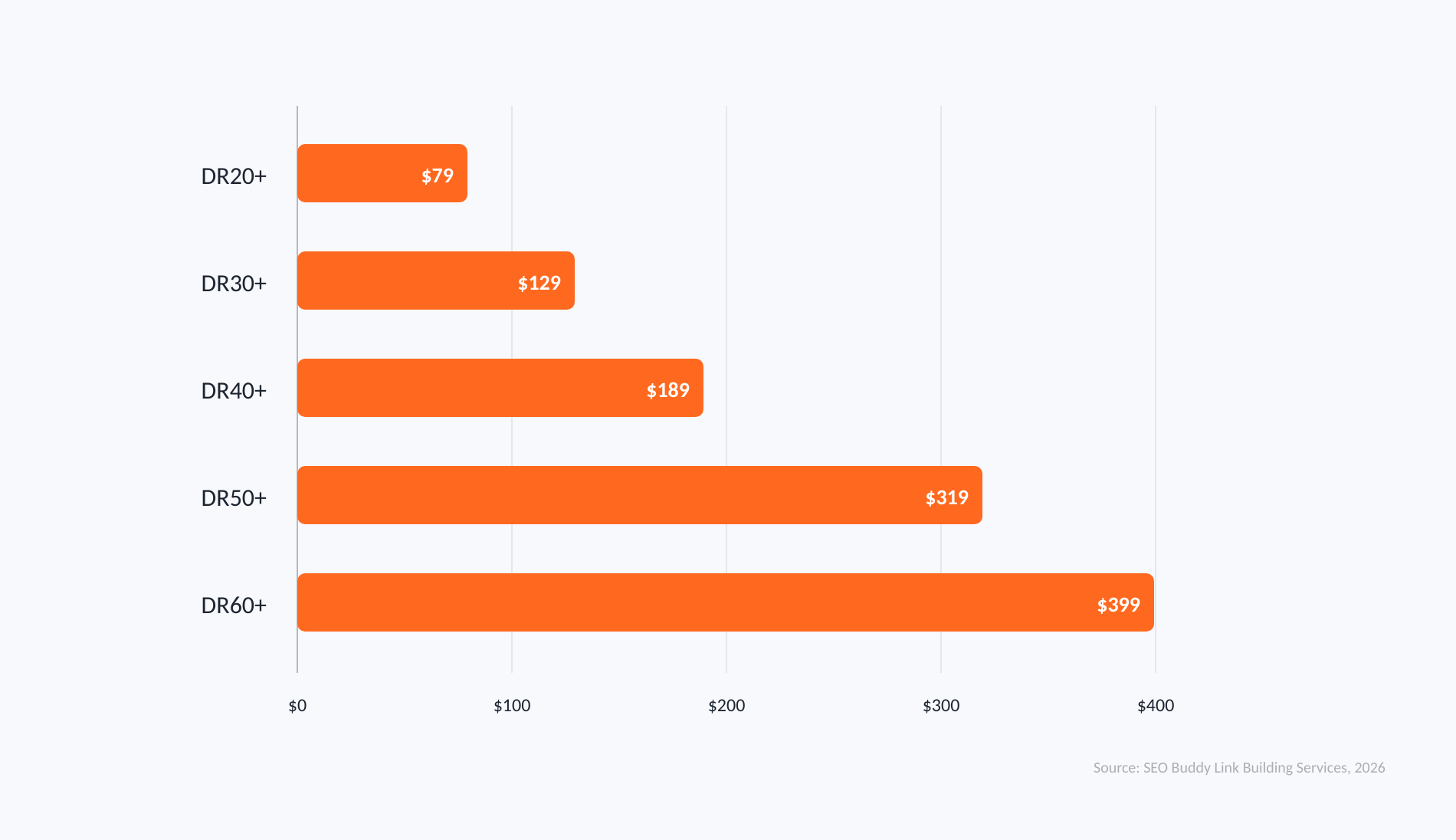
Optional specified content types and express delivery were listed at an additional 20% each. These figures are one transparent provider example, not a universal benchmark.
Compare quotes by separating the publisher or placement fee from research, vetting, writing, outreach, administration and replacement coverage. A cheap bundle that removes domain visibility and editorial review has not reduced the risk; it has removed the evidence.
Price becomes meaningful only after the placement clears the same relevance, evidence and approval threshold at every budget.
What provider red flags should make you walk away?
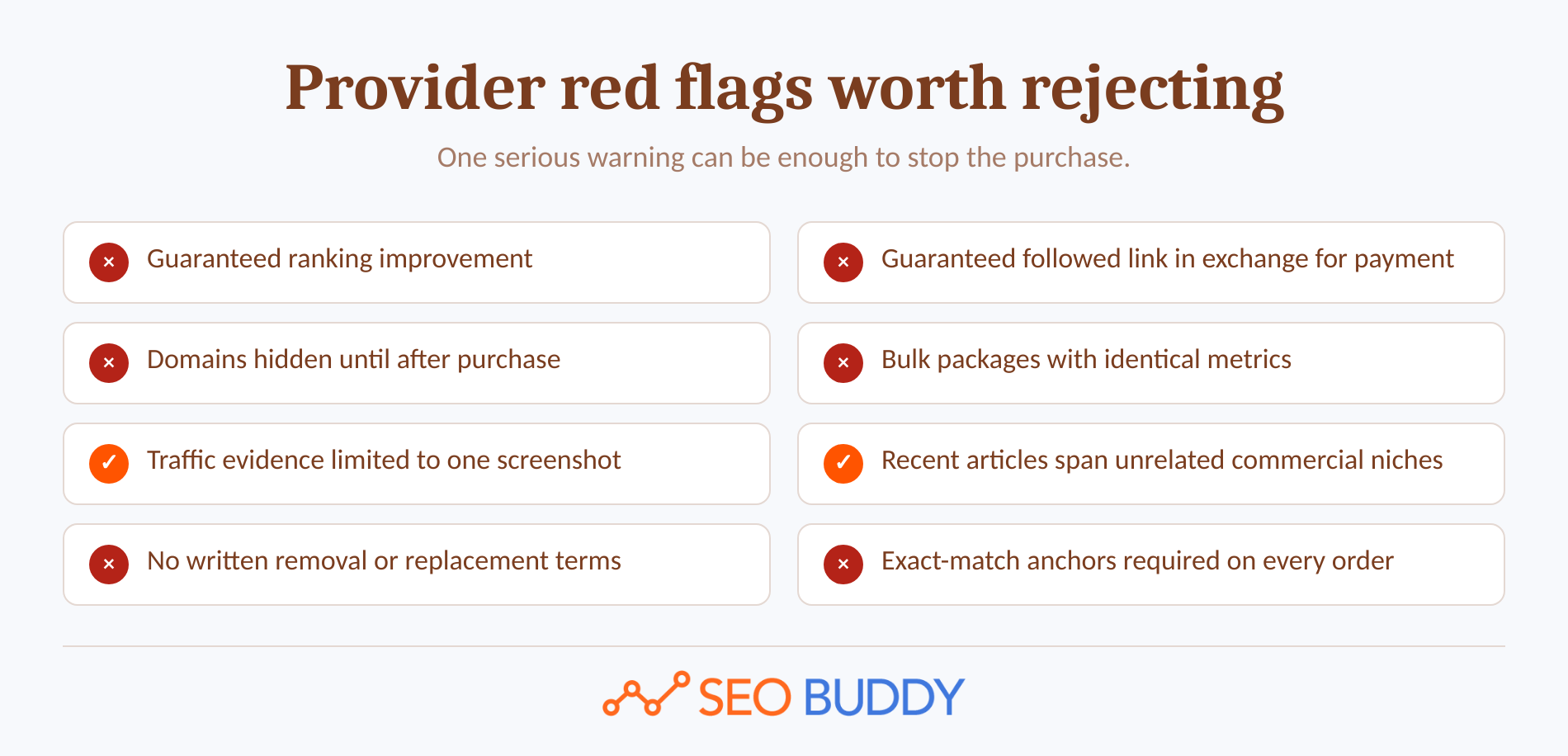
Walk away when a provider hides where links will appear, promises rankings or guarantees a followed link solely because payment was made. The strongest warning is loss of buyer visibility and editorial choice.
Common red flags include:
- Guaranteed ranking gains. No placement provider controls Google's results.
- Guaranteed followed links for payment. This directly raises the paid-ranking-credit issue.
- Domains hidden until after purchase. Approval becomes meaningless after the money is committed.
- Bulk packages with identical metrics. Real publications differ in audience, context and editorial requirements.
- One traffic screenshot. Ask for trends, leading pages, countries and the date checked.
- Every profitable niche on one site. Unrelated topic clusters often indicate that readers are secondary to link sales.
- Mandatory exact-match anchors. The sentence should determine the anchor, not a quota.
- No removal or replacement terms. A promise of permanence needs a defined remedy when it fails.
Authority metrics can help create a shortlist, but they are not proof that a publication has editorial standards or a relevant audience. Treat every metric as one field in the evidence file, not the approval decision.
Any provider that removes visibility, editorial choice or accountability from the purchase is selling risk with the link.
What should a safe purchase agreement include?
A safe agreement defines what the buyer can approve, when payment becomes final and what happens when delivery fails. It should also state the disclosure and link-qualification rules before the publisher is contacted.
Record these terms:
- The exact domain must be approved before publication.
- The proposed page topic must fit both the publisher and destination.
- The destination URL and suggested anchor must be documented.
- The publisher retains the right to edit wording for readers.
- The expected
relvalue and commercial disclosure must be stated. - Payment becomes final only after the agreed deliverable is verified.
- Delivery deadlines, cancellation rights and refunds must be defined.
- Link removal and replacement periods must be written down.
- Ranking, traffic and referral results must not be guaranteed.
Add the procurement check to the campaign's SEO checklist, including the date each site, traffic estimate and live placement was reviewed. Agencies should keep the evidence at client and placement level rather than relying on a provider's dashboard alone.
A safe purchase agreement makes approval, qualification, payment, verification and failure handling explicit before work starts.
What can you do instead of buying ranking credit?
Recover existing opportunities, build assets worth citing, conduct direct outreach or purchase qualified audience exposure. These methods still require quality control, but they do not depend on presenting paid ranking credit as an organic editorial vote.
Practical alternatives include:
- Recovering links lost during migrations, redirects or article updates.
- Asking for links where a publication already mentions the brand without citing it.
- Publishing original data, tools, templates or explanations that support another writer's claim.
- Pitching a relevant contribution while allowing the editor to decide whether a link belongs.
- Working through curated link opportunities that can be reviewed and completed without buying a blind bundle.
- Sponsoring a relevant publication for referral traffic and brand exposure while qualifying the link.
The best alternative to buying ranking credit is paying for assets, access or outreach that can earn an editor's independent choice.
What else should you know about buying backlinks?
The most common questions collapse policy, law, price and effectiveness into one word: safe. The answers below keep those issues separate so each can stand on its own.
Is buying backlinks illegal?
Buying backlinks is not necessarily illegal in the United States. Google's spam rules are platform policies, not statutes. However, the FTC says material connections behind endorsements should be disclosed clearly and conspicuously, and false or misleading paid content can create advertising-law risk. Regulated industries should obtain legal advice.
Is buying backlinks a good idea?
Buying backlinks is a poor idea when payment buys a guaranteed followed link for rankings. It can be reasonable to pay for disclosed sponsorship, prospect research, outreach, writing or editorial work when the publisher keeps control and no ranking result is guaranteed. Judge the purchase on audience value and documented controls.
How much does a backlink cost?
There is no universal price. SEO Buddy's live catalogue snapshot on September 15, 2026 showed a $20 minimum, a $269 average and 41,637 of 105,141 listings below $50. Those figures describe inventory, not quality. Relevance, traffic, editorial control, disclosure and replacement terms should determine value.
Do backlinks still matter in 2026?
Yes. Google's current ranking-systems guide says PageRank continues to be part of its core ranking systems, and Google also says links help determine page relevance. Backlinks are only one set of signals, however. Manipulative paid links may fail to help or trigger action, so quantity alone is not a defensible strategy.
No price, metric or provider label turns purchased ranking credit into a policy-safe backlink.
What is the next step if you still want help?
If the business needs execution support, choose a provider that exposes the site, explains the fit, allows rejection and charges only after the agreed result is live. SEO Buddy's approval-based editorial link-building services use site approval and post-publication verification, but the buyer still controls whether a proposed paid link meets the chosen disclosure and qualification standard.
As of September 15, 2026, the service page states that placements are followed unless a publisher requires a different attribute. A buyer seeking strict alignment with Google's paid-link guidance should require rel=sponsored or rel=nofollow before approving a paid placement.
Start by defining one target page, one relevant audience and the evidence every proposed site must show before the first dollar is approved.

CEO & Founder at SEO Buddy




Get the SEO work done, not just read about it
Create a free account and run your first content plan, keyword research and link-building campaign. No card, and setup is free until your first article.
Free to start. We never sell your address.