
Link Reclamation: How to Find and Recover Lost Backlinks

In short
Link reclamation is the work of recovering earned link value when an external backlink disappears, points to a dead URL, names a brand without linking, or uses the wrong destination. Start by fixing your own destination, then contact publishers only for relevant links that can still send readers to useful content.
Key takeaways
- Link reclamation has four distinct jobs: restore removed backlinks, repair broken destinations, claim unlinked mentions, and correct links to the wrong page.
- A permanent 301 redirect is the right site-side fix when an old URL has a closely equivalent replacement, according to Google’s current site-move documentation. ([developers.google.com](https://developers.google.com/search/docs/crawling-indexing/site-move-with-url-changes?utm_source=openai))
- Do not ask a publisher to restore a link until the destination works, matches the original context, and gives the reader a useful next step.
- Prioritize relevant links with a live source page, a clear correction, and a reachable editor over a large list of vague opportunities.
- One accurate, low-friction request is more useful than a generic pitch about SEO value.
Table of contents
- What is link reclamation, and what does it recover?
- Which link problem do you actually have?
- What must you fix before you ask a publisher?
- Which lost links are worth recovering first?
- How do you get a link back without sending a bad outreach email?
- How do you track a reclamation campaign after outreach?
- What else do people ask about link reclamation?
- What should you do first?
What is link reclamation, and what does it recover?
Link reclamation is the process of finding references that once helped readers reach your site, then repairing the route where a sensible fix exists. The work can happen on your site, on the publisher’s page, or both.
Google’s current documentation says links help Google discover pages and can be used as a relevance signal. That does not mean every old backlink deserves a recovery campaign. It means broken or inaccurate references are worth reviewing when they still serve a real reader purpose. Google’s link best-practices documentation also recommends descriptive, crawlable links and contextual internal links. (developers.google.com)
Strictly speaking, recovering a removed backlink and asking for a link on an unlinked mention are different tasks. In practice, both belong in the same recovery review because each starts with an existing relationship between a publisher’s content and your brand, resource, product, image, or research.
Link reclamation is maintenance for references that were already earned or clearly warranted, not a substitute for creating useful pages and earning new editorial links.
Anybody can generate an article. Knowing which one is worth writing is the hard part.
The AI Content Engine reads your site and your competitors, then builds a ranked content plan and writes it. Setup is free, and you see your plan before you pay for anything.
See your content plan freeWhich link problem do you actually have?
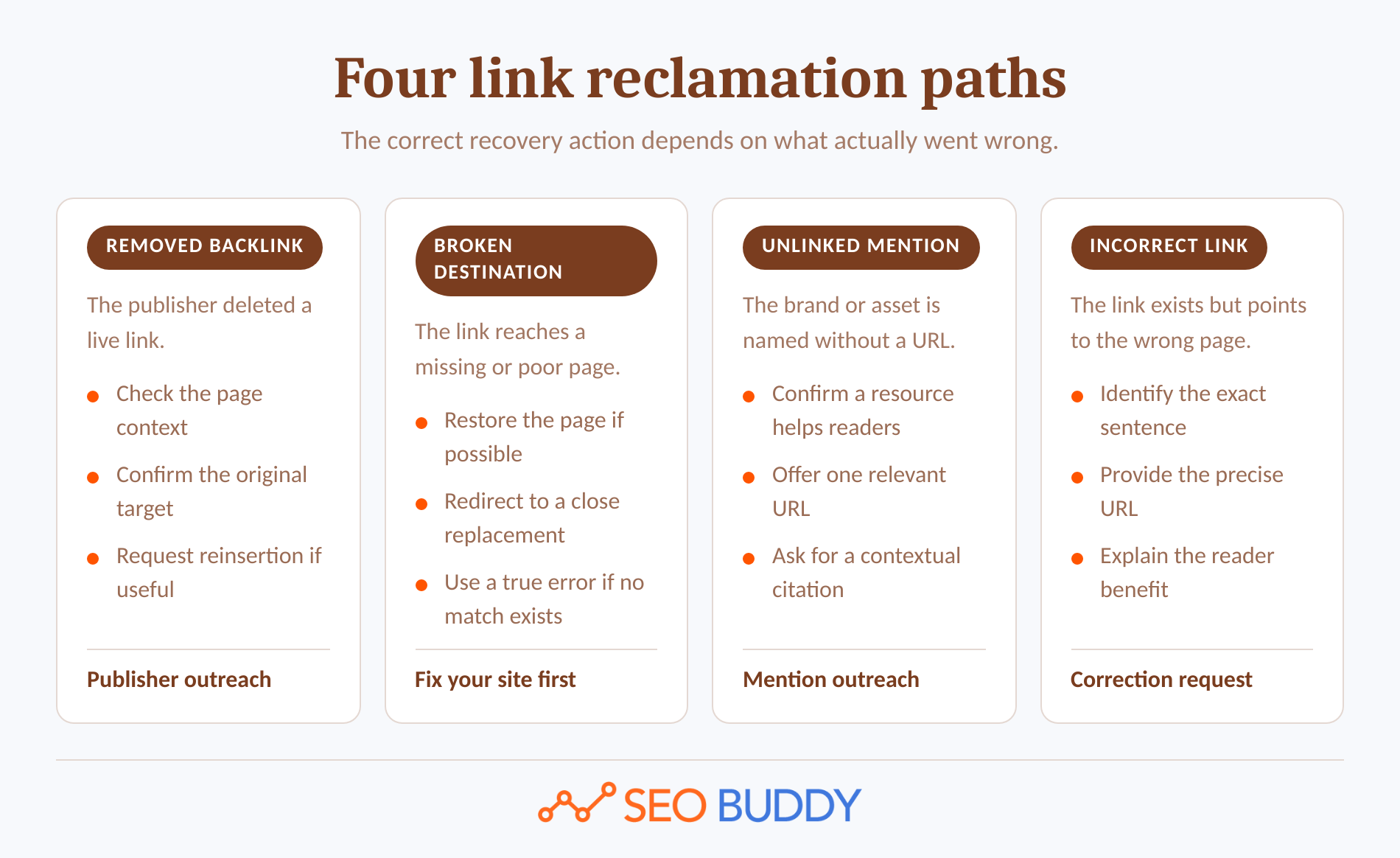
Classify each opportunity before contacting anyone. The correct fix for a removed backlink is not the correct fix for a broken destination, and treating both as the same problem creates unnecessary outreach.
1. A removed backlink
The publisher’s page is live, but the link that once pointed to your page has been deleted or replaced. Check the current page first. If the surrounding paragraph still discusses your resource, a short request to restore the most relevant URL may be reasonable.
2. A broken destination URL
The publisher still links to your site, but the URL returns a genuine error page, a poor substitute, or an unnecessary redirect chain. Fix this on your site before outreach. If the old resource moved permanently and a close replacement exists, Google recommends a server-side permanent redirect and says permanent redirects do not cause PageRank loss. (developers.google.com)
If a lost backlink was caused by a page becoming unavailable, reclamation should be followed by steps to reduce the chance of another outage. These practical measures for preventing website downtime provide a useful reliability checklist for that part of the process.
If no equivalent replacement exists, do not redirect visitors to an unrelated page just to preserve a link. Google recommends returning a true 404 or 410 when content is gone and there is no suitable replacement. (developers.google.com)
3. An unlinked brand mention
A publisher names your company, product, original asset, or research but provides no clickable URL. Ask only when a link would improve the page for readers, such as when the mention refers to a resource readers may want to inspect.
4. An incorrect link
The publisher links to your homepage, an outdated product page, a login page, or another irrelevant destination when a specific resource would serve the cited claim better. This is often the easiest request because the publisher does not need to add new editorial material. They only need the correct URL.
Different link problems need different fixes, so classify the issue before writing a single outreach email.
What must you fix before you ask a publisher?
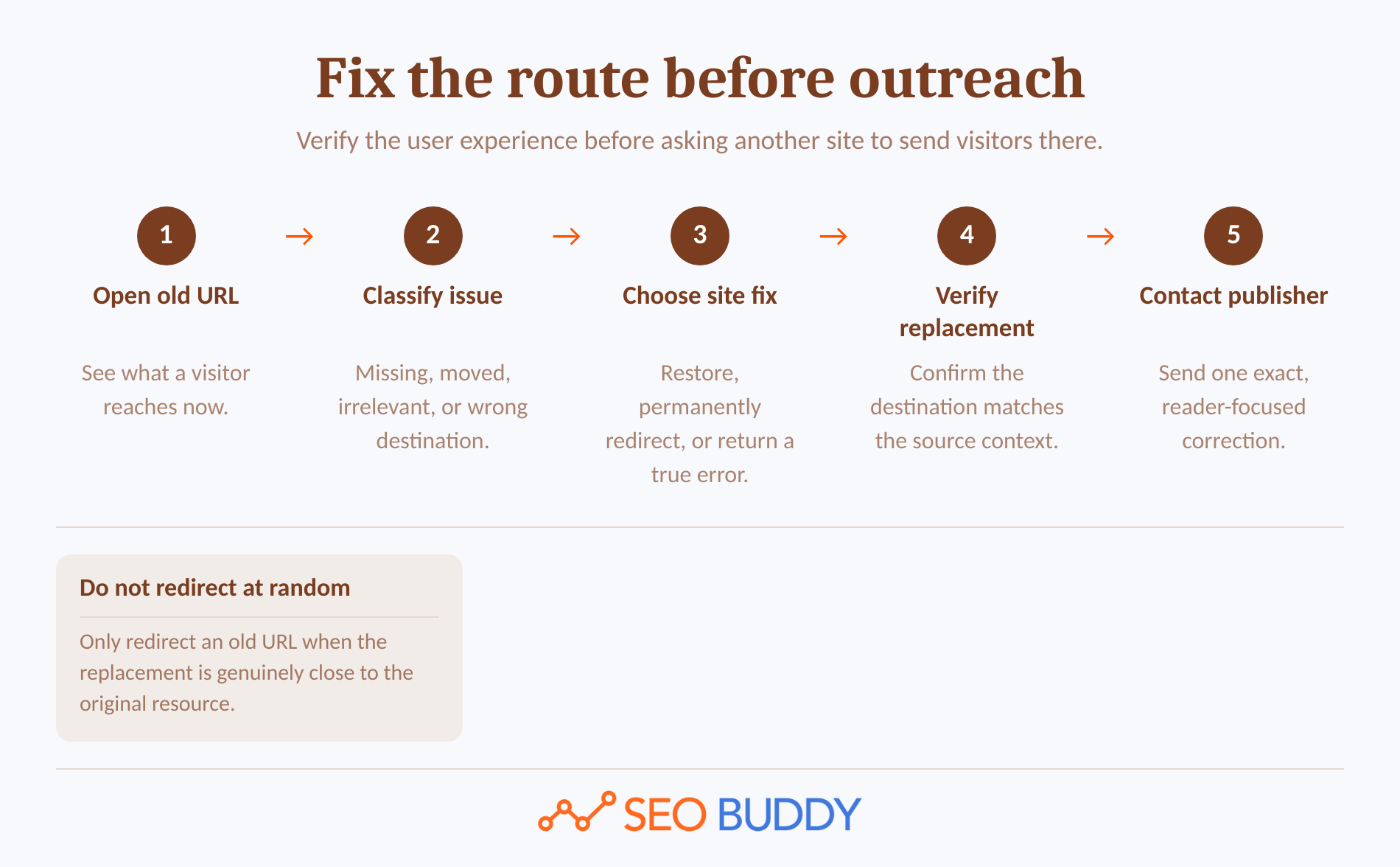
Fix the user-facing issue first. A publisher should never be asked to update a link to a page that is still broken, irrelevant, blocked, or confusing.
Start with the old destination URL. Open it in a browser, check the HTTP response if possible, and confirm what a visitor actually sees. Then choose one of three actions:
- Restore the original page when the content remains useful and you can publish a complete version.
- Add a permanent redirect when another live page is genuinely the closest replacement.
- Return a true 404 or 410 when the content has no appropriate replacement.
After a move, direct links are still preferable to avoidable redirects. Google’s site-move documentation specifically advises site owners to update important external links where possible for users and to reduce server load. (developers.google.com)
Record the old URL, the corrected destination, what changed, and the date. A repeatable SEO checklist can keep this site-side review from becoming an untracked collection of browser tabs.
A correct destination is the minimum requirement for a useful reclamation request.
Which lost links are worth recovering first?
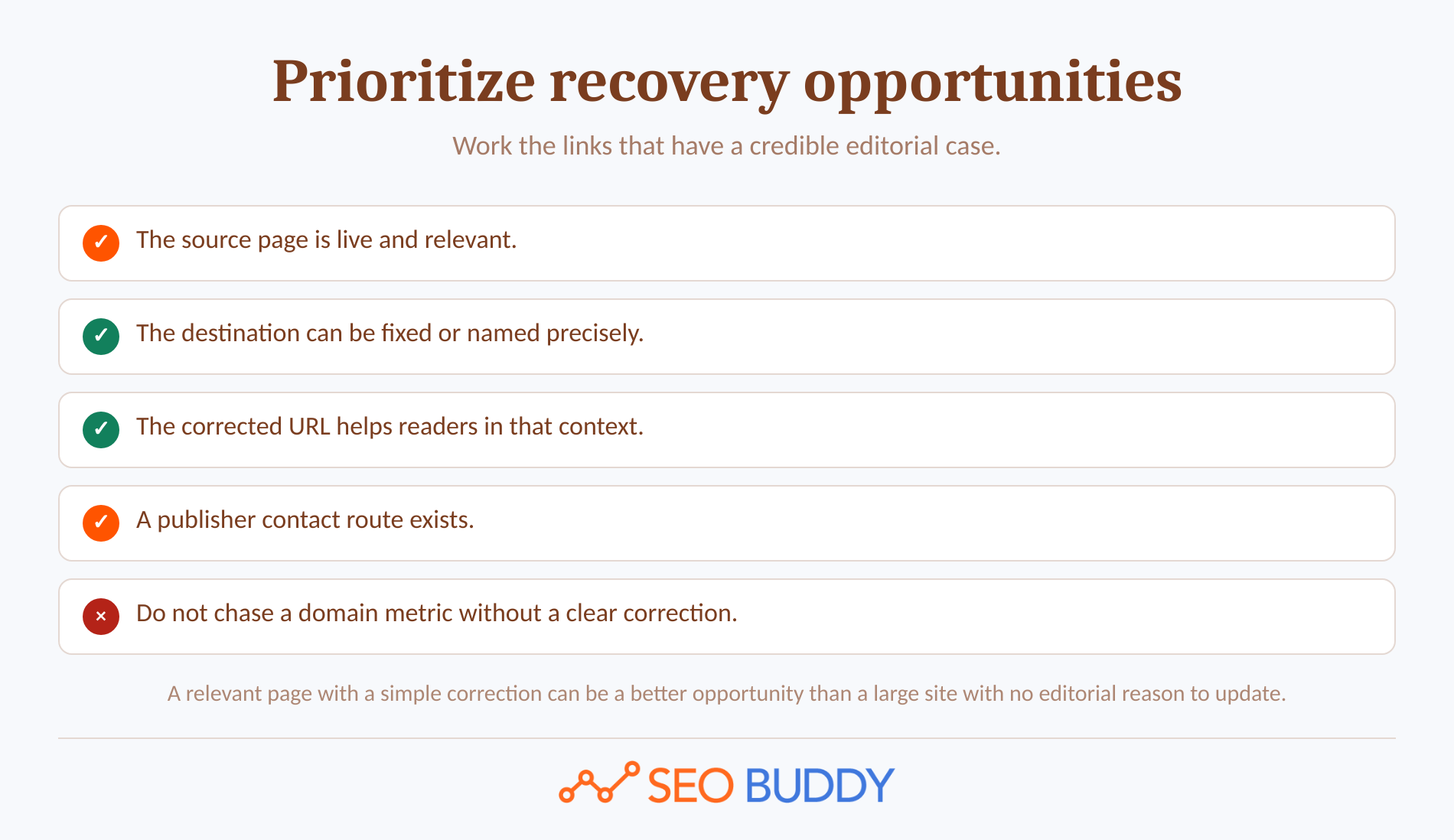
Recoverability matters more than volume. Begin with links that have a relevant live source page, a clear destination fix, and a realistic person or editorial inbox to contact.
Use this order when building a working queue:
- Check relevance. Does the source page discuss the subject your destination actually covers?
- Check the page status. Is the source page live, visible to readers, and worth maintaining?
- Check the correction. Can you name one exact URL and explain why it belongs in that specific sentence?
- Check the contact path. Is there an editor, author, webmaster, or editorial contact method?
- Check the effort. Can the publisher make the fix without rewriting the article?
A large site-level metric is not enough on its own. A relevant page with a simple, reader-friendly correction can be a better use of time than a prestigious domain with no clear editorial reason to change its page.
Move dead ends into a separate acquisition list rather than repeatedly chasing them. For fresh opportunities that are not reclamation tasks, Link Chest provides curated submission opportunities that can be worked through separately.
Prioritize pages where a real reader benefits from the correction and the publisher can make it with minimal effort.
How do you get a link back without sending a bad outreach email?
A good reclamation email identifies one page, one issue, and one precise fix. It should read like a useful editorial heads-up, not a demand for ranking value.
For a broken or incorrect destination, use this structure:
Subject: Possible broken link on [page title]
Hi [name],
I was reading your page on [topic] and noticed that the link in the [section name] section leads to [brief issue, such as a missing page].
The closest current resource is [correct URL]. It covers [one-sentence reason it helps readers].
If you are updating the page, would you be open to replacing the old link with that URL?
Thanks for publishing the resource,
[name]
For a removed link, replace the broken-link sentence with a factual observation: the page discusses [resource or topic], and this specific URL provides the source, guide, or tool readers would expect. Do not claim that the publisher previously linked to you unless your records support that statement.
Send one concise follow-up if there is no response, then close the record if the publisher does not engage. Repeated emails do not make a weak request stronger.
A link-building campaign can help teams organize prospects, find contacts, and run a controlled outreach sequence from their own mailbox. If a team has qualified opportunities but cannot handle the outreach work, Link Building Services is the direct next step for approval-based, team-handled editorial outreach.
The best reclamation email makes the publisher’s update easy to understand, easy to verify, and easy to complete.
How do you track a reclamation campaign after outreach?
Track outcomes by issue type and by action, not just by the number of emails sent. A reclaimed link is only complete when the live page points readers to the intended working destination.
Use one row per opportunity with these fields:
- Source page URL and page title
- Original destination URL
- Issue type: removed link, broken destination, unlinked mention, or incorrect link
- Correct destination URL
- Site-side fix completed date
- Contact name or contact route
- Outreach date and follow-up status
- Final outcome: fixed, declined, no response, or no action needed
Recheck successful updates after publication. A page can change again, and a redirect can be removed during a later site update. For broader, repeatable link-building education, the free SEO University library can support the process around the campaign.
A campaign record turns link reclamation from scattered requests into maintenance work that can be reviewed and repeated.
What else do people ask about link reclamation?
Is link building illegal?
Link building is not illegal by itself, and link reclamation simply asks a publisher to correct or restore a reference. Laws differ by jurisdiction, but Google’s rules are separate from law: paid links and other arrangements intended to manipulate rankings can violate Google’s spam policies. Keep requests accurate, optional, and useful to the publisher’s readers. Google’s link-spam guidance explains that distinction. (developers.google.com)
How do I get a link back?
To get a link back, first confirm that the source page is live, the old link is missing or wrong, and your proposed destination is useful. Then send the publisher one short message naming the page, the exact correction, and why the replacement helps readers. Do not pursue links with no clear editorial case.
Does link building still work?
Link building still matters as part of a broader SEO effort, but no single link guarantees visibility or rankings. Google’s current documentation says links help Google discover pages and may be used as a relevance signal. Reclamation works best when it repairs a useful route between relevant pages rather than chasing links as isolated metrics. (developers.google.com)
Are backlinks still relevant in 2026?
As of August 2026, Google’s published documentation still describes links as a way Google discovers pages and as a signal used when determining page relevance. Backlinks remain relevant, but the useful question is whether a specific link helps connect readers and search systems to a relevant, accessible page. (developers.google.com)
Link reclamation is legitimate when it corrects useful references instead of trying to manufacture editorial approval.
What should you do first?
Export the lost and broken external links you can identify, then sort them into the four problem types in this guide. Fix broken destinations first, send outreach only for relevant and reachable opportunities, and record the result so the next audit starts with evidence rather than guesswork.
The fastest recovery is usually not more outreach. It is finding the one broken path that has a clear fix today.

CEO & Founder at SEO Buddy


 How to Improve Organic Traffic: A Prioritized SEO Action Plan
General SEO
How to Improve Organic Traffic: A Prioritized SEO Action Plan
General SEO
 Best AI Writing Tools for SEO Content: What to Use and Avoid
General SEO
Best AI Writing Tools for SEO Content: What to Use and Avoid
General SEO
 Best SEO Tools of 2025: Which Ones Are Still Worth Using in 2026?
General SEO
Best SEO Tools of 2025: Which Ones Are Still Worth Using in 2026?
General SEO
 AI SEO Services: What Providers Do, What They Cost, and How to Choose
General SEO
AI SEO Services: What Providers Do, What They Cost, and How to Choose
General SEO
Get the SEO work done, not just read about it
Create a free account and run your first content plan, keyword research and link-building campaign. No card, and setup is free until your first article.
Free to start. We never sell your address.