
Best Guest Post Websites and How to Vet Them Before You Pitch

In short
Best guest post websites are relevant, reader-facing publications with real editorial standards, not simply domains with a high authority metric. Before pitching, confirm topical fit, inspect recent posts and outbound links, read contributor rules, and make sure the proposed article would help that publication’s audience even if no followed link were included.
Key takeaways
- A high authority-style metric is a filter, not proof that a guest-post placement reaches a real or relevant audience.
- Google's Spam Policies define link spam as creating links primarily to manipulate rankings, including paid articles or guest posts that pass ranking credit.
- The safest guest-post prospect is one where the proposed article fits the publication's existing readers and editorial standards.
- Free submission opportunities can be useful, but a free listing is not automatically a guest post or an editorial endorsement.
Table of contents
- What makes a guest post website worth pitching?
- Where can you find guest post websites worth your time?
- How do you vet a guest post website before you pitch?
- How can you pitch without making the link the point?
- What else do people ask about guest post websites?
- What should you do next?
What makes a guest post website worth pitching?
The best guest post website is one whose readers, topic, and editorial standards match the article you can genuinely contribute. A large metric, a low submission fee, or a promise of a followed link cannot make an irrelevant or low-quality placement valuable.
A useful guest-post opportunity has four characteristics:
- Topical relevance. The site already publishes for the people your business needs to reach. A cybersecurity company belongs on a publication that regularly covers security, IT operations, or risk management, not on a broad site accepting every imaginable topic.
- A visible audience. Read recent posts and comments, newsletters, author pages, social activity, and the kinds of questions the publication answers. Third-party traffic estimates can help you prioritize research, but they cannot prove that a specific article will be seen by the right people.
- Editorial judgment. Look for a contributor page, a named editor, author bios, consistent publishing standards, and clear article formatting. A publication that edits, credits, and updates its work is a different proposition from a page that accepts nearly any promotional copy.
- A reader-first reason to publish. The proposed article should solve a problem for that site's audience. Google's people-first content guidance recommends creating helpful, reliable material for an existing audience rather than content made primarily to manipulate rankings.
Do not confuse a guest post with every possible backlink opportunity. A directory profile, a community listing, and a genuine editorial contribution can all be legitimate ways to be discovered, but they involve different effort, review, and link attributes. For broader context before choosing a method, review the free lessons in SEO University.
The right placement is one a publisher could defend to its own readers without mentioning your SEO goal.
Anybody can generate an article. Knowing which one is worth writing is the hard part.
The AI Content Engine reads your site and your competitors, then builds a ranked content plan and writes it. Setup is free, and you see your plan before you pay for anything.
See your content plan freeWhere can you find guest post websites worth your time?
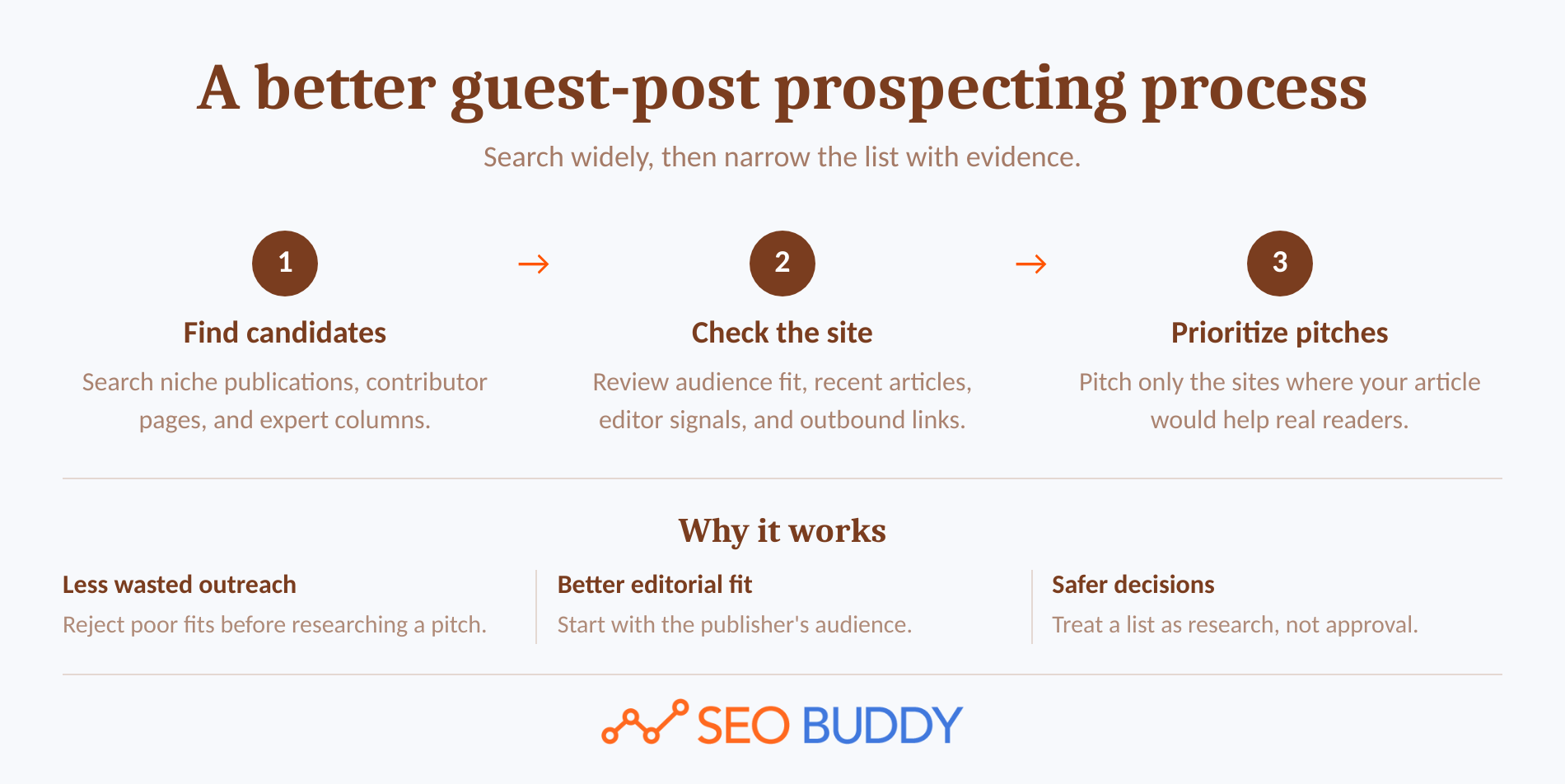
Start with publications that already cover your topic, then use contributor searches to identify those that accept outside expertise. The goal is not to collect the longest guest posting sites list; it is to build a shortlist that has a plausible audience match.
Use these prospect types before searching broad “write for us” lists:
| Prospect type | What to look for | Search starting point |
|---|---|---|
| Specialist publications | Regular articles in your niche, named editors, strong contributor standards | "your topic" "write for us" |
| Practitioner blogs | Detailed how-to content written for a defined professional audience | "your topic" "guest post guidelines" |
| Trade associations | Member resources, industry education, expert columns, regional chapters | "your industry" contributor site:.org |
| Local and regional business publications | Coverage of a city, state, or local business community relevant to your offer | "your city" business contributor |
| Partner ecosystems | Vendors, communities, and service providers that publish practical advice for shared customers | "your customer problem" "submit an article" |
| Podcasts and newsletters with companion blogs | Expert-led resources where a written contribution can support an existing audience | "your topic" newsletter contributor |
Search results are only the first pass. Open the contributor guidelines, inspect several recent posts, and record why the site could be a fit before you invest time in a pitch.
A curated workflow can reduce the time spent finding public submission opportunities. Link Chest includes opportunity details, filters, quality information, and status tracking, but each prospect should still pass a relevance review before submission.
Build a shortlist from relevant publications first, then use lists and databases to fill genuine gaps rather than to set your standards.
How do you vet a guest post website before you pitch?
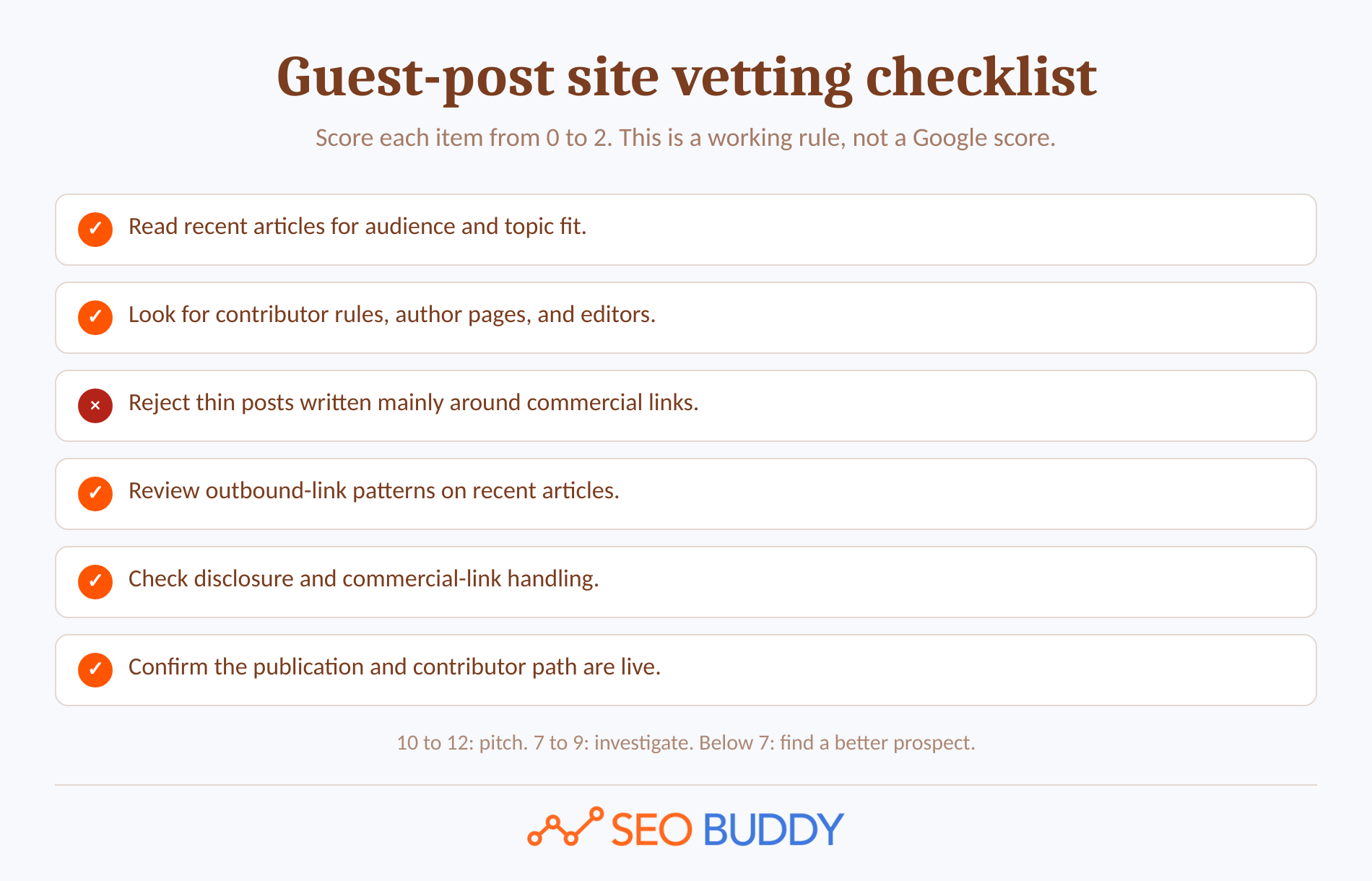
Vet a guest-post prospect by reviewing what it publishes, who it publishes for, and how it treats outbound links. If any of those checks point to a site built mainly to host promotional articles, move on.
Use this six-part review. Give each item 0 points for a clear concern, 1 point for an uncertain result, or 2 points for a strong result. This is a working prioritization rule, not a Google scoring system.
- Does the site serve the same audience? Read at least five recent articles. Their subject matter, level of expertise, and customer problems should overlap with yours.
- Is there evidence of editorial review? Check for contributor guidelines, author pages, article updates, named staff, corrections, or a clear submission process. A site can accept contributors and still maintain editorial standards.
- Do recent articles look useful without the links? Reject pages where nearly every post is thin, generic, or framed around inserting a commercial anchor text link.
- What do outbound links look like? A few relevant references are normal. Repeated exact-match commercial anchors pointing to unrelated industries are a warning sign, especially when the same article format appears across many authors.
- Does the publisher disclose commercial relationships? A paid publication or sponsored article needs transparent handling. Google's Spam Policies list paid articles, guest posts, and advertorials that pass ranking credit among examples of link spam when links are created primarily to manipulate rankings.
- Is the page technically accessible and attributable? Confirm the site loads, the contributor page is live, the post format is indexable, and the publisher provides a clear route for readers to learn who wrote the article. Technical checks do not prove editorial quality, but they can prevent wasted outreach.
A 10 to 12 score is usually worth a tailored pitch. A 7 to 9 score merits a closer look. Below that, a better prospect is likely available.
For a repeatable team process, add these checks to your SEO Checklist and SOP Collection so every prospect is reviewed before an outreach email is sent.
Metrics can help you sort a long list, but the publication's audience, editorial work, and outbound-link behavior should decide whether you pitch.
How can you pitch without making the link the point?

Lead with an article idea that helps the publisher's readers, not with a request for a specific anchor text link. A good pitch makes it easy for an editor to understand the proposed value, your relevant expertise, and the evidence you will bring.
A concise pitch usually needs four parts:
- A specific idea: Name the reader problem and the angle you would cover.
- A reason you are qualified: Link to an original example, process, dataset, or experience you can accurately discuss.
- A proof point: Mention the sources, screenshots, examples, or subject-matter input that will make the article useful.
- A flexible attribution request: If a relevant source page deserves citation, let the editor decide whether and how it belongs. Do not demand a followed link, optimized anchor text, or publication without edits.
Google's guidance on qualifying commercial links explains that commercial links should be appropriately qualified. A nofollow or sponsored attribute does not erase the value of a useful mention, referral traffic, brand exposure, or a relationship with an editor.
When prospecting volume is the challenge, Link Building Campaign can help find prospects and contact details, then send a three-email sequence from a connected mailbox. The quality check still comes before the sequence.
The strongest guest-post pitch gives an editor a publishable idea first and treats any link as a relevant citation, not the product being bought.
What else do people ask about guest post websites?
The recurring questions below have no one-size-fits-all list answer because publisher rules and editorial capacity change. A reliable answer starts with the site's current guidelines and the quality of its recent work.
What are the best guest posting platforms?
The best guest posting platforms are the ones that help you locate relevant publishers and provide enough information to vet each opportunity before you pitch. Prefer tools or lists that show the exact submission route, topic category, quality signals, and status. Do not use a platform's inventory size as proof that every placement is worthwhile.
What are some popular guest posting sites in the USA?
Popular US guest posting sites are not automatically the best choices for a US business. Start with US trade publications, state or city business resources, professional associations, and niche blogs whose readers match your market. Check current contributor guidelines directly, because a site may accept US-focused editorial content without publicly advertising open submissions.
What are some free guest post sites for 2026?
Free guest post sites for 2026 can include publications that accept unpaid expert contributions, community resources, and some open submission platforms. “Free” describes the cost to submit, not the quality or SEO value of a placement. Review the publisher's guidelines, recent articles, disclosure practices, and outbound links before spending time on a draft.
How to find websites for guest posting?
Find websites for guest posting by searching for niche publications, contributor guidelines, expert columns, and audience-specific resources related to your topic. Use search operators such as "your topic" "write for us", then verify each result manually. Build a shortlist around relevance and editorial quality before researching authority-style metrics or submission costs.
A current guideline page and a careful manual review are more reliable than a static list with hundreds of unchecked domains.
What should you do next?
Choose one topic where your business has a real point of view, build a shortlist of 20 relevant publications, and score every one before writing a pitch. Rejecting weak placements early is usually faster than chasing a large list of easy submissions.
If the research stage is slowing down the work, use Link Chest to organize public backlink opportunities and track decisions, then apply the same relevance and editorial checks before submitting anything. The site that is worth pitching is the one where the article would still deserve publication if a followed link were off the table.

CEO & Founder at SEO Buddy


 How to Improve Organic Traffic: A Prioritized SEO Action Plan
General SEO
How to Improve Organic Traffic: A Prioritized SEO Action Plan
General SEO
 Best AI Writing Tools for SEO Content: What to Use and Avoid
General SEO
Best AI Writing Tools for SEO Content: What to Use and Avoid
General SEO
 Best SEO Tools of 2025: Which Ones Are Still Worth Using in 2026?
General SEO
Best SEO Tools of 2025: Which Ones Are Still Worth Using in 2026?
General SEO
 AI SEO Services: What Providers Do, What They Cost, and How to Choose
General SEO
AI SEO Services: What Providers Do, What They Cost, and How to Choose
General SEO
Get the SEO work done, not just read about it
Create a free account and run your first content plan, keyword research and link-building campaign. No card, and setup is free until your first article.
Free to start. We never sell your address.