
10 ChatGPT SEO Tools for Faster Research, Content, and Optimization

In short
ChatGPT SEO tools work best as a connected workflow: use Search for fresh facts, Deep Research for cited synthesis, Data Analysis for exports, Projects and custom GPTs for repeatability, Canvas for editing, and human review before publication. The best setup speeds decisions without treating AI output as verified SEO data.
Key takeaways
- ChatGPT Search is suited to quick, current lookups, while Deep Research handles multi-step synthesis with citations and source controls, according to OpenAI's April 2026 research guide. (openai.com)
- ChatGPT supports common SEO export formats, including CSV, XLSX, and TSV, but the model should analyze verified data rather than invent traffic or keyword metrics. OpenAI's file upload documentation describes spreadsheet analysis as a supported use. (help.openai.com)
- OpenAI's Projects documentation shows how files, chats, and instructions can remain together, while OpenAI's GPT documentation explains how reusable assistants can encode instructions, knowledge, and selected capabilities. (help.openai.com)
- Google's 2026 guidance on generative AI content permits useful AI assistance but warns that scaled pages with little added value may violate spam policies. (developers.google.com)
- OpenAI's January 2026 Terms of Use require users to evaluate output for accuracy and appropriateness, including human review when appropriate. (openai.com)
Table of contents
- Which ChatGPT SEO tool should you use for each SEO job?
- What makes a ChatGPT SEO workflow safe enough to publish?
- Which 10 ChatGPT SEO tools are worth using in 2026?
- How should a small team combine these tools without creating more work?
- Where does human review still matter?
- What else do people ask about ChatGPT SEO tools?
- What should you do next?
Which ChatGPT SEO tool should you use for each SEO job?
Start with the bottleneck, not the longest feature list. This ChatGPT SEO tools list matches each job to the narrowest useful tool and the decision a person must still make.
| SEO job | Best-fit tool | What it should produce | Human checkpoint |
|---|---|---|---|
| Find a recent source or policy change | ChatGPT Search | A short answer with source links | Open the original source and confirm the date |
| Build a complex, cited content brief | Deep Research | A structured research report | Remove weak sources and resolve conflicts |
| Analyze Search Console or content exports | File uploads and Data Analysis | Groups, patterns, tables, and anomaly flags | Compare every material finding with the original file |
| Keep one domain's context together | Projects | Shared files, instructions, and related chats | Refresh stale instructions and business facts |
| Revise a brief or draft precisely | Canvas | Targeted edits and inline comments | Protect approved facts and sections from unnecessary rewrites |
| Standardize a repeated task | Custom GPT | A reusable assistant with defined rules | Test edge cases and update its reference files |
| Use approved internal information | Apps | Answers grounded in connected sources | Review permissions and source freshness |
| Run reminders or lightweight monitoring | Scheduled Tasks | A timed report or change notification | Confirm that the task has the data it needs |
| Produce a longer deliverable | ChatGPT Work | A finished document, spreadsheet, or report | Approve the scope, evidence, and final artifact |
| Plan and publish new SEO articles | SEO Buddy AI Content Engine | Selected topics, drafts, visuals, links, and publishing fields | Review product truth, evidence, and brand fit |
The table reflects current OpenAI documentation and SEO Buddy's documented product scope as of August 2026. Feature availability and limits can vary by plan and workspace. (help.openai.com)
Choose the tool from the bottleneck, then define the human decision it is not allowed to make.
Anybody can generate an article. Knowing which one is worth writing is the hard part.
The AI Content Engine reads your site and your competitors, then builds a ranked content plan and writes it. Setup is free, and you see your plan before you pay for anything.
See your content plan freeWhat makes a ChatGPT SEO workflow safe enough to publish?
A safe workflow gives AI a defined task, approved evidence, and a stopping point. A person remains accountable for the facts, recommendations, business claims, permissions, and final page.
Use three gates before publication:
- Evidence gate: Every factual claim needs a source that was opened, dated, and read in context. Generated search volume, traffic estimates, quotations, and product facts should be rejected unless the underlying source supplies them.
- Business-truth gate: The draft must match what the company sells and does not sell. This prevents a fluent article from recommending a nonexistent feature, unsuitable service, or unsupported result.
- Action gate: Connected tools should receive only the permissions and data required for the current task. External changes, publishing actions, and sensitive uploads need deliberate approval.
Data handling also belongs in the workflow. OpenAI's data controls documentation says personal-workspace users can turn off model training, while business workspace inputs and outputs are excluded from training by default. Teams should still check their own contracts, workspace settings, confidentiality duties, and source permissions before uploading material. (help.openai.com)
AI cannot compensate for a reviewer who does not understand the task. When a concept or check is unfamiliar, the free SEO University lessons can supply the foundation before the process is automated. (seobuddy.com)
A publishable ChatGPT SEO workflow treats AI output as a draft or analysis, never as unverified evidence.
Which 10 ChatGPT SEO tools are worth using in 2026?
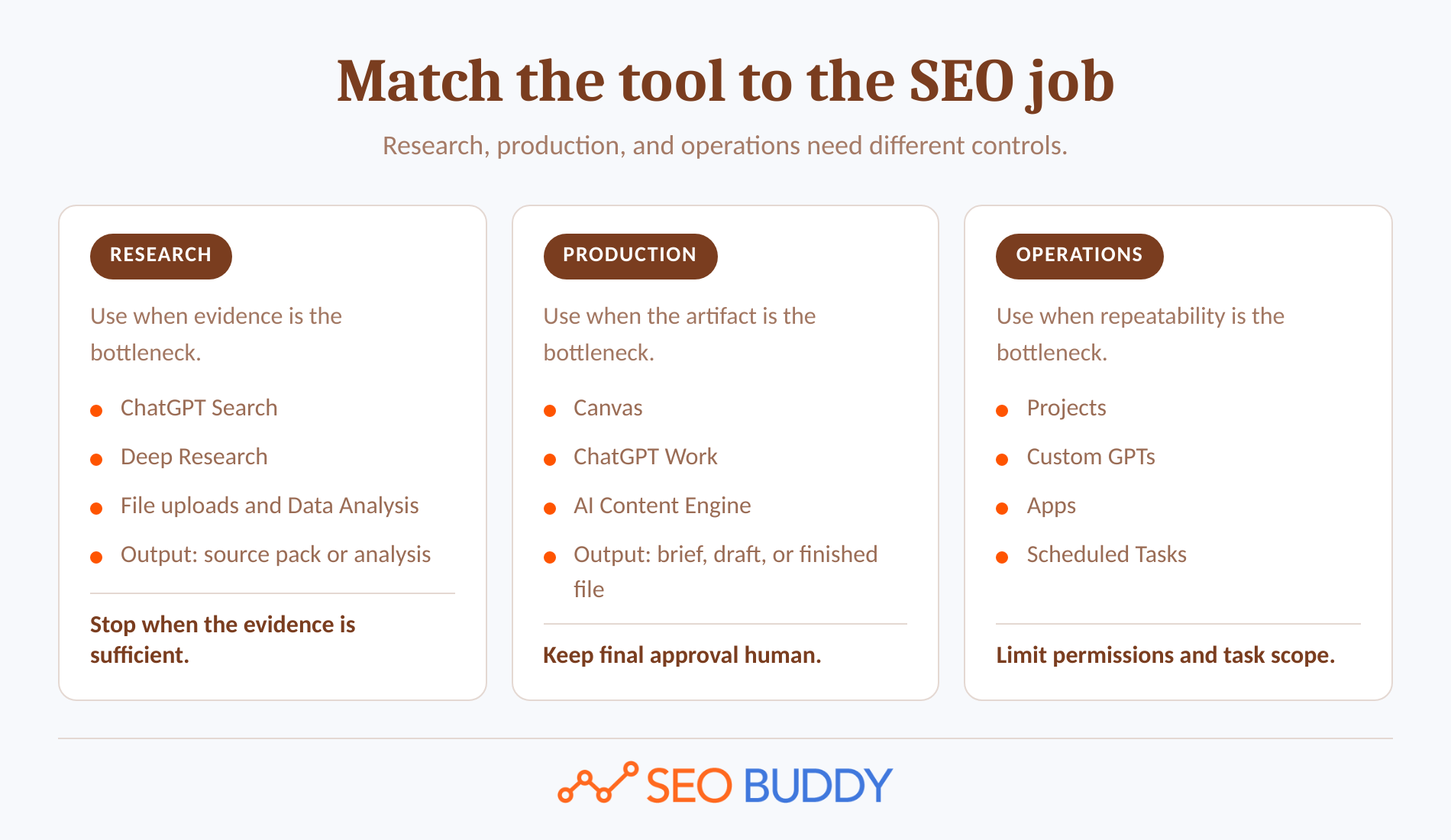
The useful tools fall into three lanes: research, production, and operations. Most teams need a small combination from all three rather than one tool expected to perform every SEO task.
1. When should you use ChatGPT Search?
Use ChatGPT Search for fast questions that depend on current information, such as a documentation change, a recent announcement, or the present wording of a policy. OpenAI's ChatGPT Search overview says answers can include links to web sources. (openai.com)
For anyone asking how to use ChatGPT for SEO keyword research, Search can collect audience phrasing, questions, and source pages. It should not be treated as the source of search volume or difficulty. Attach verified metrics from an export, then use ChatGPT to sort and interpret them.
2. When is Deep Research worth the extra time?
Use Deep Research when the assignment requires several sources, conflicting evidence, or a documented report. OpenAI's Deep Research documentation says the tool can work with the public web, specified sites, uploaded files, and enabled apps, then return a structured report with citations. (help.openai.com)
A content brief, market comparison, or policy-heavy article may justify that depth. A title tag or five meta-description options usually will not.
3. What can file uploads and Data Analysis do with SEO exports?
Upload a verified Search Console export, content inventory, keyword sheet, or crawl export and ask ChatGPT to group rows, calculate differences, flag anomalies, or identify pages requiring investigation. CSV, TSV, XLS, and XLSX are among the supported formats in OpenAI's August 2026 documentation. (help.openai.com)
The output can reveal where to look, but it cannot establish causation from a spreadsheet alone. A traffic decline, for example, may require source-page inspection, date comparison, technical checks, and business context.
4. How do Projects reduce prompt drift?
Create one Project for each domain or long-running campaign. Projects keep relevant chats, reference files, and custom instructions together, which reduces the need to paste the same audience, offer, terminology, and editorial rules into every conversation. (help.openai.com)
A Project still needs maintenance. Replace outdated files, date time-sensitive instructions, and remove assumptions that no longer match the site.
5. Why edit in Canvas instead of accepting a full rewrite?
Canvas is useful when a brief or draft is broadly correct but a particular passage needs work. OpenAI's Canvas documentation describes targeted selection, inline feedback, direct editing, and version restoration. (help.openai.com)
That control matters after facts, quotations, links, or product wording have been approved. Ask for a local edit rather than risking an unnecessary rewrite of the entire article.
6. When should a team build a custom GPT?
Build a custom GPT when the same task and rules recur, such as classifying search intent, checking a brief, formatting metadata, or reviewing a draft against a house standard. Custom GPTs can combine instructions, uploaded knowledge, and selected capabilities. (help.openai.com)
Use documented SEO SOPs as the source process rather than expecting a clever prompt to replace one. Remember that custom GPTs do not use saved memory or previous conversations, so continuity should live in maintained files, instructions, or a Project. (help.openai.com)
7. What do Apps add to an SEO workflow?
As of December 17, 2025, OpenAI uses the name Apps for features previously described as connectors. OpenAI's Apps documentation says Apps can search and reference connected information, support research, sync selected sources, and sometimes perform approved actions. (help.openai.com)
An SEO team might connect approved brand documents, planning files, or content records so answers use current internal context. Enable only the sources and actions required for the task, and review workspace controls before connecting sensitive information.
8. What should Scheduled Tasks monitor?
Scheduled Tasks can run one-off or recurring work and notify a user when a meaningful change occurs. OpenAI's Scheduled Tasks documentation also notes that a task created in a Project cannot access that Project's files, which matters when designing the prompt. (help.openai.com)
Use Tasks for reminders, source checks, or lightweight monitoring derived from an SEO checklist. Do not mistake the feature for a dedicated rank tracker, technical crawler, or complete measurement system.
9. When should ChatGPT Work handle the deliverable?
As of August 2026, OpenAI's ChatGPT Work documentation positions Work for longer, multi-step assignments and finished deliverables such as documents, spreadsheets, reports, and sites. (help.openai.com)
Use Work when the output must combine several stages into one reviewable artifact. Supply the evidence and constraints explicitly; Work cannot infer missing analytics, perform an unprovided technical crawl, or approve its own recommendations.
10. When does SEO Buddy's AI Content Engine make more sense?
SEO Buddy's AI Content Engine is designed for the broader job of selecting and producing new articles. Its documented workflow can use a sitemap, optional Search Console data, competing pages, business priorities, brand inputs, and explicit non-offer boundaries before creating drafts, visuals, internal links, SEO fields, and publishing outputs. (seobuddy.com)
That scope suits a small team whose bottleneck is the full monthly publishing pipeline rather than one prompt. It is not a dedicated rank tracker, technical crawler, standalone backlink database, existing-page optimization editor, outreach CRM, or AI-search visibility monitor.
The useful stack is not the one with the most features; it is the one that moves evidence cleanly from research to approval.
How should a small team combine these tools without creating more work?
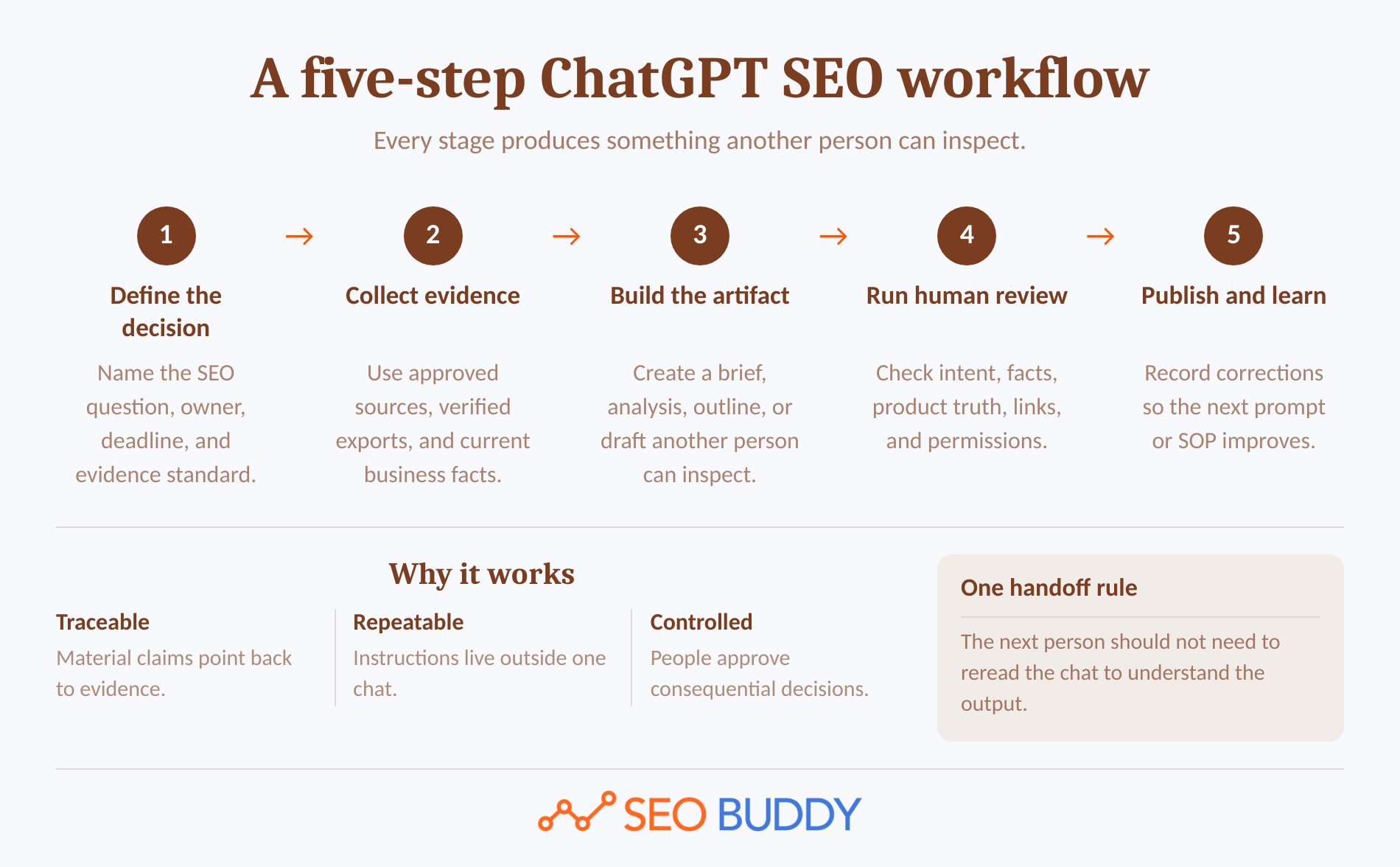
Give each stage one owner, one input, and one reviewable output. The handoff should be understandable without asking the next person to reread a long chat history.
A practical sequence looks like this:
- Define the decision. State the query, audience, business purpose, owner, deadline, and evidence standard.
- Collect the evidence. Gather approved sources, verified exports, relevant pages, and current product facts.
- Create the artifact. Produce a brief, analysis, outline, draft, or checklist rather than leaving the result inside an exploratory chat.
- Run human review. Check intent, facts, dates, product boundaries, links, permissions, and the value added beyond existing pages.
- Publish and record corrections. Update the Project, custom GPT, prompt, or SOP so the same error is less likely next time.
Assign responsibility by decision, not by tool. A research owner approves the source pack, an editor approves the argument and wording, and a business owner approves product claims or consequential publishing actions.
A small team saves time when every AI step produces a reviewable artifact for the next person.
Where does human review still matter?
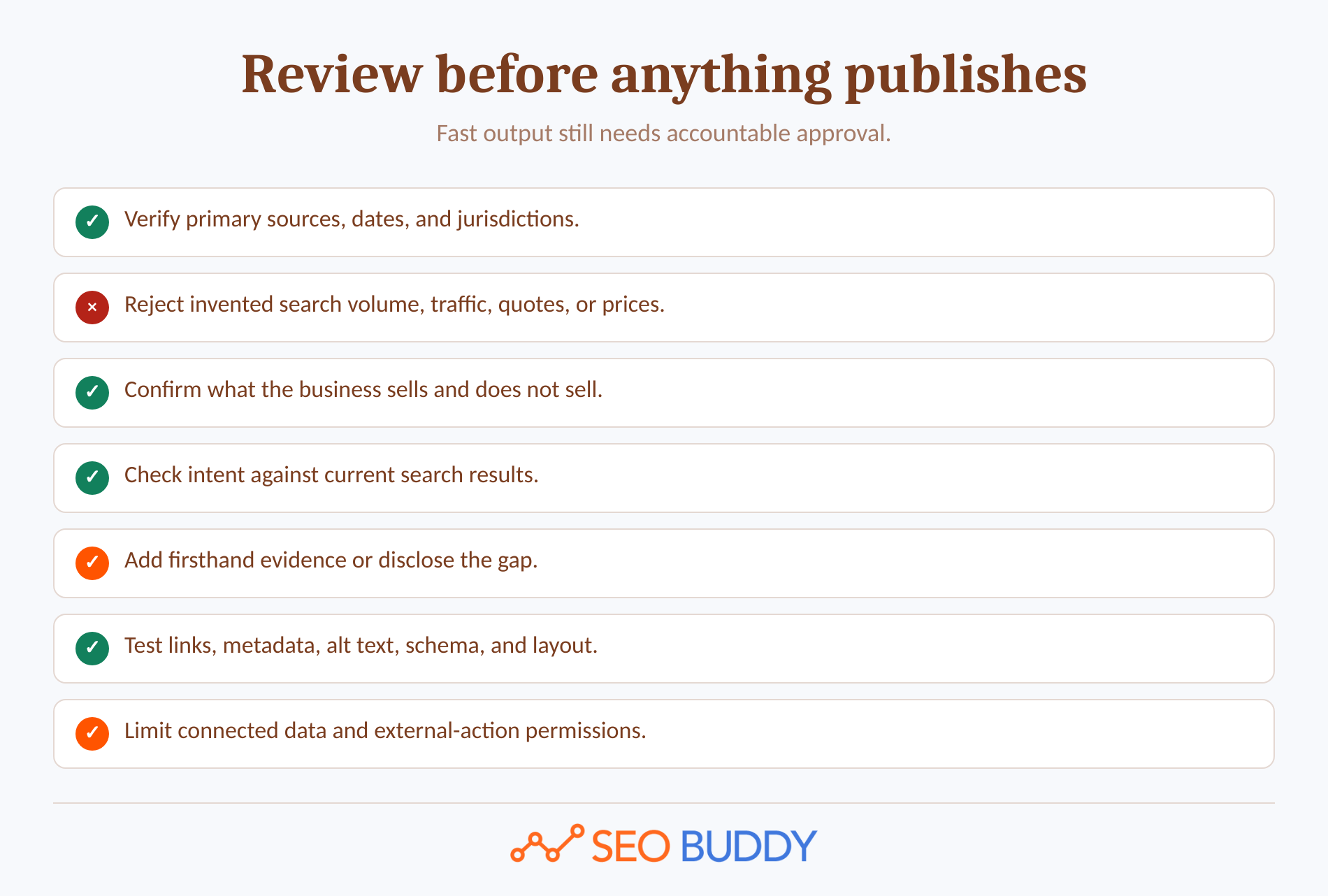
Human review matters wherever an error could mislead a reader, misrepresent the business, expose private data, or publish a weak page at scale. The reviewer should inspect the evidence and rendered page, not merely ask the same model whether its own answer is correct.
Check these six areas:
- Facts and dates: Open the primary source, confirm the jurisdiction or publication date, and remove claims the source does not support.
- Metrics and calculations: Compare material numbers with the original export and reproduce important calculations independently.
- Search intent: Read the current results and confirm that the page answers the problem behind the query rather than repeating related terminology.
- Business truth: Check every product statement against current documentation and the list of services the business does not provide.
- Original contribution: Add first-party experience, a named example, a useful decision framework, or a clearly disclosed evidence gap. The first-person SEO stories can help reveal reader language and practical situations, but factual claims still require stronger sources. (seobuddy.com)
- Rendered page quality: Test links, headings, tables, alt text, metadata, mobile layout, structured data, and the final call to action in the CMS preview.
OpenAI's 2026 terms place responsibility for evaluating output on the user, while Google's 2026 guidance focuses on accuracy, quality, relevance, and added value. Those standards point to the same operating rule: automation can accelerate production, but it does not transfer accountability. (openai.com)
Human review is the control that turns fast AI output into accountable SEO work.
What else do people ask about ChatGPT SEO tools?
The following questions appear in current People Also Ask results for this topic. Each answer separates useful AI assistance from the data and judgment an SEO program still needs.
Which AI tool is best for SEO?
The best AI tool for SEO is the one matched to the job and backed by reliable data. Use search for fresh facts, deep research for complex briefs, data analysis for verified exports, and a structured publishing workflow for production. No single tool replaces keyword data, technical checks, editorial judgment, and measurement.
What search tool does ChatGPT use?
OpenAI says ChatGPT Search uses third-party search providers plus content supplied by partners, and ChatGPT adds links to sources in its answers. OpenAI's public overview does not present one permanent provider as the universal answer, so SEO teams should inspect the cited pages rather than assume a single underlying index. (openai.com)
Which AI agent is best for SEO?
The best AI agent for SEO is a constrained one with a defined task, approved data sources, clear stop conditions, and human approval before publishing or changing external systems. In ChatGPT, use Work for longer deliverables and custom GPTs for repeatable instructions; avoid granting broad access when a narrower workflow will do. (help.openai.com)
Can I use AI to do my SEO?
Yes, AI can assist with SEO research, clustering, briefs, draft production, data analysis, and repeatable checks. Google says AI use is not automatically against its guidelines, but scaled pages that add little value may violate spam policies. Human reviewers still need to verify facts, intent, product claims, links, and final page quality. (developers.google.com)
The right answer is a constrained workflow, not a promise that one AI tool can run SEO alone.
What should you do next?
Pick one bottleneck this week and automate only that handoff. Write the human approval step before connecting another tool.
If the bottleneck is turning site and search data into a monthly plan and finished drafts, set up the AI Content Engine and keep publishing approval manual until the team is satisfied with the evidence and brand fit.
Automate the handoff, not the responsibility.

CEO & Founder at SEO Buddy


 How to Improve Organic Traffic: A Prioritized SEO Action Plan
General SEO
How to Improve Organic Traffic: A Prioritized SEO Action Plan
General SEO
 Best AI Writing Tools for SEO Content: What to Use and Avoid
General SEO
Best AI Writing Tools for SEO Content: What to Use and Avoid
General SEO
 Best SEO Tools of 2025: Which Ones Are Still Worth Using in 2026?
General SEO
Best SEO Tools of 2025: Which Ones Are Still Worth Using in 2026?
General SEO
 AI SEO Services: What Providers Do, What They Cost, and How to Choose
General SEO
AI SEO Services: What Providers Do, What They Cost, and How to Choose
General SEO
Get the SEO work done, not just read about it
Create a free account and run your first content plan, keyword research and link-building campaign. No card, and setup is free until your first article.
Free to start. We never sell your address.