
My SEO Journey [Pro Edition]: Breanna Golub from safaridigital.com.au – From Content Writer to Head of Content: Why the AI Content Flood Changed Everything

My SEO Journey [PRO Edition] is a series where professionals in the SEO Industry, Digital Marketing, or Web Design share their honest SEO Journey filled with failure, success, and most importantly, proven results. Episode #173 features Breanna Golub from Safari Digital.
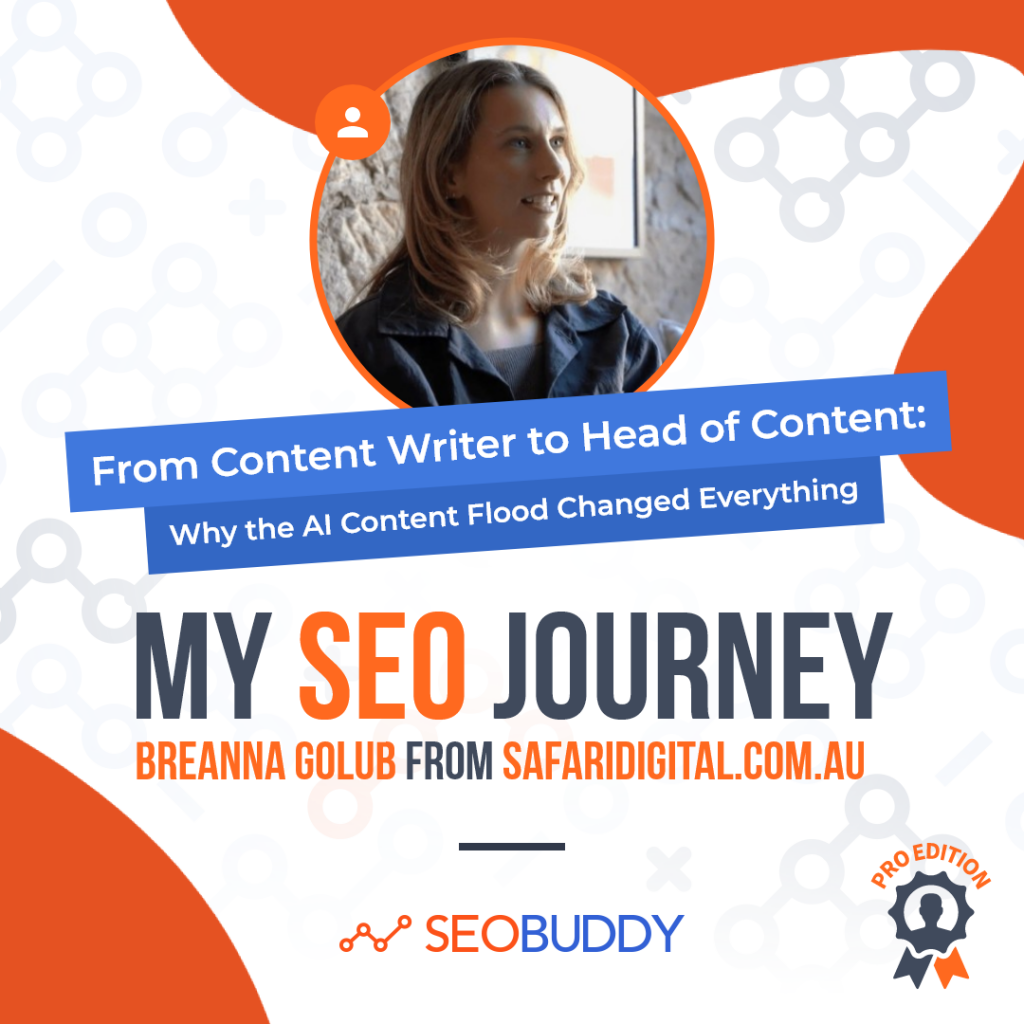
Hello! I’m Breanna Golub, Head of Content at Safari Digital – an SEO-only agency based in Sydney, Australia. Safari Digital works with businesses across Australia, Singapore, and the UK, delivering SEO services with a focus on results that are actually measurable.
My role sits at the intersection of SEO strategy and content execution. I lead a team of content writers and work closely with our SEO team to make sure what we produce isn’t just well-written – it’s built to rank and built to convert. The clients we work with range from local trades businesses through to national brands, professional services firms, and medical providers with strict compliance requirements.
What’s your backstory and how did you get into the industry?
I started in SEO in late 2018 – initially just as a content writer. I had no grand plan to build a career in search marketing; I came across an opportunity and took it. What I didn’t expect was how invested/interested I would become in the analytical side of things.
Content writing naturally evolved into understanding why certain content performed and why other content didn’t. That curiosity pushed me toward keyword research, then into off-site strategy, and eventually back into content – but at a much higher level. The progression wasn’t linear, but looking back, every step added something.
I joined Safari Digital in the first few months and now I’m coming up to 9 years! Being part of a fast-growing team meant I had to develop quickly across a lot of different areas of SEO. There wasn’t always someone to hand something off to, so you figured it out. That kind of environment accelerates your growth faster than any course or certification ever could.
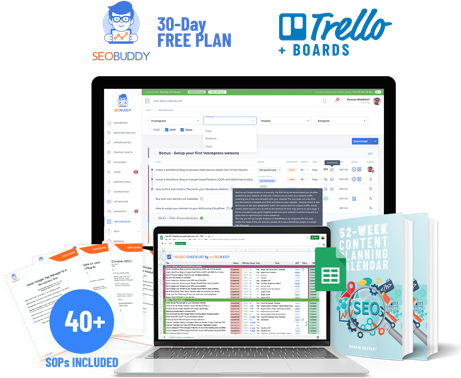
Now it’s time to discover the other 102 steps that will get more organic traffic flowing to your website. Get the SEO Checklist here — it’s free now, and so is the SOP Collection that goes with it. All you need is an account.
Want a look before you sign up?
Enter your email and I’ll send you the demo version.
Anybody can generate an article. Knowing which one is worth writing is the hard part.
The AI Content Engine reads your site and your competitors, then builds a ranked content plan and writes it. Setup is free, and you see your plan before you pay for anything.
See your content plan freeWhat is Something People Should Know About SEO & Content in 2026?
The honest answer is: less is more.
One of the clearest lessons I’ve learned working across dozens of client accounts is that volume without strategy is a waste of everyone’s time and money.
Early in my career I inherited a client who had been working with an overseas provider producing eight to ten articles per month at around 300 words each. On the surface, it sounded like a lot of content activity. In practice, not one of those articles was generating a single visit from organic search. When we audited the full library of 400+ articles, we found that removing them entirely would have had zero impact on their overall traffic. The entire output was invisible to Google.
That experience cemented something I now apply to every content engagement: one well-researched, well-structured, properly optimised article will outperform one hundred short, aimless ones every single time.
The approach that consistently delivers results across our client base comes down to three things:
Proper keyword research before a single word is written. We don’t produce content speculatively. Every piece is tied to a search term with real volume, real intent, and a realistic pathway to ranking. Article skeletons and briefs are built around this research so that whether our team writes the content or the client’s internal team does, the SEO fundamentals are already baked in.
Matching content depth to search intent. This is the difference between content that ranks and content that sits. A page targeting a high-intent transactional query doesn’t need 3,000 words. A page targeting a complex informational query might need more. We don’t pad for padding’s sake, and we don’t truncate when depth is warranted.
Working within compliance constraints without compromising SEO. A significant portion of our clients operate in medical and financial verticals where there are strict rules around what can and cannot be published. Rather than treating compliance as a barrier, we work with clients’ internal teams to produce article skeletons that give their writers all of the right ingredients – keyword targets, structure, internal linking opportunities – while keeping them on the right side of their industry regulations.
What has Changed the Most During Your Time in SEO?
I’m sure most people reading this and in the SEO field will know, but just to state the obvious, I don’t think I can overstate how much SEO – and in particular content – has changed since AI content has become a thing.
When I started out in 2018, content strategy in SEO was already being oversimplified, but the damage was limited by the sheer effort required to produce content at scale. Then came the AI content explosion of 2022, and everything changed. Almost overnight the SERPs were flooded with machine-generated articles optimised for keywords but built on nothing – no real expertise, no point of view, no useful signal for a reader trying to solve a real problem. It felt like everyone had discovered the same cheat code at the same time.
What happened next was entirely predictable, in hindsight. Google’s Helpful Content Update followed. Then the March 2024 core update absorbed it into the core ranking system. The algorithm adapted because it had to. There’s a useful concept I’ve come across in SEO that describes this pattern: the “meta.” When enough people pile into the same strategy, results degrade and the rules change. The 2022 AI content surge is one of the clearest examples of that cycle playing out in real time, at an enormous scale.
There has been a fundamental shift from the keyword-matching era, and it’s one that rewards genuine subject matter expertise in a way that templated AI output structurally cannot. There is an absolutely brilliant talk by Mark Williams-Cook on this topic which I would implore everyone to watch (find it here)
My view is that this is a good thing, even if it made our jobs more complex. The bar for content quality has risen permanently. The clients who understood this early – who invested in researched, expert-informed content rather than chasing volume – have come out of the last few algorithm cycles in significantly better shape than the ones who took shortcuts.
The Link Chest is a collection of high-quality, easy-to-win backlink opportunities. It’s the smart way to kickstart your SEO mission and improve the rank of your website in Google.

“This is such a simple idea but very well executed. I’ve been powering through this giant list of backlinks for a few hours and already have loads pointing to my site. Link Chest is an essential tool for early stage link building.”
The biggest lesson I’d pass on to anyone starting out is that asking questions is not a weakness. When I started out, I was fortunate to be in an environment with a lot of knowledge around me. Taking advantage of that, asking why something worked rather than just doing it, made an enormous difference to how quickly I developed. That same curiosity – understanding the mechanism, not just the output – is what separates the SEOs who adapted to the last few years from the ones who got caught out by them.
How Do You See AI Content Affecting SEO in the Coming Months/Years?
The AI content flood hasn’t stopped over the last 12-months. If anything – it has accelerated.
There are now entire industries producing content at a scale that would have been unimaginable five years ago, almost entirely machine generated. Most of it is structurally competent and entirely forgettable. It contains no genuine insight, no first-hand experience, and no perspective that a real expert in the field would offer.
That’s where I think content strategy is heading – not toward more volume, but toward genuine differentiation. Content that draws on real expertise, reflects actual experience, and takes a defensible point of view. Content that a person with knowledge of the topic would recognise as credible, rather than content that just matches a pattern of what a credible article looks like.
My focus over the next twelve months is on building frameworks that let us scale that kind of content production without compromising what makes it worth producing. That means stronger subject matter expert integration, higher editorial standards, and being willing to produce less if less means better. The clients who have thrived over the last three years are the ones who understood early that quality was the only durable competitive advantage. I don’t see that changing.

Head of Content at Safari Digital SEO Agency

 My SEO Journey: Hussain Jatoi from hussainjatoi.com – Why I Stopped Treating SEO…
My SEO Journey
My SEO Journey: Hussain Jatoi from hussainjatoi.com – Why I Stopped Treating SEO…
My SEO Journey
 My SEO Journey [Pro Edition]: Sanket Parmar from cmarix.com – How We Built…
My SEO Journey
My SEO Journey [Pro Edition]: Sanket Parmar from cmarix.com – How We Built…
My SEO Journey
 My SEO Journey [Pro Edition]: Gethin Davies from futurmedia.co.uk – Building a DR48…
My SEO Journey
My SEO Journey [Pro Edition]: Gethin Davies from futurmedia.co.uk – Building a DR48…
My SEO Journey
 My SEO Journey [Pro Edition]: Thibault Louis-Lucas from Outrank – From Failed Startups…
My SEO Journey
My SEO Journey [Pro Edition]: Thibault Louis-Lucas from Outrank – From Failed Startups…
My SEO Journey
Get the SEO work done, not just read about it
Create a free account and run your first content plan, keyword research and link-building campaign. No card, and setup is free until your first article.
Free to start. We never sell your address.