
Monthly SEO Tasks: A Repeatable Checklist for Consistent Growth

In short
Monthly SEO tasks work best as a fixed operating cycle: review search and conversion changes first, choose the highest-value content work next, maintain priority pages, check indexability and user-experience risks, then complete one quality-led authority action. Assign an owner and a time limit to every step so urgent requests do not consume the month.
Key takeaways
- Search Console is the source of truth for Google Search performance, while analytics explains what organic visitors do after they arrive on the site. (developers.google.com)
- Review clicks, impressions, CTR, queries, and landing pages before deciding which SEO task deserves this month's effort. (developers.google.com)
- A monthly SEO cycle should produce a short list of completed actions, not an unfocused backlog of possible optimizations.
- Treat link acquisition as relationship and editorial work, not a volume target, because links created primarily to manipulate rankings can violate Google's spam policies. (developers.google.com)
Table of contents
- What should happen first each month?
- Which numbers should you review before changing anything?
- What content work deserves this month?
- Which on-page fixes are worth a monthly pass?
- What technical checks cannot wait until a quarterly audit?
- How should you build authority without creating link spam?
- Who owns recurring SEO tasks on a small team?
- What else do people ask about monthly SEO tasks?
- What should you do next?
What should happen first each month?
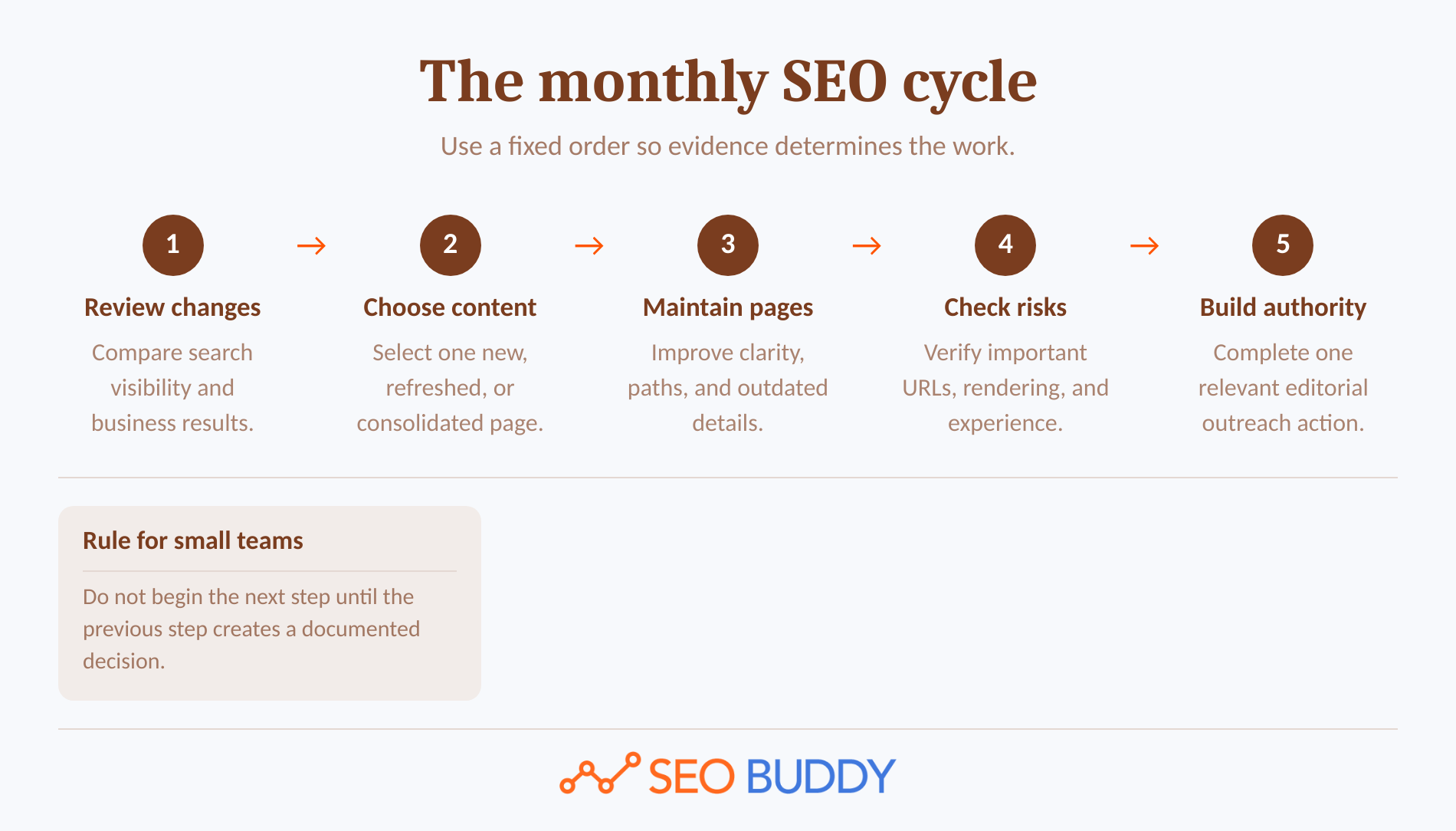
Start with evidence, not edits. Review what changed in search visibility and business results before choosing content, technical, or link-building work for the month.
Use this sequence as a planning template rather than a rigid calendar:
| Step | Suggested owner | Time cap | Required output |
|---|---|---|---|
| Review performance | Marketing lead or SEO owner | 60 minutes | One-page change log with winners, losses, and anomalies |
| Choose content work | Content lead | 120 minutes | One new brief, refresh brief, or consolidation decision |
| Maintain priority pages | Content or web owner | 60 minutes | A small batch of completed page improvements |
| Check technical risks | Web owner or developer | 45 minutes | A list of confirmed issues, owners, and due dates |
| Build authority | Marketing or outreach owner | 90 minutes | One quality-led outreach, partnership, or resource action |
The order matters. A falling click total might come from a weaker query mix, an indexing problem, seasonality, a changed search result page, or a page that no longer satisfies the searcher's need. Editing title tags before checking the evidence can waste the month's limited time.
Keep a running task log with four fields: observation, decision, owner, and completion date. That log prevents the familiar cycle of rediscovering the same issue every month without anyone fixing it.
The monthly SEO checklist should turn data into a few finished decisions, not a longer list of ideas.
Anybody can generate an article. Knowing which one is worth writing is the hard part.
The AI Content Engine reads your site and your competitors, then builds a ranked content plan and writes it. Setup is free, and you see your plan before you pay for anything.
See your content plan freeWhich numbers should you review before changing anything?

Review Search Console for what happened in Google Search, then use analytics to see whether organic visitors engaged, converted, or left. Google states that Search Console is the source of truth for Search performance, while Google Analytics is the source of truth for behavior on the site. (developers.google.com)
For local-business clients, include evergreen location guides in the monthly content review. For example, a Maui snorkeling guide covering Turtle Town’s location, access, and what visitors should expect should be checked for accuracy and continued usefulness.
In Search Console, compare the last 28 days with the previous 28 days, then filter by page and query. Google defines the core performance metrics as clicks, impressions, click-through rate, and average position; those metrics can also be segmented by queries, pages, countries, devices, and search appearances. (developers.google.com)
Look for four practical signals:
- Pages with lower clicks but stable impressions. The result may be earning fewer clicks, so inspect the query mix and search-result presentation before rewriting the page.
- Pages with lower impressions. Check whether the page lost visibility for important queries or whether the subject has less demand than in the previous period.
- Pages with more impressions but weak CTR. Confirm that the page still matches the query and that the title and visible page purpose are clear.
- Pages that gain search traffic but do not help the business. Use analytics and conversion data to decide whether the page attracts the right audience.
Do not use average position as a monthly scorecard on its own. It is an average across queries and contexts, while clicks and impressions show whether people actually saw and chose the result.
For teams that need a clearer foundation before interpreting reports, SEO Buddy's free SEO University is a useful place to build the vocabulary behind recurring SEO work.
A useful monthly report explains what changed, where it changed, and what action follows from the change.
What content work deserves this month?
Choose one content decision per important page or topic: publish something new, refresh an existing page, consolidate overlapping pages, or leave the page alone. The best choice follows the evidence from queries, page performance, customer questions, and the site's commercial priorities.
Start with pages that have one of these patterns:
- A page is already visible for relevant queries but no longer answers them fully.
- Several pages compete for the same intent and confuse the site's structure.
- A recurring customer question has no page that answers it directly.
- A high-value service or product needs a supporting page that explains a real decision, process, or use case.
A refresh should be more than changing the publication date. Recheck the main question, add missing explanations, remove advice that no longer applies, improve internal links where they help a reader continue, and verify that examples still reflect the product or market.
Google's spam policies warn against scaled content created primarily to manipulate rankings rather than help people. That means publishing more pages is not a monthly SEO goal by itself; each page needs a clear reader purpose and original value. (developers.google.com)
If content research, drafts, illustrations, metadata, and internal-link suggestions are slowing down the cycle, SEO Buddy's AI Content Engine is designed to turn site and business inputs into planned SEO articles rather than leaving the team with a blank document.
The best monthly content task is the one that makes a specific page more useful for a specific searcher, not the one that produces the most words.
Which on-page fixes are worth a monthly pass?
Use a monthly on-page pass to improve the pages you have already chosen, not to rewrite every URL on the site. Focus on clarity, intent match, internal paths, and any page element that prevents a visitor from completing the next useful action.
For each priority page, check:
- Does the title and H1 make the page's purpose obvious?
- Does the opening answer the central question quickly?
- Does the page cover the terms and subquestions a qualified visitor would expect?
- Does each important internal link take the reader to a genuinely useful next step?
- Are images described with meaningful alternative text when the image conveys information?
- Are outdated claims, screenshots, product details, or broken links still present?
Avoid turning this into a keyword-insertion exercise. Repeating a phrase unnaturally is keyword stuffing, which Google's spam policies identify as an attempt to manipulate rankings. (developers.google.com)
Make one small page-level record for every completed change: URL, change made, reason, editor, and date. It gives the next monthly review a reliable starting point.
A monthly on-page pass should make priority pages clearer and easier to use, not merely more optimized-sounding.
What technical checks cannot wait until a quarterly audit?
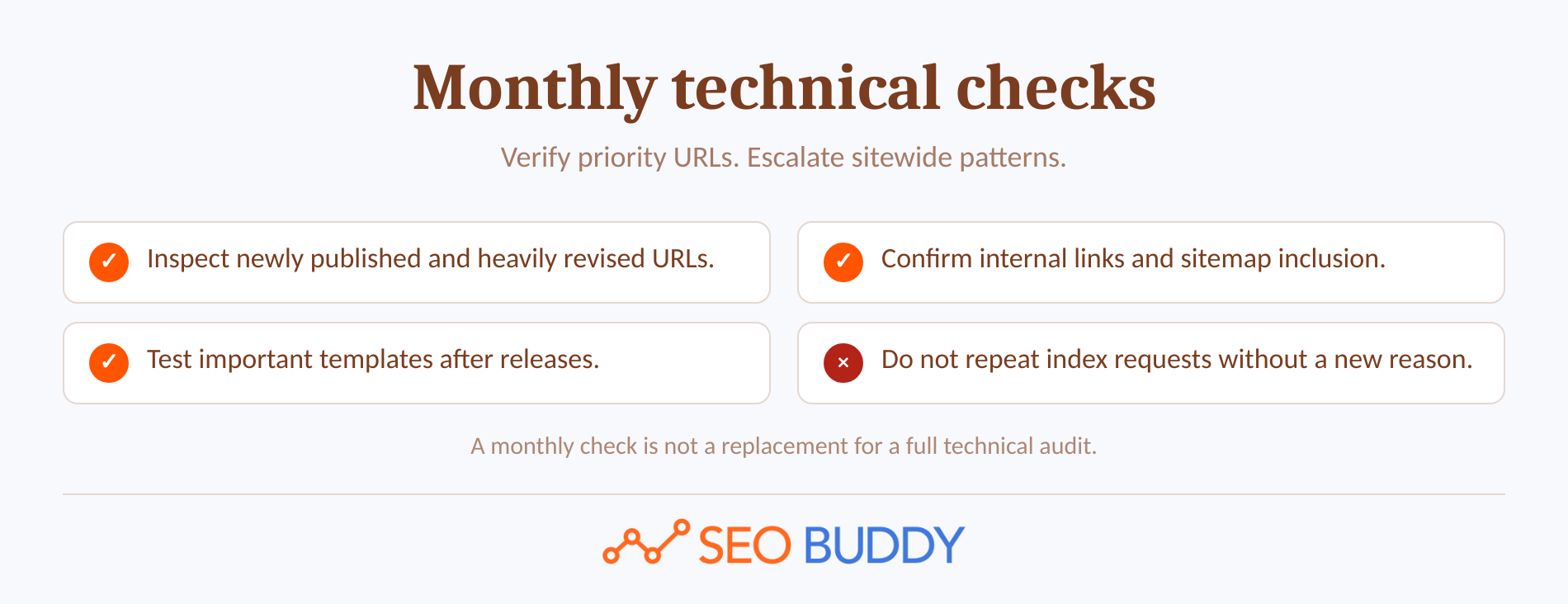
A monthly technical check should catch obvious indexability, rendering, and experience risks on recently changed or commercially important pages. It is not a substitute for a full crawl or a specialist audit when the site has broad technical problems.
Check these items each month:
- Recently published or substantially revised URLs. Use URL Inspection to confirm whether Google can crawl and index the page, and investigate unexpected canonical or noindex signals. Google describes URL Inspection as a way to see crawl, index, and serving information for a URL you own. (developers.google.com)
- New pages that need discovery. Confirm that the URL is linked internally and included in the appropriate sitemap. Google says sitemaps can help it discover URLs, especially for a new site or a large number of pages. (developers.google.com)
- Visible page failures. Test important templates after releases for broken navigation, missing content, failed forms, or JavaScript-rendering problems.
- Page experience signals. Google recommends aiming for Largest Contentful Paint within 2.5 seconds, Interaction to Next Paint below 200 milliseconds, and Cumulative Layout Shift below 0.1. (developers.google.com)
Do not request indexing repeatedly as a routine task. Google says recrawling can take days to weeks, requests do not guarantee immediate inclusion, and repeated requests for the same URL do not make crawling faster. (developers.google.com)
A monthly technical check should verify important changed pages and escalate patterns, not create a false sense of control through repeated index requests.
How should you build authority without creating link spam?
Build authority by earning relevant editorial mentions, useful referrals, and relationships that make sense even if search rankings never changed. Do not set a monthly target that pressures the team to collect links from irrelevant or low-quality pages.
Google defines link spam as creating links to or from a site primarily to manipulate rankings. Its examples include excessive link exchanges, paid links that pass ranking credit, automated link creation, and low-quality directory or bookmark links. (developers.google.com)
A safer monthly authority task can be small:
- Pitch a genuinely useful resource to a site whose readers would benefit from it.
- Offer a qualified expert contribution, original data, or a careful answer to a relevant editorial request.
- Reconnect with a legitimate partner after checking that the proposed page and audience are relevant.
- Find unlinked brand mentions or broken references only where a correction would help the publisher and their reader.
Record the target page, why it is relevant, the person contacted, the pitch angle, and the response. Those fields force quality control before outreach begins.
For teams that want to run their own prospecting and email sequences, SEO Buddy's Link Building Campaign supports controlled outreach from a connected mailbox. The judgment about relevance, value, and policy compliance still belongs to the person running the campaign.
The right monthly authority task creates a credible reason for another publisher to mention the site.
Who owns recurring SEO tasks on a small team?
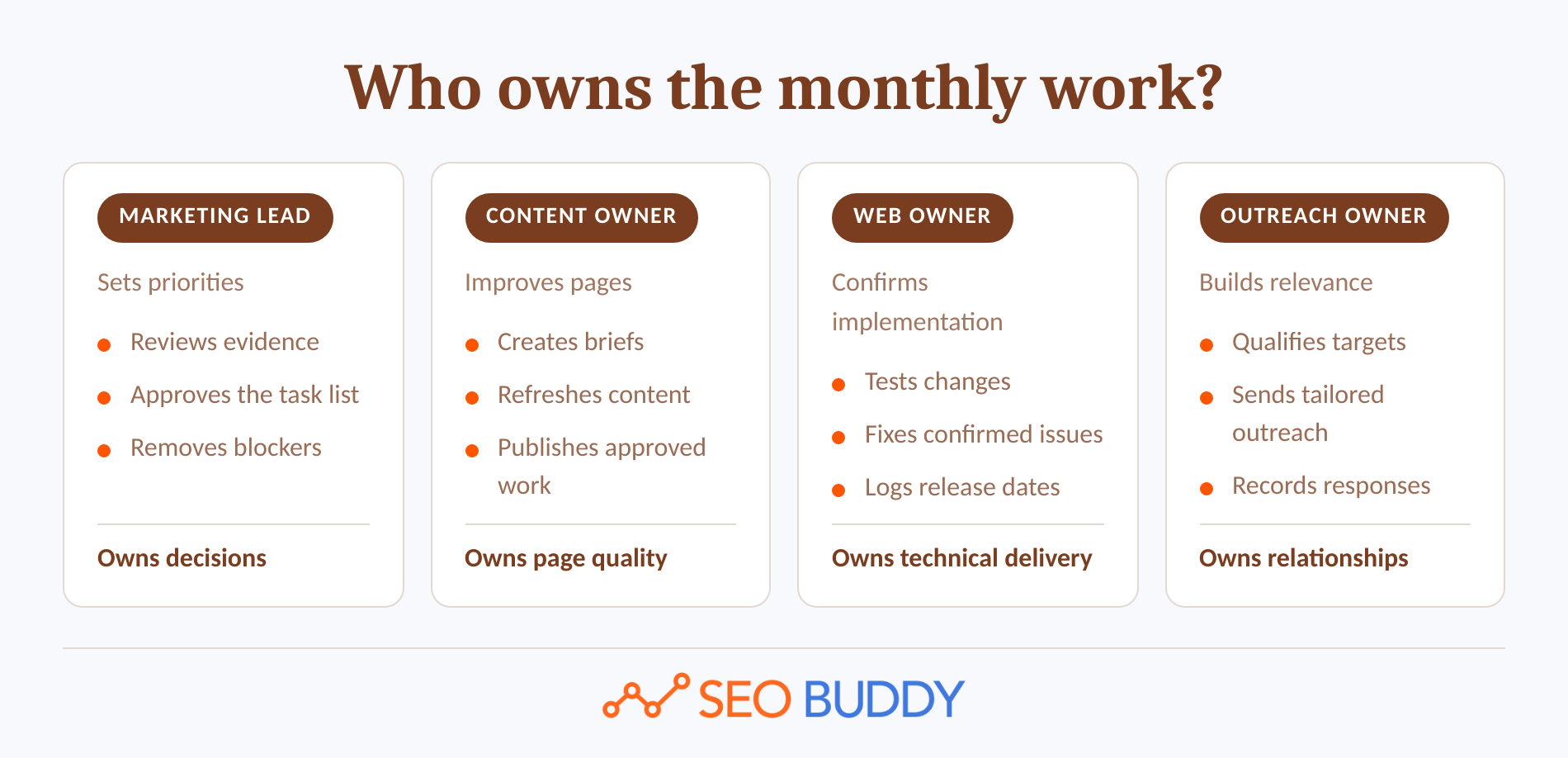
One person should own the monthly SEO calendar, but that person does not need to perform every task. Split the work by decision rights: the marketing lead sets priorities, the content owner improves pages, the web owner resolves implementation issues, and an outreach owner manages relationship work.
A lightweight responsibility model looks like this:
| Role | Monthly responsibility | Completion standard |
|---|---|---|
| SEO or marketing lead | Reviews performance and chooses priorities | A short approved task list tied to evidence |
| Content owner | Creates, refreshes, or consolidates content | A page that answers the intended query and is ready to publish |
| Web owner | Checks implementation and fixes confirmed issues | A tested change with a documented release date |
| Outreach owner | Runs one quality-led authority action | A relevant, personalized outreach record or completed editorial action |
Use documented procedures when work moves between people. SEO Buddy's SOP Collection includes 66 editable SEO procedures, which can help teams turn recurring work into instructions that a colleague, freelancer, or virtual assistant can follow consistently.
If a task does not have an owner, due date, and completion standard, it is not a monthly SEO task yet. It is only a suggestion.
Clear ownership is what turns a monthly SEO checklist from a planning document into an operating routine.
What else do people ask about monthly SEO tasks?
The questions below cover common ways people frame recurring SEO work. The useful answer is usually a prioritization decision, not a longer task list.
What is the 80/20 rule in SEO?
The 80/20 rule in SEO is a prioritization heuristic rather than a fixed monthly process. It means focusing first on the small group of pages, queries, and technical issues most likely to affect qualified traffic or conversions. Use Search Console and analytics to identify that group instead of assuming it from rankings alone.
What are some tasks associated with SEO?
SEO tasks can include reviewing search performance, researching customer queries, creating or refreshing content, improving page clarity and internal links, checking indexability, monitoring important user-experience issues, and earning relevant editorial mentions. A monthly plan should select only the tasks supported by current evidence and business priorities.
What are the top 5 SEO strategies?
Five practical SEO strategies are measuring search performance, publishing useful content for specific intent, maintaining important pages, resolving confirmed technical barriers, and earning relevant editorial mentions. The order matters: measure first, then choose the page or problem with the strongest evidence instead of spreading effort across every strategy at once.
What are the four main types of SEO?
A useful practical grouping is on-page SEO, technical SEO, content SEO, and off-page SEO. The labels overlap in real work, because a content update can involve on-page elements and internal links, while off-page activity still needs technical and editorial quality checks. Use the categories to assign ownership, not to create silos.
The monthly SEO questions worth answering are the ones that lead to a concrete action, owner, and completed output.
What should you do next?
Run this process once with a narrow scope: choose your five most important pages, complete the evidence review, and commit to no more than one meaningful action in each workstream. Then use what you learn to refine next month's cycle.
For a ready-made operating framework, start with SEO Buddy's 122-step SEO Checklist + SOP Collection and adapt the relevant steps to the people and capacity you actually have.

CEO & Founder at SEO Buddy






Get the SEO work done, not just read about it
Create a free account and run your first content plan, keyword research and link-building campaign. No card, and setup is free until your first article.
Free to start. We never sell your address.