
30 PR Pitch Subject Line Examples, Organized by Story Type

In short
A strong PR pitch subject line names the story, shows why it fits the journalist, and includes the most useful proof or timing signal. Keep it specific enough to understand at a glance, use labels such as data, exclusive, interview, or press release only when accurate, and remove any phrase that sounds promotional.
Key takeaways
- In a 2026 survey of nearly 1,100 journalists, 70% wanted pitches to demonstrate clear relevance to their beat.
- The same 2026 survey found that 88% immediately disregard irrelevant pitches and 71% reject pitches that feel overly promotional.
- One 2022 analysis of 467 subject lines found that the strongest lines averaged 60 characters, although that campaign sample is not a universal limit.
- Labels such as data, exclusive, interview, embargoed, and press release should appear only when the email delivers what the label promises.
- The safest template is the one that matches the actual story type and replaces every placeholder with a verifiable fact.
Table of contents
- What makes a journalist open a PR pitch subject line?
- Which PR pitch subject line examples fit your story?
- Which subject line mistakes get pitches deleted?
- How long should a PR pitch subject line be?
- When is a PR pitch the wrong kind of outreach?
- What should you check before you press send?
- What else do people ask about PR pitch subject lines?
- What should you do with the next pitch?
The subject line has one job: help the right journalist classify the email quickly. A journalist should be able to see the likely story, its relevance, and the most useful supporting signal before opening the message.
A subject line cannot repair weak news or a poorly targeted media list. The examples below are adaptable patterns, not promises of coverage, and every bracketed placeholder must be replaced with accurate information before sending.
What makes a journalist open a PR pitch subject line?
Journalists are more likely to consider a subject line that quickly answers three questions: Is this on my beat, is there a real story, and why now? The strongest wording leads with the news and adds one trustworthy signal, such as a number, source, location, date, exclusive, or available interview.
As of September 2026, the latest 2026 State of Journalism survey is based on responses from nearly 1,100 journalists. The survey measures reported preferences rather than guaranteeing that a particular phrase will produce an open or reply.
Which signals matter most to journalists?
In the 2026 survey, 70% wanted clear relevance to their beat, 58% wanted interview access to relevant sources, 40% valued original data or research, 37% wanted high-resolution images, and 33% valued exclusive or embargoed content.
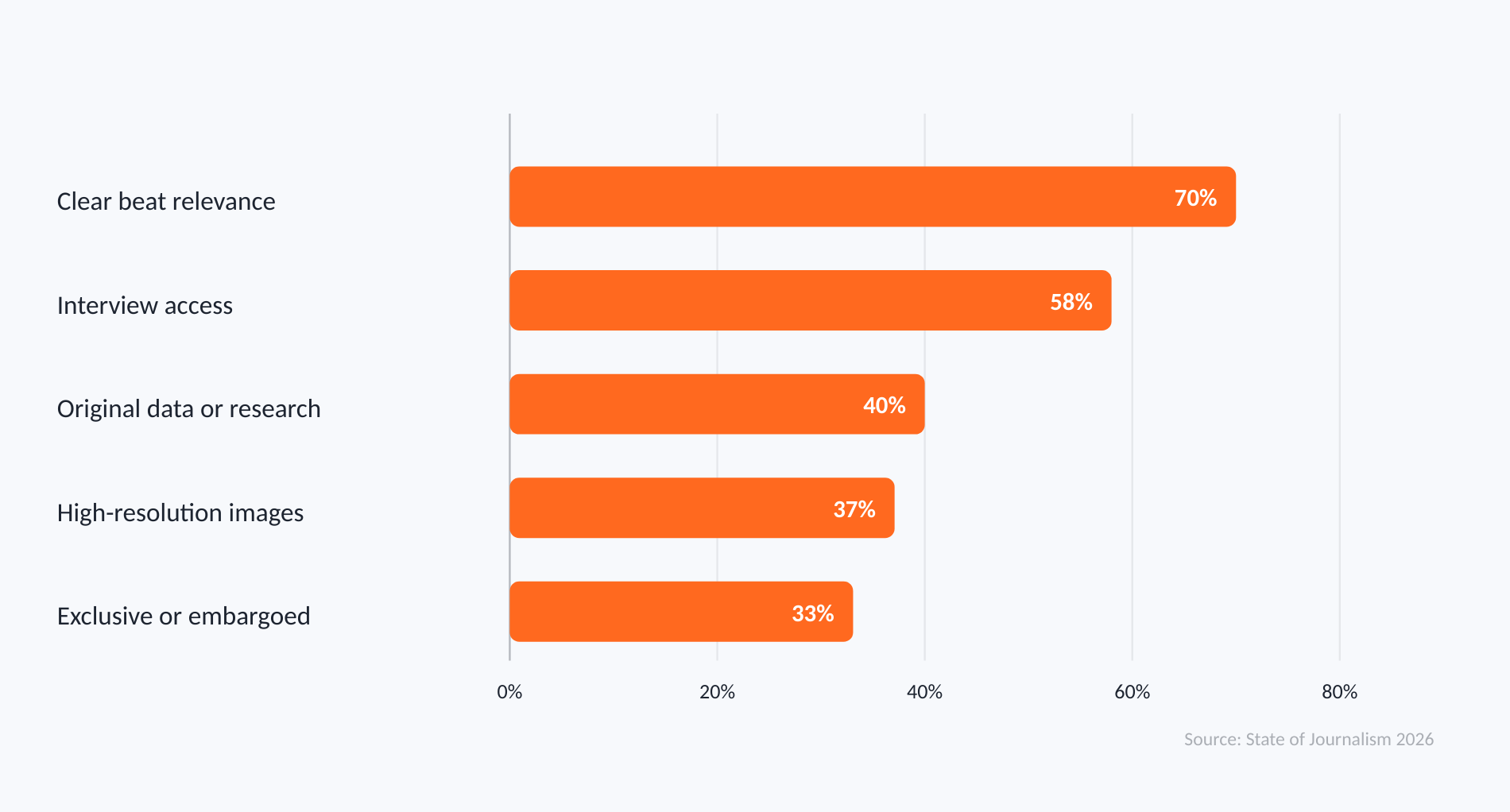
The same report found that 43% of journalists seldom receive pitches matching what they cover, while 4% said they never do. That gap makes accurate targeting valuable, but it does not mean a clever subject line can compensate for sending the wrong story to the wrong person.
Lead with the reason the story belongs in that journalist's inbox. Add source access, data, images, or exclusivity only when the pitch can provide them.
Relevance earns attention first; clever wording cannot rescue a story that misses the journalist's beat.
Anybody can generate an article. Knowing which one is worth writing is the hard part.
The AI Content Engine reads your site and your competitors, then builds a ranked content plan and writes it. Setup is free, and you see your plan before you pay for anything.
See your content plan freeWhich PR pitch subject line examples fit your story?
The right email subject when pitching depends on what is actually being offered: data, timely analysis, an expert, company news, a local event, or a contributed article. Start with that story type, then add the strongest honest detail that helps the journalist judge it.
What four signals should every example carry?
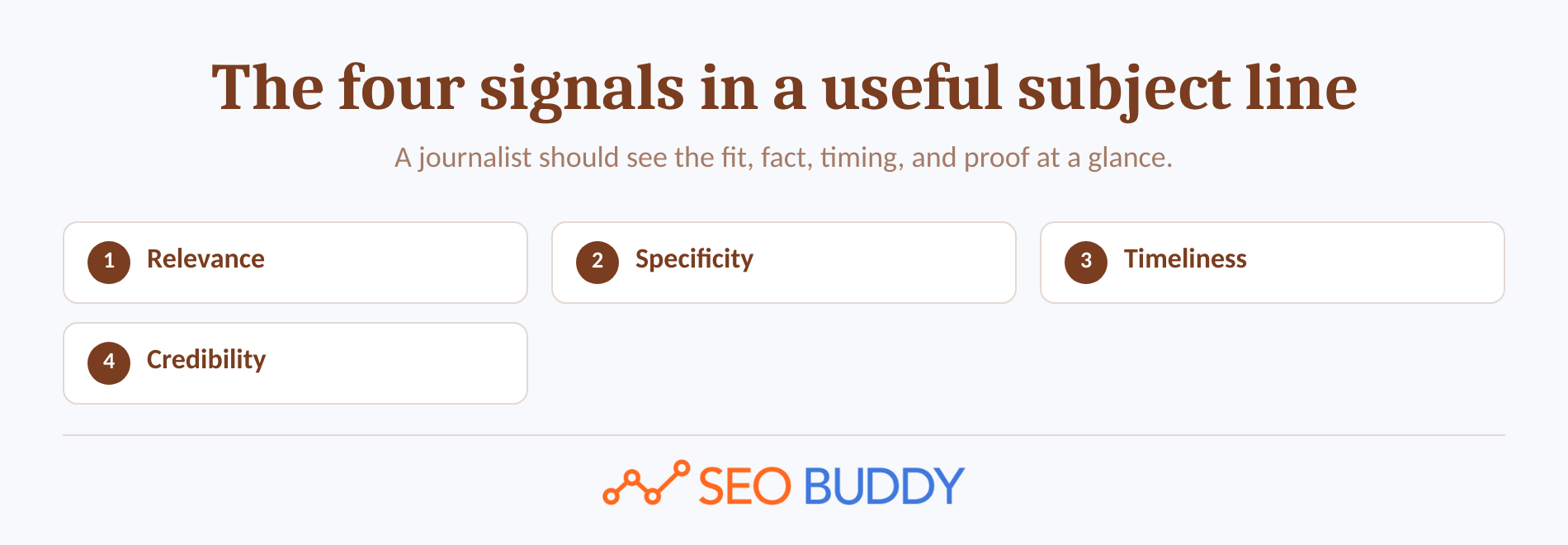
The subject line should make the fit, fact, timing, and proof easier to identify.
Use the four signals as a diagnostic, not as four phrases that must be squeezed into every line:
- Relevance: The idea belongs on the recipient's beat and serves the publication's audience.
- Specificity: The line names a finding, person, event, location, result, or argument.
- Timeliness: The recipient can see why the story matters now.
- Credibility: The pitch offers evidence, source access, original research, an embargo, or another real asset.
The brackets in the following PR pitch subject line examples mark information that must be supplied. Never send the brackets, invent a statistic, or claim an exclusive that has been offered elsewhere.
Are you pitching new data or research?
Data-led subject lines should identify the finding before the organization that produced it. Include the sample size when it improves credibility without making the line difficult to scan.
[Data] [X]% of [audience] now [finding], survey of [n]New study: [finding] among [specific sample][Place] ranks No. [X] for [metric], new analysisExclusive data: [finding] before [event or report date]Report: [industry metric] changed [X]% in [time period]
These patterns work best when the finding is independently interesting and the methodology can be supplied immediately. Avoid leading with survey results available because it hides the result the journalist needs to assess.
Are you reacting to a current event or trend?
Reactive pitches need a narrow consequence, not a generic offer to comment. State the event, identify the affected audience, and make the expert's availability clear when deadlines are short.
[Event]: what it means for [journalist's audience]Expert available today: [event] and [specific consequence]Rapid analysis: [event] could [measurable impact][Local place] angle on [national development]Background briefing: [topic] after [new decision]
Do not attach breaking or urgent to ordinary commentary. The date, decision, deadline, or immediate consequence should establish urgency without demanding attention.
Are you offering an expert or interview?
An expert-source subject line should explain why this person is qualified for this exact story. A job title alone is weak unless the role creates direct experience with the question being covered.
Source available: [credential] on [specific question]Interview: [role] who [relevant achievement or experience]On-record comment by [deadline]: [specific topic]Case study and interview: how [organization] achieved [verified result]Contrarian expert view: why [assumption] misses [evidence]
Use expert only when the person's background supports the topic. Name the result, field experience, publication, qualification, or direct involvement that makes the source useful.
Are you announcing company news or a press release?
Press release email subject line examples should put the announcement after the label, not the sender's excitement. The label helps classify the email only when the message contains or links to an actual release.
Press release: [company] launches [specific product] for [audience]Embargoed until [date, time zone]: [specific announcement][Company] raises [$X] to [specific use of funding][Named executive] joins [company] as [role]Media advisory: [event] in [place] on [date]
A funding round, appointment, launch, or event still needs an audience-level reason to matter. If that reason cannot fit in the subject or opening sentence, the announcement may not yet have a clear media angle.
Is the story local or event-led?
Local outlets need the place, community, and practical impact early. Replace broad national framing with the city, region, institution, employer, or affected group the outlet serves.
[City]: [local finding] from [named data source][City] business adds [number] jobs at [location]Local expert available on [issue] affecting [community][Region] ranks No. [X] for [metric], with local dataPhoto and interview opportunity: [event], [place], [date]
Only promise jobs, access, images, or interviews that are confirmed. A location token added to a national mass email is not meaningful localization.
Are you pitching an article, op-ed, or contributed idea?
Article pitch examples should state the proposed argument or reader outcome. Editors do not need a biography in the subject line unless the author's identity is itself central to the idea.
Op-ed pitch: [specific argument] after [news event]Article idea for [section]: [specific reader problem]Byline proposal: [counterintuitive claim] backed by [evidence]Guest contribution: [practical method] for [publication audience]Commentary pitch: what [change] means for [industry]
Avoid broad topics such as Thought leadership on AI or Article about marketing. A contributed pitch becomes assessable when the editor can see the thesis, audience, evidence, and reason for publishing it now.
Choose the template that matches the actual story, then replace every placeholder with a fact the journalist can verify.
Which subject line mistakes get pitches deleted?
The highest-risk mistakes are not a missing power word or an imperfect character count. They are mismatched targeting, promotional framing, obvious mass distribution, repeated follow-ups, unclear wording, incorrect names, and a lack of useful source access.
Which mistakes trigger an immediate delete?
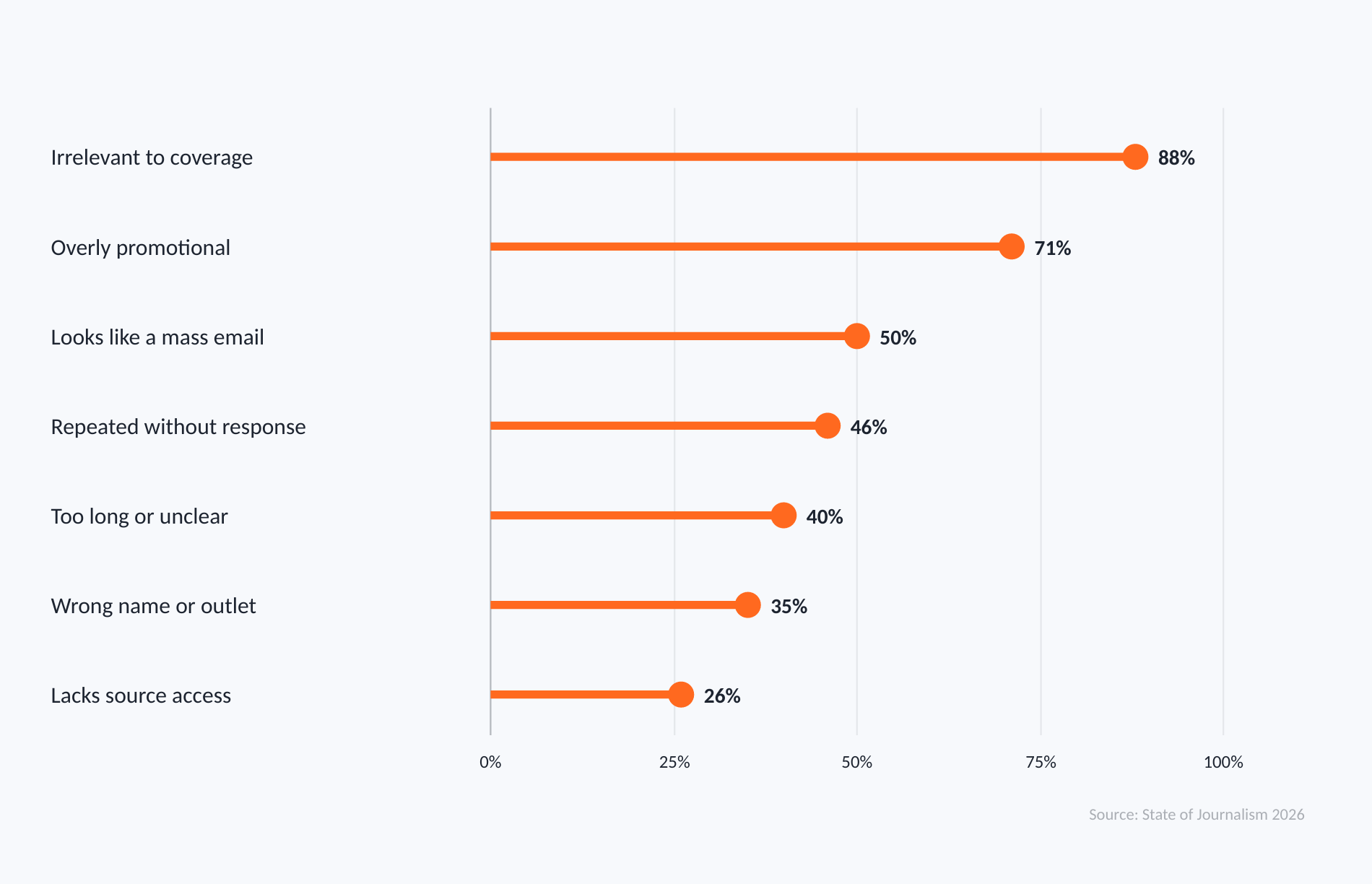
The 2026 journalist survey found that 88% immediately disregard pitches irrelevant to their coverage, 71% reject overly promotional pitches, 50% reject messages that look mass-sent, 46% reject repeated outreach without a response, 40% reject pitches that are too long or unclear, 35% reject messages addressed to the wrong person or outlet, and 26% reject pitches lacking source access.
How do weak lines become useful?
Replace demands and adjectives with information the journalist can evaluate:
- Change
Exciting news from [company]toPress release: [company] opens [facility] in [city]. - Change
URGENT: OPEN NOWtoExpert available today: [event] and [specific consequence]. - Change
You will not believe this studyto[Data] [X]% of [audience] now [finding]. - Change
Quick questiontoOp-ed pitch: [specific argument] after [news event]. - Change
Revolutionary product announcementto[Company] launches [specific product] for [audience] on [date]. - Change
Following up againtoFollow-up: [original story in a few accurate words].
A name token cannot rescue a mass email, and a compliment cannot create beat relevance. Personalization should demonstrate that the idea fits the recipient, not merely prove that their name was found.
A useful subject line describes the story instead of demanding attention.
How long should a PR pitch subject line be?
Use the shortest wording that preserves the story's meaning, rather than treating one character count as a law. A practical line usually contains one story and one supporting signal, not a miniature version of the entire email.
A 2022 analysis of 467 pitch subject lines found that the best-performing lines in that campaign sample averaged 60 characters. The analysis covered several journalist verticals and one agency's 2022 outreach, so 60 characters is an editing checkpoint rather than a universal benchmark.
Compress a draft in four passes:
- Write the complete news statement without trying to sound clever.
- Move the strongest number, location, event, or asset type toward the beginning.
- Remove greetings, sender-focused phrases, unsupported adjectives, and duplicate context.
- Check whether the core story remains understandable if the final words are not visible in an inbox preview.
For example, An exciting new report from [company] reveals surprising changes in [industry] can become Report: [industry metric] changed [X]% in [period]. The shorter version names the asset and finding while removing claims the journalist would have to take on trust.
Use 60 characters as an editing checkpoint, not a universal rule.
When is a PR pitch the wrong kind of outreach?
A PR pitch is the wrong format when the real objective is a backlink, guest-post placement, directory submission, partnership, or sales conversation without a credible news story. Use media outreach when the recipient can reasonably cover the data, event, source, announcement, or argument for their audience.
Which outreach route matches the real goal?
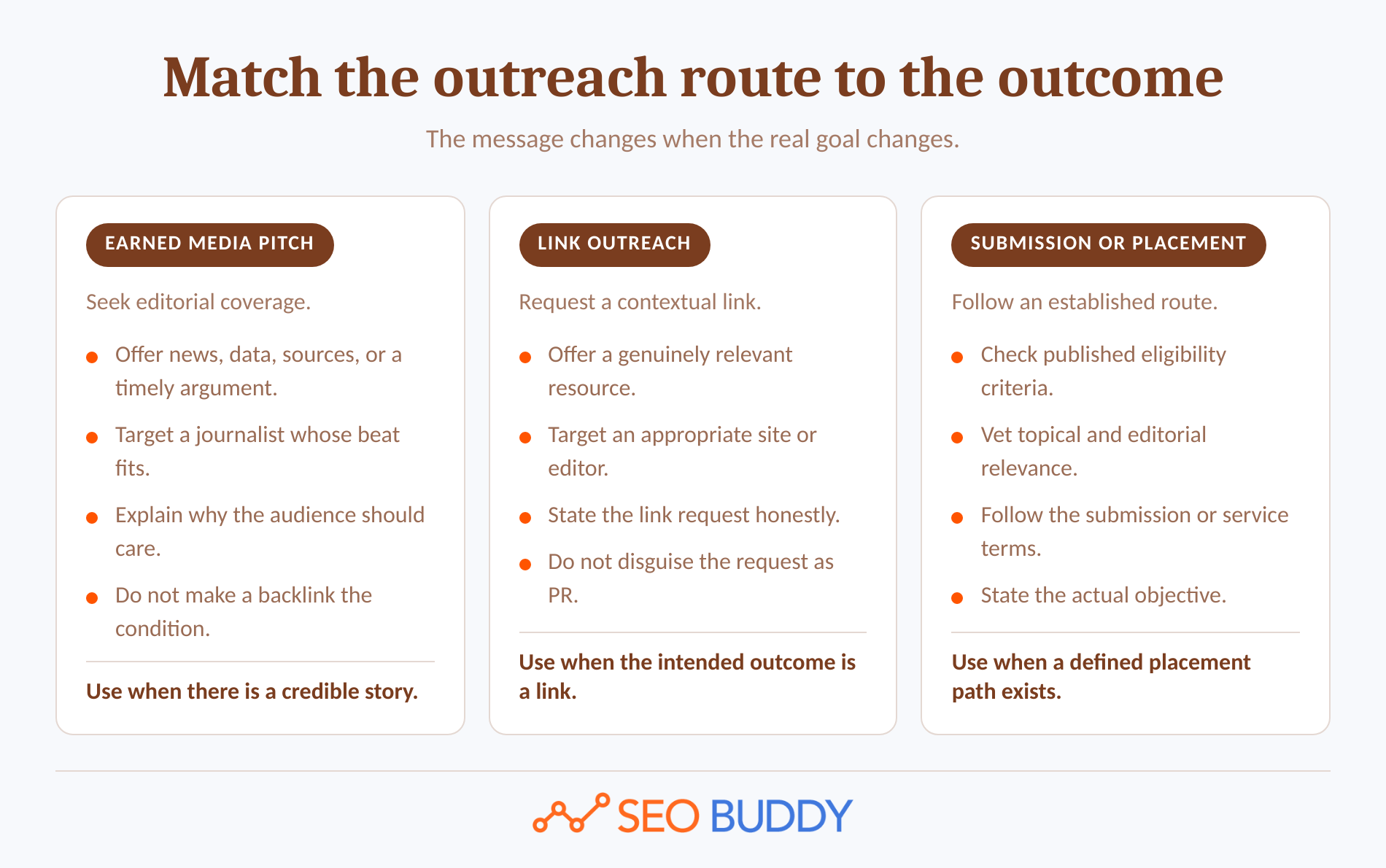
Match the message to the outcome instead of disguising one kind of request as another.
- Earned media pitching fits real news, original research, source access, local relevance, or a timely argument. The request concerns editorial coverage, not a mandatory backlink.
- Managed placement work serves a different objective. A managed editorial link-building service is relevant when the intended outcome is an approved editorial placement rather than journalist coverage.
- Known submission routes may suit directories, resource pages, communities, and other established opportunities. Curated submission opportunities support that workflow without pretending the request is news.
- Education and planning matter when outreach is only one part of the SEO program. The link-building lessons in SEO University cover the broader discipline, while the SEO Checklist places link acquisition within a wider sequence of SEO work.
A journalist pitch should not conceal a guest-post request or turn a product promotion into artificial news. Clear intent protects the sender's reputation and helps the recipient decide without decoding the message.
A media pitch belongs only where there is a credible story for a journalist and their audience.
What should you check before you press send?
Review the subject line against the recipient, story, timing, proof, and email promise. A five-question check catches targeting and substance problems that wordsmithing alone cannot solve.
What is the five-question pre-send test?
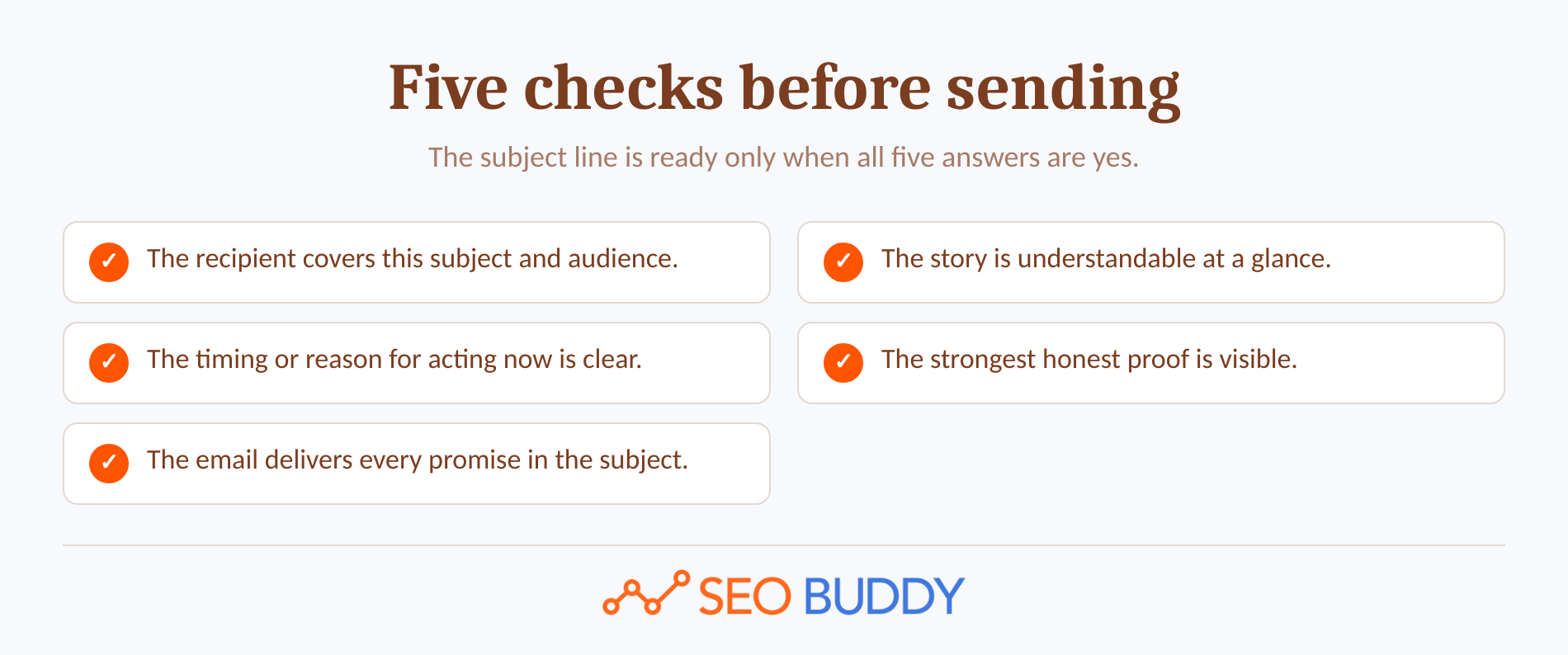
- Does the recipient cover this subject? Review recent work and remove anyone whose beat, audience, geography, or format does not fit.
- Can the story be understood at a glance? A reader should be able to identify the event, finding, person, argument, or opportunity without opening the email.
- Does the line show why the story matters now? Add a real date, decision, trend, deadline, event, local consequence, or release timing when it is central.
- Is the strongest proof visible? Consider a verified number, sample size, relevant credential, named source, interview, location, embargo, or original asset.
- Does the email deliver every promise? Confirm that data is documented, interviews are available, exclusivity is real, embargo details are explicit, and the press release or images are accessible.
A no on beat fit is a targeting problem. A no on timing or proof may be a story problem. Changing adjectives will not solve either one.
If the subject line cannot pass all five checks, the pitch is not ready to send.
What else do people ask about PR pitch subject lines?
The questions below address the wording choices people make just before sending a PR email. Each answer assumes the pitch contains a real, relevant story and that every label in the subject line is accurate.
What is a good example of a subject line?
A good PR subject line example is New survey: [X]% of [audience] now [finding]. The line identifies the asset, gives the central finding, and lets the journalist judge relevance quickly. Replace every bracket with verified information, and remove new if the research is not genuinely recent.
What should I write in the subject line of a press release?
For a press release email, use Press release: [company] [specific announcement] or Embargoed until [date, time zone]: [announcement]. Put the news in the subject, not a vague phrase such as company update. Use press release only when the message includes or links to an actual release.
What are some good pitch examples?
Good pitch examples match the story type: Expert available today: [event] and [consequence], [City] angle on [national development], or Op-ed pitch: [specific argument] after [news event]. Each one names what is available and gives the recipient a reason to decide quickly whether it fits.
What should the subject be for a PR email?
The subject for a PR email should state the story in plain language and add the strongest honest signal, such as a statistic, location, date, interview, exclusive, embargo, or press release. Avoid greetings, unsupported superlatives, fake urgency, and labels that the email cannot substantiate.
The best PR email subject is the shortest accurate version of the story being offered.
What should you do with the next pitch?
Take one template that matches the story and test it against beat fit, clarity, timing, proof, and promise. If any answer is weak, fix the story or recipient list before polishing the wording.
When the story and targeting pass the test, start a Link Building Campaign to find relevant prospects and contacts and send a three-email sequence from the sender's own mailbox. The sender remains responsible for the message, targeting, mailbox authentication, and the legality of contacting each recipient, and no outreach tool can guarantee an open, reply, placement, or link.
The subject line earns the open only when the story inside keeps the promise.

CEO & Founder at SEO Buddy






Get the SEO work done, not just read about it
Create a free account and run your first content plan, keyword research and link-building campaign. No card, and setup is free until your first article.
Free to start. We never sell your address.